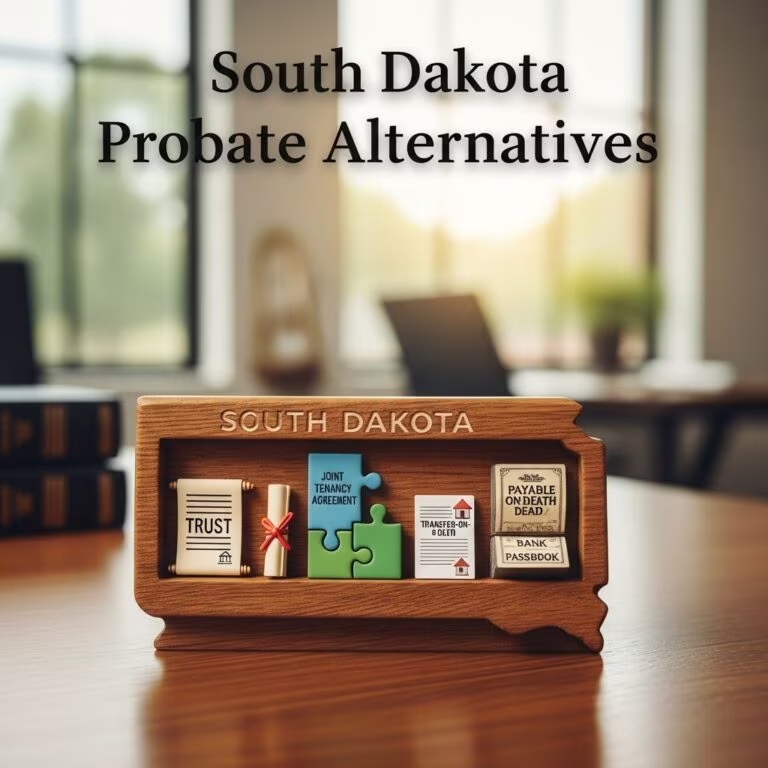
Probate serves as the legal mechanism for validating wills and distributing a deceased person’s assets under court supervision in New Mexico. However, this process often involves significant time delays—sometimes up to two years—and substantial costs, including executor fees and court expenses. For estates valued over certain thresholds, formal proceedings become mandatory, complicating asset transfers. To circumvent these hurdles, New Mexicans can employ several proactive estate planning tools that enable direct transfers to heirs outside of probate.
Understanding Probate Thresholds and Timelines in New Mexico
In New Mexico, estates exceeding $50,000 typically require court-supervised probate if the decedent left a will, while smaller estates may qualify for simplified procedures. Estates under this amount can often use affidavit processes for quick distribution. Larger estates, particularly those surpassing $500,000, demand formal probate, involving inventory, creditor notifications, and judicial approval for distributions. Probate filings must occur within three years of death, excluding the first 120 hours post-passing, and cannot proceed until all debts are settled.
Jointly held properties or those with designated beneficiaries bypass this entirely. For real estate sales during probate, executors must seek court confirmation, often through public auctions where buyers compete with 10% earnest deposits. This underscores the value of preemptive planning to avoid such entanglements.
Joint Ownership: A Simple Path to Automatic Transfer
One of the most straightforward methods to sidestep probate involves holding assets in joint tenancy with right of survivorship. In New Mexico, when co-owners hold property this way, the deceased owner’s share automatically passes to the surviving owner upon death, without court intervention. This applies to real estate, bank accounts, and vehicles.
- Key Benefits: Immediate transfer, no probate fees, and minimal paperwork—just a death certificate suffices for retitling.
- Requirements: All owners must explicitly agree to joint tenancy in the deed or account title.
- Caveats: Potential gift tax implications for non-spouses and vulnerability if a joint owner faces creditors.
For married couples, community property with right of survivorship offers similar protections, treating spousal shares as automatically transferable. This tool shines for family homes or shared investments, ensuring continuity without probate delays.
Beneficiary Designations on Financial Accounts
Payable-on-death (POD) and transfer-on-death (TOD) designations allow bank accounts, investment portfolios, and securities to pass directly to named beneficiaries. New Mexico recognizes these for most financial assets, bypassing probate regardless of estate size.
| Asset Type | Probate Avoidance Method | Process |
|---|---|---|
| Bank Accounts | POD Designation | Name beneficiary; funds transfer post-death with ID verification. |
| Brokerage Accounts | TOD Registration | Securities shift to beneficiary without court order. |
| Retirement Accounts (IRA/401k) | Primary Beneficiary | Direct payout to heirs per plan rules. |
Updating designations after life events like divorce or births is crucial to align with current wishes. Unlike wills, these override testamentary instructions, prioritizing speed and privacy.
Living Trusts: Comprehensive Control Over Your Estate
Revocable living trusts provide robust probate avoidance by transferring assets into a trust during the grantor’s lifetime. The grantor retains full control as trustee, and upon death, a successor trustee distributes assets per trust terms without probate.
- Setup Steps: Draft trust document, fund by retitling assets (deeds, titles), name successor trustee and beneficiaries.
- Advantages: Avoids probate entirely, maintains privacy (no public filings), and allows incapacity planning.
- Costs: Initial attorney fees, but savings on probate outweigh this for moderate-to-large estates.
In New Mexico, trusts handle real estate, personal property, and out-of-state assets seamlessly. Unlike joint ownership, they prevent co-owner risks and offer detailed distribution instructions, such as staggered payouts to minors.
Transfer-on-Death Deeds for Real Property
New Mexico permits transfer-on-death (TOD) deeds, also called beneficiary deeds, for real estate. This recorded instrument names beneficiaries who inherit the property automatically upon the owner’s death, invalidating probate claims on that asset.
- Drafting: Specify property, owner, and beneficiaries clearly.
- Recording: File with the county clerk where the property sits before death.
- Activation: Takes effect only post-death; owner retains full rights until then.
This method suits single owners wishing to pass homes directly to heirs. It revokes prior TOD deeds upon refiling, ensuring flexibility. No revocation needed for sales—simply convey via standard deed.
Small Estate Affidavits for Simplified Handling
For modest estates under $50,000 in New Mexico (excluding certain homesteads), heirs can use small estate affidavits. After 30 days post-death, an affidavit collects and distributes assets without full probate.
- Applicable Assets: Personal property, vehicles under $50k value.
- Exclusions: Real estate typically requires separate handling unless jointly owned.
This accelerates transfers, often within weeks, ideal for bank accounts or cars. Heirs must swear no conflicting claims exist.
Comparing Probate Avoidance Options
| Method | Best For | Cost | Flexibility | Privacy Level |
|---|---|---|---|---|
| Joint Tenancy | Spouses/Family Homes | Low | Medium | High |
| POD/TOD Accounts | Financial Assets | Free | High | High |
| Living Trust | Large/Complex Estates | Medium-High | High | Very High |
| TOD Deed | Real Estate | Low | Medium | Medium |
| Small Estate Affidavit | Low-Value Assets | Minimal | Low | Medium |
This comparison highlights trade-offs: simplicity versus control. Combining methods often yields optimal results.
Potential Pitfalls and Professional Guidance
While effective, these strategies demand precision. Mismatched beneficiary designations can spark disputes, and unfunded trusts fail to avoid probate. New Mexico’s community property rules add layers for married individuals. Creditor claims may still attach pre-transfer. Consulting estate attorneys ensures compliance with statutes like those governing intestate succession if plans falter.
Recent legislative updates, effective post-2016, refine probate rules, emphasizing timely filings and court oversight.
Frequently Asked Questions
What triggers probate in New Mexico?
Probate is required for estates over $50,000 without bypass mechanisms, or when wills need validation amid contests.
Can I sell property during probate?
Yes, but only after court approval, often via auction; full probate must precede legal sale.
How long does probate take in New Mexico?
Typically 1-2 years, depending on estate complexity and disputes.
Do TOD deeds work for all New Mexico properties?
Yes, for real estate, filed with the county clerk; effective only after death.
Is a living trust expensive to set up?
Initial costs range from $1,000-$3,000, but save thousands in probate fees.
What if someone dies without a will?
Intestate laws prioritize spouse, children, then relatives; probate appoints an administrator.
References
- How Does a Probate Sale Work in New Mexico? (2026 Guide) — ListWithClever. 2026. https://listwithclever.com/probate-sale/new-mexico/
- The Probate Process — Genus Law Group. Accessed 2026. https://www.genuslawgrp.com/video/the-probate-process.cfm
- Probate Court — Incorporated County of Los Alamos, NM (Official Government Site). 2026. https://www.losalamosnm.us/Courts/Probate-Court
- Probate Judge — Santa Fe County, NM (Official Government Site). Accessed 2026. https://www.santafecountynm.gov/probate
- SB0248 – Probate Court Legislation — New Mexico Legislature. 2023. https://nmlegis.gov/Sessions/23%20Regular/bills/senate/SB0248.pdf
- Probate Law Frequently Asked Questions — NM Financial Law. Accessed 2026. https://nmfinanciallaw.com/probate-law/faq/
- Probate Forms — New Mexico Courts (Official). Accessed 2026. https://nmcourts.gov/forms-files/probate/