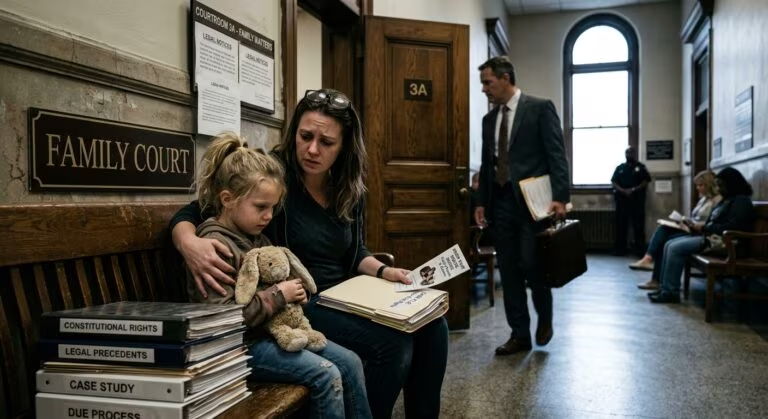
Probate in California involves a court-supervised process to validate wills, pay debts, and distribute assets, often taking 12-18 months and costing 4-7% of the estate’s value in fees. These delays and expenses can burden families, making probate avoidance essential for efficient estate planning. This guide outlines practical, legal methods to transfer property directly to heirs, preserving privacy and savings.
Understanding Probate and Why Avoid It
The probate process in California is public, exposing estate details to scrutiny, and requires attorney and executor fees based on estate size. For estates over $184,500 in personal property or $61,500 in real estate, full probate applies, leading to significant costs. Avoiding it keeps transfers private, quicker, and cheaper, allowing beneficiaries access within weeks.
Key drawbacks include:
- Time delays: Court backlogs extend resolution beyond a year.
- High costs: Statutory fees for Los Angeles County can exceed $30,000 on a $1 million estate.
- Loss of privacy: All assets and heirs become public record.
- Family stress: Disputes can arise during prolonged proceedings.
Revocable Living Trusts: The Cornerstone Method
A revocable living trust stands out as the most versatile tool for comprehensive probate avoidance. You create the trust, transfer assets into it, and act as trustee during your lifetime, retaining full control to amend or revoke it. Upon death, a successor trustee distributes assets per your instructions without court involvement.
Steps to establish one:
- Draft the trust document outlining beneficiaries and distribution rules.
- Retitle assets (e.g., deeds, accounts) in the trust’s name.
- Name successor trustees and pour-over wills for any forgotten assets.
Benefits include incapacity planning, as the successor trustee manages affairs if you’re unable. Unlike wills, trusts bypass probate entirely since assets are no longer personally owned.
Beneficiary Designations for Financial Assets
Payable-on-Death (POD) for bank accounts and Transfer-on-Death (TOD) for brokerage or investment accounts allow direct transfer to named beneficiaries. Upon death, heirs present a death certificate and ID to claim funds, avoiding probate.
| Account Type | Designation | Probate Impact |
|---|---|---|
| Checking/Savings | POD | Bypassed |
| Brokerage | TOD | Bypassed |
| Retirement (IRA/401k) | Beneficiary Form | Bypassed |
| Life Insurance | Beneficiary | Bypassed |
Update designations after life events like marriage or divorce to align with your estate plan. No dollar limits apply, making this ideal for liquid assets.
Transfer-on-Death Deeds for Real Estate
California’s Revocable Transfer on Death (TOD) Deed, effective since 2016, lets homeowners name beneficiaries for residential property (up to four-unit homes). Record the deed with the county recorder; upon death, beneficiaries file an affidavit to retitle without probate.
Advantages:
- Simple and low-cost compared to trusts.
- Retains full ownership and control during life.
- Revocable by recording a revocation or new deed.
Limitations: Applies only to qualifying real estate; not for commercial properties. Combine with trusts for full coverage.
Joint Ownership Arrangements
Joint tenancy with right of survivorship or community property with right of survivorship (CPWROS) for spouses automatically transfers property to survivors, bypassing probate for the first death.
Common setups:
- Married couples: CPWROS for homes, ensuring seamless spousal transfer.
- Family or partners: Joint tenancy, but risks include creditor exposure and severing on disputes.
Caveats: Only avoids probate for the first owner; surviving owner’s assets still need planning. Potential tax basis step-up issues for non-spouses.
Lifetime Gifting to Reduce Estate Size
Gifting assets while alive removes them from your probate estate. In 2025, the annual gift tax exclusion is $18,000 per recipient ($36,000 for couples), with lifetime exemptions over $13 million.
Strategic uses:
- Cash, stocks, or property to heirs.
- Prepay tuition or medical expenses (unlimited exclusion).
- 529 plans for education.
Drawbacks: Loss of control, potential Medicaid ineligibility (five-year lookback), and capital gains taxes for recipients.
Simplified Procedures for Modest Estates
California offers probate shortcuts for smaller estates. As of 2025, small estate affidavits handle personal property up to $184,500; real estate under $61,500 qualifies for summary probate.
Process:
- Wait 40 days after death.
- File affidavit with institutions holding assets.
- Institutions release property without court.
Ideal for bank accounts, vehicles, or minor realty; excludes jointly held or trust assets.
Comparing Probate Avoidance Options
| Method | Best For | Cost | Complexity | Coverage |
|---|---|---|---|---|
| Living Trust | All assets | Medium-High | High | Comprehensive |
| POD/TOD | Financial accounts | Low | Low | Limited |
| TOD Deed | Real estate | Low | Medium | Property-specific |
| Joint Ownership | Spouses/family homes | Low | Low | Partial |
| Gifting | Cash/property | Low | Low | Reduces estate |
| Small Estate | Low-value assets | Low | Low | Under thresholds |
Potential Pitfalls and Best Practices
Incomplete funding of trusts leaves assets in probate. Always review titles and update after purchases. Consult attorneys for complex estates to avoid tax traps or invalid documents. Pour-over wills catch stragglers but still require probate for those.
For blended families, specify distributions clearly to prevent challenges. Digital assets like crypto need special handling via trust provisions.
Frequently Asked Questions
Is a living trust the only way to avoid probate in California?
No, options like POD/TOD designations, TOD deeds, joint ownership, and small estate affidavits also work, but trusts offer the broadest coverage.
Does a will prevent probate?
No, wills direct probate; they specify distribution but require court oversight for most estates.
Can I avoid probate for my home without a trust?
Yes, a recorded TOD deed transfers residential real estate directly to beneficiaries.
What are the 2025 small estate limits?
Personal property up to $184,500 via affidavit; real estate under $61,500 via summary petition.
Are there costs to setting up POD accounts?
Typically free; just complete a form at your financial institution.
References
- How to Avoid Probate in California — Law Office of Robert L. Firth. 2023. https://firthlaw.com/resources/blog/how-to-avoid-probate-in-california/
- How to Avoid Probate in California: 5 Proven Strategies for 2025 — Bay Legal, APC. 2025. https://baylegal.com/how-to-avoid-probate-in-california-5-proven-strategies-for-2025/
- Can You Avoid Probate? State-Specific Estate Planning Strategies — NBI National Business Institute. 2024. https://nbi-sems.com/blogs/news/how-can-you-avoid-probate
- Guide to Probate Alternatives in Los Angeles — Ask My Attorney. 2025-08. https://www.askmyattorney.net/blog/2025/august/guide-to-probate-alternatives-in-los-angeles/
- How to Avoid Probate in California — White and Bright, LLP. 2024. https://www.whiteandbright.com/tips-for-how-to-avoid-probate-in-california/
- Check if you can use a simple process to transfer property — California Courts Self-Help Guide. 2025. https://selfhelp.courts.ca.gov/probate/simple-transfer
- Keeping Your House Out of Probate — Sacramento County Public Law Library. 2024. https://saclaw.org/resource_library/keeping-your-house-out-of-probate/