The Fundamental Human Cost of Border Enforcement Policies
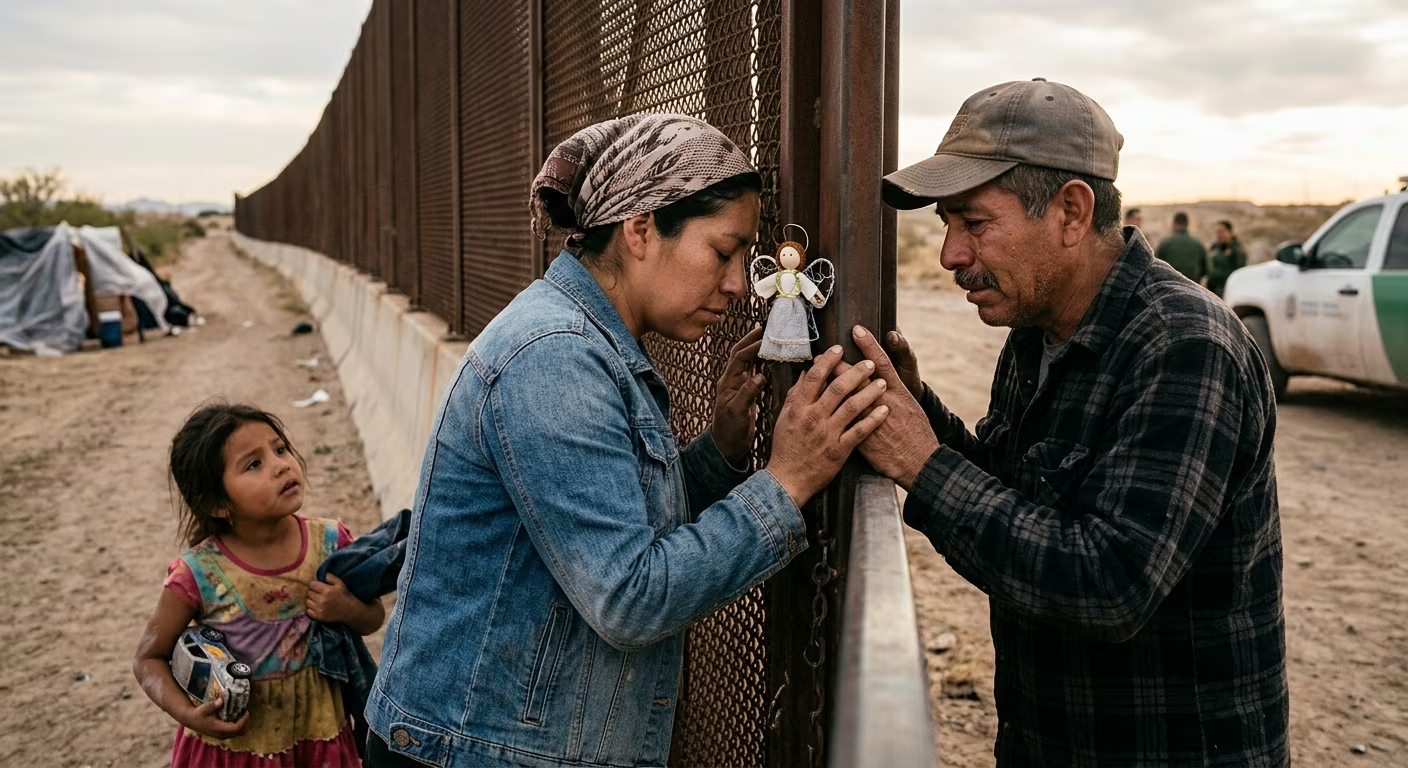
The innate bond between a parent and a child represents the most fundamental relationship within human society, serving as the primary source of emotional security, neurological development, and psychological stability. When individuals make the harrowing decision to flee their home countries—often escaping severe violence, political persecution, systemic extortion, or crippling poverty—they do so with the singular goal of protecting this familial bond and securing a safer future for their children. However, when border enforcement policies are explicitly designed to sever this connection, the resulting trauma reverberates across generations. The profound agony of a parent whose child has been forcibly taken by state authorities transcends basic grief; it introduces a unique, compounding form of psychological torture. The simple, desperate desire to merely lay eyes on one’s child—to know they are safe, fed, and alive—becomes an agonizing and unattainable luxury in the shadow of rigid, deterrence-based immigration enforcement.
Understanding the full scope of family separation requires moving beyond the immediate political rhetoric and examining the long-term, devastating consequences inflicted upon vulnerable populations. It demands a rigorous analysis of the legal frameworks that allowed such practices to flourish, the bureaucratic failures that lost track of children in a maze of government databases, and the biological impact of sudden caregiver deprivation on developing minds. This comprehensive examination reveals a system that not only failed to uphold international humanitarian standards but actively engineered a profound human rights crisis. As we unpack the multifaceted layers of this issue, the unseen scars borne by thousands of migrant families come into stark relief, serving as a solemn reminder of the heavy human cost associated with punitive border policies.
The Architecture of Deterrence and Systemic Fracture
The evolution of U.S. immigration policy at the southern border has frequently oscillated between administrative processing and punitive enforcement. However, the implementation of sweeping “zero-tolerance” directives marked an unprecedented and aggressive pivot in recent history. The core strategy of this policy framework was to utilize the forced separation of families not merely as an unfortunate consequence of detention logistics, but as an explicit, highly publicized deterrent against future irregular migration. By shifting the default federal response from civil immigration proceedings to federal criminal prosecution for unauthorized entry, the government established a formalized mechanism to systematically dismantle family units. Under federal statutes criminalizing improper entry, a misdemeanor charge was aggressively leveraged against asylum-seeking parents. Once a parent was referred for criminal prosecution, the government legally classified them as “unavailable” to provide care for their offspring.
This seemingly minor bureaucratic reclassification triggered a catastrophic chain of events. Because federal law and long-standing legal settlements dictate that children cannot be held in adult criminal detention facilities, the immediate legal consequence of prosecuting the parent was the reclassification of the accompanied child into an “Unaccompanied Alien Child” (UAC). Stripped of their guardians, these children were abruptly transferred from the jurisdiction of border enforcement agencies to the Office of Refugee Resettlement (ORR) under the Department of Health and Human Services (HHS). This inter-departmental transfer meant that children—some as young as a few months old—were physically relocated to shelters, foster homes, or temporary holding facilities scattered across the country, often thousands of miles away from where their parents were being prosecuted or held in separate detention centers.
The sheer scale of this operation quickly overwhelmed the existing infrastructure, exposing critical and deeply tragic flaws in interagency communication and data management. There was no integrated tracking system designed to link a criminally prosecuted parent with a child absorbed into the sprawling HHS shelter network. The deliberate architecture of deterrence simply did not include a blueprint for eventual reunification. As a result, the government effectively manufactured thousands of state-sponsored orphans, plunging parents into a bureaucratic black hole where obtaining basic information about their child’s whereabouts became nearly impossible.
The Psychological Toll: Toxic Stress and Ambiguous Loss
The Neurological Impact on Children
The sudden and forceful removal of a child from their primary caregiver is not merely an emotional shock; it is a severe biological trauma. The American Academy of Pediatrics has extensively documented the physiological consequences of such separations, highlighting the phenomenon of “toxic stress.” When a child is placed in an unfamiliar, highly stressful, and potentially hostile environment without the buffering presence of a trusted caregiver, their developing brain is flooded with cortisol and other stress hormones. Unlike tolerable stress, which builds resilience when managed with a parent’s support, toxic stress continuously activates the hypothalamic-pituitary-adrenal (HPA) axis.
Prolonged exposure to these elevated stress hormones can physically alter the architecture of a child’s developing brain. It damages the prefrontal cortex, which is responsible for executive functioning and emotional regulation, and enlarges the amygdala, the brain’s fear center. Children subjected to this level of trauma often exhibit severe behavioral regression, loss of language skills, acute anxiety, sleep disturbances, and an inability to form trusting attachments. The developmental consequences can persist for decades, increasing the lifetime risk of cardiovascular disease, severe depression, and substance use disorders. The policy of separation effectively turned the bodies and minds of children into collateral damage.
The Agony of Ambiguous Loss for Parents
For the parents left behind in adult detention centers, the psychological devastation was equally profound. Psychologists characterize the state these parents endured as “ambiguous loss”—a form of grief that remains unresolved because there is no closure or clear understanding of the loved one’s fate. Unlike the finality of death, the parent knows the child is alive but remains entirely powerless to protect them, comfort them, or even ascertain their location. This lack of resolution paralyzes the grieving process and subjects the parent to relentless, tormenting anxiety.
- Hypervigilance and Panic Disorders: Parents frequently reported an inability to sleep, eat, or focus on their legal proceedings, consumed entirely by the biological imperative to locate their child.
- Major Depressive Episodes: The sheer powerlessness of fighting a massive, faceless bureaucracy from inside a detention cell led to profound hopelessness and, in several documented cases, extreme self-harm.
- Complicated Grief: The inability to mourn properly, combined with overwhelming guilt for having brought the child on the journey, created a complex psychological burden that requires years of intensive clinical therapy to navigate.
Navigating a Bureaucratic Labyrinth
The tragedy of border separation was compounded by a catastrophic failure of logistics and due process. Government accountability investigations later revealed the staggering extent to which federal agencies failed to communicate. Customs and Border Protection (CBP) officers utilized one database, Immigration and Customs Enforcement (ICE) utilized another, and HHS relied on an entirely separate, non-integrated portal. Because parents were assigned one alien registration number (A-number) and their separated children were assigned another, the digital links connecting family units were easily broken or never established at all.
This lack of interoperability meant that when a parent was scheduled for deportation, the system often failed to flag that they had a child in U.S. custody. Consequently, hundreds of parents were deported back to the dangerous conditions they initially fled, while their children remained isolated in U.S. government shelters. These parents were thrust back into precarious survival situations, forced to attempt to locate and fight for their toddlers from thousands of miles away using spotty international phone lines and zero legal representation.
The legal labyrinth faced by these families was Kafkaesque. The right to seek asylum is enshrined in both U.S. and international law, yet separated parents were frequently coerced into signing deportation documents they could not read, falsely believing that abandoning their asylum claim was the only mechanism to get their children back. Without access to legal counsel, parents were structurally disadvantaged in a highly adversarial immigration court system, fighting parallel legal battles: one to secure their own right to remain, and another to pry their children from the custody of the state.
The Anatomy of a Systemic Disconnect
To fully grasp the magnitude of the operational failure during this period, it is helpful to visualize the divergent paths forced upon a unified family the moment they crossed the border. The table below illustrates the simultaneous but entirely disconnected tracks of a separated parent and child within the U.S. immigration apparatus.
| Phase of Enforcement | Parent’s Trajectory | Child’s Trajectory |
|---|---|---|
| Apprehension | Referred for federal criminal prosecution; classified as an adult offender. | Reclassified as an “Unaccompanied Alien Child” (UAC). |
| Detention | Transferred to an ICE adult detention center; faces civil deportation proceedings. | Transferred to an ORR/HHS shelter, foster home, or influx facility. |
| Information Access | Restricted to a 1-800 number with severe wait times; often given no information. | Assigned a case worker; often too young to provide their parent’s full name. |
| Resolution | Frequently deported without the child, or held indefinitely fighting asylum case. | Remains in U.S. custody; placed with a sponsor, or faces solo immigration court. |
International Human Rights Perspectives
The global community and international human rights organizations have unequivocally condemned the systematic separation of families as a tool of border enforcement. The foundational tenets of international humanitarian law, particularly those outlined in conventions protecting refugees and the rights of children, prioritize family unity as an essential human right. According to the Office of the United Nations High Commissioner for Human Rights (OHCHR), the practice of forcibly separating children from their parents to deter irregular migration constitutes a severe violation of the rights of the child.
Human rights experts argue that such policies breach the principle of the “best interests of the child,” a core doctrine in international law. Furthermore, various advocacy groups and legal scholars have posited that the intentional infliction of severe mental pain and suffering upon parents to coerce a specific outcome—in this case, abandoning their asylum claims—meets the international legal definition of torture. This perspective shifts the discourse from a domestic policy dispute to a grave breach of international human rights obligations, demanding accountability and structural reform to ensure such practices are never repeated.
The Arduous Path to Healing and Reunification
Even when the monumental hurdles of bureaucracy and legal battles are finally overcome, physical reunification is rarely the conclusion of the story; rather, it marks the beginning of an arduous, lifelong process of healing. Children who have spent months or years in state custody often struggle to recognize the parents who fought so desperately to find them. The broken bond is not instantly repaired by a courtroom order. The trauma of abandonment—even when forcefully imposed by the state—leaves children confused, angry, and deeply insecure.
Parents, carrying the heavy burden of their own untreated PTSD and the guilt of the separation, often find themselves unequipped to handle the severe behavioral issues their traumatized children exhibit. Rebuilding trust requires immense patience, specialized psychiatric support, and community resources—tools that are tragically scarce for families actively navigating the precarious realities of the asylum process. The legacy of family separation serves as a stark warning about the irreversible damage caused when administrative efficiency and deterrence are prioritized over fundamental human dignity.
Frequently Asked Questions (FAQ)
What was the primary legal justification used for separating families at the border?
The primary justification stemmed from a “zero-tolerance” directive that mandated the federal criminal prosecution of all adults crossing the border unauthorized. By charging parents with a federal misdemeanor (8 U.S.C. § 1325), the government legally classified them as criminal detainees, thereby rendering them “unfit” to care for their children. The children were subsequently reclassified as unaccompanied minors.
How does forced separation biologically affect a child’s brain development?
The abrupt loss of a primary caregiver plunges a child into a state of “toxic stress.” This constant activation of the brain’s stress-response system floods the body with cortisol, which can physically damage the developing prefrontal cortex and enlarge the amygdala. This leads to long-term behavioral, emotional, and cognitive impairments, severely hindering the child’s ability to self-regulate and form healthy attachments.
What is the Flores Settlement Agreement, and how does it relate to this issue?
The Flores Settlement Agreement is a binding 1997 court settlement that limits the length of time and the conditions under which immigrant children can be detained by the U.S. government. It mandates that children must be held in the least restrictive setting possible. During the zero-tolerance era, the government cited the inability to hold children in adult criminal jails alongside their prosecuted parents as the logistical reason for removing the children into HHS custody.
Why was it so difficult for the government to reunite the families?
The immense difficulty arose from a profound lack of interagency coordination. The Department of Homeland Security (DHS) and the Department of Health and Human Services (HHS) utilized different, incompatible databases. When a family was separated, the parent and child were assigned different tracking numbers, effectively erasing the digital link between them and resulting in thousands of “lost” connections within the federal system.
What role do international human rights laws play in border enforcement?
International human rights frameworks, such as guidelines issued by the UN, emphasize the paramount importance of family unity and the “best interests of the child.” Global consensus views the weaponization of family separation as a deterrent mechanism as a severe violation of these international norms, with some human rights experts classifying the resulting psychological torment as a form of state-sanctioned torture.
References
- Southwest Border: Actions Needed to Improve DHS Processing of Captive Families and Unaccompanied Alien Children — U.S. Government Accountability Office. 2020-02-19. https://www.gao.gov/products/gao-20-245
- US must stop separating migrant children from parents, say UN rights experts — Office of the United Nations High Commissioner for Human Rights. 2018-06-22. https://www.ohchr.org/en/press-releases/2018/06/us-must-stop-separating-migrant-children-parents-say-un-rights-experts
- AAP Statement on Protecting Immigrant Children — American Academy of Pediatrics. 2018-05-08. https://www.aap.org/en/news-room/news-releases/aap/2018/aap-statement-on-protecting-immigrant-children/
- U.S. to settle family separation lawsuits, limiting future border separations — Reuters. 2023-10-16. https://www.reuters.com/world/us/us-settle-family-separation-lawsuits-limiting-future-border-separations-2023-10-16/