
Balancing Faith and Equality: The First Amendment in the Foster Care System
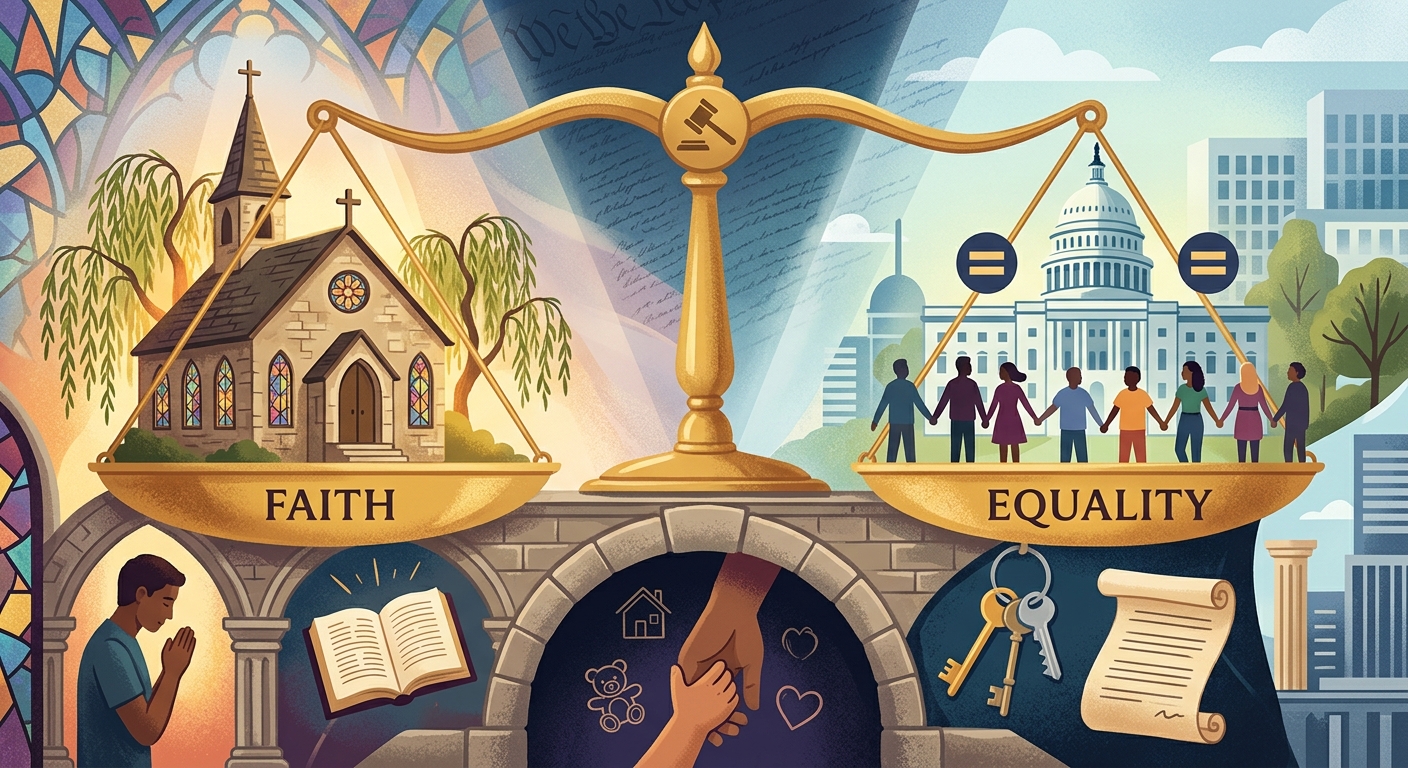
Exploring the complex intersection of religious liberty, government contracts, and LGBTQ+ rights within the American child welfare landscape.
Introduction
The United States foster care system operates under a singular, profound mandate: to protect vulnerable children and secure safe, nurturing environments for them. Achieving this goal requires a massive, coordinated effort between government entities and private organizations. For decades, faith-based agencies have been a cornerstone of this collaborative network, providing essential resources, recruiting foster parents, and facilitating placements. However, as the legal and cultural landscape regarding LGBTQ+ rights has evolved, a complex constitutional friction has emerged. The tension between enforcing municipal non-discrimination policies and protecting the religious liberties of faith-based child welfare providers has sparked intense legal battles, reaching the highest court in the nation.
At the heart of this debate is the delicate balance between the First Amendment’s Free Exercise Clause and the government’s compelling interest in ensuring equal access to public services. When a private, religiously affiliated agency accepts government funding to perform a public service—such as certifying foster parents—must it adhere strictly to government anti-discrimination mandates, even if those mandates violate its core religious doctrines? This question recently came to a head in the landmark Supreme Court case, Fulton v. City of Philadelphia. The ruling not only altered the dynamics of local government contracts but also ignited a nationwide conversation about how to best serve the hundreds of thousands of youth waiting for a stable home.
The Child Welfare Landscape: Demographics and Deficits
To fully grasp the gravity of this legal tug-of-war, one must first examine the demographic realities of the foster care system. The primary objective of any child welfare agency is to secure a stable and loving environment for children who have been removed from their homes due to abuse, neglect, or abandonment. According to national child welfare statistics, there are consistently over 400,000 children in the U.S. foster care system at any given time. Placing these children requires a vast network of willing, qualified, and licensed foster families. Currently, the system faces chronic shortages of available homes, particularly for older children, sibling groups, and children with specialized medical or psychological needs.
In many jurisdictions, the government relies heavily on private agencies to recruit and vet these prospective families. These private agencies are essential force multipliers. Faith-based organizations, in particular, bring deep community roots and extensive networks of highly motivated volunteers. Removing these organizations from the child welfare equation would drastically reduce the operational capacity of the foster care system, potentially leaving thousands of children without swift placement options. Yet, the demographic makeup of the children entering the system, and the families stepping up to foster, complicates this partnership.
Vulnerabilities of LGBTQ+ Youth in State Care
A critical layer of this demographic puzzle is the overrepresentation of LGBTQ+ youth within the system. Research published in peer-reviewed journals, such as Pediatrics, highlights that LGBTQ+ youth are significantly more likely to experience unstable housing and enter the foster care system compared to their heterosexual and cisgender peers . Many of these youths enter state custody after being rejected by their families of origin due to their sexual orientation or gender identity.
Once in the system, these marginalized youths face higher rates of mental health struggles, bullying, and multiple placement disruptions. They are in desperate need of affirming, supportive foster homes that can provide a safe haven from societal hostility. Simultaneously, demographic data consistently demonstrates that same-sex couples are highly motivated to foster and adopt. They are statistically more likely to open their homes to the very demographics that are often the hardest to place. When faith-based agencies turn away prospective LGBTQ+ parents based on religious tenets, child welfare advocates argue that it artificially limits the pool of available homes, directly harming the youth waiting for placement.
The First Amendment and the Free Exercise Clause
To understand the legal defenses employed by faith-based agencies, one must look to the bedrock of American constitutional law. The Free Exercise Clause of the First Amendment asserts that the government “shall make no law respecting an establishment of religion, or prohibiting the free exercise thereof.” As defined by the Legal Information Institute at Cornell Law School, this clause protects not just internal beliefs, but also certain actions made on behalf of those beliefs, provided they do not run afoul of a compelling governmental interest .
Historically, the Supreme Court has navigated a pendulum of interpretations regarding religious exemptions. In the 1990 landmark case Employment Division v. Smith, the Court established that the right of free exercise does not relieve an individual of the obligation to comply with a “valid and neutral law of general applicability.” This means that if a state passes a law that applies to everyone equally, a religious group cannot claim an automatic exemption simply because the law incidentally burdens their religious practices. This legal backdrop is crucial for understanding modern battles over government contracts. When a city government issues a contract for social services, it typically includes standard boilerplate language requiring compliance with local anti-discrimination ordinances. If these ordinances are considered “generally applicable,” faith-based agencies historically had little legal recourse if their religious practices violated the contract. However, the nuances of how these contracts are written can completely alter the constitutional framework applied by the courts.
Fulton v. City of Philadelphia: A Constitutional Crossroads
The theoretical clash between anti-discrimination laws and religious freedom materialized forcefully in the 2021 Supreme Court case Fulton v. City of Philadelphia [1, 4]. The controversy began when the City of Philadelphia discovered that Catholic Social Services (CSS), a long-standing partner in the city’s foster care network, was refusing to evaluate and certify same-sex couples as foster parents. CSS asserted that certifying same-sex couples would implicitly endorse same-sex marriage, which fundamentally contradicts their religious doctrines.
The Core Arguments
In response to this discovery, Philadelphia halted all foster child referrals to CSS. The city argued that the agency was directly violating the non-discrimination provisions embedded within their government contract, as well as the city’s Fair Practices Ordinance. Philadelphia maintained that when an agency steps into the shoes of the government to perform a public function, it must abide by the government’s mandate to treat all citizens equally, regardless of sexual orientation.
CSS sued the city, arguing that Philadelphia’s actions violated their First Amendment rights under the Free Exercise and Free Speech Clauses. They contended that they were not discriminating against individuals, but rather adhering to a religious definition of marriage. Furthermore, CSS pointed out that no same-sex couple had actually been denied a foster placement by them; if a same-sex couple had approached CSS, the agency’s policy was to seamlessly refer them to another nearby agency that was authorized and willing to perform the certification.
The Supreme Court’s Unanimous Verdict
While lower courts sided with Philadelphia, relying on the Smith precedent to declare the non-discrimination policy a neutral law of general applicability, the Supreme Court unanimously reversed the decision in favor of CSS . Chief Justice John Roberts, writing for the majority, zeroed in on a specific and fatal element of the city’s contract. The contract stipulated that agencies could not reject prospective parents “unless an exception is granted by the Commissioner… in his/her sole discretion.”
Because the city retained the explicit authority to grant individualized exemptions, the Court ruled that the non-discrimination policy could no longer be classified as “generally applicable.” By creating a system of discretionary exceptions, the city triggered a much higher level of judicial review known as “strict scrutiny.” Under strict scrutiny, the government must prove it has a compelling interest in refusing an exemption to CSS while maintaining the power to grant exemptions to others. The Court concluded that Philadelphia failed to meet this heavy burden, resulting in a victory for religious liberty protections in the context of this specific contract.
| Constitutional Standard | Legal Definition | Application in Government Contracts |
|---|---|---|
| Neutral and Generally Applicable | Laws that apply to everyone equally without targeting a specific religion or allowing discretionary exceptions. | If a non-discrimination policy has absolute, zero-tolerance enforcement without exceptions, it may survive Free Exercise challenges under the Smith precedent. |
| Strict Scrutiny | The highest level of judicial review, requiring a compelling government interest and narrow tailoring to achieve that interest. | Triggered if a law burdens religious exercise and allows for individualized exemptions, as seen in the Fulton decision. |
Implications for Faith-Based Agencies and Municipal Contracts
The Fulton decision sent immediate ripples through the legal and social services sectors. For faith-based agencies, the ruling was a vital validation of their ability to participate in public programs without being forced to abandon their theological convictions. It reassured legacy providers that their historical contributions to the child welfare system would not be entirely erased by shifting municipal policies, provided the contracts contained mechanisms for discretionary exemptions.
For local governments, however, the ruling presented a contractual puzzle. If a city is deeply committed to enforcing strict LGBTQ+ non-discrimination policies across all its privatized services, it must now ensure that its contracts are entirely devoid of any discretionary exemption clauses. By closing loopholes that allow a Commissioner or director to grant exceptions, a city might theoretically return its policies to the realm of “general applicability,” thus protecting them from similar Free Exercise challenges. Yet, doing so risks alienating major religious organizations, potentially devastating the local foster care infrastructure.
Navigating the Future: Policy Solutions and Compromises
Moving forward, the child welfare system must find a sustainable middle ground that maximizes the number of safe foster homes while respecting constitutional boundaries. One heavily discussed policy solution is the implementation of a formalized dual-track or guaranteed referral system. In this model, if a faith-based agency is unable to certify a prospective family due to religious constraints, the system ensures an immediate, respectful, and mandatory referral to an inclusive agency. This approach aims to prevent prospective parents from experiencing the emotional toll of a flat rejection, ensuring they remain in the pipeline to become foster parents.
Furthermore, states are being urged to aggressively fund and support LGBTQ+-inclusive agencies to ensure there are abundant pathways for all willing families to participate in the child welfare system. Ultimately, the focus must remain resolutely on the children. Legal experts, social workers, and policymakers must collaborate to ensure that constitutional disputes do not create bottlenecks that leave vulnerable youth languishing in institutional care.
Frequently Asked Questions (FAQs)
What was the central issue in Fulton v. City of Philadelphia?
The case centered on whether the City of Philadelphia could legally terminate its foster care contract with Catholic Social Services because the agency refused to certify same-sex couples as foster parents due to its religious beliefs.
Why did the Supreme Court rule in favor of the religious agency?
The Court found that Philadelphia’s non-discrimination contract included a clause allowing the Commissioner to grant discretionary exemptions. Because of this loophole, the policy was not “generally applicable.” Therefore, refusing an exemption to the religious agency violated their First Amendment Free Exercise rights under strict scrutiny review.
Does the First Amendment Free Exercise Clause allow anyone to break the law for religious reasons?
No. Under the Employment Division v. Smith precedent, individuals and organizations generally must comply with neutral, generally applicable laws. However, if a law targets religion or allows for individualized exemptions, the government must pass a strict scrutiny test to enforce it against a religious objection.
How does this legal battle impact LGBTQ+ youth in foster care?
Advocates worry that allowing agencies to reject same-sex couples reduces the overall pool of available foster homes. Because LGBTQ+ youth are overrepresented in the system and highly benefit from affirming environments, maximizing the number of inclusive foster parents is critical to their well-being and placement success.
Conclusion
The intersection of religious liberty and government anti-discrimination mandates remains one of the most complex battlegrounds in modern American jurisprudence. The unanimous decision in Fulton v. City of Philadelphia provided crucial protections for faith-based agencies, ensuring they can continue their vital work in the child welfare sector without compromising their core beliefs. However, it also highlighted the ongoing vulnerability of LGBTQ+ prospective parents and youth within the system. As the nation moves forward, the ultimate metric for success cannot merely be constitutional victories; it must be the safety, stability, and love provided to every single child waiting for a home.
References
- Fulton v. City of Philadelphia, 141 S. Ct. 1868 — Supreme Court of the United States. 2021-06-17. https://www.supremecourt.gov/opinions/20pdf/19-123_g3bi.pdf
- Free Exercise Clause — Legal Information Institute (LII), Cornell Law School. 2024-06. https://www.law.cornell.edu/wex/free_exercise_clause
- LGBTQ Youth in Unstable Housing and Foster Care — Baams L, Wilson BDM, Russell ST. Pediatrics (PubMed Central). 2019-03-01. https://www.ncbi.nlm.nih.gov/pmc/articles/PMC6398453/
- Fulton v. City of Philadelphia Case Summary — Oyez, Chicago-Kent College of Law. 2020-11-04. https://www.oyez.org/cases/2020/19-123
Similar Articles








Read full bio of medha deb


