
Warrantless Pole Cameras and the Threat to Digital Privacy
Unregulated 24/7 pole camera surveillance threatens the Fourth Amendment.
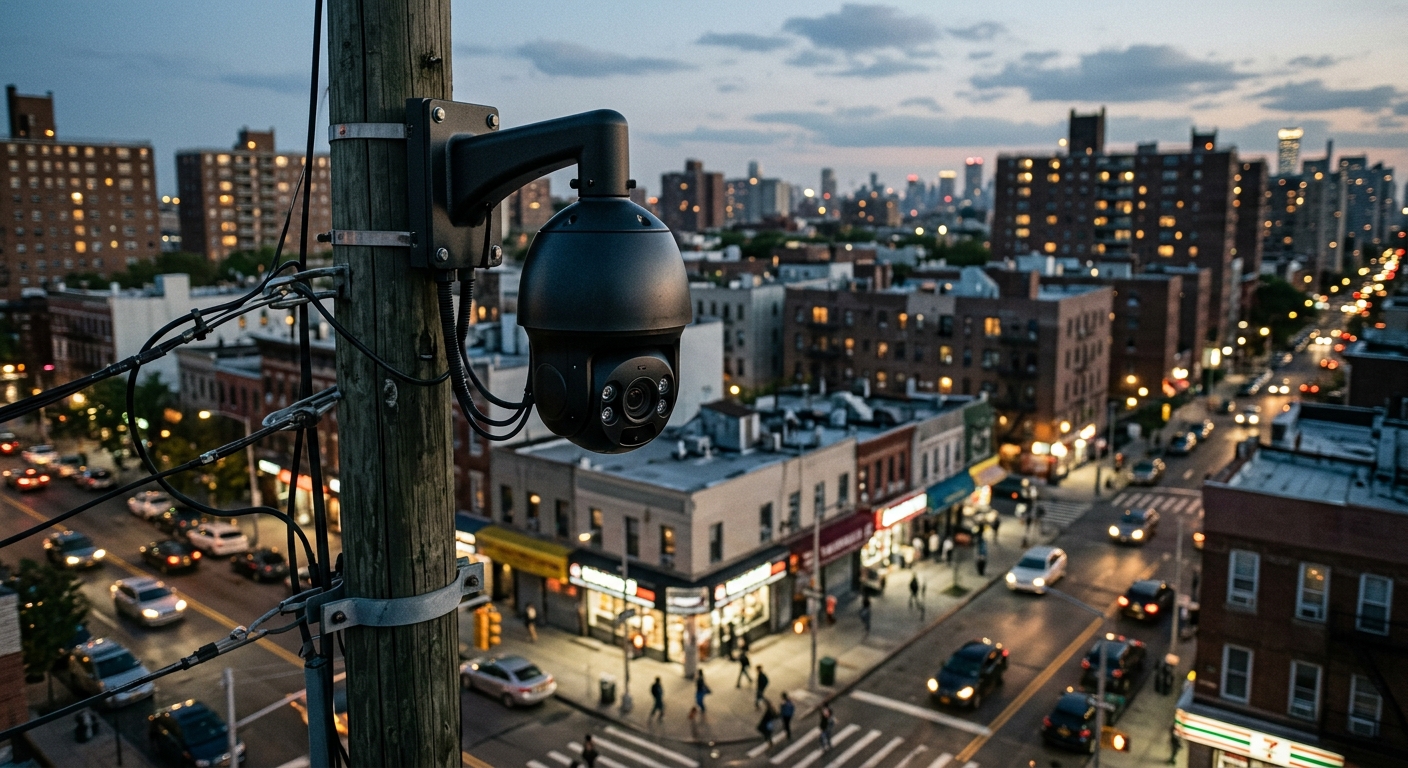
In cities, suburbs, and rural intersections across the United States, an invisible, fundamental shift has altered the modern landscape of law enforcement. High atop utility poles, telephone lines, and streetlights, hidden in plain sight, sophisticated digital video cameras are silently recording the daily, intimate movements of citizens. Unlike the targeted, human-led stakeouts of previous decades, these devices do not blink, they do not sleep, and they do not require an hourly paycheck. They sit passively for weeks, months, or even years at a time, cataloging every single person who enters or leaves a specific home or business. What is most alarming about this rapid proliferation of surveillance technology is not the hardware itself, but the startling legal vacuum in which it currently operates. In many jurisdictions across the country, police departments can deploy these powerful, all-seeing surveillance tools without ever obtaining a warrant from a judge.
The constitutional implications of this practice are staggering. The United States Constitution was deliberately designed to protect individuals from arbitrary and invasive government overreach. Yet, as surveillance capabilities leapfrog existing legislative boundaries, citizens are left vulnerable to pervasive monitoring that would have been entirely unimaginable to the architects of the Bill of Rights. As lower courts deeply diverge on whether this practice violates fundamental privacy rights, a profound legal crisis is brewing. The situation presents a pressing mandate for the United States Supreme Court to establish clear, nationwide guardrails. Warrantless pole camera surveillance is not merely a localized law enforcement tactic; it represents a fundamental threat to digital privacy and the future of civil liberties in a modern, heavily monitored society.
The Evolution of Surveillance: From Leather Soles to Digital Sensors
To comprehensively understand the danger of warrantless pole cameras, one must first examine the history of police observation. Historically, surveillance was self-limiting due to sheer logistics. If a police department wanted to secretly monitor a suspect’s home twenty-four hours a day, it required a massive, coordinated allocation of resources. Teams of undercover officers had to rotate through exhausting shifts, surveillance vehicles had to be constantly disguised or swapped, and the intense logistical friction of the operation meant it was only utilized for the most serious, high-stakes investigations. The high financial cost of human labor acted as a natural, structural safeguard against widespread, casual surveillance. The government simply could not afford to watch everyone, so it only watched those it had a strong, articulable reason to suspect of committing a major crime.
Today, the economics of surveillance have been entirely rewritten. Advances in digital optics, wireless data transmission, and massive cloud storage networks have reduced the financial cost of persistent observation to near zero. A modern pole camera can be equipped with remote pan, tilt, and zoom functionalities, alongside advanced infrared sensors that easily cut through the darkness of night. These cameras quietly feed high-definition video into remote servers indefinitely. Officers no longer need to sit in a cold sedan on a dark street corner; they can comprehensively monitor a neighborhood from a desktop computer miles away, scanning through weeks of footage with the simple click of a mouse. By completely removing the practical limitations of physical surveillance, technology has erased the implicit protections that once shielded the general public from overzealous policing.
The Fourth Amendment and the “Public View” Dilemma
At the absolute center of the pole camera debate is the Fourth Amendment, which guarantees the right of the people to be secure in their persons, houses, papers, and effects against unreasonable searches and seizures. For several decades, courts have interpreted this sacred right through a legal framework heavily reliant on the concept of a “reasonable expectation of privacy.” A foundational element of this legal framework is the “public view” doctrine, which generally dictates that a person has no constitutional protection for what they knowingly expose to the public. If an individual walks out their front door, a passing police officer—or a neighbor—is completely free to observe them without violating their rights.
Law enforcement agencies rely heavily on this traditional doctrine to justify the warrantless deployment of long-term pole cameras. Their legal argument is deceptively simple: if a digital camera only records what a human officer standing on the public street could legally see, no constitutional search has occurred, and therefore no judicial warrant is necessary. However, this logic falsely equates a fleeting, momentary human observation with a permanent, searchable, unblinking video archive. It completely fails to recognize that the very nature of the observation changes entirely when it becomes continuous, automated, and prolonged over months. A neighbor might casually notice you carrying groceries into your house on a Tuesday; they do not maintain a timestamped, permanent log of every single visitor, package delivery, and late-night departure you make over a six-month period.
Assembling the Pieces: The Mosaic Theory of Privacy
To intelligently bridge the gap between traditional legal doctrines and modern, pervasive technology, legal scholars and privacy advocates frequently invoke the “mosaic theory.” First popularized in the context of prolonged GPS tracking, the mosaic theory correctly argues that comprehensive, continuous surveillance reveals substantially more than the mere sum of its individual parts. Just as a single colored tile reveals absolutely nothing about the broader picture, a single public movement is relatively meaningless. But when thousands of these discrete behavioral tiles are arranged together by a computer, a highly intimate, comprehensive portrait of a person’s private life rapidly emerges.
When a pole camera records a home without any interruption for several months, it captures a deep, profoundly revealing narrative of the occupants’ lives. It flawlessly documents when they leave for work and when they return home. It reveals whether they regularly visit a medical clinic, attend religious services, or actively participate in controversial political meetings based on their precise patterns of departure and arrival. It explicitly logs the identities and routines of their friends, romantic partners, and professional associates. The Supreme Court has previously recognized the immense danger of this aggregated data in landmark cases involving cell-site location information and physical GPS trackers, heavily noting that such pervasive monitoring violates a person’s reasonable expectation of privacy. Yet, in the specific realm of visual video surveillance, the application of this essential theory remains deeply and frustratingly contested.
The Chilling Effect on Everyday Freedoms
The unchecked use of continuous video surveillance extends far beyond theoretical privacy debates; it has tangible, intensely corrosive effects on the functioning of a free society. When individuals know or firmly suspect that their private homes are being monitored around the clock by the government, their everyday behavior fundamentally changes. This psychological phenomenon, widely known as the chilling effect, strikes directly at the core of First Amendment freedoms. A person might severely hesitate to host a controversial political advocacy group, quietly seek confidential legal counsel, or intimately invite certain marginalized associates to their home if they fear that a hidden government camera is meticulously documenting their every association.
Furthermore, warrantless surveillance technologies are almost never deployed equally across society. Historical patterns of domestic policing clearly demonstrate that invasive tactics are disproportionately concentrated in marginalized, lower-income, and minority communities. When powerful pole cameras can be installed without a neutral judge’s approval, there is absolutely no legal mechanism to prevent biased, retaliatory, or discriminatory monitoring. Entire neighborhoods can rapidly find themselves subjected to an unblinking, suspicious gaze based on vague intuitions or systemic biases, effectively stripping law-abiding residents of the basic dignity of a private life.
The Judicial Divide: A Growing Circuit Split
The stark lack of definitive, modern guidance from the nation’s highest court has resulted in a deeply fragmented legal landscape. Federal and state courts are starkly divided on whether long-term, warrantless pole camera surveillance violates the Fourth Amendment. Some judicial circuits maintain a strict, unyielding adherence to the historical public view doctrine, ruling that citizens have absolutely no right to privacy in their front yards, regardless of how long the digital cameras continually record. These conservative courts forcefully argue that it is the exclusive job of the legislature, not the judiciary, to strictly regulate new technologies.
Conversely, other courts have slowly begun to push back, intelligently recognizing that advanced technology has fundamentally altered the historical balance of power between the sprawling state and the individual citizen. For example, recent intense legal battles in the First Circuit have highlighted deep judicial anxieties about completely unregulated surveillance, even as those courts struggle to formulate a cohesive, durable legal standard. This growing circuit split means that a citizen’s fundamental constitutional rights currently depend heavily on their geographic zip code. A specific surveillance action that currently constitutes an illegal, warrantless search in one state may be considered perfectly permissible in the state next door. This profound, untenable inconsistency demands immediate resolution.
A Simple Solution: The Warrant Requirement
Advocating aggressively against warrantless pole cameras is definitely not synonymous with arguing that police departments should be entirely stripped of technological tools. High-definition video surveillance can be a highly effective, necessary tool in carefully investigating serious crimes and gathering critical evidence. The core issue is not the existence of the camera, but the dangerous lack of judicial oversight. The solution is remarkably straightforward and deeply rooted in classical American jurisprudence: simply require law enforcement officers to obtain a sworn warrant based on probable cause before deploying a continuous, long-term pole camera.
The constitutional warrant requirement is a foundational, indispensable check on government power. It forces police to carefully articulate specific, evidence-based reasons for their suspicion to a neutral, detached judge. It effectively prevents baseless fishing expeditions and highly speculative surveillance. Obtaining a warrant is not an insurmountable, crippling burden for modern law enforcement; it is the exact standard procedure for searching a physical house, tapping a cellular phone, or continuously tracking a vehicle. Extending this basic requirement to long-term digital video surveillance simply ensures that modern policing tools are strictly governed by the exact same constitutional principles that have safely guided the justice system for over two centuries.
Traditional vs. Continuous Digital Surveillance
To explicitly illustrate the stark, fundamental differences between historic policing methods and modern technological observation, the following table compares traditional human stakeouts with modern pole camera surveillance capabilities.
| Feature | Traditional Human Stakeout | Pole Camera Surveillance |
|---|---|---|
| Financial Cost | Extremely high (requires multiple officers, overtime pay, vehicles) | Extremely low (one-time hardware purchase, minimal cloud storage fees) |
| Operational Duration | Strictly limited by human endurance and strict departmental budgets | Virtually unlimited (operates 24/7/365 without ever experiencing fatigue) |
| Scope of Gathered Data | Narrow (officers only observe specific, targeted daily events) | Comprehensive (records absolutely everything, allowing retrospective searching) |
| Judicial Oversight | Often inherently limited by constant requests for financial resources | Frequently deployed entirely at officer discretion without any judicial warrants |
Conclusion: Safeguarding the Future of Privacy
The unbelievably rapid advancement of digital surveillance technology has vastly outpaced the aging legal frameworks historically designed to carefully regulate it. Warrantless pole camera surveillance currently represents a profound, existential threat to the Fourth Amendment, allowing the government to silently compile intimate, long-term digital dossiers on ordinary citizens without any judicial approval whatsoever. The ongoing transition from limited human observation to automated, unblinking digital eyes fundamentally alters the delicate balance between public safety and individual liberty. As lower courts remain deeply fractured over how to correctly apply centuries-old constitutional principles to modern technology, the need for nationwide clarity has never been more incredibly urgent. The Supreme Court must boldly step forward and definitively establish that prolonged video surveillance requires a warrant. Only by demanding strict judicial oversight can society ensure that the amazing tools of the future do not entirely dismantle the essential rights of the past.
Frequently Asked Questions (FAQ)
What exactly is a pole camera?
A pole camera is a highly advanced digital surveillance device, often equipped with high-definition optics, remote pan/tilt/zoom capabilities, and infrared night vision, that law enforcement quietly attaches to utility lines or telephone poles. They are specifically designed to blend seamlessly into the urban environment and can record specific locations continuously for several months or even years at a time.
Doesn’t the Fourth Amendment only protect the inside of a person’s home?
While the Fourth Amendment absolutely provides the highest level of strict protection to the inside of a physical home, constitutional privacy fundamentally extends beyond the physical walls. Courts critically look at whether a person has a “reasonable expectation of privacy.” Recent sophisticated legal arguments strongly suggest that continuous, long-term observation of a person’s movements—even outside the home—violates that expectation.
What is the “mosaic theory” in legal terms?
The mosaic theory posits that while a single, isolated instance of public observation (like seeing someone walk to their car) is not a constitutional privacy violation, the continuous, systemic aggregation of these minor observations over a very long period creates an intimate, highly comprehensive picture of a person’s life that should absolutely require a legal warrant to obtain.
Why can’t police just get a warrant for these cameras?
They certainly can, and privacy advocates aggressively argue they always should. Requiring a warrant correctly forces police to demonstrate probable cause to a neutral judge, ensuring that the surveillance is entirely justified. Currently, many departments simply choose not to get warrants because certain fragmented legal jurisdictions do not explicitly require them for exterior cameras.
Has the Supreme Court ruled on pole cameras specifically?
As of right now, the Supreme Court has not issued a definitive, nationwide ruling explicitly addressing long-term, warrantless pole camera video surveillance. However, they have previously ruled on similar continuous tracking technologies, such as physical GPS devices and historical cell-site location data, indicating a clear willingness to modernize Fourth Amendment protections.
References
- Carpenter v. United States, 138 S. Ct. 2206 (2018) — Supreme Court of the United States. 2018-06-22. https://www.supremecourt.gov/opinions/17pdf/16-402_h315.pdf
- United States v. Jones, 565 U.S. 400 (2012) — Supreme Court of the United States. 2012-01-23. https://www.supremecourt.gov/opinions/11pdf/10-1259.pdf
- First Circuit Divides on Constitutionality of Warrantless Pole-Camera Surveillance — Harvard Law Review (Vol. 136, Issue 4). 2023-02-10. https://harvardlawreview.org/print/vol-136/united-states-v-moore-bush/
- Fourth Amendment — Constitution Annotated, Congress.gov. 2023-01-01. https://constitution.congress.gov/constitution/amendment-4/
Similar Articles








Read full bio of medha deb


