
Understanding U.S. Privacy Torts and Landmark Cases
Explore how American courts protect personal privacy through four key torts and major Supreme Court decisions.
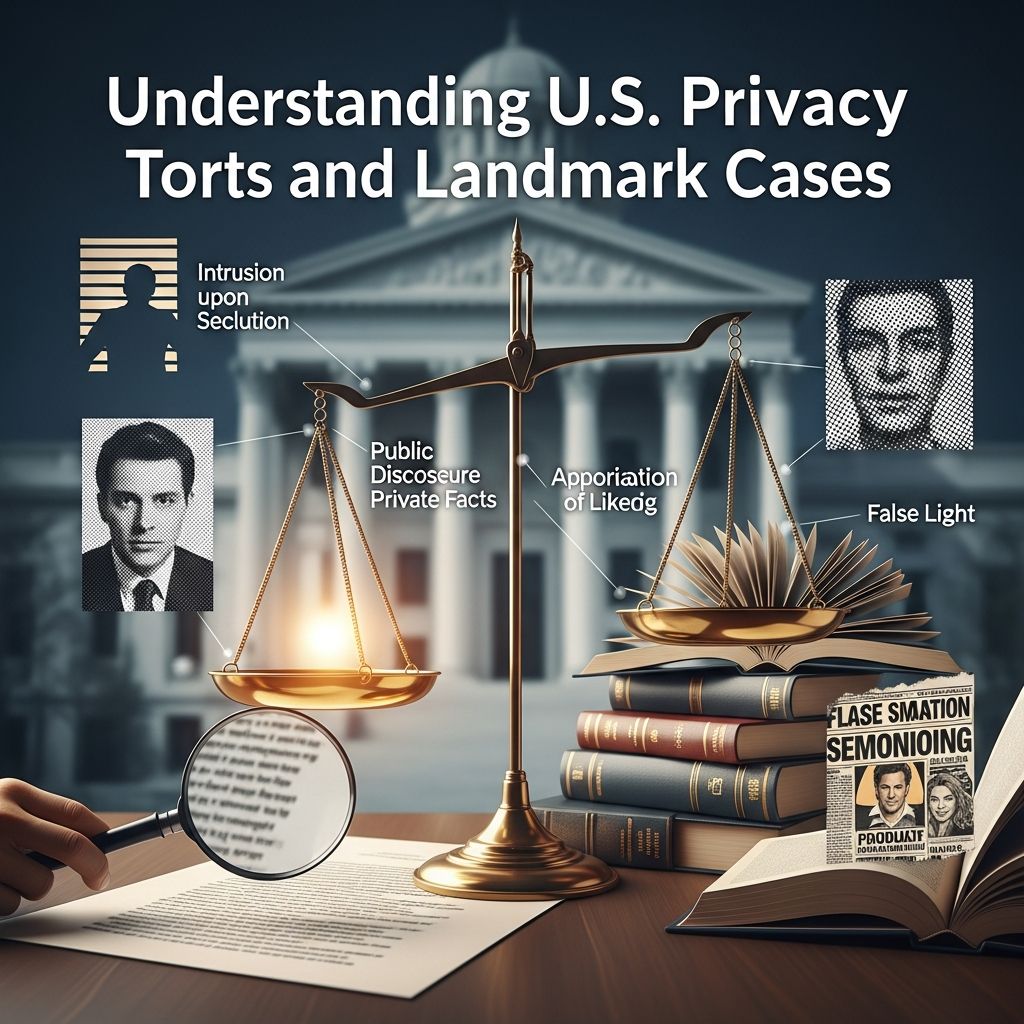
The modern American right to privacy is largely a product of courts rather than explicit constitutional text. Although the U.S. Constitution does not use the word “privacy,” courts have recognized both constitutional protections and civil lawsuits—known as privacy torts—that safeguard individuals from unwanted exposure, surveillance, or exploitation of their personal lives.
This article explains the main types of invasion of privacy claims, highlights important court decisions, and shows how judges balance privacy with free speech, press, and public safety.
From “Right to Be Let Alone” to Modern Privacy Law
Privacy as a legal concept in the United States grew out of changing technology and social expectations. In the late nineteenth century, scholars warned that cameras and mass circulation newspapers made it possible to expose intimate details of everyday life. That concern eventually reached the courts and shaped a body of law that now touches everything from medical records to digital surveillance.
Constitutional Privacy vs. Civil Privacy Torts
It is important to distinguish between two major strands of privacy protection in U.S. law:
- Constitutional privacy limits what government can do—such as search your home, access your data, or regulate intimate decisions like childrearing or contraception.
- Privacy torts allow individuals to sue other private parties—such as media outlets, employers, or businesses—for certain kinds of intrusive or harmful conduct.
Constitutional rules are mostly derived from a combination of amendments—especially the First, Fourth, Fifth, Ninth, and Fourteenth Amendments—interpreted by the Supreme Court to protect certain “zones of privacy.” Privacy torts, by contrast, come from state common law and statutes and can vary by jurisdiction.
The Four Classic Privacy Torts
Most states recognize some or all of four traditional categories of privacy torts. These were originally synthesized by legal scholar William Prosser and widely adopted in U.S. courts and legal education.
| Privacy Tort | What It Protects | Typical Example |
|---|---|---|
| Intrusion upon seclusion | Freedom from highly offensive intrusions into your private space or affairs | Hidden cameras or wiretapping in a private home |
| Public disclosure of private facts | Protection from publication of highly personal, non-newsworthy information | Publishing medical or sexual history of an ordinary person |
| False light | Protection against misleading publicity that paints you inaccurately | Story implying you engaged in conduct you did not actually commit |
| Appropriation / right of publicity | Control over commercial use of your name, image, or likeness | Using a person’s photo in an advertisement without consent |
1. Intrusion upon Seclusion
Intrusion upon seclusion focuses on the method of obtaining information, not on whether it is ever published. Courts typically ask whether the defendant intentionally intruded into a place or activity where the plaintiff had a reasonable expectation of privacy, and whether the intrusion would be highly offensive to a reasonable person.
Examples can include:
- Entering a private residence without consent to photograph or record.
- Secretly recording a conversation in a private office.
- Using long-range lenses or drones to peer into a home or secluded backyard.
The concept of a “reasonable expectation of privacy” also plays a central role in constitutional law. In Katz v. United States (1967), the Supreme Court held that wiretapping a public phone booth without a warrant violated the Fourth Amendment because the user had a reasonable expectation that his phone call would be private.
2. Public Disclosure of Private Facts
The tort of public disclosure of private facts addresses publication of truthful but sensitive information that is not of legitimate public concern. Plaintiffs usually must show:
- The defendant publicized a matter concerning the plaintiff’s private life.
- The disclosure would be highly offensive to a reasonable person.
- The matter was not newsworthy or of public interest.
Courts often side with defendants when information is connected to a crime, public office, or other matters that affect the public. The Supreme Court has recognized strong First Amendment protection for accurate, lawfully obtained information about public records or newsworthy events, which can limit this tort.
3. False Light
False light involves portraying someone in a misleading way that would be highly offensive, even if technically not defamatory. Unlike defamation, which focuses on harm to reputation, false light centers on the embarrassment or emotional distress caused by distortion.
For instance, an article might use a person’s photo to illustrate a story about drug use, implying they are involved when they are not. Because of its overlap with defamation and concerns about free speech, some states either restrict or do not recognize false light claims.
4. Appropriation and the Right of Publicity
The final category, often called appropriation of name or likeness (or the right of publicity), protects a person’s control over commercial uses of their identity. This tort generally occurs when someone uses another’s name, voice, image, or other identifying characteristic for advertising or trade purposes without consent.
Key features often include:
- Unauthorized use of a person’s identity.
- A clear commercial or promotional purpose.
- Resulting injury, which may include economic loss or emotional distress.
Some states give celebrities broader rights of publicity, recognizing the economic value of fame. Others extend these protections to ordinary individuals as well.
Constitutional Right to Privacy: Landmark Supreme Court Cases
Beyond civil torts, some of the most influential privacy protections come from Supreme Court decisions interpreting the Constitution. These cases often involve intimate or personal decisions, governmental searches, or access to sensitive information.
Griswold v. Connecticut (1965): Marital Privacy
In Griswold v. Connecticut, the Supreme Court struck down a state law that criminalized giving contraceptive advice to married couples. The Court held that the Constitution created various “zones of privacy” derived from several amendments, protecting the marital relationship from unwarranted state intrusion.
Justice Douglas famously reasoned that the First, Third, Fourth, Fifth, and Ninth Amendments together created penumbras—shadows—where privacy is fundamental to ordered liberty. Griswold laid the foundation for later cases involving reproductive autonomy and intimate relationships.
Eisenstadt, Roe, and Lawrence: Expanding Privacy in Intimate Life
Griswold’s logic did not remain confined to married couples. Subsequent cases broadened the scope of constitutional privacy:
- Eisenstadt v. Baird (1972) extended the right to possess contraception to unmarried individuals, emphasizing individual privacy rather than marital status.
- Roe v. Wade (1973) held that a woman’s decision to terminate a pregnancy in early stages fell within a broad right to privacy, though this framework has been significantly altered by later cases.
- Lawrence v. Texas (2003) invalidated laws criminalizing consensual same-sex intimacy, reaffirming that the liberty protected by the Fourteenth Amendment includes certain deeply personal decisions about intimate conduct.
These decisions are controversial and have evolved over time, but they illustrate the Court’s willingness to treat certain personal choices as protected from government interference.
Katz and the Reasonable Expectation of Privacy
In the context of government searches and surveillance, the Supreme Court’s decision in Katz v. United States reshaped Fourth Amendment law. The Court rejected the idea that only physical trespass mattered and held that the Amendment protects people, not places.
Justice Harlan’s concurrence introduced a two-part test that remains central today:
- Did the person exhibit a subjective expectation of privacy?
- Is that expectation one society is prepared to recognize as reasonable?
This framework influences both criminal procedure and civil privacy expectations—informing when intrusions might be considered highly offensive or unlawful.
Modern Privacy, Technology, and Sensitive Data
As digital technology developed, courts faced questions about how constitutional privacy rules apply to electronic communications and data held by private companies. In recent years, the Supreme Court has signaled heightened protection for certain kinds of sensitive information.
For example:
- Location tracking via cellphones can reveal a detailed picture of a person’s movements and associations, raising serious privacy concerns and often requiring a warrant.
- Electronic communications and stored data may be protected under the Fourth Amendment when users have a reasonable expectation of privacy, even if the information rests with a third-party service provider.
Lower courts and legislatures continue to adapt traditional privacy principles to new contexts such as social media, smart devices, and large-scale data analytics.
Balancing Privacy, Free Speech, and Public Interest
Privacy claims often compete with other important values, particularly freedom of expression and the public’s right to know. Courts frequently engage in balancing tests to determine which interest should prevail in a given case.
Newsworthiness and Matters of Public Concern
Claims for public disclosure of private facts and related torts regularly fail when defendants can show that the information was newsworthy or addressed a matter of legitimate public concern. Courts generally give wide latitude to the press in covering:
- Criminal proceedings and police investigations.
- Conduct of public officials and public figures.
- Events occurring in public places.
At the same time, there are limits. Reporting that focuses solely on sensational, highly intimate facts about a private individual with no connection to broader public issues is more likely to raise viable privacy claims.
Public Figures vs. Private Individuals
Courts frequently distinguish between public figures (celebrities, high-ranking officials, or those who thrust themselves into public controversies) and private individuals. Public figures typically have a reduced expectation of privacy as to their public roles and conduct. Private individuals receive more protection, particularly when the matter has little public significance.
This distinction influences defamation, false light, and disclosure claims. It also intersects with the right of publicity, where public figures have stronger economic interests in the commercial use of their identity.
Privacy in the Workplace and Organizational Settings
Another important arena for privacy disputes is the workplace, where employers often monitor computer systems, emails, and physical spaces. Courts generally look at whether employees had notice of monitoring and whether their expectations of privacy were reasonable in light of workplace policies.
Illustrative principles from case law include:
- Employees may have limited privacy in employer-owned computers and email systems, especially when policies clearly state that communications can be monitored.
- Even with monitoring policies, certain communications—such as those with personal attorneys—may receive special protection due to attorney–client privilege or professional ethics rules.
- Physical searches of desks, lockers, or offices are often assessed under reasonableness standards, similar to Fourth Amendment analyses for government workplaces.
Public-sector employees also benefit from constitutional protections when the employer is a government entity. Courts apply modified Fourth Amendment standards to workplace searches conducted for operational, rather than criminal, purposes.
Practical Takeaways for Individuals
Because privacy law is complex and varies by state, specific legal advice always requires consultation with a qualified attorney. Still, several general lessons emerge from the major cases and doctrines:
- Context matters. What counts as a reasonable expectation of privacy depends heavily on where you are and what you have been told about monitoring.
- Consent and notice reduce liability. Clear consent forms, privacy policies, and workplace notices can shift expectations and affect whether a claim succeeds.
- Public spaces are different from private sanctuaries. The law protects homes, bedrooms, and confidential communications more strongly than activities visible from public streets.
- Public roles invite scrutiny. People who voluntarily take on public roles often have limited privacy regarding their public actions.
- Digital footprints are increasingly regulated. Courts and legislatures are still defining how traditional privacy principles apply to online data, social media, and emerging technology.
Frequently Asked Questions (FAQs)
What is the difference between privacy and confidentiality?
Privacy is the right to be free from unwanted intrusion or exposure, while confidentiality is a duty—often imposed on professionals or organizations—not to disclose information entrusted to them without authorization. A breach of confidentiality can sometimes also be an invasion of privacy, but the concepts are not identical.
Can I sue someone for sharing my private messages online?
In some situations, yes. If the messages contained highly personal information and were shared widely without consent, you may have a claim for public disclosure of private facts or related privacy torts, depending on your state’s law. The strength of your claim will likely turn on how sensitive the information was and whether there was any legitimate public interest.
Do I have a right to privacy at work?
Your workplace privacy is limited and depends on factors like company policies, whether you’re on a personal or employer-owned device, and whether the employer clearly notified you about monitoring. Public employees may also have constitutional protections against unreasonable workplace searches.
Is all personal information legally protected as “private”?
No. Information that is already publicly available, visible in public places, or part of official public records usually receives little or no legal privacy protection. Courts focus on whether the information was truly private and whether exposing it would be highly offensive to a reasonable person.
How does technology change my right to privacy?
Technology both increases risks and prompts new legal protections. Courts have recognized that certain digital data—like location history or the contents of cellphones—can be so revealing that they require stronger safeguards, such as warrants for government access. At the same time, users often lower their own expectations of privacy by sharing information on public platforms.
References
- Court Cases — Privacy & Technology — American Civil Liberties Union. 2018-06-22 (and updated case listings). https://www.aclu.org/court-cases?issue=privacy-technology
- Chapter 16: Finding a Right to Privacy — Annenberg Classroom. 2010-01-01. https://www.annenbergclassroom.org/resource/the-pursuit-of-justice/pursuit-justice-chapter-16-finding-right-privacy/
- History of Privacy Timeline — University of Michigan, Safe Computing. 2022-05-01. https://safecomputing.umich.edu/protect-privacy/history-of-privacy-timeline
- Privacy and Civil Liberties Case Law Examples — Center for Development of Security Excellence (CDSE). 2017-08-01. https://www.cdse.edu/Portals/124/Documents/jobaids/insider/case-law.pdf
- The Right of Privacy: Is it Protected by the Constitution? — UMKC School of Law. 2019-09-01. https://law2.umkc.edu/faculty/projects/ftrials/conlaw/rightofprivacy.html
- Privacy — Legal Information Institute, Cornell Law School. 2023-05-15. https://www.law.cornell.edu/wex/privacy
Similar Articles








Read full bio of medha deb


