Introduction
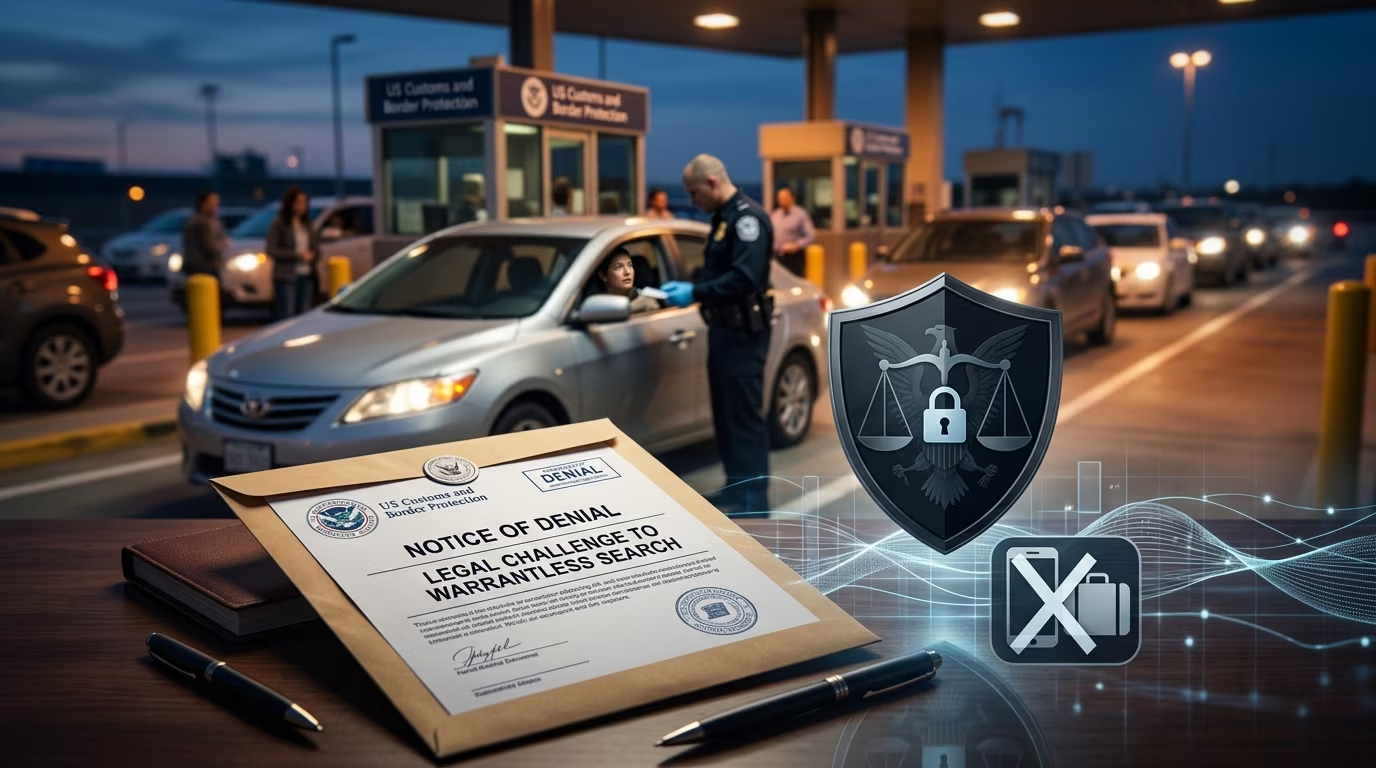
When you purchase a ticket for a domestic bus or train ride, your primary expectations are reaching your destination safely and enjoying a relatively peaceful journey. You settle into your seat, perhaps with a book or a podcast, expecting the miles to roll by uninterrupted. However, for many passengers traversing the United States, this expectation of privacy and peace has been shattered by the sudden, intimidating boarding of federal immigration agents conducting warrantless sweeps. For years, a pervasive myth dominated the commercial transit landscape: the belief that transportation companies were legally obligated to allow U.S. Customs and Border Protection (CBP) agents to board their vehicles and question passengers without a warrant. This corporate compliance transformed everyday commuter routes into impromptu immigration checkpoints, leaving vulnerable travelers exposed to questioning, delays, and potential profiling.
However, the legal landscape is far more nuanced, and the power dynamic leans heavily toward the transit operators. Commercial transportation companies possess a fundamental legal choice. They are not helpless conduits for federal overreach; rather, they hold the power to invoke the Fourth Amendment on behalf of their private property and, by extension, their ticketed passengers. By examining the intersection of constitutional law, border enforcement policies, and corporate responsibility, we can understand why it is imperative for transit companies to unequivocally refuse warrantless searches and prioritize passenger privacy.
Decoding the “100-Mile Border Zone”
To understand the prevalence of these transportation checks, one must first comprehend the geographic and legal parameters in which border enforcement operates. Under the Immigration and Nationality Act (INA) of 1952, federal law grants immigration officers the authority to conduct certain stops and searches within a “reasonable distance” from any external boundary of the United States. Federal regulations have historically defined this distance as 100 air miles from any land or coastal border.
This 100-mile border zone is not a narrow strip of uninhabited land; it is a massive jurisdictional footprint that encompasses the entire U.S. coastline and international land borders. According to census data, nearly two-thirds of the American population—well over 200 million people—reside within this zone. It includes major metropolitan hubs such as New York City, Los Angeles, Chicago, Philadelphia, and Houston. Furthermore, several entire states fall completely within this boundary.
Within this expansive territory, federal agents frequently exercise enhanced powers, such as operating stationary immigration checkpoints and conducting roaming patrols. Agents have utilized this geographic authority to justify boarding commercial buses and trains at domestic transit centers far removed from actual international crossings. However, this statutory authority is not an absolute mandate that supersedes the United States Constitution. While the INA provides the geographic jurisdiction for agencies to operate, it does not nullify the foundational protections afforded to individuals and private entities. The application of these enforcement powers remains strictly bound by constitutional limitations, meaning that operating within the 100-mile zone does not automatically grant federal agents unfettered access to private commercial property.
The Fourth Amendment on Commercial Transit
The Fourth Amendment of the U.S. Constitution guarantees the right of the people to be secure in their persons, houses, papers, and effects against unreasonable searches and seizures. It establishes the foundational principle that law enforcement cannot arbitrarily invade privacy without sufficient legal justification—typically in the form of a warrant issued by a judge, based on probable cause.
When analyzing how the Fourth Amendment applies to commercial transit, the distinction between public spaces and private property becomes crucial. A public bus terminal may have areas open to the general populace, but the interior of a commercial bus or the non-public operational areas of a transit center are private property controlled by the transit corporation.
For federal agents to lawfully board a private commercial vehicle to conduct a search or interrogate passengers, they must satisfy specific legal criteria. They need a judicially authorized warrant, probable cause combined with exigent circumstances, or reasonable suspicion of a specific crime or immigration violation. Absent these elements, there is only one other legal pathway for agents to board: voluntary consent from the property owner or their authorized representative.
In the context of a commercial bus line, the driver or the corporate management acts as the authorized representative of the private property. Therefore, when agents approach a bus at a domestic terminal without a warrant or reasonable suspicion, their entry is entirely contingent upon the transit company granting them permission to cross the threshold. The Fourth Amendment protects the bus itself as commercial property, meaning that if the operator denies entry, agents cannot legally force their way aboard to conduct random, suspicionless sweeps.
Unmasking the Corporate Consent Fallacy
For a significant period, major players in the commercial bus industry maintained a defensive posture regarding immigration checks, publicly asserting that federal law tied their hands. Corporate spokespeople frequently claimed that they disliked the disruption and the discomfort caused to their passengers but insisted they had no legal choice but to comply with federal boarding requests. This narrative created a widespread “corporate consent fallacy,” misleading both the public and policymakers into believing that warrantless bus raids were an unavoidable reality of domestic travel within the 100-mile zone.
This defense, however, crumbled under legal scrutiny and public records requests. Internal government documents, including leaked training memorandums, explicitly contradicted the bus industry’s claims. The internal guidance clearly stated that when conducting transportation checks at non-checkpoint locations, agents have “no inherent authority to simply board a common carrier without at least reasonable suspicion or consent.” The memos further directed that if bus company employees refuse access, agents must terminate the encounter and are restricted to operating in public areas of the station.
The revelation of these internal directives proved that corporate compliance was voluntary. The transit companies were not victims of an unstoppable federal mandate; they were active, albeit perhaps reluctant, participants who were routinely waiving their Fourth Amendment property rights and, consequently, compromising the privacy of their passengers.
This realization sparked intense legal and public pressure. State authorities filed lawsuits against major bus lines, arguing that their practice of voluntarily allowing law enforcement to conduct warrantless and suspicionless sweeps violated consumer protection laws and failed to safeguard passengers. The legal argument was clear: by consenting to these searches when they had the undeniable right to refuse, transportation companies were actively enabling the harassment of their ticketed customers.
The Human Toll: Profiling, Harassment, and Civil Liberties
The decision of a transit company to consent to warrantless searches carries profound human consequences. When armed federal agents board a confined commercial bus and begin questioning passengers about their citizenship, the environment instantly becomes coercive. Even if agents claim the encounters are “consensual,” the power dynamic of armed, uniformed officers blocking the narrow aisle of a bus makes it incredibly difficult for the average traveler to feel free to decline to answer or terminate the encounter.
These sweeps have consistently raised severe civil liberties concerns, primarily regarding racial profiling and biased policing. Reports from civil rights organizations and passenger testimonies highlight that individuals are frequently singled out based on their skin color, language, or accent. Passengers who appear to be of minority descent or who speak languages other than English are disproportionately targeted for questioning and asked to produce identification or proof of citizenship, while other passengers are bypassed entirely.
The impact of these operations extends beyond the individuals directly questioned. The sweeps cause significant travel delays, creating anxiety and frustration for everyone on board. For mixed-status families, immigrants, and people of color, the prospect of taking a domestic bus trip becomes fraught with the fear of interrogation and potential detention.
Furthermore, the demographic that relies most heavily on interstate bus travel often includes low-income individuals, students, and marginalized communities who may lack the resources to seek alternative modes of transportation. By permitting these warrantless searches, transit companies disproportionately expose their most vulnerable customers to the stress, intimidation, and potential civil rights violations inherent in suspicionless law enforcement sweeps.
Industry Shifts and the Path to Corporate Responsibility
The exposure of the corporate consent fallacy marked a turning point in the transportation industry. Faced with mounting public outrage, undeniable legal realities, and the threat of state-led litigation, the tide began to turn. Major carriers officially reversed their long-standing policies, announcing that they would no longer grant agents permission to board their buses without a warrant.
This shift represented a monumental victory for civil liberties and established a new standard for corporate responsibility within the transit sector. To effectively implement this change, companies had to move beyond mere public statements. True corporate responsibility required systemic operational changes, including:
- Clear Corporate Directives: Drafting explicit policies stating that the company does not consent to warrantless searches of its vehicles or non-public terminal areas.
- Employee Training: Equipping bus drivers, terminal managers, and staff with the knowledge and protocols to politely but firmly deny entry to federal agents lacking a warrant.
- Public Signage: Displaying placards on buses and in terminals communicating the company’s stance on warrantless searches, serving as a clear deterrent to agents.
The evolution of these policies demonstrates that commercial entities have agency. They are not required to be passive enablers of government overreach. When transportation companies choose to assert their constitutional rights, they create a vital shield that protects the privacy and dignity of the traveling public.
Know Your Rights as a Passenger
While corporate policies have improved, passengers must still be equipped with the knowledge to protect themselves during domestic travel. If you are approached by law enforcement while on a bus or at a transit center, it is crucial to remember the following rights:
- The Right to Remain Silent: You are not legally obligated to answer questions about your immigration status or where you were born. You can politely state, “I wish to remain silent.”
- The Right to Refuse Searches: You can decline consent for agents to search your personal belongings, such as backpacks, purses, or luggage.
- The Right to Ask for Clarification: You are entitled to ask the agent if you are being detained or if you are free to leave. If they say you are free to leave, you may choose to walk away or simply end the conversation.
- The Right to Record: In most public spaces, you have the First Amendment right to film or record law enforcement interactions, provided you do not physically interfere with their duties.
Conclusion
The intersection of domestic travel and border enforcement underscores a critical lesson in civil liberties: constitutional protections are only as strong as our willingness to invoke them. The myth that commercial transportation companies were legally bound to permit warrantless sweeps was a damaging fallacy that compromised the rights of millions of travelers. The eventual policy shifts by major carriers proved that corporations possess both the legal authority and the ethical responsibility to deny access to federal agents operating without warrants. Safeguarding passenger privacy is not an act of defiance against the law; it is a fundamental assertion of the Fourth Amendment. As we navigate the complex landscape of domestic travel, it remains vital for both transit operators and passengers to remain vigilant, understand their rights, and stand firm against unwarranted intrusions.
Frequently Asked Questions (FAQs)
Can federal agents legally board a domestic commercial bus without a warrant?
No, unless they have probable cause or the explicit consent of the bus company or driver. Without a warrant or reasonable suspicion, federal agents cannot force their way onto private commercial property like the interior of a bus.
What is the 100-mile border zone?
It is a geographic area extending 100 air miles inland from any U.S. external boundary, including land borders and coastlines. While immigration agencies have expanded operational authority within this zone, the Fourth Amendment still protects individuals and property from unreasonable searches.
Do I have to answer questions about my citizenship if stopped on a bus?
No. Every individual in the United States has the right to remain silent under the Fifth Amendment. You can politely decline to answer questions regarding your birthplace or citizenship status.
Are bus companies penalized for refusing to let agents board?
No. Refusing a warrantless search is a protected constitutional property right. Internal agency guidelines instruct officers to respect the denial of access and terminate the encounter if consent is not granted by the property owner.
References
- What Does the Fourth Amendment Mean? — United States Courts. 2024-01-01. https://www.uscourts.gov/about-federal-courts/educational-resources/about-educational-outreach/activity-resources/what-does-0
- Transportation Bus Check Operations (Redacted Memo) — U.S. Customs and Border Protection. 2019-12-01. https://www.cbp.gov/document/guidance/transportation-bus-check-operations
- 8 U.S. Code § 1357 – Powers of immigration officers and employees — Legal Information Institute (Cornell Law School). 2024-01-01. https://www.law.cornell.edu/uscode/text/8/1357
- Spokane judge denies Greyhound’s attempt to dismiss AG Ferguson’s lawsuit — Washington State Office of the Attorney General. 2021-03-18. https://www.atg.wa.gov/news/news-releases/spokane-judge-denies-greyhound-s-attempt-dismiss-ag-ferguson-s-lawsuit