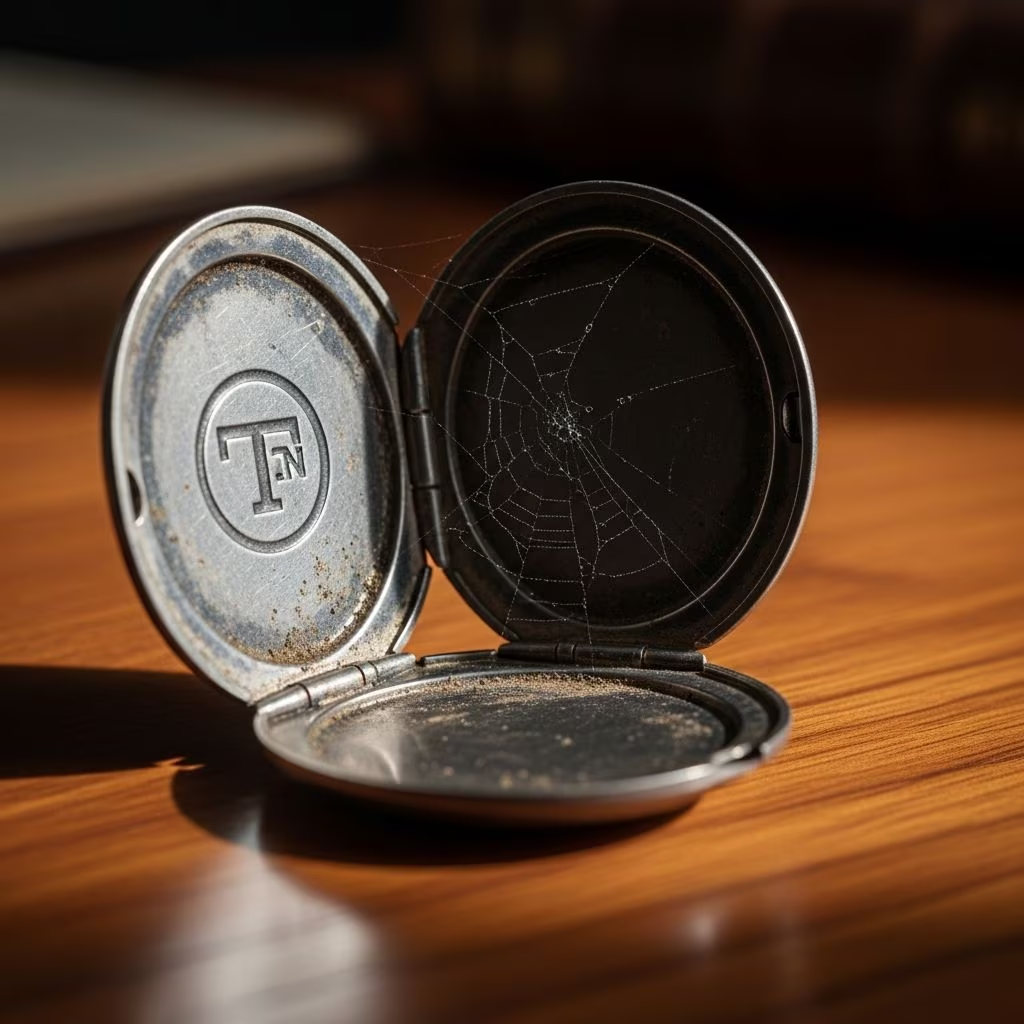
Trademark tarnishment represents a critical threat to famous brands, occurring when unauthorized use of a similar mark associates it with negative connotations, thereby damaging its reputation. Unlike traditional infringement, tarnishment does not require consumer confusion and targets iconic trademarks regardless of industry overlap.
Core Principles of Trademark Tarnishment
At its essence, tarnishment involves linking a renowned trademark to unseemly, low-quality, or scandalous elements, eroding public goodwill. U.S. federal law, primarily through the Trademark Dilution Revision Act (TDRA) of 2006, codifies this protection in 15 U.S.C. § 1125(c), defining tarnishment as an “association arising from the similarity between a mark or trade name and a famous mark that harms the reputation of the famous mark.”
This statutory framework empowers owners of “famous” marks—those with widespread recognition—to seek remedies against diluters. Courts assess fame using factors like duration of use, nationwide recognition, and federal registration status.
- Fame Determination Factors: Courts evaluate the mark’s inherent strength, advertising expenditures, and media coverage to confirm its elite status.
- Commercial Use Requirement: The infringing party must employ the mark in interstate commerce for profit, excluding non-commercial or fair uses.
Tarnishment Distinguished from Other Trademark Harms
Trademark dilution encompasses two main forms: tarnishment and blurring. While both protect famous marks without needing proof of confusion, they address distinct injuries.
| Aspect | Tarnishment | Blurring | Infringement |
|---|---|---|---|
| Core Harm | Reputation damage via negative associations (e.g., sex, drugs, vulgarity) | Weakened distinctiveness from unrelated product proliferation | Consumer confusion in related goods/services |
| Fame Required? | Yes, only famous marks | Yes, only famous marks | No, any registered mark |
| Confusion Needed? | No | No | Yes, likelihood of confusion |
| Examples | Luxury brand on adult site; family logo with alcohol | Famous soda name on clothing | Similar restaurant names |
Tarnishment uniquely focuses on reputational staining, often through scandalous linkages, whereas blurring dilutes uniqueness via expansion into dissimilar fields.
Proving Tarnishment in Court
To prevail, plaintiffs must establish four elements: (1) their mark’s fame predating defendant’s use; (2) defendant’s commercial exploitation of a similar mark; (3) dilution via tarnishment; and (4) absence of statutory defenses.
Dilution proof hinges on judicial factors including mark similarity, the famous mark’s uniqueness and recognition, defendant’s intent, and any prior relationships.
- Similarity Analysis: Marks need not be identical; substantial resemblance suffices if it evokes the original.
- Reputation Harm Evidence: Courts infer harm from associations with immorality, poor quality, or controversy; actual economic loss is unnecessary.
- Temporal Priority: Fame must precede diluting use.
Real-World Illustrations of Tarnishment Claims
Notable cases highlight tarnishment’s application. For instance, associating a wholesome baby food brand like Gerber with alcohol marketing tarnishes its family-oriented image, even sans confusion. Similarly, deploying a luxury mark on offensive adult websites harms its prestige.
In Deere & Co. v. MTD Products, green paint on lawnmowers blurred John Deere’s mark, but tarnishment suits often involve edgier contexts like vulgar parodies. Hypotheticals abound: affixing a premium jeweler’s name to low-end knockoffs or scandalous ads.
- A fast-food icon paired with drug paraphernalia.
- Children’s toy brand in gambling promotions.
- Health-focused mark on junk food packaging.
These scenarios demonstrate how even non-competitive uses can provoke liability.
Statutory Defenses Against Tarnishment Claims
The TDRA enumerates exemptions shielding certain uses from liability, promoting free speech and competition.
- Fair Use: Nominative or descriptive employment without source indication.
- Parody/Satire: Non-commercial humor critiquing the mark.
- News/Commentary: Journalistic or editorial contexts.
- Comparative Advertising: Truthful product comparisons.
- Non-Commercial Expression: Artistic or political speech.
Defendants must prove these apply; parody succeeds if it critiques rather than exploits the mark.
Remedies and Enforcement Options
Successful plaintiffs secure injunctions halting dilutive use. The TDRA enables monetary awards—defendant’s profits, actual damages, and attorney fees—upon willful intent or bad faith.
Willfulness includes bad-faith adoption or fame exploitation. Courts may treble damages for egregious violations. Pre-TDRA uses may still qualify if dilution persists post-enactment.
Strategic enforcement blends cease-and-desist letters, litigation, and monitoring tools to deter tarnishers early.
Building and Safeguarding Famous Marks
Aspiring brand owners cultivate fame via consistent use, robust marketing, federal registration, and policing infringers. Monitoring services detect dilutive threats promptly.
- Register principal registers at USPTO.
- Document advertising and sales data.
- Enforce rights aggressively yet judiciously.
- Conduct clearance searches pre-launch.
Even non-famous marks benefit from dilution awareness, as fame can evolve.
Global Perspectives on Tarnishment
While U.S. law leads, EU and other jurisdictions offer analogous protections. The EU’s Trade Mark Directive prohibits marks evoking earlier famous ones with reputational detriment. International harmonization aids multinational brands.
Frequently Asked Questions
What qualifies a trademark as “famous” for tarnishment protection?
Courts consider nationwide recognition, use duration, advertising scope, and registration. Examples include Coca-Cola, Nike, and Rolex.
Does tarnishment require economic harm proof?
No; likelihood of reputational harm suffices, presumed from unsavory associations.
Can parodies tarnish trademarks?
Generally no, if non-commercial and transformative; commercial exploitation may cross the line.
What remedies exceed injunctions?
Willful cases yield profits, damages, fees, and destruction of infringing goods.
How does TDRA differ from prior FTDA?
TDRA clarifies blurring/tarnishment definitions, eases injunction proof, adds damages, and lists defenses.
Strategic Implications for Businesses
In an era of viral memes and digital knockoffs, proactive IP strategies are vital. Brands must balance enforcement with innovation, avoiding overreach that stifles competition. Tarnishment claims deter opportunists but demand precise evidence to withstand scrutiny.
Emerging challenges include AI-generated content mimicking marks in derogatory contexts and social media’s rapid dissemination. Forward-thinking companies integrate dilution audits into compliance regimes.
Ultimately, tarnishment law preserves the intangible value of brands—the trust and allure fueling consumer loyalty. By understanding its contours, businesses fortify their most prized assets against reputational sabotage.
References
- What is Trademark Dilution? — Nolo. 2023. https://www.nolo.com/legal-encyclopedia/what-trademark-dilution.html
- Trademark Dilution (15 U.S.C. §1125(c)) — U.S. Code (via Nolo). 2023. https://www.nolo.com/legal-encyclopedia/what-trademark-dilution.html
- Trademark Dilution Explained: Blurring, Tarnishment — Jafari Law Group. N/A. https://jafarilawgroup.com/trademark-dilution-explained-blurring-tarnishment-and-what-they-mean-for-your-brand/
- Trademark Tarnishmyths — Florida State University Law Review (ir.law.fsu.edu). N/A. https://ir.law.fsu.edu/articles/833/
- Dilution (trademark) — Legal Information Institute, Cornell Law School. N/A. https://www.law.cornell.edu/wex/dilution_(trademark)