
Superficial Surveillance Reforms and the Fourth Amendment
Why cosmetic surveillance laws fail to protect fundamental civil liberties.
The Facade of Meaningful Reform
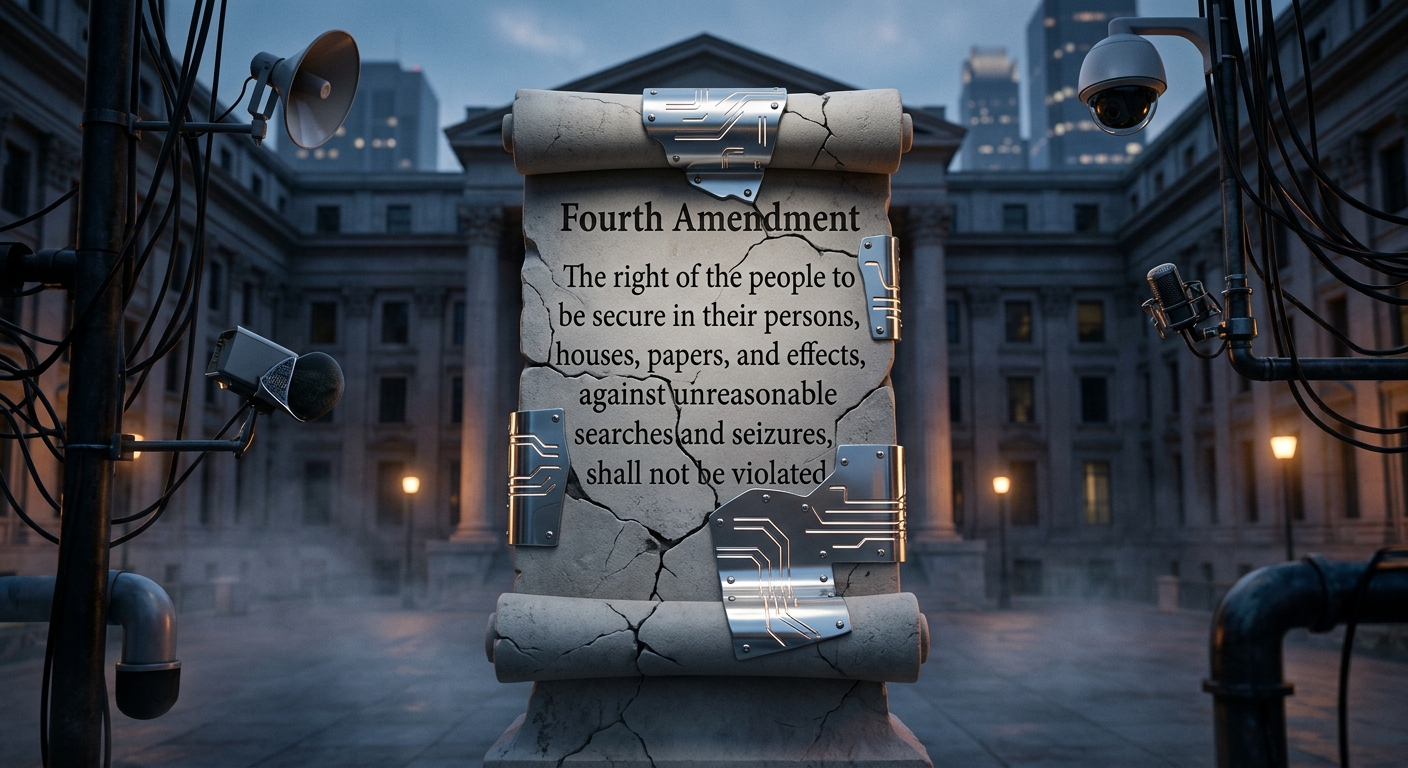
“Rearranging the deck chairs on the Titanic” is a familiar idiom used to describe superficial actions taken in response to a crisis—actions that offer the illusion of improvement while fundamentally failing to address the impending catastrophe. When it comes to the ongoing debate surrounding government surveillance and the preservation of civil liberties, this phrase is particularly apt. In the decades following the digital revolution and subsequent global crises, lawmakers have continuously introduced legislative amendments and regulatory tweaks aimed at balancing national security interests with constitutional rights. However, many of these efforts serve as little more than cosmetic fixes to a deeply flawed systemic framework.
The rapid expansion of mass surveillance architecture, hidden behind the veil of national security, continues to erode the fundamental expectation of privacy. Instead of tearing down the invasive structures that compromise individual freedoms, legislative bodies frequently pass minor amendments that leave the core mechanisms of data collection intact. This article explores how these superficial reforms fail to protect constitutional rights, the historical context of privacy jurisprudence, and the profound psychological impact of unwarranted surveillance on democratic societies. The persistence of bulk data collection, combined with minimal statutory guardrails, poses a monumental threat to modern civil liberties.
The Evolution of the Fourth Amendment in a Hyper-Connected World
To understand the gravity of modern surveillance overreach, one must first look at the constitutional bedrock of American privacy: the Fourth Amendment. Originally drafted to protect citizens from unreasonable searches and seizures, the amendment was a direct response to the intrusive general warrants used by colonial powers. For over a century, the courts interpreted this protection strictly through the lens of physical trespass. If the government did not physically enter your home or property, a search had not legally occurred.
This framework was irrevocably changed by the landmark Supreme Court decision in Katz v. United States (1967). In this case, federal agents had attached an eavesdropping device to the outside of a public telephone booth used by the defendant. The Supreme Court ruled in favor of Katz, famously declaring that “the Fourth Amendment protects people, not places.” This decision introduced the legal standard of a “reasonable expectation of privacy,” extending constitutional protections to intangibles like electronic communications.
Yet, in our hyper-connected modern world, this standard is under unprecedented strain. Every day, individuals voluntarily hand over vast quantities of personal data to third-party service providers, internet service providers, and telecommunications companies. The legal doctrine known as the “Third-Party Doctrine” posits that individuals diminish their expectation of privacy when they voluntarily share information with outside entities. Consequently, intelligence agencies and law enforcement have exploited this gap, leveraging advanced technology to intercept digital communications without traditional probable-cause warrants. The spirit of the Katz decision is routinely bypassed as our digital footprints expand far beyond our physical homes, leaving a gaping void in constitutional protection that superficial legislative reforms have entirely failed to close.
The Legislative Smokescreen: The Legacy of FISA and Section 702
The Foreign Intelligence Surveillance Act (FISA) of 1978 was originally enacted as a reform measure to curb the rampant domestic spying abuses uncovered during the Watergate era. It established the Foreign Intelligence Surveillance Court (FISC) to oversee requests for surveillance warrants against foreign spies and agents inside the United States. However, the legal landscape shifted dramatically in the post-9/11 era, culminating in the FISA Amendments Act of 2008. This legislation introduced Section 702, a provision that permits the government to conduct targeted surveillance of non-U.S. persons located outside the country to acquire foreign intelligence information.
While proponents argue that Section 702 is vital for national security, privacy advocates point to a glaring loophole: the “incidental” collection of Americans’ communications. Because internet traffic is inherently global, sweeping up the communications of foreign targets inevitably drags vast troves of domestic emails, text messages, and phone records into government databases. Once this data is stored, domestic law enforcement agencies can search through it using the identifiers of U.S. citizens without obtaining a traditional warrant—a practice widely condemned as a “backdoor search.”
When controversies arise and public outcry demands reform, legislators often respond by tweaking compliance protocols, adding bureaucratic oversight layers, or minimally adjusting the minimization procedures. Yet, these measures are the quintessential definition of rearranging deck chairs. They do not dismantle the statutory authority that allows the warrantless collection of domestic data in the first place. The core architecture of surveillance remains entirely untouched, shielded by national security imperatives, while the public is given the false assurance that their civil liberties have been successfully restored and safeguarded.
The “Chilling Effect” and the Cost to Free Speech
One of the most insidious consequences of unchecked government surveillance is not just the loss of digital privacy, but the subsequent erosion of free speech through what is known as the “chilling effect.” First introduced into jurisprudence to describe how overly broad laws could deter lawful expression, the chilling effect in the digital age refers to the heavy psychological burden placed on individuals who suspect their communications are being monitored. When people believe that their private conversations, internet searches, or personal associations are subjected to government scrutiny, they naturally alter their behavior. They self-censor.
A person might hesitate before typing a controversial keyword into a search engine, avoid reading dissenting political articles, or refrain from engaging in sensitive conversations over the phone or email out of fear that their words could be taken out of context. This self-censorship degrades the foundational values of democratic discourse. It forces ordinary citizens to police their own thoughts and words to avoid being flagged by an opaque, government-run algorithmic system. The International Justice Clinic at the University of California, Irvine, has extensively documented how modern surveillance programs cast a dark shadow of fear over society.
Journalists are often forced to take extreme measures to protect their sources, sometimes avoiding digital communication entirely, which severely impedes their ability to report on matters of profound public interest. Human rights defenders, political activists, and minority communities bear a disproportionate share of this burden, as they are historically the most vulnerable to government overreach. A democracy simply cannot thrive when its citizens are too fearful to speak their minds freely and securely.
Mass Surveillance Architecture vs. Targeted Investigations
The transition from traditional, targeted law enforcement to predictive mass surveillance represents a fundamental and dangerous shift in how the state interacts with its citizens. Historically, wiretaps and surveillance were deployed only after an investigator demonstrated probable cause to a judge—meaning they had to show specific evidence that a crime had been, was being, or was about to be committed. The modern surveillance architecture, however, flips this paradigm entirely on its head.
Through the bulk collection of metadata and the integration of highly sophisticated artificial intelligence, intelligence agencies build massive digital profiles of populations just in case someone commits a crime in the future. Although certain domestic programs—such as the bulk telephony metadata collection under Section 215 of the PATRIOT Act—were eventually curtailed by subsequent legislation like the USA FREEDOM Act, the overarching philosophy of mass data aggregation stubbornly persists. Government entities increasingly purchase datasets from private commercial data brokers, effectively bypassing the need for warrants by treating personal, sensitive information as an easily purchasable commodity.
Artificial intelligence algorithms then rapidly sift through this data, mapping out social networks, predicting behaviors, and flagging minor anomalies. This automated suspicion effectively treats every citizen as a potential threat. Superficial legislative fixes that merely require intelligence agencies to report how many times they searched a specific database do absolutely nothing to address the core ethical and constitutional nightmare of dragnet data collection. True reform requires abandoning the architecture of mass surveillance in favor of returning to the principles of individualized, warrant-based investigations.
Navigating the Path Forward: Real Structural Change
Achieving meaningful reform in the realm of digital privacy and national security requires far more than just cosmetic adjustments; it demands robust, structural change that directly addresses the root causes of surveillance overreach. Citizens and privacy advocacy groups must fiercely demand that legislative bodies close the statutory loopholes that allow intelligence agencies to bypass the Fourth Amendment. To move past the illusion of reform, sweeping policy alterations must be implemented.
Specific actionable reforms that address the heart of the issue include:
- Closing the Backdoor Search Loophole: Mandating that all government entities, regardless of their operational mandate, must obtain a probable-cause warrant before querying Section 702 databases for the communications or digital records of U.S. citizens.
- Regulating Data Brokers: Enacting comprehensive data privacy legislation that strictly limits the ability of commercial data brokers to sell the sensitive digital information of Americans to law enforcement and intelligence agencies without a warrant.
- Reevaluating the Third-Party Doctrine: Encouraging the judiciary to adapt constitutional interpretations to reflect the realities of the digital era, ensuring that data entrusted to technology companies retains its full Fourth Amendment protection.
- Strengthening Oversight Mechanisms: Granting independent watchdog bodies like the Privacy and Civil Liberties Oversight Board (PCLOB) stronger enforcement and auditing capabilities, rather than limiting them to strictly advisory roles.
Ultimately, public awareness is the most potent weapon against surveillance overreach. As long as citizens remain uninformed or indifferent, the apparatus of mass surveillance will continue to expand in the shadows. Reclaiming our civil liberties requires a collective refusal to accept the mere illusion of privacy, demanding instead a highly transparent legal framework that genuinely respects and unconditionally protects our fundamental constitutional rights.
Frequently Asked Questions (FAQ)
What is the Fourth Amendment?
The Fourth Amendment to the United States Constitution protects citizens from unreasonable searches and seizures by the government. It establishes the legal requirement that warrants be issued only upon probable cause, supported by an oath or affirmation, and specifically describing the place to be searched and the persons or things to be seized.
What did Katz v. United States establish?
The 1967 Supreme Court case Katz v. United States established the “reasonable expectation of privacy” test. It shifted the constitutional focus of the Fourth Amendment from physical property to personal privacy, declaring that the amendment protects people, not places.
What is the “chilling effect” in terms of surveillance?
The chilling effect occurs when individuals self-censor their speech, alter their behavior, or refrain from exercising their First Amendment rights due to the fear or suspicion that they are being monitored by the government or other powerful entities.
What is Section 702 of the FISA Amendments Act?
Section 702 is a provision of the Foreign Intelligence Surveillance Act that allows the U.S. government to conduct targeted surveillance of non-U.S. persons located abroad. However, it controversially results in the incidental, warrantless collection and subsequent searching of Americans’ private communications.
References
- The FISA Amendments Act: Q&A — Office of the Director of National Intelligence. 2017-04-18. https://www.dni.gov/files/documents/icotr/The-FISA-Amendments-Act-Q-and-A.pdf
- Foreign Intelligence Surveillance Act (FISA) and Section 702 — Federal Bureau of Investigation (FBI). 2024-04-01. https://www.fbi.gov/investigate/national-security/foreign-intelligence-surveillance-act
- Katz and Reasonable Expectation of Privacy Test — Constitution Annotated, Library of Congress. https://constitution.congress.gov/browse/essay/amdt4-3-3/ALDE_00013717/
- Chilling Effects of Surveillance — International Justice Clinic, UC Irvine School of Law. 2019-12-01. https://internationaljustice.law.uci.edu/chilling-effects-of-surveillance/
Similar Articles








Read full bio of medha deb


