
The Invisible Tracker: How Your Smartphone Fuels Modern Surveillance
Uncovering the hidden ecosystem of data brokers and government surveillance tracking your every move.
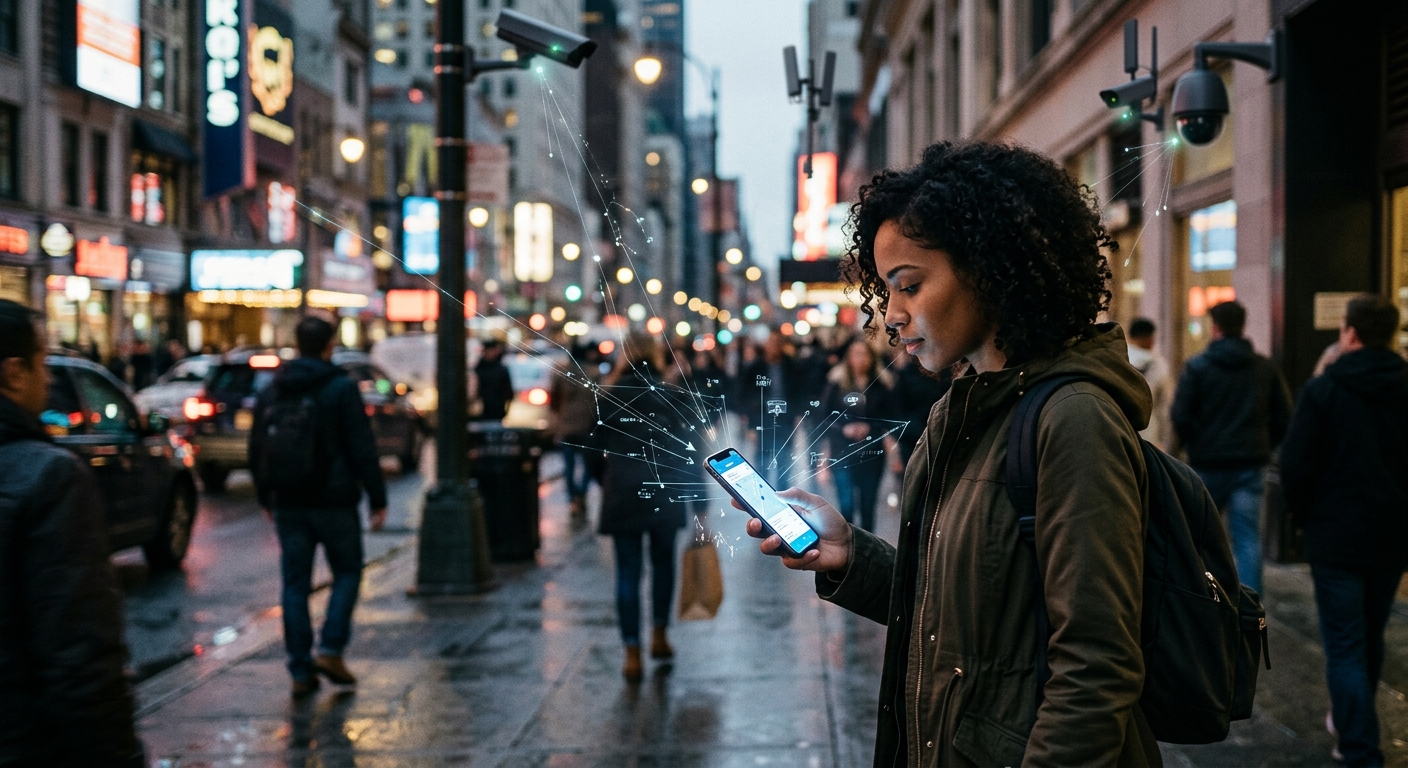
Start with a narrative of a typical day. A person wakes up, checks the weather app, maps the route to work, grabs a coffee, and scrolls through a social media feed. At every single touchpoint, the smartphone in their pocket acts as a digital homing beacon. While users perceive their mobile devices as essential tools for communication and productivity, they simultaneously function as some of the most pervasive surveillance instruments ever created in human history. In the modern era, physical tracking no longer requires an undercover operative tailing a subject down a city block. Instead, it relies on silent strings of code running in the background of consumer technology.
The geolocation data continuously broadcasted by our phones reveals the most intimate details of our lives: the medical clinics we visit, the places of worship we attend, the political rallies we support, and the people we spend our time with. This article explores the hidden ecosystem of location tracking, detailing how an unregulated commercial market allows data brokers to monetize our movements, and how government agencies exploit legal loopholes to bypass constitutional protections. Understanding this invisible web is the first crucial step toward reclaiming digital privacy in a hyper-connected world.
The Architecture of Mobile Surveillance
How exactly does a piece of glass and metal track your every move? The surveillance architecture relies on multiple overlapping technologies, ensuring that even if one method is disabled or blocked, another can seamlessly fill the gap to maintain a constant stream of location intelligence.
First, there is the Global Positioning System (GPS). While incredibly accurate, GPS drains battery life and struggles indoors or in dense urban environments. To compensate, smartphones constantly scan for nearby Wi-Fi networks and Bluetooth beacons. Even if you never actively connect to a coffee shop’s Wi-Fi network, simply having your device’s Wi-Fi receiver enabled allows it to log the network’s unique identifier. Tech companies map these networks globally, creating a secondary location database that pinpoints you with terrifying accuracy, even inside large office buildings or underground transit systems.
Furthermore, cellular networks require phones to ‘ping’ nearby cell towers to maintain service. This generates Cell-Site Location Information (CSLI). Every time you receive a text message, make a phone call, or an application refreshes its background data, the telecommunications provider logs your proximity to a specific tower. While less precise than GPS, historical CSLI creates a continuous, months-long timeline of a user’s movements across cities and states.
Finally, software development kits (SDKs) embedded within seemingly innocuous applications—such as flashlight utilities, mobile games, or digital coupons—harvest this data aggressively. Developers are often paid to include these SDKs by third-party data aggregators. Users unwittingly consent to this collection by hastily agreeing to lengthy, impenetrable terms of service agreements, fundamentally exchanging their privacy for minor conveniences.
Common Tracking Technologies
| Method | Accuracy Level | How It Works | Primary Data Collector |
|---|---|---|---|
| GPS | High (within meters) | Communicates with satellites to triangulate exact geographical coordinates. | Operating Systems, Navigation Apps |
| Wi-Fi Scanning | High (indoor capability) | Logs unique MAC addresses of nearby routers to map against known locations. | OS, Background SDKs |
| CSLI | Medium (neighborhood level) | Pings regional cell towers to maintain cellular service connections. | Telecom Providers |
| Bluetooth Beacons | Very High (within feet) | Communicates with local transmitters in stores to track micro-movements. | Retail Apps, Marketing SDKs |
The Unregulated Bazaar of Data Brokers
Once harvested, your location data enters an opaque, multi-billion-dollar marketplace operated by commercial data brokers. These entities specialize in collecting, aggregating, and analyzing personal information from millions of devices, then selling those insights to the highest bidder. Buyers range from retail marketers attempting to measure foot traffic in their stores to hedge funds analyzing broader economic trends based on consumer movements.
A persistent defense utilized by the data broker industry is the concept of ‘anonymization.’ They claim that the datasets sold do not contain names, phone numbers, or email addresses, but rather pseudonymous advertising identifiers attached to data points. However, privacy researchers and government regulators have repeatedly demonstrated that this anonymization is a myth. When a dataset reveals that a specific anonymous device sleeps at a particular residential address every night and commutes to a specific office building every day, identifying the device’s owner is trivial. Human behavior is inherently unique, and a few days of location data is all it takes to unmask a supposedly anonymous user.
The Federal Trade Commission (FTC) has recently begun cracking down on these invasive practices. Recognizing that openly selling a person’s location data can expose them to harassment, discrimination, and physical danger, the FTC has taken enforcement actions against several prominent data brokers. In early 2024, the agency issued orders prohibiting companies like X-Mode Social and Outlogic from sharing or selling sensitive location data, marking a significant step toward recognizing the inherent dangers of this unchecked market. These regulatory actions highlight that the unrestricted flow of geolocation data is not just an abstract privacy concern, but a direct threat to consumer safety.
The Fourth Amendment and the Warrantless Loophole
In the United States, the Fourth Amendment protects citizens against unreasonable searches and seizures, generally requiring law enforcement to obtain a warrant based on probable cause before conducting intrusive surveillance. In the landmark 2018 case Carpenter v. United States, the Supreme Court ruled that the government must obtain a warrant to access a suspect’s historical cell-site location information from telecommunications providers. Chief Justice John Roberts noted that a cell phone ‘tracks nearly exactly the movements of its owner’ and that accessing such data provides an ‘all-encompassing record of the holder’s whereabouts.’
However, modern surveillance has evolved to sidestep this constitutional safeguard through what privacy advocates call the ‘data broker loophole.’ Because the Carpenter ruling specifically addressed data compelled from telecom carriers via subpoenas or court orders, government agencies realized they could simply pull out their checkbooks and buy similar—and often more precise—location data directly from commercial data brokers.
Federal law enforcement agencies, military branches, and local police departments have spent millions of taxpayer dollars purchasing bulk location data. By characterizing this as a standard commercial transaction for publicly available information, agencies argue they do not need to seek a warrant. This effectively outsources mass surveillance to the private sector. The government bypasses the judicial oversight required by the Constitution, accessing vast troves of sensitive information without ever having to prove probable cause to an impartial judge. This loophole creates a two-tiered justice system where constitutional rights are contingent upon whether the government compels data with a legal document or purchases it with a credit card.
Civil Liberties and the Threat to Sensitive Spaces
The implications of warrantless location tracking extend far beyond traditional criminal investigations; they strike at the very heart of civil liberties and democratic participation. When the government or malicious private actors can track populations in bulk, the chilling effect on constitutional rights is profound.
Consider the fundamental right to freedom of assembly. If citizens know that their presence at a political protest, a labor strike, or a controversial rally will be permanently logged and potentially purchased by law enforcement agencies, they may choose to stay home out of fear of retribution. This invisible tracking actively suppresses First Amendment rights, creating an environment where dissent is monitored and archived indefinitely.
Moreover, the concept of ‘sensitive locations’ is critical to understanding the danger of unregulated data brokers. Location data easily reveals visits to reproductive health clinics, mental health facilities, substance abuse treatment centers, and places of worship. In the hands of domestic extremists, this data could be used to target and harass vulnerable groups. In the hands of the state, it can be used to monitor marginalized communities or track individuals seeking medical procedures that may be legally contested or scrutinized in their local jurisdictions. The intersection of highly precise GPS data and the unregulated broker market means that the most private moments of a person’s life are packaged as commodities, available to anyone willing to pay the asking price.
Technological Countermeasures and Digital Hygiene
While systemic changes and legislative reform are desperately needed to close the data broker loophole and regulate the commercial market, individuals can implement proactive digital hygiene practices to minimize their tracking footprint.
- Audit App Permissions: Perform a rigorous audit of your device’s application permissions. The vast majority of applications do not need location access to function properly. If a simple game or a calculator requests your location, deny it immediately. For apps that legitimately need your location, such as mapping software, restrict their access to ‘Only While Using the App’ rather than granting them persistent background access.
- Toggle Connectivity: Routinely turn off your device’s Wi-Fi and Bluetooth radios when you are not actively using them. This prevents your phone from silently logging the networks and beacons you pass throughout your daily commute.
- Reset Identifiers: Utilize privacy-focused settings within your phone to reset your advertising identifier regularly. This breaks the continuity of the profile being built around your device.
- Limit Smart Devices: Be wary of digital conveniences that require continuous tracking. From fitness trackers to family location-sharing apps, every node added to your digital ecosystem is another potential vector for surveillance. Evaluate whether the convenience outweighs the privacy cost.
Frequently Asked Questions (FAQs)
Q: Does turning off my phone’s GPS completely stop location tracking?
A: No. While disabling GPS stops highly precise satellite tracking, your phone still communicates with cell towers to maintain network service, generating CSLI. It may also scan for nearby Wi-Fi networks if that feature remains active in your settings.
Q: Is it legal for the government to buy my location data?
A: Currently, yes. While the Supreme Court requires a warrant to demand location data directly from your cellular carrier, a legal loophole allows government agencies to purchase this exact same data from commercial brokers without a warrant.
Q: How do apps get away with selling my data?
A: Through complex, lengthy Terms of Service and Privacy Policies. When you click ‘Agree’ upon installing an app, you often grant the developer the legal right to share your data with third-party ‘partners,’ which is a common euphemism for data brokers.
Q: Can my data truly be anonymized?
A: Cybersecurity experts widely agree that true anonymization of precise location data is nearly impossible. A consistent pattern of movements between a specific home address and a specific workplace easily re-identifies the supposedly anonymous data points, unmasking the user.
References
- Carpenter v. United States, 585 U.S. ___ (2018) — Supreme Court of the United States. 2018-06-22. https://www.supremecourt.gov/opinions/17pdf/16-402_h315.pdf
- Statement of Chair Lina M. Khan In the Matter of X-Mode Social and Outlogic — Federal Trade Commission. 2024-01-09. https://www.ftc.gov/system/files/ftc_gov/pdf/Khan-Slaughter-Bedoya-Statement-X-Mode-Outlogic.pdf
- FTC Takes Action Against Gravy Analytics, Venntel for Unlawfully Selling Location Data Tracking Consumers to Sensitive Sites — Federal Trade Commission. 2024-12-03. https://www.ftc.gov/news-events/news/press-releases
Similar Articles








Read full bio of medha deb


