The Invisible Dragnet: Surveillance in the Digital Era
In the modern era, the smartphone has evolved from a luxury communication device into an indispensable extension of human life. It holds our most intimate conversations, our financial data, our schedules, and, crucially, a continuous log of our physical locations. Because mobile devices are designed to constantly seek out the strongest cellular signal to maintain connectivity, they act as inadvertent beacons, broadcasting their presence to the surrounding environment. This fundamental engineering reality has not gone unnoticed by federal law enforcement and immigration agencies, who have rapidly integrated sophisticated digital tracking tools into their operational arsenals. Chief among these tools is the cell site simulator.
Often referred to by the popular brand name “Stingray,” cell site simulators represent a profound shift in government surveillance capabilities. While traditional physical surveillance requires immense manpower and carries a high risk of detection, digital tracking can be executed covertly, continuously, and from a distance. The deployment of these devices by federal entities—specifically those tasked with border security and immigration enforcement—has ignited intense debates regarding the erosion of privacy, the scope of executive power, and the limits of the Fourth Amendment in an increasingly connected world.
Unmasking the Technology: What Are Cell Site Simulators?
To understand the controversy surrounding cell site simulators, it is essential to understand the mechanics of the technology. At its core, a cell site simulator is an electronic surveillance device designed to mimic a legitimate cellular network tower. By broadcasting a signal that appears stronger or more attractive than those of actual cell towers managed by telecommunications providers, the simulator tricks nearby mobile devices into disconnecting from their legitimate networks and connecting directly to the surveillance equipment.
Once a mobile device connects to the simulator, the equipment can execute several covert operations:
- IMSI Extraction: The device forces the phone to transmit its International Mobile Subscriber Identity (IMSI) number, a unique code associated with the user’s SIM card, effectively identifying the owner.
- Geolocation Tracking: By measuring the strength and direction of the signal emitting from the mobile device, operators can triangulate the user’s physical location with pinpoint accuracy, often down to a specific room within a building.
- Service Disruption: During the connection process, the simulator can cause targeted devices (and surrounding devices) to experience a disruption in legitimate cellular service, sometimes preventing outgoing calls.
- Data Interception (Advanced Configurations): While law enforcement agencies routinely claim they configure the devices to act strictly as tracking tools (akin to a pen register), advanced iterations of this technology possess the technical capability to intercept the contents of unencrypted text messages and phone calls.
The covert nature of these devices is amplified by their portability. Cell site simulators can be installed in law enforcement vehicles, carried in backpacks by officers on foot, or even mounted on small aircraft or drones to cast a surveillance net over an entire neighborhood.
Federal Immigration Enforcement’s Digital Arsenal
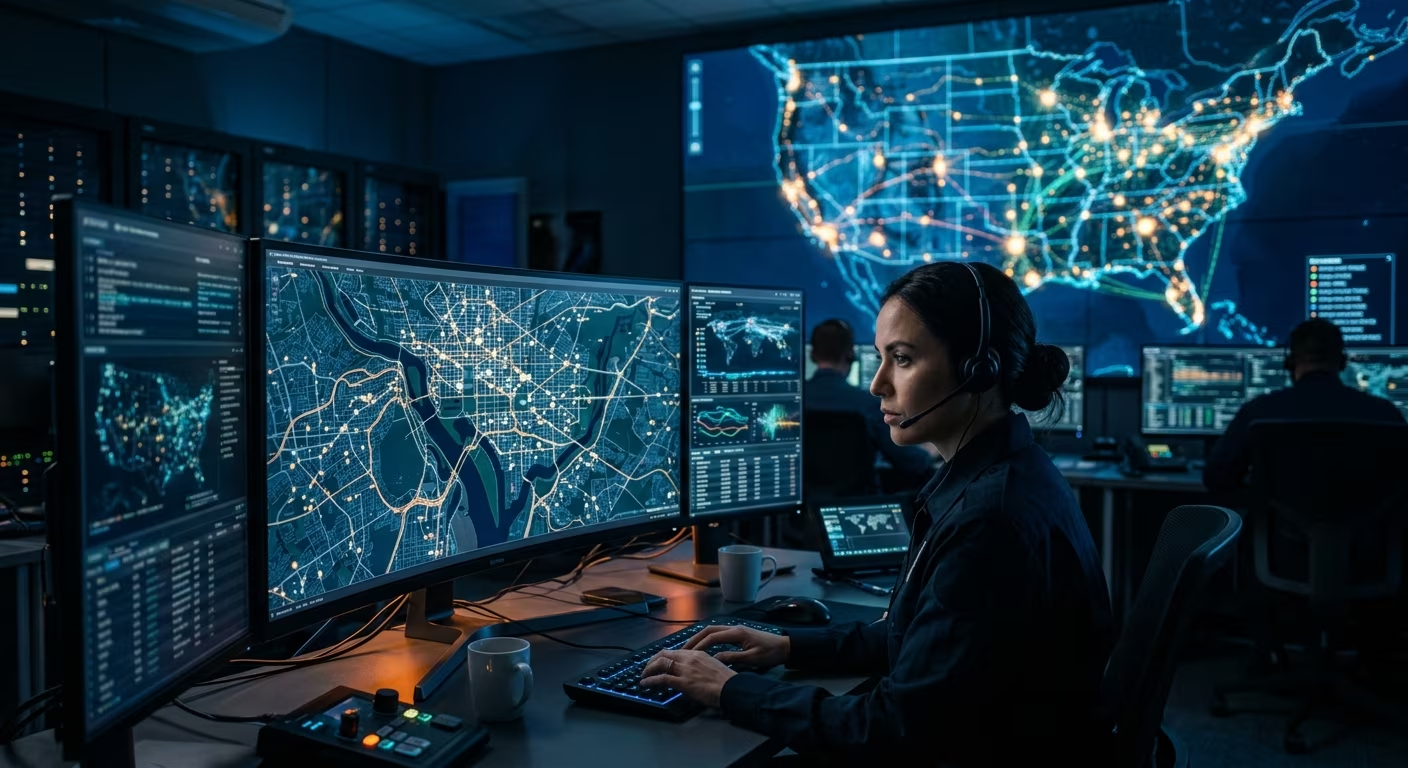
Historically, border security and immigration enforcement relied heavily on physical infrastructure, patrols, and localized investigations. However, in recent years, agencies such as Customs and Border Protection (CBP) and Immigration and Customs Enforcement (ICE) have drastically modernized their methodologies, turning toward expansive digital dragnet tools. The integration of cell site simulators allows these agencies to track individuals suspected of civil immigration violations with the same sophisticated military-grade hardware traditionally reserved for high-level counter-terrorism operations.
The primary concern among civil rights advocates is the lack of transparency surrounding how ICE and CBP procure, deploy, and regulate these devices. For years, federal agencies operated under strict non-disclosure agreements (NDAs) with the manufacturers of cell site simulators, such as the Harris Corporation. These NDAs were so restrictive that they often prohibited prosecutors from disclosing the use of the technology to defense attorneys, and in some startling instances, even required police to drop criminal charges rather than reveal the surveillance methods in open court.
While immigration agencies argue that these tools are necessary for locating high-value targets, human trafficking rings, and individuals with outstanding deportation orders, the covert nature of their deployment has left the public completely in the dark regarding how often this technology is aimed at ordinary communities, rather than specific, serious threats.
The Collateral Damage of Indiscriminate Data Harvesting
One of the most alarming features of a cell site simulator is its inherent lack of precision. Unlike a wiretap, which targets a specific phone line, a simulator is an area-based surveillance tool. When an agency activates a Stingray in a densely populated urban area or an apartment complex, the device does not exclusively ping the suspect’s phone. Instead, it forces every single mobile device within its operational radius to connect and identify itself.
This “bystander effect” means that the government is routinely, albeit temporarily, capturing the identifying information and location data of hundreds or thousands of innocent civilians who happen to be in the wrong place at the wrong time. Privacy advocates argue that this constitutes a digital dragnet, fundamentally violating the constitutional premise that law enforcement must have individualized suspicion before conducting a search.
Constitutional Clashes: The Fourth Amendment Under Fire
The widespread, covert use of cell site simulators strikes at the very heart of the Fourth Amendment of the United States Constitution, which protects citizens against unreasonable searches and seizures. The constitutional debate hinges on whether pinging a phone to determine its location inside a private residence—a place where an individual has a reasonable expectation of privacy—constitutes a “search” requiring a probable cause warrant.
The legal landscape surrounding digital privacy shifted monumentally with the Supreme Court’s 2018 decision in Carpenter v. United States. In that landmark ruling, the Court held that the government must generally obtain a warrant supported by probable cause before acquiring historical Cell-Site Location Information (CSLI) from a wireless carrier. The Court recognized that mobile phones are essentially “almost a feature of human anatomy” and that tracking their location provides a deeply revealing, intimate window into a person’s life.
While Carpenter specifically addressed historical data obtained from telecom companies, civil liberties experts argue that its logic applies even more forcefully to cell site simulators. A simulator provides real-time tracking, operates without the mediation of a third-party telecom company, and is physically brought into communities by the government itself. Despite this logical extension, the application of constitutional protections to real-time surveillance remains fiercely contested in lower courts.
Policy Shifts and Oversight Deficiencies
In response to mounting public pressure and legislative scrutiny, federal agencies have attempted to self-regulate. In September 2015, the Department of Justice (DOJ) issued a sweeping policy update requiring federal law enforcement agencies to obtain a search warrant supported by probable cause before deploying cell site simulators, except in tightly defined exigent circumstances. Following the DOJ’s lead, the Department of Homeland Security (DHS), which oversees ICE and CBP, adopted a similar internal policy.
Furthermore, a 2016 bipartisan staff report from the House Committee on Oversight and Government Reform investigated the domestic use of these devices. The committee emphatically recommended that Congress pass comprehensive legislation to establish a clear, nationwide legal framework, noting that the patchwork of internal agency memos was insufficient to protect American civil liberties.
However, the existence of internal policies does not guarantee strict compliance. A heavily redacted 2023 report published by the DHS Office of Inspector General (OIG) audited the use of cell site simulators by ICE and the United States Secret Service. The Inspector General discovered alarming gaps in oversight, concluding that the agencies did not always adhere to the statutory requirements and internal policies governing the deployment of the technology and the subsequent handling of the extracted data. This failure to consistently follow their own rules underscores the danger of relying on voluntary agency compliance in the absence of stringent, codified federal laws.
Comparing Surveillance Methods
To fully grasp the invasive nature of Stingrays, it is helpful to compare them to traditional tracking methods utilized by law enforcement.
| Feature | Traditional Cell Tower Tracking (CSLI) | Cell Site Simulators (Stingrays) |
|---|---|---|
| Method of Acquisition | Data is requested from a third-party telecommunications provider (e.g., AT&T, Verizon). | Law enforcement actively deploys a device to intercept signals directly in real-time. |
| Accuracy | General area estimation based on the nearest fixed cell tower sector. | High precision pinpointing, often down to a specific room or apartment unit. |
| Collateral Data | Only the target’s data is requested from the telecom provider’s database. | Indiscriminately forces all nearby phones to connect and transmit unique identifiers. |
| Legal Standard | Warrant generally required per the Supreme Court’s ruling in Carpenter v. United States. | Governed by internal agency policies (warrants expected) but lacks explicit nationwide federal legislation. |
The Battle for Transparency and Legal Accountability
Given the immense power of cell site simulators and the evident gaps in agency compliance, the battle for accountability has largely been taken up by civil society organizations and privacy advocates. These groups recognize that a democratic society cannot function when the government deploys invasive surveillance technologies entirely in the shadows.
Through aggressive litigation, often utilizing the Freedom of Information Act (FOIA), watchdogs have successfully sued federal immigration and law enforcement agencies to compel the release of purchasing records, deployment logs, and operational guidelines. These lawsuits are not merely academic exercises; they are vital mechanisms for restoring the balance of power. By forcing agencies to admit when, where, and how they use simulators, civil rights organizations provide lawmakers and the judiciary with the factual foundation necessary to craft appropriate legal restraints.
Moving Forward: Safeguarding Civil Liberties in the Modern Age
The unchecked proliferation of cell site simulators represents a critical inflection point in the relationship between technology, government authority, and individual liberty. While law enforcement and immigration agencies undoubtedly face complex security challenges, the pursuit of safety cannot justify the systemic, covert circumvention of constitutional privacy protections.
Moving forward, several steps are necessary to safeguard civil liberties in the digital age. First, Congress must enact binding, nationwide legislation that strictly regulates the use of all digital location tracking technologies, mandating a high standard of probable cause and strictly limiting data retention for non-targets. Second, telecommunications standard-setting bodies must continue to enhance the cryptographic security of mobile networks, such as those being developed for 5G, to make it technically harder for rogue cell towers to trick modern devices.
Ultimately, technology will continue to outpace the law. It is the responsibility of an engaged public, an independent judiciary, and vigilant civil rights advocates to ensure that the fundamental right to privacy is not sacrificed on the altar of technological convenience.
Frequently Asked Questions (FAQ)
What exactly is a cell site simulator?
A cell site simulator is a surveillance device that mimics a legitimate cell phone tower, tricking nearby mobile phones into connecting to it in order to identify their unique subscriber numbers and track their physical locations.
Can a cell site simulator read my text messages or listen to my phone calls?
While the hardware is technically capable of intercepting unencrypted communications, federal law enforcement agencies state that they configure the devices solely for tracking location and identifying phone numbers, not for intercepting content. However, the exact configurations are often kept secret.
Do law enforcement agencies need a warrant to use a cell site simulator?
According to internal policies issued by the Department of Justice and the Department of Homeland Security in 2015, federal agencies are generally required to obtain a probable cause warrant. However, independent audits have shown that these policies are not always strictly followed, and loopholes for “exigent circumstances” exist.
How do Stingrays affect innocent bystanders?
Because they act like localized cell towers, simulators cannot distinguish between a suspect’s phone and the phones of innocent people nearby. They indiscriminately force all devices in range to connect, temporarily harvesting the identifying data of bystanders.
Is it possible to detect if a cell site simulator is being used nearby?
For the average consumer, it is incredibly difficult to detect. While some advanced applications claim to identify rogue cell towers by monitoring anomalous network behavior, the government constantly updates its technology to evade commercial detection.
References
- Department of Justice Policy Guidance: Use of Cell-Site Simulator Technology — U.S. Department of Justice (DOJ). 2015-09-03. https://www.justice.gov/opa/pr/justice-department-announces-enhanced-policy-use-cell-site-simulators
- Carpenter v. United States, 585 U.S. 296 (2018) — Supreme Court of the United States. 2018-06-22. https://www.supremecourt.gov/opinions/17pdf/16-402_h315.pdf
- Secret Service and ICE Did Not Always Adhere to Statute and Policies Governing Use of Cell-Site Simulators — Department of Homeland Security, Office of Inspector General (DHS OIG). 2023-02-23. https://www.oig.dhs.gov/sites/default/files/assets/2023-02/OIG-23-14-Feb23-Redacted.pdf
- Bipartisan Committee Staff Report: Clear Guidelines Needed for “Stingray” Devices — House Committee on Oversight and Government Reform. 2016-12-19. https://oversightdemocrats.house.gov/news/press-releases/bipartisan-committee-staff-report-clear-guidelines-needed-for-stingray-devices