“What Are You Doing Tonight?”: The Silent Spread of Mass Surveillance in the Nation’s Capital
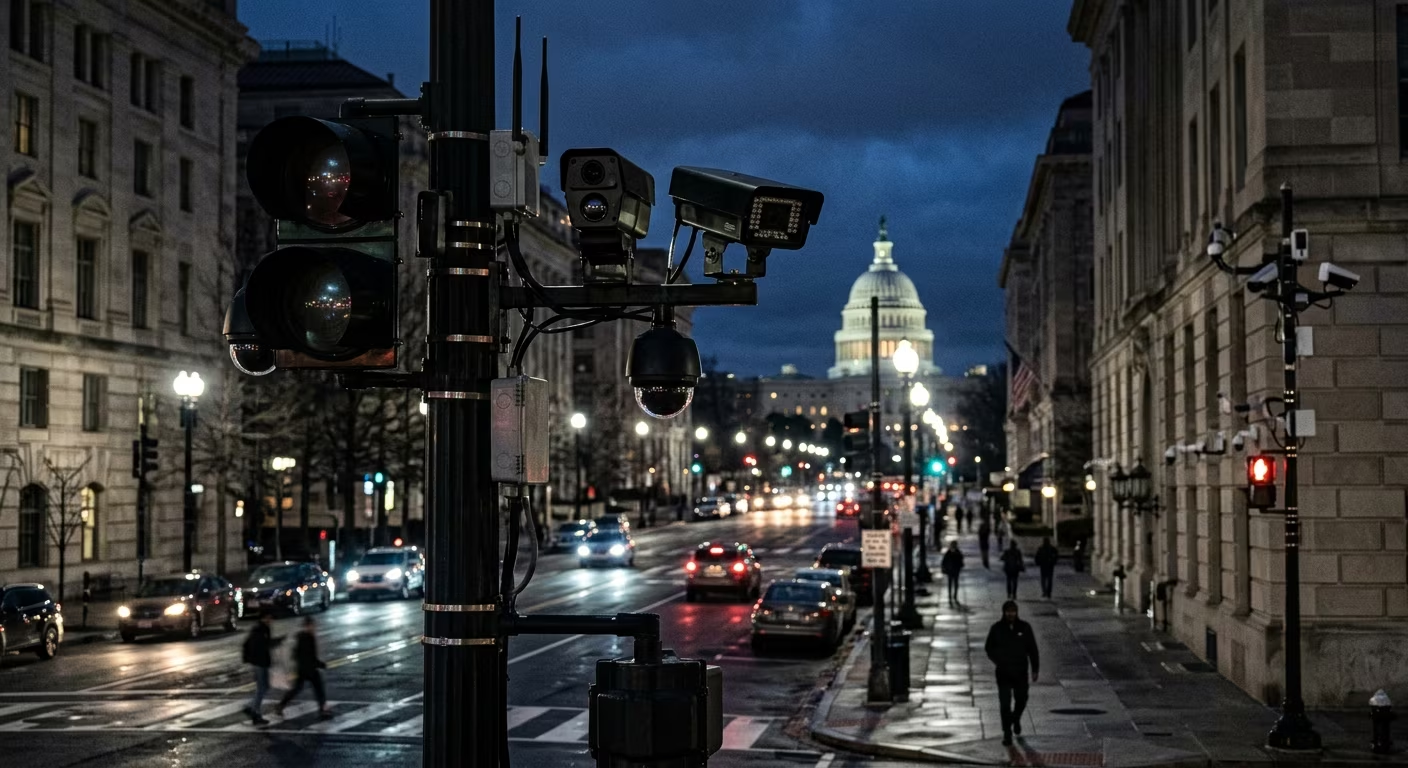
The casual question, “What are you doing tonight?” usually prompts thoughts of evening plans, social gatherings, or quiet nights at home. However, when the entity implicitly asking this question is a sprawling, unchecked network of government surveillance systems, the phrase takes on a far more sinister tone. In Washington, D.C., the intersection of local law enforcement, federal security apparatuses, and rapidly advancing digital technology has created one of the most intensely monitored urban environments in the United States. For residents and visitors navigating the capital, their nighttime plans, daytime commutes, and public associations are constantly captured by a silent, invisible web of surveillance.
Historically, physical surveillance required substantial human resources, naturally limiting its scope to specific individuals suspected of crimes. Today, the deployment of automated technologies allows law enforcement to conduct dragnet monitoring of entire populations without establishing individualized suspicion. From thousands of networked closed-circuit television (CCTV) cameras and automated license plate readers to highly invasive cell-site simulators and facial recognition algorithms, the modern surveillance state tracks citizens with unprecedented precision. While authorities argue these tools are critical for public safety and national security, civil rights advocates contend that they fundamentally threaten the Fourth Amendment right to privacy and the First Amendment right to free expression. As government agencies pool their resources into centralized hubs, the fundamental right to simply walk down a public street without being documented and analyzed is steadily vanishing.
The Capital’s Expanding Network: Centralizing the Watchful Eye
The infrastructure underpinning domestic surveillance in Washington, D.C., has experienced exponential growth over the past two decades, accelerating rapidly in recent years. In early 2024, the Metropolitan Police Department formalized this expansion by launching a state-of-the-art Real-Time Crime Center . D.C. police leadership noted that this command center serves as the new epicenter for investigating cases, pooling live video feeds from transit systems, public intersections, and private security cameras through unified digital networks. While the stated goal is to decrease violent crime and improve emergency response times, the aggregation of these constant feeds creates a persistent, citywide panopticon that inherently monitors innocent civilians alongside criminal activity.
The primary issue with such centralized systems lies not just in their immediate existence, but in their capacity for retroactive “pattern of life” analysis. By stitching together footage from disparate neighborhoods, authorities can theoretically trace an individual’s movements from the moment they leave their doorstep to their final evening destination. This mass collection of location data reveals intimate details about a person’s life—where they worship, which medical specialists they visit, what political meetings they attend, and precisely who they are meeting. When combined with automated license plate readers, which log the dates and times of vehicle locations, police can build massive, searchable databases of resident movements. Because there are currently minimal legal constraints on how long this data can be retained or how it can be shared with federal agencies, the potential for mission creep remains dangerously high.
Facial Recognition and the End of Public Anonymity
Perhaps the most controversial component of modern urban surveillance is the deployment of facial recognition technology (FRT). Unlike traditional video surveillance, which relies on human operators to manually identify a suspect, FRT automates the process by instantly cross-referencing live or recorded faces against massive databases containing driver’s license photos, mugshots, and social media images. The use of facial recognition fundamentally alters the balance of power between the state and the citizen, transforming every public space into a digital checkpoint.
In a comprehensive 2024 report by the National Academies of Sciences, Engineering, and Medicine, experts highlighted that the use of FRT implicates serious civil liberties and human rights concerns, particularly regarding freedom from state surveillance and control over personal information . The report emphasized that as the technology becomes more capable and accurate, the harms associated with pervasive surveillance become even more profound. Even a perfectly functioning algorithm infringes on the basic democratic right to anonymity. Furthermore, facial recognition algorithms have repeatedly demonstrated devastating racial and gender biases. Numerous independent studies have shown that these systems are significantly less accurate when identifying people of color, women, and non-binary individuals. This technological flaw translates into severe real-world harm, including wrongful arrests and targeted harassment of already marginalized communities.
Invisible Nets: Cell-Site Simulators
While cameras watch the public streets, another invisible layer of surveillance operates silently through the airwaves. Cell-site simulators, frequently referred to by the brand name “Stingrays,” are highly powerful electronic surveillance devices that mimic legitimate mobile phone towers. By forcing all nearby cellular devices to connect to them instead of the actual service provider, Stingrays allow law enforcement operators to pinpoint the exact physical location of a target phone, track its dynamic movements, and in certain configurations, intercept the metadata of text messages and voice calls.
The defining and most constitutionally problematic characteristic of a Stingray is its entirely indiscriminate nature. Policy analysts at the Cato Institute have emphasized that because these devices broadcast a signal that forces all phones within a certain radius to connect, they inevitably sweep up the sensitive data of countless innocent bystanders who happen to be in the same geographic area . This dragnet approach to data collection represents a modern digital manifestation of the “general warrants” that the Fourth Amendment was specifically drafted to prevent . In Washington, D.C., civil rights groups have aggressively challenged the police department’s deployment of these simulators. In 2017, advocates argued before local appellate courts that tracking a person’s physical location—often penetrating the walls of a private home—requires a strict probable cause warrant . Operating without rigorous judicial oversight allows authorities to digitally map out personal associations outside the bounds of constitutional checks and balances.
The Chilling Effect on First Amendment Rights
Washington, D.C., is not merely a major metropolitan area; it is the symbolic stage for national protests, demonstrations, and political gatherings. Consequently, the unchecked expansion of surveillance technology in the capital exerts a profound chilling effect on First Amendment rights. When citizens are acutely aware that their faces are being scanned, their cell phones pinged, and their license plates recorded by law enforcement, they are significantly less likely to participate in constitutionally protected activities out of fear of retaliation.
This chilling effect materialized starkly during the historic civil rights protests in the summer of 2020. Federal and local law enforcement agencies deployed an unprecedented array of surveillance tools against demonstrators, utilizing systems that had previously been reserved for overseas intelligence operations. Researchers at the Brennan Center for Justice point out that modern policing tools risk obscuring and automating long-standing racial inequalities under the veneer of objective, unbiased computer systems . When these surveillance technologies are heavily deployed at protests demanding racial justice or systemic reform, they serve as a digital mechanism of suppression. The right to assemble anonymously and speak out against government policy is a foundational cornerstone of American liberty. If attending a public protest means sacrificing one’s digital privacy and risking permanent inclusion in a government database, the vitality of public dissent is severely compromised.
The Urgent Need for Community Oversight and Legislative Guardrails
The rapid proliferation of urban surveillance technologies has vastly outpaced the legal and legislative frameworks designed to regulate them. In many jurisdictions, police departments have historically acquired and deployed powerful monitoring tools without public knowledge, explicit city council approval, or clear usage policies. This culture of secrecy entirely prevents meaningful public discourse regarding what level of surveillance a community is willing to tolerate in exchange for promised security benefits.
To counter this dangerous trend, broad coalitions of local groups and civil rights activists are championing Community Oversight of Surveillance legislation. These critical frameworks require law enforcement agencies to publicly disclose the surveillance technologies they currently possess and seek explicit, democratic approval from elected city councils before acquiring any new tools. Comprehensive surveillance legislation must include:
- Strict Data Retention Limits: Mandating that law enforcement delete data collected on innocent civilians within a short timeframe to prevent the creation of permanent digital dossiers.
- Bans on Biometric Surveillance: Outright prohibitions on the most invasive tracking techniques, such as running live facial recognition on public video feeds.
- Mandatory Independent Audits: Requiring regular, third-party evaluations to assess the efficacy, security, and disparate racial impacts of deployed surveillance tools.
- Judicial Oversight: Ensuring that police obtain a probable cause warrant before utilizing mass-tracking devices like cell-site simulators or accessing extensive location databases.
Furthermore, the judicial system must actively modernize its interpretation of the Fourth Amendment to reflect the realities of the digital age, recognizing that the sum total of our public movements deserves robust constitutional protection.
Conclusion
The seemingly benign question, “What are you doing tonight?” constitutes a profound and existential invasion of personal privacy when it is systematically asked by the unblinking, automated eye of the state. As Washington, D.C., continues to build out a centralized, high-tech surveillance apparatus, the fundamental character of the city and its relationship with its citizens are being irrevocably transformed. The integration of facial recognition databases, indiscriminate cell-site simulators, and sprawling real-time video networks has created a digital dragnet that monitors the innocent as closely and persistently as the guilty. Safeguarding civil liberties in the twenty-first century does not require entirely abandoning public safety initiatives, but it absolutely demands radical transparency, stringent judicial oversight, and an unwavering, active commitment to the constitutional rights that define a free society. Without immediate and decisive legislative action to reign in unchecked surveillance, the right to simply be left alone in public will soon become nothing more than a historical artifact.
Frequently Asked Questions
What is a Real-Time Crime Center (RTCC)?
A Real-Time Crime Center is a centralized law enforcement hub that aggregates live data from various surveillance technologies. These centers pull feeds from public CCTV cameras, private security systems, automated license plate readers, and acoustic gunshot sensors to monitor urban environments continuously and assist officers in responding to incidents as they happen.
Why is facial recognition technology considered a threat to civil liberties?
Facial recognition automates mass tracking by scanning public spaces and matching faces against government databases, largely without the subject’s consent. This effectively eliminates public anonymity. Additionally, numerous studies have proven that facial recognition algorithms suffer from severe racial and gender biases, leading to higher rates of misidentification and wrongful arrests for people of color and women.
What are cell-site simulators or “Stingrays”?
Stingrays are covert surveillance devices used by law enforcement that mimic legitimate cell phone towers. By broadcasting a strong signal, they force all mobile phones within a specific geographic radius to connect to them. This allows operators to track the precise location of a target device, but it inherently sweeps up the private location data and metadata of innocent bystanders in the area.
How does mass surveillance affect First Amendment rights?
Pervasive surveillance creates a well-documented “chilling effect” on free speech and assembly. When individuals know they are being digitally tracked, recorded, and analyzed by the government, they frequently self-censor or avoid participating in lawful protests, political meetings, and public assemblies out of fear of retaliation, harassment, or inclusion in a persistent law enforcement database.
References
- D.C. police ‘Real-Time Crime Center’ launches with live video monitoring — The Washington Post. 2024-04-08. https://www.washingtonpost.com/dc-md-va/2024/04/08/dc-police-real-time-crime-center-cameras/
- Chapter 4: Equity, Privacy, Civil Liberties, Human Rights, and Governance — National Academies of Sciences, Engineering, and Medicine. 2024. https://nap.nationalacademies.org/read/27397/chapter/6
- Stingray: A New Frontier in Police Surveillance — Cato Institute. 2017-01-25. https://www.cato.org/policy-analysis/stingray-new-frontier-police-surveillance
- DC’s Highest Court to Hear Challenge to Police’s Warrantless Use of ‘Stingray’ Cell Phone Tracker — ACLU of DC. 2017-04-13. https://www.acludc.org/en/press-releases/dcs-highest-court-hear-challenge-polices-warrantless-use-stingray-cell-phone
- Policing & Technology — Brennan Center for Justice. 2026. https://www.brennancenter.org/our-work/research-reports/policing-technology
- Constitution of the United States: Fourth Amendment — Congress.gov. https://constitution.congress.gov/constitution/amendment-4/