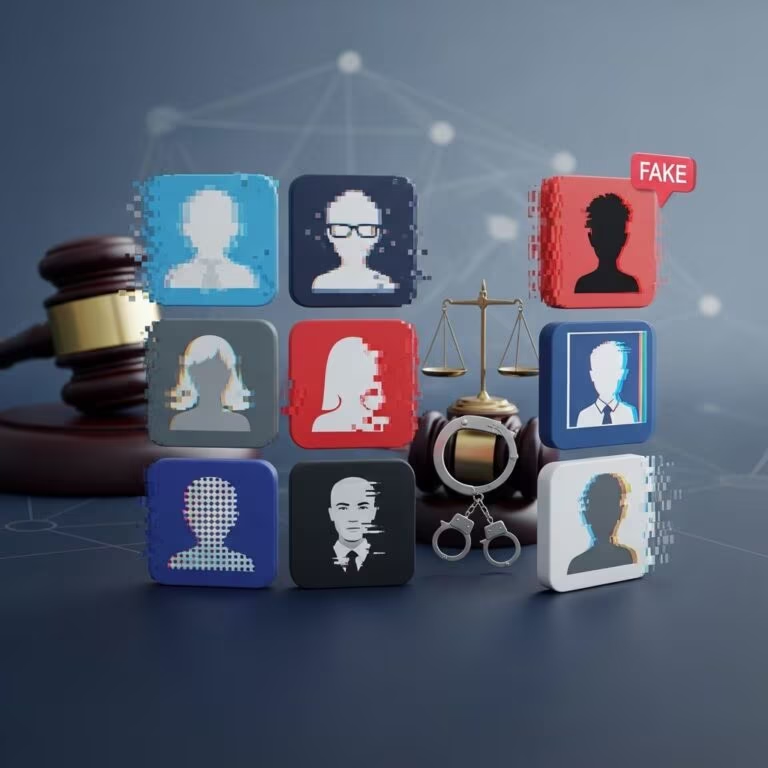
The Erosion of Digital Privacy in the Modern Town Square
The contemporary digital landscape has transformed social media platforms into the modern equivalent of the public town square. Billions of users log onto platforms like Meta (Facebook, Instagram) and X (formerly Twitter) daily to share their thoughts, organize community events, network with professionals, and connect with peers. In recent years, these massive technology giants have launched aggressive public relations campaigns emphasizing their unyielding commitment to user privacy, the deployment of end-to-end encryption, and robust data protection policies. Consumers are repeatedly assured that their digital footprints are safeguarded against unauthorized intrusions. Yet, beneath the surface of these consumer-facing promises lies a complex, opaque, and highly profitable ecosystem of data sharing that fundamentally undermines the core tenets of digital privacy.
While social media companies explicitly state in their terms of service that their developer tools and application programming interfaces (APIs) cannot be used for state surveillance or discriminatory targeting, the reality of the situation paints a far more convoluted picture. A highly sophisticated network of third-party data brokers serves as an invisible intermediary, effectively bridging the gap between social media platforms and law enforcement agencies. These brokers siphon staggering amounts of user data, apply advanced artificial intelligence algorithms to filter the noise, and sell the resulting intelligence directly to government entities. This dynamic raises critical legal and ethical questions about corporate complicity, deceptive trade practices, and the urgent, unavoidable need for stringent regulatory intervention by government oversight bodies.
The Mechanics of the Data Firehose
To fully grasp how mass surveillance operates in the digital age, one must first understand the technical concept of the “data firehose.” Major social media platforms offer enterprise-level API access to specific corporate partners, researchers, and developers. Unlike standard user interfaceswhich present a curated, algorithmically limited feed of content based on individual preferencesa firehose connection provides real-time, unfiltered access to millions of public posts, geolocation tags, metadata, timestamps, and user interactions every single minute of the day. The sheer volume of this data is beyond human comprehension, requiring massive server arrays just to process.
Platforms grant this privileged access ostensibly for benign, business-oriented purposes: brand reputation management, market research, academic studies, or real-time breaking news alerts. However, the data rarely remains confined to marketing analytics. Third-party data analytics firms ingest this monumental stream of information and utilize sophisticated artificial intelligence and machine learning models to parse it. They deploy sentiment analysis, entity extraction, and relationship mapping to identify specific keywords, geographic clusters, and network associations. While the platforms claim to maintain strict developer agreements prohibiting the use of this data for intelligence gathering and surveillance, practical enforcement is notoriously lax. The platforms largely rely on self-reporting from the data brokers themselves, creating a glaring, dangerous blind spot in data governance. When a developer builds a “threat alerting” tool based on social media activity and subsequently licenses that precise tool to a local police department, the conceptual line between public safety monitoring and unconstitutional mass surveillance completely evaporates.
The Data Broker Loophole and the Fourth Amendment
The proliferation of these data-sharing relationships has exposed a significant legal gray area that privacy advocates often refer to as the “Data Broker Loophole.” Under the Fourth Amendment of the United States Constitution, citizens are guaranteed protection against unreasonable searches and seizures by the state. Traditionally, if law enforcement wanted to access detailed, long-term information about an individual’s private communications, physical whereabouts, or personal associations, they were strictly required to demonstrate probable cause and obtain a search warrant signed by an impartial judge.
Data brokers have completely short-circuited this critical judicial oversight. Because social media users are technically agreeing to the platforms’ sprawling terms of service and making their data “public” or available to third-party developers, law enforcement agencies argue that they do not legally need a warrant to purchase this aggregated data. Instead of compelling the platforms to hand over the data through a legal subpoena or warrant, government agencies simply use taxpayer dollars to buy high-priced subscription access to data broker platforms. This effectively allows authorities to monitor grassroots protests, track the movements of specific demographics, and intricately map out social networks without any judicial scrutiny or constitutional friction. Legal scholars and civil liberties advocates argue passionately that this practice allows the government to outright buy its way around the Constitution, establishing an ecosystem of warrantless surveillance that previous generations could never have imagined.
Why Regulatory Bodies Like the FTC Must Step In
The systemic failure of technology companies to effectively police their own developer ecosystems is not merely an abstract, theoretical privacy concern; it is a potential violation of federal law. The Federal Trade Commission (FTC) stands as the primary consumer protection agency in the United States, tasked by Congress with preventing unfair or deceptive acts or practices in commerce. Both Meta and X are intimately familiar with the investigative power of the FTC, as both corporations currently operate under strict, legally binding consent decrees stemming from their past catastrophic privacy failures.
In 2019, the FTC levied a historic, record-breaking $5 billion penalty against Meta (then operating as Facebook) for flagrantly deceiving users about their ability to control the privacy of their personal information. Similarly, X (formerly Twitter) was heavily fined $150 million in 2022 by the FTC and the Department of Justice for violating a 2011 consent order. The agency found that the platform deceptively utilized user security dataspecifically phone numbers and email addresses provided for two-factor authenticationfor targeted advertising purposes. These severe consent decrees require the platforms to maintain comprehensive privacy programs, submit to independent audits, and rigorously safeguard user data from unauthorized third-party access.
When platforms publicly declare to consumers that their data cannot and will not be used for surveillance, yet consistently fail to cut off data brokers who actively sell this exact capability to the police, they are engaging in potentially deceptive practices. Regulators possess a clear mandate to investigate whether these companies are violating the terms of their consent orders. A thorough FTC investigation would legally compel these corporations to disclose their internal API auditing processes, reveal the exact extent of their knowledge regarding how data brokers use their firehoses, and enforce meaningful, structural penalties for non-compliance.
The Disproportionate Impact on Vulnerable Populations
It is a well-documented historical fact that mass surveillance is rarely, if ever, deployed evenly across a society. Historically, state surveillance apparatusesfrom COINTELPRO in the mid-20th century to modern digital monitoringhave disproportionately targeted marginalized communities, civil rights activists, racial minorities, and political dissidents. The weaponization of massive social media data sets is no exception to this deeply troubling rule. When data brokers provide law enforcement with real-time digital mapping of public assemblies, it directly and severely impacts the fundamental constitutional rights to freedom of speech and freedom of assembly.
During moments of significant civil unrest, such as nationwide protests advocating for racial justice and against police brutality, data brokers have been explicitly observed utilizing platform APIs to track the movements of organizers, journalists, and participants. By setting up digital geofences around protest locations, monitoring cellular endpoints, and filtering for specific ideological hashtags, police departments can effortlessly build extensive dossiers on individuals who are simply exercising their First Amendment rights. The widespread public knowledge that such ubiquitous monitoring is taking place creates a profound and damaging “chilling effect.” Individuals may choose to self-censor their online speech, refrain from joining political advocacy groups, or completely avoid attending peaceful protests out of a justified fear of retribution, blacklisting, or targeted harassment by state actors.
Pathways to Corporate Accountability and Transparency
Effectively addressing the complicity of social media giants in the facilitation of state surveillance requires a comprehensive, multi-faceted approach involving strict corporate accountability, robust regulatory enforcement, and sweeping legislative action. Relying on the goodwill, self-regulation, or public relations apologies of technology executives has proven completely insufficient over the past decade. Therefore, concrete, actionable steps must be taken to dismantle the hidden surveillance pipeline:
- Mandatory Independent Auditing: Platforms must be legally required to subject their API partners to rigorous, ongoing, independent third-party audits. Self-certification by data brokers should no longer be accepted as legitimate proof of compliance with anti-surveillance policies. Auditors must verify exactly who the end-users of the data are.
- Immediate Termination of Bad Actors: If a data broker is found to be supplying analytical surveillance tools to law enforcement or intelligence agencies in violation of a platform’s terms of service, the platform must immediately and permanently revoke their API access. There can be no grace periods or exceptions for lucrative corporate partners.
- FTC Enforcement and Algorithmic Disgorgement: The Federal Trade Commission must aggressively interpret and enforce its existing consent decrees. If platforms are turning a blind eye to surveillance, they must face substantial structural remedies. This includes not just monetary fineswhich massive tech companies view merely as the cost of doing businessbut forced algorithmic disgorgement, requiring companies to delete any models built on improperly acquired data.
- Legislative Action: Congress must urgently pass comprehensive federal privacy legislation that explicitly closes the data broker loophole. This legislation must firmly establish that government agencies cannot circumvent the Fourth Amendment by simply purchasing data that they would otherwise need a warrant to obtain.
The Future of Digital Privacy in a Hyper-Connected World
The internet was initially envisioned by its pioneers as a decentralized, democratizing force that would inherently empower individuals, tear down informational barriers, and facilitate the completely free exchange of ideas. Instead, over the last two decades, it has been systematically co-opted into the most efficient, pervasive, and invisible surveillance apparatus in human history. Reclaiming the digital town square requires acknowledging the deeply symbiotic, highly profitable relationship between massive technology monopolies, predatory third-party data brokers, and government agencies eager to bypass constitutional constraints.
Regulatory bodies like the FTC hold the legal authority and the institutional power to force much-needed transparency into this deliberately opaque system. By fiercely demanding that social media platforms actually enforce the privacy policies they proudly advertise on television and billboards, the government can begin the arduous process of dismantling the hidden architecture of mass surveillance. Until regulators step up to hold these corporations genuinely accountable for their downstream data flows, the foundational promise of digital privacy remains nothing more than a carefully crafted corporate illusion.
Frequently Asked Questions (FAQs)
What exactly is a third-party data broker?
A data broker is a specialized company that quietly collects, aggregates, and analyzes vast amounts of personal information from various public and private sources, including social media platforms, public property records, and commercial transactions. They package this raw data into comprehensive profiles or actionable intelligence alerts and sell it to other businesses, marketers, or government agencies.
Is it explicitly illegal for police to monitor public social media posts?
No, it is generally not illegal for individual law enforcement officers to view public social media posts manually. However, the legal and ethical controversy centers entirely on the use of automated, AI-driven tools purchased from data brokers. These tools aggregate massive amounts of data in real-time, effectively bypassing the need for search warrants to systematically track millions of citizens’ movements and associations on an industrial scale.
How can the FTC punish social media companies for the actions of data brokers?
The FTC can take severe enforcement action if a social media company’s practices are deemed “unfair or deceptive.” If a platform publicly promises its users that its data will not be used for state surveillance, but fails to implement reasonable technical safeguards to prevent data brokers from doing exactly that, the FTC can impose massive fines and mandate strict corporate restructuring. This is particularly true if the company is already operating under a prior FTC consent decree regarding data privacy.
Can individual users prevent their data from being scraped by these mass surveillance tools?
Unfortunately, user control over this specific issue is highly limited. While setting your social media profile to “private” can restrict public access to your explicit posts, platforms still continuously collect underlying metadata, geolocation history, and your friends’ interactions with you. The systemic nature of API data sharing means that individual privacy settings are often fundamentally insufficient to completely avoid data broker aggregation.
What constitutional rights are primarily threatened by this data broker loophole?
The primary constitutional rights at risk are the First and Fourth Amendments. The Fourth Amendment is circumvented when police buy data instead of getting a warrant. The First Amendment is threatened because unchecked mass surveillance creates a chilling effect on free speech and the right to peaceful assembly, making citizens afraid to express dissenting opinions or attend protests.
References
- FTC Imposes $5 Billion Penalty and Sweeping New Privacy Restrictions on Facebook https://www.ftc.gov/news-events/news/press-releases/2019/07/ftc-imposes-5-billion-penalty-sweeping-new-privacy-restrictions-facebook
- FTC Charges Twitter with Deceptively Using Account Security Data to Sell Targeted Ads https://www.ftc.gov/news-events/news/press-releases/2022/05/ftc-charges-twitter-deceptively-using-account-security-data-sell-targeted-ads
- Closing the Data Broker Loophole https://www.brennancenter.org/our-work/research-reports/closing-data-broker-loophole
- Police Social Media Monitoring: The New Undercover Assignment https://carrcenter.hks.harvard.edu/publications/police-social-media-monitoring-new-undercover-assignment