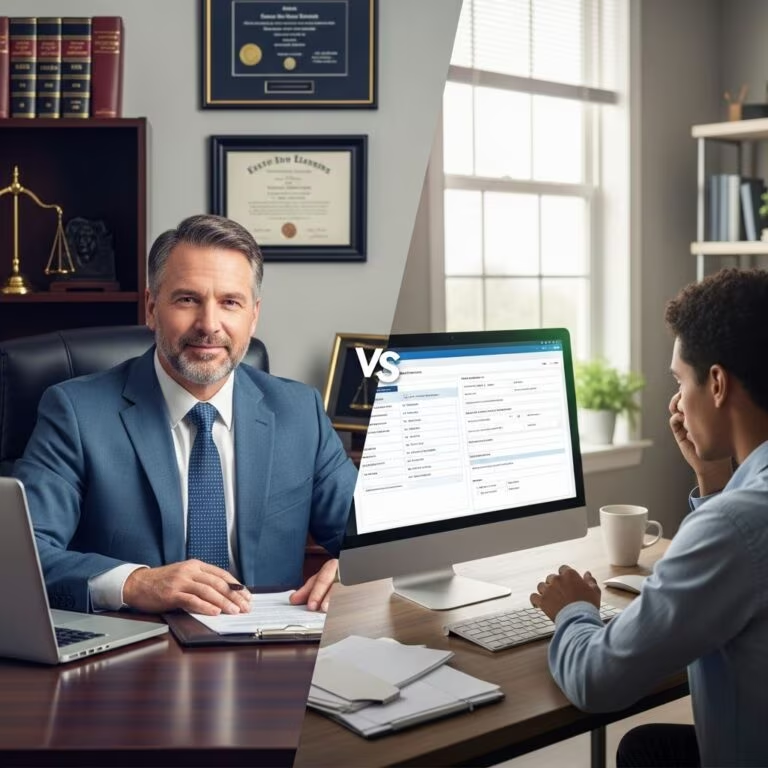
Your artistic creations deserve robust protection in an era where digital sharing is rampant. Copyright law grants artists exclusive rights over their original works from the moment they are fixed in a tangible form, such as canvas, paper, or digital files. This guide explores how to leverage these rights effectively, including automatic safeguards and formal registration processes.
Understanding Copyright Fundamentals for Artists
Copyright arises automatically when an artist creates an original work fixed in a tangible medium of expression. Under U.S. law, this includes paintings, drawings, sculptures, photographs, and digital illustrations—essentially any pictorial, graphic, or sculptural creation. No formalities like registration or notice are required for basic protection, aligning with international standards like the Berne Convention.
Key rights include reproducing the work, creating derivatives, distributing copies, performing or displaying publicly, and authorizing others to do so. These protections last for the artist’s life plus 70 years in the U.S. However, ideas, concepts, or styles remain unprotected—only the specific expression is covered.
- Originality threshold: The work must show minimal creativity; mere copies or commonplace designs do not qualify.
- Fixation: Must be perceivable, reproducible, or communicable by machine or device, like paint on canvas or pixels on a screen.
- Exclusions: Useful articles (e.g., clothing designs) get limited protection under the separability doctrine.
While automatic, unregistered copyrights limit remedies in disputes, making formal steps crucial for serious artists.
Why Register Your Artwork with the Copyright Office?
Federal registration with the U.S. Copyright Office elevates protection significantly. It creates a public record, enabling lawsuits for infringement and unlocking enhanced remedies. Without registration, proving ownership relies on weaker evidence like dated sketches or digital metadata.
| Benefit | Unregistered Work | Registered Work |
|---|---|---|
| Public Record | No official proof | Establishes prima facie validity (if within 5 years of publication) |
| Lawsuit Eligibility | Limited to actual damages | Full infringement suits possible |
| Damages | Only profits/losses | Statutory damages up to $150,000 per work + attorney fees (if timely) |
| Customs Protection | None | Record with U.S. Customs to block imports |
Registration is voluntary but essential for commercial artists, galleries, or online sellers facing copycats.
Step-by-Step Process to Register Visual Artworks
The U.S. Copyright Office handles registrations via its electronic system (eCO), processing visual arts works efficiently. Here’s how artists can register paintings, prints, or digital art.
- Prepare your application: Log into the eCO portal at copyright.gov. Select ‘Visual Arts’ category for 2D works like paintings (use ‘2D Artwork’ not ‘Photograph’ even if submitting a photo).
- Complete the form: Provide author details, work title, creation/publication dates, and claim specifics. For groups of unpublished works, register as a collection if by the same author.
- Pay the fee: Standard fee is $45-$65 for online single applications; group options reduce costs.
- Submit deposit: Upload digital files or photos (JPEG/TIFF, 8×10 inches min for unpublished). Published works may need two copies.
- Wait for processing: 3-10 months typical; effective date is submission day if complete.
Paper applications are slower and costlier—opt for electronic. Track status online post-submission.
Proving Ownership Without Formal Registration
Not every sketch needs registration. Build evidence trails:
- Timestamp digital files via metadata or blockchain tools.
- Sign and date originals physically.
- Email works to yourself for dated records.
- Use poor man’s copyright: Mail sealed originals via certified post (open only if needed).
These suffice for minor disputes but falter against determined infringers. Prioritize registration for high-value pieces.
Navigating Copyright Notices and Symbols
Pre-1989, notices (© year author) were mandatory; now optional but recommended for deterrence. Place on front or back: ‘© 2026 Your Name. All Rights Reserved.’ Digital watermarks serve online art.
Group Registrations: Efficient for Prolific Artists
Register multiple unpublished works as one ‘collection’ if same author and theme (e.g., sketch series). Published works qualify under specific options like group periodicals. No blanket coverage—each new version needs separate filing.
Duration and Renewal: When Protection Ends
Post-1978 works: Life + 70 years. Pre-1978 may require renewal. Public domain entry frees works for all use. Track via Cornell’s copyright slider tool for specifics.
Enforcing Your Rights Against Infringers
Monitor platforms like Etsy, Instagram via reverse image search. Send DMCA takedown notices to hosts. Sue only post-registration for max remedies. Document everything for court.
International Considerations for Global Artists
U.S. registrations protect abroad via Berne Union (180+ countries). No universal registration—rely on treaties.
Common Pitfalls and Best Practices
- Avoid registering ideas or unoriginal copies.
- Separate applications for collaborations unless joint work.
- Update for derivatives (e.g., new editions).
Frequently Asked Questions
Is copyright automatic for my digital drawings?
Yes, upon saving to a file; registration adds enforcement power.
Do I need to register every piece?
No, but prioritize commercial or unique works.
What if my art is copied online?
Issue DMCA notice; sue if registered.
Can I register sculptures or 3D prints?
Yes, under visual arts if original.
How much does registration cost?
$45+ online; check copyright.gov for current fees.
Does publication affect protection?
No, but triggers deposit requirements.
References
- Copyright Basics — U.S. Copyright Office. 2023-10-01. https://www.copyright.gov/circs/circ01.pdf
- How to Copyright Paintings? — Copyright Alliance. 2024-05-15. https://copyrightalliance.org/faqs/how-to-copyright-paintings/
- How to Copyright Protect Your Art or Photographs — FinerWorks / U.S. Copyright Office. 2023-01-01. https://finerworks.com/tips/how-to-copyright-your-art-or-photographs.aspx
- Copyright Basics — USPTO. 2025-01-10. https://www.uspto.gov/ip-policy/copyright-policy/copyright-basics
- Copyright Term and the Public Domain — Cornell Law School. 2024-11-20. https://copyright.cornell.edu/publicdomain
- Visual Arts: Registration — U.S. Copyright Office. 2025-02-01. https://www.copyright.gov/registration/visual-arts/
- Register Your Work: Registration Portal — U.S. Copyright Office. 2026-01-15. https://www.copyright.gov/registration/