
The Hidden Web: National Security Letters and Gag Orders
How citizens fought secret FBI subpoenas to protect privacy.
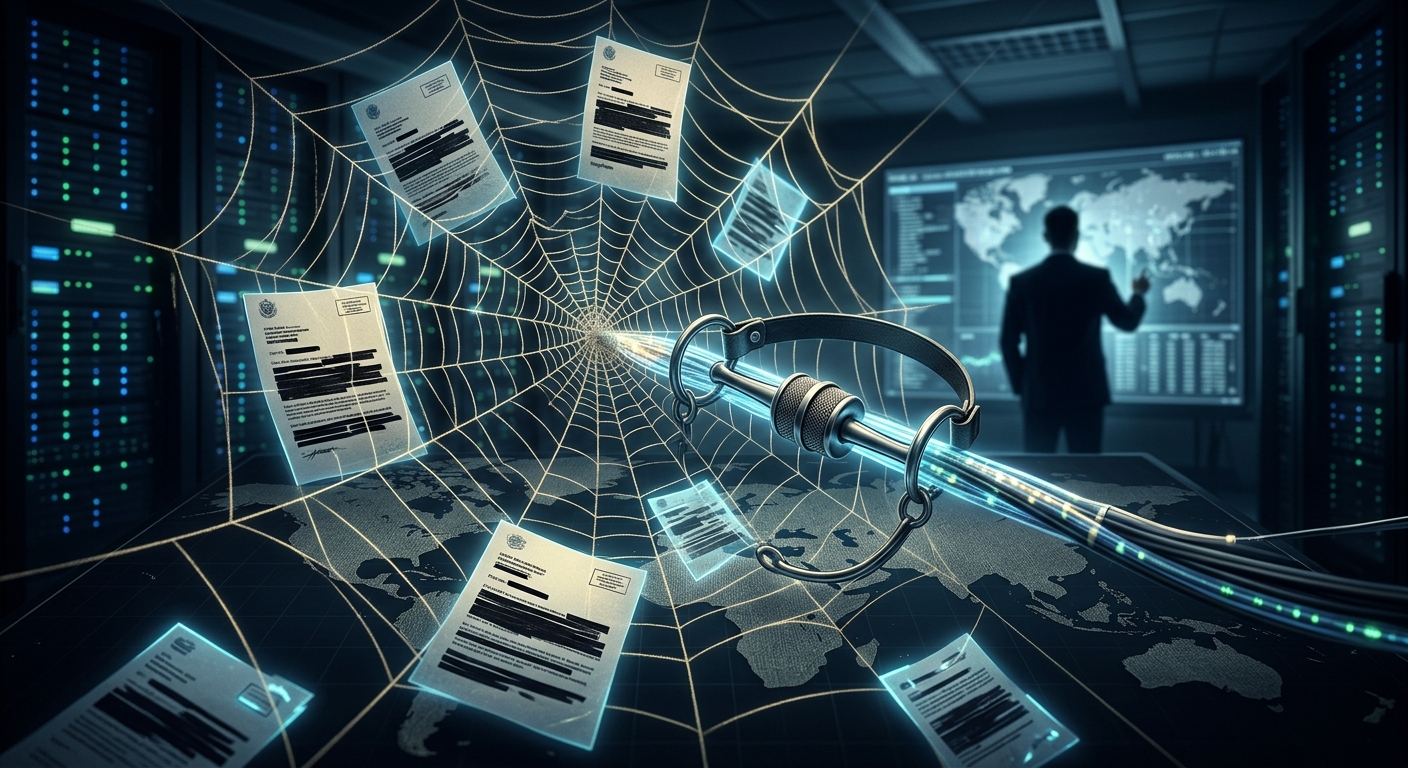
The Shadow of Secrecy in Modern Surveillance
In the direct aftermath of the September 11 attacks, the United States government dramatically recalibrated its approach to intelligence gathering. The shift prioritized preventive, broad-scale surveillance over the traditional law enforcement paradigms that had governed the nation for decades. Among the most potent and highly controversial investigative tools to emerge from this rapid legislative evolution was the aggressively expanded use of the National Security Letter (NSL). Operating entirely outside the traditional bounds of judicial oversight, these administrative subpoenas empowered the government to unilaterally compel private companies to turn over massive troves of sensitive customer data.
However, the most insidious nature of the National Security Letter did not merely lie in its unprecedented data-gathering capabilities. The true shock to the constitutional system was its ability to enforce absolute, perpetual silence. For years, the recipients of these secret demands were immediately slapped with strict, non-negotiable gag orders that legally prohibited them from ever discussing the government’s intrusion into their businesses. This mechanism forced ordinary Americans into a shadow world of state secrecy, effectively stripping them of their First Amendment right to speak out about the very mechanisms of power targeting them and their users.
Decoding the National Security Letter Framework
To fully grasp the magnitude of this surveillance tool, one must understand what a National Security Letter is and how it functions differently from standard legal processes. Under normal circumstances, if law enforcement wishes to search a home or acquire private correspondence, they must present evidence to a neutral judge or magistrate to demonstrate “probable cause” of a crime. Only then is a formal warrant issued.
An NSL completely bypasses this foundational judicial check. Governed primarily by 18 U.S.C. § 2709, an NSL is an administrative directive issued directly by the executive branch—specifically, authorized field office heads within the Federal Bureau of Investigation (FBI). Instead of requiring probable cause, the issuing agent merely needs to certify that the requested information is “relevant” to an authorized national security investigation.
While National Security Letters cannot legally be used to extract the actual content of communications—such as the body of an email or the audio of a phone call—they grant sweeping access to transactional records and metadata. This includes subscriber information, billing records, browsing history logs, and local and long-distance telephone routing data. In the digital age, this non-content data can paint an intimately detailed portrait of an individual’s personal life, political affiliations, medical history, and social network.
Comparing Surveillance Tools
| Feature | Standard Search Warrant | National Security Letter (NSL) |
|---|---|---|
| Issuing Authority | Neutral Magistrate or Judge | Executive Branch (FBI field office heads) |
| Evidentiary Standard | Probable Cause of a crime | Relevance to a national security investigation |
| Notice to Subject | Typically provided, with rare exceptions | Secret; accompanied by a gag order |
| Data Scope | Communications content and physical items | Metadata, subscriber info, financial records (no content) |
The USA PATRIOT Act and the Expansion of Executive Power
The concept of the National Security Letter existed long before the modern era of the war on terror; its origins trace back to legislation in the late 1980s. However, the USA PATRIOT Act, passed overwhelmingly by Congress just weeks after the 9/11 attacks, fundamentally transformed the scope and frequency of their use. Prior to 2001, the FBI could only issue an NSL if there were specific, articulable facts demonstrating that the target of the data request was directly connected to a foreign power or an agent of a foreign power.
The PATRIOT Act deliberately stripped away this localized restriction. The new threshold only required that the data be “relevant” to an ongoing terrorism or counterintelligence investigation. By untethering the tool from a specific foreign agent requirement, the law inadvertently opened the floodgates for mass data collection on ordinary American citizens who were entirely unconnected to terrorism.
The result was a staggering explosion in secret data requests. Official reports from the Office of the Inspector General (OIG) of the Department of Justice later revealed that the FBI issued hundreds of thousands of National Security Letters in the years following the PATRIOT Act’s passage. The internal audits exposed rampant misuse, poor record-keeping, and instances where data was collected on U.S. citizens completely outside the bounds of authorized investigations, highlighting the profound dangers of granting unilateral power without mandatory judicial oversight.
The Constitutional Crisis: Prior Restraint and the First Amendment
While the Fourth Amendment concerns regarding unreasonable searches and seizures were significant, it was the First Amendment implications of the accompanying gag orders that sparked some of the most fierce legal battles of the decade. Whenever an ISP, a telecommunications company, or a financial institution received an NSL, the document inherently included a blanket non-disclosure requirement. This legal gag effectively bound the recipient to permanent silence under the threat of severe criminal penalties.
In American constitutional law, preventing someone from speaking before they have uttered a word is known as “prior restraint.” The Supreme Court has historically viewed prior restraints as the most serious and least tolerable infringement on First Amendment rights. In standard legal settings, gag orders are strictly limited in duration and scope, and must be approved by a judge who weighs the government’s need for secrecy against the individual’s fundamental right to free speech.
The NSL gag orders, however, operated in reverse. They were issued indefinitely, applied broadly, and were mandated by the executive branch without a court assessing whether the speech actually posed a threat to national security. Recipients were barred from participating in the vibrant, ongoing national debate over the PATRIOT Act and government surveillance, despite being the few individuals in the country who actually understood exactly how these powers were being deployed in practice.
The Human Toll: Carrying the Weight of State Secrecy
The abstract legal arguments surrounding constitutional rights often obscure the profound psychological toll placed on the real people caught in the crossfire. The individuals who received these letters—frequently mid-level executives at internet service providers or directors of regional library systems—were thrust into an unprecedented and terrifying environment of state-mandated isolation.
Imagine receiving a federal demand for the private reading habits or browsing histories of your patrons or clients. You believe the demand is an unconstitutional overreach, yet the moment you are handed the document, you are legally forbidden from discussing it. If you choose to challenge the order in court, you must do so under a pseudonym, such as “John Doe.” You are barred from telling your board of directors why the company is incurring massive legal fees. You cannot explain to your colleagues why you are constantly stepping out for hushed phone calls. Most devastatingly, you cannot tell your spouse or your children the source of your immense anxiety.
These “John Does” lived double lives for years. They hid legal documents in their own homes to ensure family members wouldn’t accidentally discover their secret battle against the federal government. They sat silently while pundits and politicians debated surveillance laws on television, unable to share their firsthand experiences of systemic overreach. Their courageous, silent defiance became a cornerstone in the eventual dismantling of the absolute secrecy surrounding the program.
Judicial Pushback and Legislative Reforms
The oppressive nature of the permanent gag orders eventually met fierce resistance in the federal courts, largely championed by civil liberties advocates and privacy organizations. Lawsuits filed on behalf of these anonymous service providers systematically dismantled the government’s claim to unchecked secrecy. A landmark moment occurred when the U.S. Court of Appeals for the Second Circuit ruled in cases such as Doe v. Mukasey that the FBI’s ability to impose indefinite, non-reviewable gag orders violated the First Amendment.
The court dictated that the burden of proving the necessity of a gag order must fall on the government, not the citizen, and that meaningful judicial review must be guaranteed. This sustained legal pressure forced the hands of lawmakers in Washington. In 2015, Congress passed the USA FREEDOM Act, a comprehensive reform bill that aimed to curb the most egregious excesses of the post-9/11 surveillance state.
Among its many provisions, the USA FREEDOM Act fundamentally altered the landscape for National Security Letters. It established formal termination procedures for gag orders, requiring the government to periodically review whether the need for secrecy still existed. It also empowered recipients with a clearer path to challenge the non-disclosure requirements in court, finally providing an avenue for transparency and restoring a measure of constitutional balance.
The Ongoing Struggle for Privacy in the Digital Age
While legislative reforms and judicial interventions have mitigated the most severe abuses of the NSL framework, the underlying tension between national security imperatives and individual civil liberties remains unresolved. The FBI still retains the authority to issue administrative subpoenas without prior judicial approval, and metadata collection continues to be a highly invasive tool in the digital era, where non-content data can reveal an almost complete picture of an individual’s private life.
The history of National Security Letters serves as a crucial reminder of how easily foundational constitutional protections can be eroded in times of national crisis. The courage of the unnamed librarians, tech executives, and privacy advocates who fought back from the shadows ensured that the machinery of surveillance could not operate with total impunity. Maintaining this balance requires constant vigilance, public awareness, and an unwavering commitment to the principles of transparency and judicial oversight.
Frequently Asked Questions (FAQ)
- What exactly is a National Security Letter (NSL)?
An NSL is an administrative subpoena used by the U.S. government, primarily the FBI, to compel organizations to hand over specific records and data pertaining to individuals. Unlike typical subpoenas, they do not require prior approval from a judge. - Can an NSL be used to read my emails or listen to my phone calls?
No. By law, National Security Letters can only be used to acquire non-content data. This includes metadata, such as billing records, the time and duration of communications, and subscriber identities. They cannot legally compel the production of the actual content of a conversation or message. - Why were the gag orders considered unconstitutional by some courts?
Many courts ruled that the indefinite and automatic nature of the gag orders violated the First Amendment. Because they permanently banned recipients from speaking about the government request without a judge ever reviewing the necessity of the silence, they functioned as an illegal “prior restraint” on free speech. - How did the USA FREEDOM Act change the use of NSLs?
Passed in 2015, the USA FREEDOM Act introduced crucial reforms, including a requirement that the government periodically review and terminate gag orders when secrecy is no longer necessary. It also created better avenues for recipients to legally challenge the demands and increased public reporting requirements regarding how often these tools are used.
References
- National Security Letter Overview — Legal Information Institute (LII), Cornell Law School. https://www.law.cornell.edu/wex/national_security_letter
- A Review of the FBI’s Use of National Security Letters — Office of the Inspector General, U.S. Department of Justice. 2008-03-01. https://oig.justice.gov/sites/default/files/legacy/special/s0803b/final.pdf
- USA FREEDOM Act of 2015 (Public Law 114-23) — Congress.gov. 2015-06-02. https://www.congress.gov/bill/114th-congress/house-bill/2048
- Doe v. Mukasey, 549 F.3d 861 — U.S. Court of Appeals for the Second Circuit. 2008-12-15. https://law.justia.com/cases/federal/appellate-courts/ca2/07-4242/07-4242-2011-03-27.html
Similar Articles








Read full bio of Sneha Tete


