
The Digital Pat-Down: Mobile Biometrics vs Civil Liberties
How police mobile fingerprinting threatens privacy and echoes stop-and-frisk.
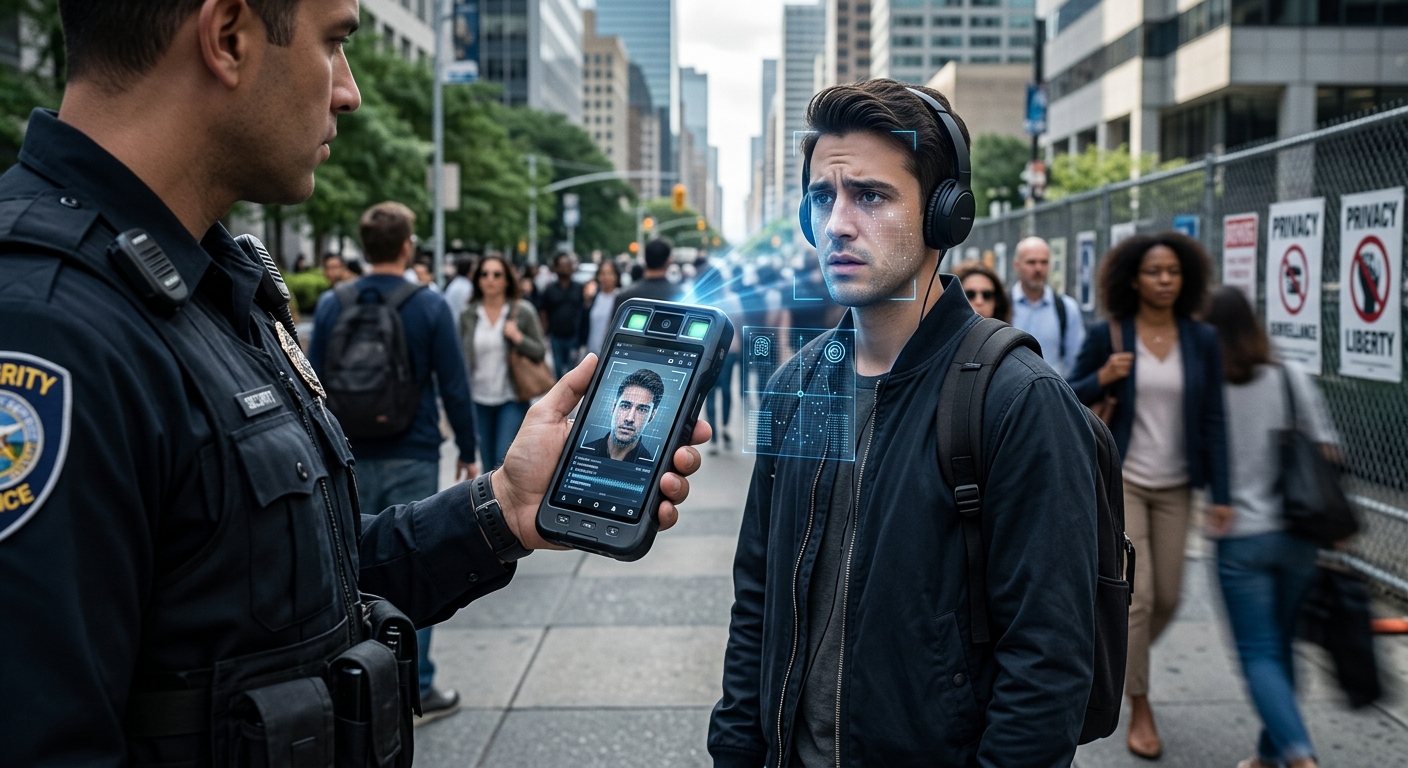
The Digital Evolution of Street Encounters
Imagine walking down the street or driving home from work when you are unexpectedly stopped by law enforcement. After a brief conversation, the officer pulls out a smartphone-sized device and asks you to press your index finger against its glowing screen. In a matter of seconds, your highly sensitive biometric data is beamed to state and federal databases. This scenario is no longer a futuristic concept confined to science fiction; it is a burgeoning reality on the streets of American cities today. Mobile fingerprinting technology is rapidly transforming how police officers interact with the public, shifting the paradigm of identification from physical paperwork to instantaneous digital extraction.
While proponents laud this technology as a triumph of modern law enforcement efficiency, civil rights advocates and legal scholars are sounding the alarm. The deployment of mobile biometric scanners in routine street encounters raises profound constitutional questions. If left unchecked, the practice of on-the-spot biometric data collection threatens to erode the fundamental privacy protections guaranteed by the Fourth Amendment. More alarmingly, the highly discretionary nature of these digital searches risks replicating the widespread discrimination and racial profiling that characterized the controversial “stop-and-frisk” era. As police departments increasingly adopt mobile biometric tools, society must critically evaluate whether trading foundational civil liberties for investigative convenience is a price we are willing to pay.
The Mechanics of Mobile Identification
Mobile fingerprint identification devices are compact, portable scanners that connect directly to automated fingerprint identification systems (AFIS) at the state level, as well as the Federal Bureau of Investigation’s massive repository. According to law enforcement policy documents, such as the operational directives established by various municipal departments, these digital tools are explicitly designed to identify individuals whose identity is questioned during a field encounter.
In practice, an officer can take a digital imprint of a civilian’s fingerprint and run a comprehensive background check in under two minutes. The system instantly returns the individual’s identity, any outstanding warrants, and their criminal history. The scale of this operation is staggering; state authorities, such as the Michigan State Police, process tens of thousands of these mobile biometric inquiries annually, illustrating the sheer volume and normalization of this surveillance technology in everyday policing.
However, the rapid expansion of this capability fundamentally alters the timeline of criminal justice procedures. Traditionally, the collection of a suspect’s fingerprints was an event firmly anchored to the formal booking process. It occurred almost exclusively after an arrest was made, which meant it was justified by “probable cause”—the constitutional legal threshold required to believe a person has committed a crime. Mobile fingerprinting untethers biometric collection from the controlled environment of a booking room and brings it directly to the sidewalk. This shift essentially transforms fingerprinting from a post-arrest administrative necessity into a pre-arrest investigative fishing expedition, allowing officers to search for crimes before they have evidence one has occurred.
The Fourth Amendment in the Digital Crosshairs
The Fourth Amendment of the United States Constitution is designed to protect citizens from unreasonable searches and seizures by the government. For decades, the courts have navigated the complex boundary between a lawful police investigation and an unconstitutional invasion of privacy. The introduction of mobile biometric scanners on the street significantly complicates this legal landscape.
Legal scholars have long debated the extent to which biometric data is protected against forced extraction. While traditional ink fingerprinting during a lawful arrest is considered a standard administrative procedure, compelling a person to provide biometric data on the street—often without a warrant or probable cause—strikes at the very heart of bodily autonomy and privacy rights. The analysis of compelling biometrics increasingly highlights the immense tension between law enforcement’s desire for immediate digital identification and an individual’s constitutional protections against intrusive searches.
The greatest legal danger of mobile fingerprinting lies in its subtle circumvention of the probable cause standard. During a “Terry stop”—a brief, investigatory detention based on the lower standard of “reasonable suspicion”—an officer is permitted to conduct a superficial physical pat-down of an individual’s outer clothing strictly to search for weapons that might endanger the officer. This physical frisk is not a blanket license to search for general evidence of a crime. Yet, when an officer deploys a mobile fingerprint scanner during a Terry stop, they are no longer searching for an immediate physical threat; they are conducting a sophisticated, digital search of the person’s identity and entire personal history. By exploiting the ambiguity between a consensual encounter, an investigatory stop, and a full-blown arrest, police can utilize mobile scanners to conduct warrantless digital searches that bypass established Fourth Amendment safeguards.
Echoes of Stop-and-Frisk: The Threat of Disparate Impact
To understand the societal threat posed by mobile fingerprinting, one must examine the legacy of “stop-and-frisk” policies. For years, major police departments utilized the Terry stop framework to routinely stop, question, and physically frisk pedestrians in urban environments. While officially touted as a necessary strategy to remove illegal firearms from the streets, the implementation of stop-and-frisk was deeply flawed, legally questionable, and profoundly discriminatory.
Extensive research and judicial reviews have consistently demonstrated that stop-and-frisk heavily targeted marginalized communities. A comprehensive examination of stop-and-frisk practices, for instance, revealed that unconstitutional stops remain a persistent issue, with a significant percentage of police encounters still failing to meet the basic legal requirements of the Fourth Amendment. Furthermore, social psychology research highlights how implicit racial bias plays a crucial role in these street-level encounters, leading officers to interpret the ambiguous behaviors of Black and Hispanic individuals as far more suspicious than identical behaviors exhibited by white individuals, thus exacerbating racial disparities in the criminal justice system.
When officers are granted broad, unchecked discretion to deploy mobile fingerprint scanners on the street, the exact same historical biases that infected stop-and-frisk will inevitably dictate who is asked to provide their biometric data. The “digital pat-down” quickly becomes the new tool of disproportionate surveillance. If history is any indicator, low-income neighborhoods and communities of color will bear the brunt of this digital extraction. Instead of merely being physically pushed against a wall and searched, individuals will be digitally indexed, checked against global databases, and permanently recorded for minor infractions or for simply appearing “suspicious” to an officer on patrol.
The Fallacy of Voluntary Consent on the Street
A common and pervasive defense offered by law enforcement agencies is that mobile fingerprinting during routine stops is an entirely voluntary process. Officers are often instructed by departmental policy to ask for permission before scanning an individual’s finger. However, this argument willfully ignores the inherent, overwhelming power dynamics of a police-civilian encounter.
When an armed, uniformed police officer flashing emergency lights asks a civilian to place their finger on a scanner, the request rarely feels like a genuine choice. The psychological pressure to comply is immense, particularly for individuals who belong to communities that have historically experienced systemic police violence, harassment, or intimidation. Many people are completely unaware that they have the constitutional right to refuse a biometric scan during a routine encounter. Fearing that a polite refusal will be interpreted as an admission of guilt, an act of resistance, or a justification for an escalation of physical force, the vast majority of civilians will “consent” to the search.
True, legal consent requires a clear understanding of one’s rights and the genuine freedom to decline without fear of negative consequences. Without mandatory, explicit warnings—akin to Miranda rights—informing individuals that they can legally refuse a digital scan, the notion of voluntary consent in a roadside biometric search is nothing more than a dangerous legal fiction designed to bypass the need for a warrant.
The Shadow Databases: Data Security and Unregulated Retention
Another deeply alarming aspect of mobile fingerprinting is the utter ambiguity surrounding the biometric data once it is collected. If an officer scans your fingerprint on a sidewalk and the system returns no warrants or criminal history, what exactly happens to that digital imprint? Where does it go?
Traditional fingerprinting during a post-arrest booking process is heavily regulated by state and federal laws, with strict rules governing how records are stored, sealed, or eventually expunged if criminal charges are dropped. In stark contrast, the field collection of biometric data via mobile scanners is largely an unregulated Wild West. Without stringent state or federal legislation, the retention policies for mobile scans are often left completely to the discretion of individual police departments or the private third-party tech vendors that manufacture the scanning technology.
Comparing Biometric Data Collection Protocols
| Feature | Traditional Booking Fingerprints | Mobile Field Scans |
|---|---|---|
| Legal Threshold required | Probable Cause (Post-Arrest constraint) | Reasonable Suspicion or coerced “Consent” |
| Environment of collection | Controlled, monitored police station facility | Unpredictable street or roadside encounter |
| Data Regulation & Retention | Strict state/federal expungement laws | Varies widely by local department policy |
| Primary Purpose | Administrative identification of actual arrestees | Pre-arrest investigative fishing and surveillance |
The lack of uniform regulations across jurisdictions raises the terrifying prospect of shadow databases—vast, unregulated repositories of biometric data collected from innocent civilians who were never arrested, charged, or convicted of any crime. These databases could be continually searched by law enforcement algorithms for decades, transforming innocent people into perpetual, digitized suspects in an unending virtual lineup.
The Urgent Need for Legislative Guardrails
The digital evolution of police stops cannot be allowed to outpace our civil liberties. Relying on the self-regulation of local police departments is a fundamentally flawed and insufficient approach to protecting the constitutional rights of citizens. We need immediate, robust legislative action at both the state and federal levels to place clear, unyielding guardrails on the use of mobile biometric technology.
First and foremost, legislation must focus on several core pillars to protect the public:
- Strict Warrant Requirements: Mandating that law enforcement officers obtain a judicial warrant based on probable cause before conducting a biometric scan in the field, thereby eliminating the massive loophole of coerced street-level consent.
- Data Retention Limits: Enacting ironclad laws to ensure that the biometric data of individuals who are not subsequently arrested is immediately and permanently deleted from all devices, servers, and interconnected databases.
- Independent Oversight and Auditing: Establishing external audit bodies to continuously monitor the deployment of mobile scanners, ensuring the technology is not being utilized in a racially discriminatory manner or heavily concentrated in marginalized neighborhoods.
The transition from physical frisks to digital surveillance represents a critical juncture in American policing. We must recognize that the extraction of a person’s biometric identity is a profound, highly personal intrusion that warrants the highest level of constitutional protection. By demanding strict legislative accountability and judicial oversight, we can ensure that the devastating mistakes of the stop-and-frisk era are not simply rebranded and coded into the digital tools of the future.
Frequently Asked Questions (FAQs)
What is a mobile fingerprint scanner in law enforcement?
A mobile fingerprint scanner is a portable, often smartphone-sized device used by police officers to digitally capture an individual’s fingerprints in the field. The device connects wirelessly to state and federal criminal databases to instantly retrieve the person’s true identity, criminal history, and any outstanding arrest warrants.
Can I refuse a mobile fingerprint scan during a police stop?
In most jurisdictions, if you are not currently under arrest, you have the right to refuse a mobile biometric scan. If an officer asks for your fingerprint during a consensual encounter or a minor traffic stop without probable cause, you can politely decline. However, you should always remain calm and clearly ask if you are required by law to provide it or if you are free to leave.
Why do civil rights advocates compare this to stop-and-frisk?
Advocates compare mobile fingerprinting to “stop-and-frisk” because both practices give police broad discretion to stop individuals on the street and conduct invasive searches without a warrant. Historically, this massive level of street-level discretion has led to severe racial profiling, with marginalized communities disproportionately targeted for searches without actual evidence of a crime.
Does the Fourth Amendment protect my biometric data?
The Fourth Amendment protects against unreasonable searches and seizures, but the judicial interpretation of the law is still catching up to modern digital technology. While a fingerprint taken after a lawful arrest is generally deemed constitutional, civil rights groups passionately argue that coercing a biometric scan from an individual on the street without a warrant or probable cause constitutes a clear violation of Fourth Amendment protections.
References
- General Order 19: Mobile Fingerprint Identification — Fayetteville Police Department, Arkansas. 2025-04-10. https://www.fayetteville-ar.gov/DocumentCenter/View/11559/General-Order-19-Mobile-Fingerprint-Identification
- Biometrics and Identification Division 2022 Annual Transparency Report — Michigan State Police. 2023-06. https://www.michigan.gov/-/media/Project/Websites/msp/cjic/Transparency_Report_2022.pdf
- Place Your Finger on the Home Button: The Legality of Compelling Biometrics — University of Florida Journal of Law & Public Policy. 2021-04-07. https://scholarship.law.ufl.edu/jlpp/vol31/iss3/5/
- An Examination of NYPD Stop-and-Frisk Practices — City University of New York Institute for State and Local Governance (CUNY ISLG). 2025-05-06. https://islg.cuny.edu/research/an-examination-of-nypd-stop-and-frisk-practices
- Implicit Racial Bias and Racial Anxiety: Implications for Stops and Frisks — NYU Law. 2018-05. https://www.nyulawreview.org/wp-content/uploads/2018/08/NYULawReview-93-3-Richardson.pdf
Similar Articles








Read full bio of Sneha Tete


