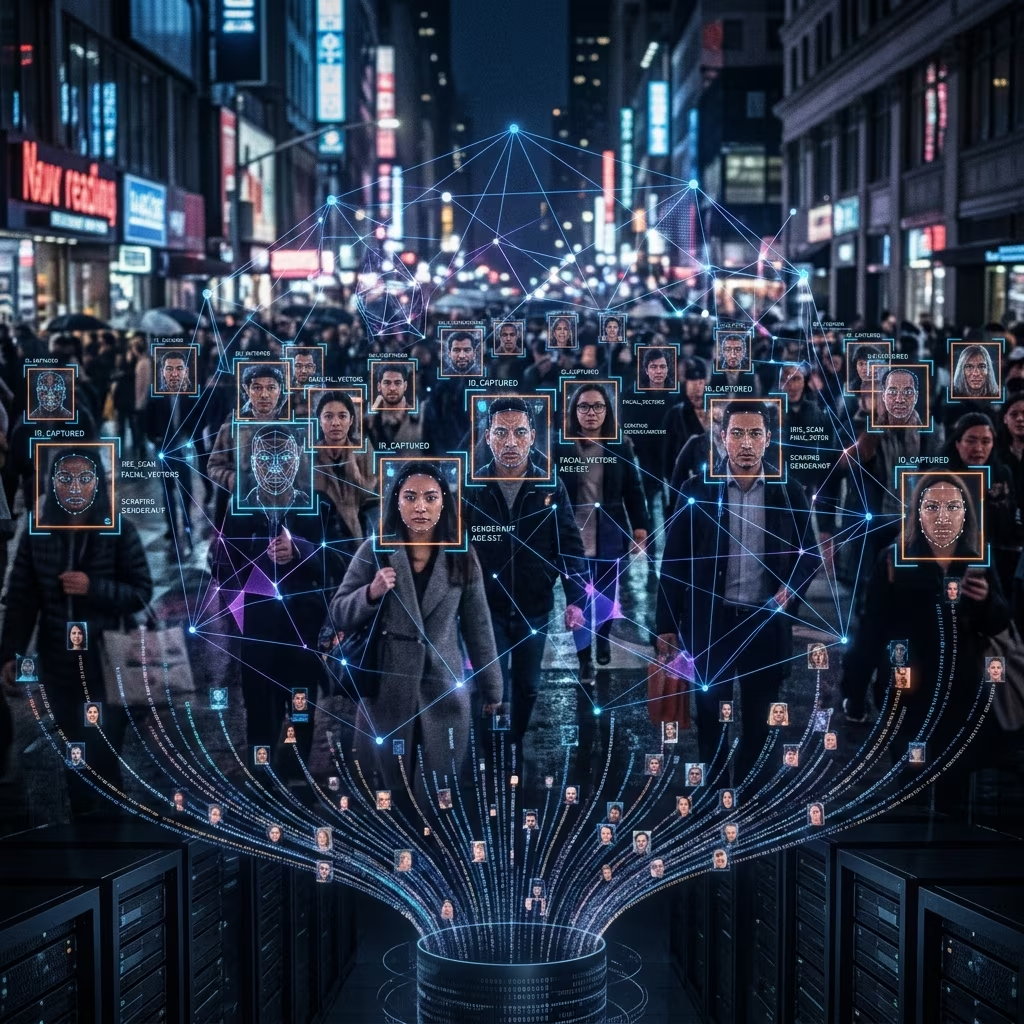
Every time we upload a photograph to a social networking site, attend a public demonstration, or simply walk down a crowded metropolitan street, we leave behind a digital trail. For decades, this trail was ephemeral. However, the advent of mass biometric data scraping has permanently altered the landscape of personal privacy. Tech companies have quietly constructed vast, searchable databases containing billions of human faces, transforming our most immutable physical characteristics into commodities. This quiet revolution in surveillance technology forces society to grapple with unprecedented ethical, legal, and constitutional challenges.
While the corporate entities behind these systems often launch aggressive public relations campaigns to paint their products as benign tools for public safety, a closer examination reveals a far more dystopian reality. The non-consensual extraction of biometric data does not merely catch criminals; it fundamentally rewrites the rules of public engagement, anonymity, and civil liberties. By examining the underlying mechanisms of these technologies, the inherent biases within their algorithms, and the global regulatory responses to their proliferation, we can begin to understand the true cost of our hyper-visible modern world.
The New Frontier of Surveillance Capitalism
Surveillance capitalism originally relied on tracking our digital behaviors—our search queries, our purchase histories, and our geographic locations. Biometric scraping represents the next, and arguably most invasive, frontier of this economic model. Instead of merely tracking what we do, companies are now tracking who we are at a physiological level.
The business model is deceptively simple: automated software programs, or “crawlers,” scour the public internet, downloading billions of publicly available images from news articles, social media profiles, and employment directories. These images are then processed through complex artificial intelligence algorithms that map the geometry of the faces within them, creating unique “faceprints.” These faceprints are stored in proprietary databases and sold as a service to law enforcement agencies, private corporations, and authoritarian regimes. The individuals whose faces constitute the very product being sold are never asked for their consent, nor are they compensated for the commercial exploitation of their biological identities.
Redefining Public Spaces in the Digital Age
Historically, moving through a public space afforded a crucial degree of practical anonymity. While a person walking through a city square was visible to anyone present, they were not simultaneously identifiable to a global network of government agencies and private actors. This physical anonymity provided a protective buffer, allowing individuals to associate freely, visit controversial locations, or seek medical care without the fear of permanent, searchable documentation.
Facial recognition technology obliterates this buffer. When a public space is monitored by cameras linked to massive biometric databases, the concept of being “lost in a crowd” ceases to exist. Every face becomes a hyper-link to a dossier of personal information. Proponents of biometric scraping often argue that individuals have no reasonable expectation of privacy regarding their faces in public spaces or in photos they voluntarily upload online. However, this argument maliciously conflates human visibility with algorithmic aggregation. Consenting to a friend posting a group photo on a social feed is entirely different from consenting to that photo being permanently indexed in a global surveillance dragnet.
The Myth of the “Public” Photograph
The justification that scraped images are “public data” ignores the context in which information is shared. Privacy in the digital age is not a binary state of “completely hidden” or “totally public.” It is contextual. An image shared with a limited audience for social purposes is suddenly weaponized when fed into an identification machine. The aggregation of scattered data points creates a mosaic of an individual’s life that is far more invasive than any single photograph could ever be.
Beyond the Spin: The “Public Safety” PR Shield
To deflect criticism and avoid stringent regulation, companies dealing in facial recognition often employ highly sophisticated public relations campaigns. The core tactic of these campaigns is to position their technology as an absolute necessity for public safety. They flood the media with curated anecdotes of their software being used to identify violent criminals, solve cold cases, or rescue victims of human trafficking.
While these specific use cases may be valid, they serve as a deliberate misdirection from the technology’s broader, more insidious applications. This PR strategy creates a false dichotomy: society must either accept unregulated mass surveillance or allow dangerous criminals to roam free. By framing the debate entirely around extreme outliers, these companies attempt to justify the routine, non-consensual scanning of billions of innocent people. A tool capable of tracking a fugitive is equally capable of tracking a political dissident, a whistle-blower, or a marginalized citizen seeking sanctuary. The PR shield intentionally obscures the collateral damage inflicted on the general populace’s right to live without perpetual monitoring.
The Accuracy Illusion and Demographic Bias
The narrative of infallibility pushed by biometric tech firms is severely undermined by rigorous scientific analysis. While artificial intelligence has improved, facial recognition systems are neither flawless nor neutral. In fact, independent audits have repeatedly demonstrated that these algorithms suffer from deep-seated demographic biases.
A landmark study conducted by the National Institute of Standards and Technology (NIST) analyzed numerous face recognition algorithms and found empirical evidence of demographic differentials across the majority of the software tested. The research indicated that systems frequently struggled to accurately identify individuals from specific demographic groups, leading to higher rates of false positives for women and people of color. In a law enforcement context, a “false positive” is not merely a technical glitch; it is a catalyst for profound human rights violations. It can lead to wrongful interrogations, false arrests, and the destruction of livelihoods. When the burden of algorithmic error falls disproportionately on already marginalized communities, the technology ceases to be an impartial tool of justice and becomes an automated engine of systemic inequality.
The Chilling Effect on Civil Liberties and Free Speech
The implementation of mass biometric surveillance casts a long, chilling shadow over fundamental democratic freedoms. The First Amendment of the United States Constitution guarantees the right to peaceably assemble and to associate freely. However, the exercise of these rights relies heavily on the ability to do so without fear of unjust retaliation.
If individuals know that attending a lawful protest, a union organizing meeting, or a religious service will result in their automatic identification and logging in a database, many will simply choose to stay home. This chilling effect undermines the very foundation of civic engagement. The power dynamic between the state and the citizen is irreparably altered when the state possesses the capability to retroactively identify every attendee at a political demonstration. The mere existence of these databases acts as a powerful deterrent against dissent, allowing authorities to stifle opposition without ever needing to explicitly ban free speech.
Regulatory Vacuum vs. Global Precedents
The rapid deployment of facial recognition technology has vastly outpaced the development of legal frameworks to govern it, resulting in a dangerous regulatory vacuum, particularly in the United States. Without comprehensive federal legislation, law enforcement agencies have adopted these tools with alarming opacity.
A comprehensive report by the U.S. Government Accountability Office (GAO) reviewed federal law enforcement agencies and discovered systemic deficiencies in oversight. The GAO found that across multiple agencies, law enforcement officers were utilizing facial recognition systems with little to no specific training regarding civil liberties or privacy protection. The absence of standardized policies means that a technology with the power to ruin lives is frequently deployed at the sole discretion of individual officers, operating in an environment largely devoid of accountability.
In stark contrast, other global regulatory bodies have recognized the existential threat posed by unregulated biometric surveillance. The European Union has taken a decisive stance with its Artificial Intelligence Act (AI Act). Under this groundbreaking legislation, the use of “real-time” remote biometric identification systems in publicly accessible spaces for law enforcement purposes is largely prohibited, recognizing it as an unacceptable risk to fundamental human rights. The EU framework acknowledges that the potential for societal harm and mass control inherent in these systems far outweighs their utility, setting a powerful precedent that prioritizes human dignity over technological overreach.
The Opt-Out Fallacy
In response to mounting privacy concerns, some biometric scraping companies have offered “opt-out” mechanisms, allowing individuals to request the removal of their data from the system. This approach is a masterclass in shifting responsibility. It forces the victim of a privacy violation to proactively navigate complex bureaucratic hurdles simply to reclaim ownership of their own face. Furthermore, because these databases are constantly scraping new data, an opt-out request is often only a temporary fix. The burden of consent must inherently lie with the entity collecting the data, not the individual attempting to survive in a digital society.
Reclaiming Biometric Sovereignty: The Path Forward
The pervasive spread of mass biometric scraping is not an inevitable consequence of technological progress; it is a policy choice. To prevent the complete erosion of public anonymity, society must demand robust, enforceable regulations that treat biometric data as an extension of bodily autonomy. This requires moving beyond industry self-regulation and corporate public relations campaigns.
True biometric sovereignty demands federal legislation that mandates explicit, affirmative consent before physiological data can be harvested. Furthermore, outright bans on specific implementations—such as live facial recognition in public squares—must be considered to preserve the democratic right to unmonitored existence. The technology we build should serve to enhance human freedom, not to construct an invisible panopticon that tracks our every move.
Frequently Asked Questions (FAQs)
- What is biometric data scraping?
Biometric data scraping is the automated process of collecting billions of images of human faces from public internet sources (like social media and news sites) without the subjects’ consent. These images are then analyzed to create unique faceprints for massive, searchable surveillance databases. - Why are false positives in facial recognition dangerous?
A false positive occurs when an algorithm incorrectly matches an innocent person to a database image of a suspect. This can lead to wrongful detainment, arrest, and significant psychological trauma, particularly for minority demographics who are often misidentified at higher rates due to algorithmic bias. - How does facial recognition impact the First Amendment?
The technology can create a “chilling effect” on free speech and association. If citizens know they can be instantly identified by attending a protest or political gathering, they may choose to self-censor and avoid participating in lawful democratic activities for fear of retaliation. - Are there any laws preventing companies from scraping my face?
In the United States, there is currently no comprehensive federal law prohibiting biometric scraping, leading to a patchwork of state laws (like the Illinois Biometric Information Privacy Act). Conversely, the European Union’s AI Act implements strict prohibitions on certain forms of public biometric surveillance. - Can I completely opt out of these databases?
While some companies provide an opt-out form, it is highly ineffective. The process puts the burden on the user, and because crawlers continuously scrape the internet, a person’s image may be re-ingested into the system even after an initial deletion request.
References
- Face Recognition Vendor Test (FRVT) Part 3: Demographic Effects — National Institute of Standards and Technology (NIST). 2019-12-19. https://nvlpubs.nist.gov/nistpubs/ir/2019/NIST.IR.8280.pdf
- Facial Recognition Services: Federal Law Enforcement Agencies Should Take Actions to Implement Training, and Policies for Civil Liberties (GAO-23-105607) — U.S. Government Accountability Office (GAO). 2023-09-12. https://www.gao.gov/products/gao-23-105607
- Article 5: Prohibited AI Practices — EU Artificial Intelligence Act. 2024-02-27. https://artificialintelligenceact.eu/article/5/