The Changing Face of Public Assembly
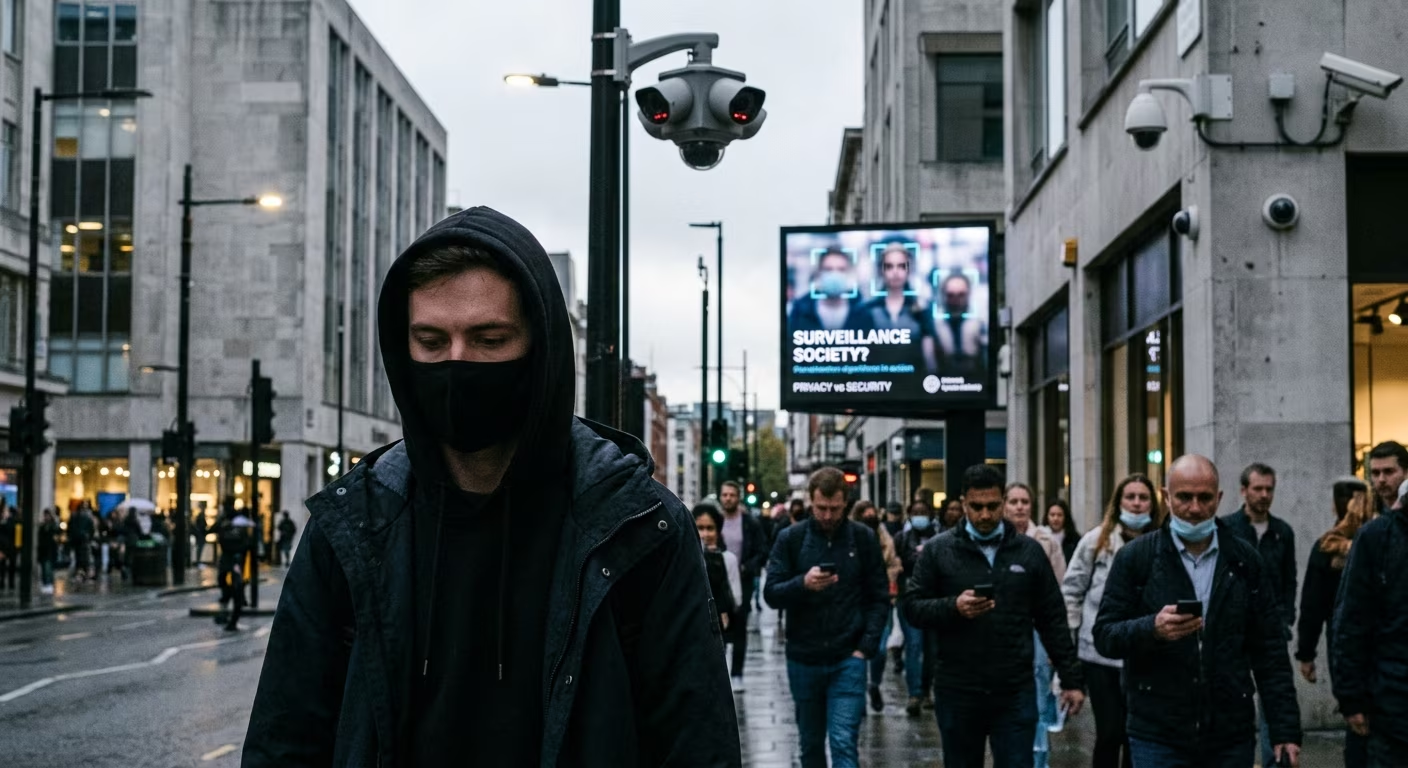
The public square has long served as the ultimate theater for American democracy—a space where citizens congregate to voice dissent, demand change, and hold their leaders accountable. Over the past few years, the visual landscape of these gatherings has undergone a dramatic transformation. During the peak of the global pandemic, facial coverings became a ubiquitous symbol of civic duty and public health. Today, however, those same protective garments have become the center of a fierce legal and political battle. Across the United States, lawmakers are introducing or reviving anti-mask legislation. But this modern push to ban facial coverings does not exist in a vacuum; it is unfolding precisely as artificial intelligence and facial recognition technology reach unprecedented levels of sophistication. This collision between archaic public disguise laws and cutting-edge biometric surveillance has ignited a complex debate regarding privacy rights, public health, and the constitutional guarantee of free speech.
The Resurgence of Facial Covering Restrictions
Tracing the Historical Roots
To understand the current legislative climate, one must look back at the origins of mask prohibitions in the United States. Many of the anti-mask statutes currently on the books were drafted in the mid-twentieth century. Their primary, and largely noble, objective at the time was to dismantle the terroristic activities of secret societies, most notably the Ku Klux Klan. By stripping these individuals of their anonymity, lawmakers hoped to curb coordinated campaigns of violence and intimidation. However, as decades passed, the application of these laws expanded. Law enforcement agencies began utilizing them to manage public protests, targeting individuals whose only offense was attempting to protect their identities while participating in demonstrations.
The Modern Legislative Pivot: The North Carolina Example
Fast forward to the present day, and the rationale for banning masks has shifted once again, often framed around maintaining public order during contentious political protests. A prime illustration of this modern pivot is North Carolina’s House Bill 237, which dominated legislative sessions in 2024. The bill originally sought to strip away the pandemic-era health and safety exemptions that allowed citizens to wear masks in public without fear of legal reprisal. Proponents argued that masks were being exploited by bad actors to conceal their identities while obstructing traffic or committing vandalism during demonstrations. However, the proposal to eliminate health exemptions altogether sparked immense public outrage, leading to a gubernatorial veto and eventually forcing a legislative compromise . The fierce debate surrounding North Carolina’s law underscores the broader national tension: efforts to unmask political dissenters inevitably sweep up everyday citizens attempting to navigate public spaces safely.
The Biometric Dragnet: The Threat of Facial Recognition
How AI Has Transformed the Public Square
The debate over mask bans takes on a far more sinister tone when one considers the invisible architecture of modern surveillance. We no longer live in an era where unmasking simply means revealing one’s face to the people in the immediate vicinity. Today, removing a mask exposes an individual to a sprawling, automated biometric dragnet. Facial Recognition Technology (FRT) utilizes advanced artificial intelligence to scan crowds, extract unique nodal points from human faces, and compare those biometric signatures against massive databases containing billions of images scraped from social media, driver’s licenses, and mugshots. When a person is forced to remove their mask at a protest, their presence is instantly logged, cataloged, and stored indefinitely by both law enforcement agencies and private data brokers.
Demographic Differentials and Flawed Algorithms
The mass deployment of FRT is not just a privacy nightmare; it is also a civil rights hazard due to inherent technological flaws. The National Institute of Standards and Technology (NIST) conducted an exhaustive study on the demographic effects of face recognition algorithms, revealing deeply concerning disparities . The NIST report documented that facial recognition systems often exhibit significantly higher false-positive match rates for certain demographic groups, particularly women and people of color . In a policing context, a false positive can lead to wrongful detainment, harassment, or arrest. By enacting mask bans and forcing marginalized individuals to expose their faces to flawed surveillance networks, governments are amplifying the risk of algorithmic injustice and discriminatory policing.
Navigating the Constitutional Landscape
Freedom of Speech and Anonymous Association
Anonymity has always been a cornerstone of American political expression. From the pseudonymous authors of the Federalist Papers who shaped the U.S. Constitution, to the Civil Rights era when the Supreme Court ruled that the NAACP could not be forced to hand over its membership lists to hostile state governments, the right to remain unidentified has been recognized as essential to free speech. When citizens cannot protect their identities, they are significantly less likely to participate in controversial or unpopular speech. Mask bans inherently disrupt this right. If a citizen knows that attending a peaceful rally will result in their face being scanned, identified, and potentially placed on a government watchlist, they may choose to simply stay home. This ‘chilling effect’ strikes at the very heart of the First Amendment, suppressing democratic participation out of a fear of state monitoring.
Doxing and the Privatization of Retaliation
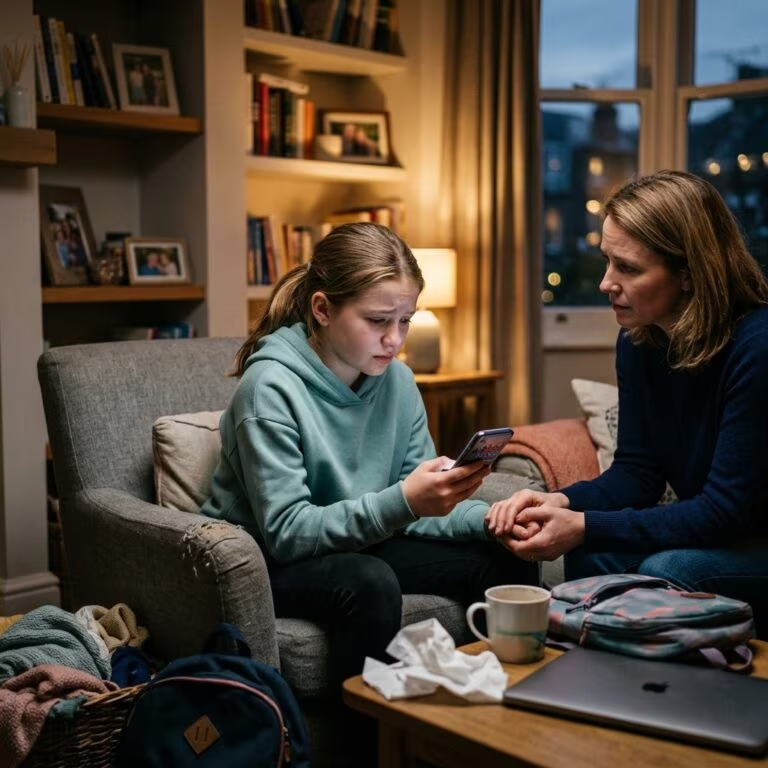
The threat of exposure does not come solely from government surveillance. In the digital age, private citizens routinely engage in ‘doxing’—the malicious broadcasting of an individual’s private information, such as their full name, home address, and place of employment, across the internet. Activists who are unmasked at public demonstrations are frequently targeted by ideological opponents who use online facial recognition tools to identify them. The resulting harassment campaigns can lead to individuals losing their jobs, receiving death threats, and experiencing severe psychological trauma. Mask bans effectively weaponize the public square, serving up vulnerable citizens to online mobs and vigilantes who seek to destroy their livelihoods simply for expressing their political beliefs.
Collateral Consequences: Public Health in the Crosshairs
The Vulnerability of the Immunocompromised
While civil liberties advocates focus heavily on the surveillance implications, another critical dimension of the mask ban debate is its disastrous impact on public health. The world has supposedly moved into a post-pandemic phase, but for millions of Americans, the threat of severe respiratory illness remains a daily reality. The Centers for Disease Control and Prevention (CDC) continues to explicitly recommend that individuals who are moderately to severely immunocompromised, or those at high risk for severe respiratory complications, wear high-quality masks to protect themselves in crowded spaces . Broadly written anti-mask laws create an impossible dilemma for these individuals: risk their lives by venturing into public unprotected, or risk criminal prosecution and police harassment by wearing a medically necessary facial covering.
The Intersection of Medical Necessity and Law Enforcement
When anti-mask laws lack ironclad, easily provable health exemptions, the burden of proof falls entirely on the vulnerable citizen. Imagine a scenario where a cancer patient or an organ transplant recipient is stopped by law enforcement and forced to justify their medical history simply to buy groceries or commute to work. Furthermore, the subjective enforcement of these laws means that marginalized communities are more likely to be challenged or penalized for wearing a mask than others. Criminalizing a vital public health tool effectively exiles the disabled and the immunocompromised from public life, turning a basic survival strategy into a suspicious, punishable act.
Striking a Balance: Security Versus Civil Liberties
The path forward requires a fundamental shift in how lawmakers approach public safety. Rather than focusing on the garment itself, legislation should target the specific criminal behaviors that bad actors engage in while masked, such as property destruction or physical assault. Enhancing penalties for crimes committed while concealing one’s identity is a far more precise legal instrument than instituting blanket bans that strip innocent citizens of their privacy and health protections. As facial recognition technology continues to evolve and permeate our cities, the ability to obscure one’s face is no longer just about avoiding a camera; it is about maintaining autonomy over one’s own biometric data. Society must rigorously defend the right to anonymity, ensuring that the public square remains a safe arena for both robust political debate and basic human survival.
Frequently Asked Questions (FAQ)
What is Facial Recognition Technology (FRT)?
Facial recognition technology is a biometric software application capable of uniquely identifying or verifying a person by comparing and analyzing patterns based on their facial contours. It maps facial features from a photograph or video and compares the information with a massive database of known faces to find a match.
Why were anti-mask laws originally created?
Historically, many state-level anti-mask laws were enacted in the mid-20th century to combat the Ku Klux Klan and other violent secret societies. The goal was to prevent these groups from hiding their identities while committing acts of terror. However, these laws are now frequently applied to modern political protesters.
How do mask bans affect public health?
Mask bans severely impact immunocompromised individuals and those with chronic health conditions. Organizations like the CDC recommend masking for high-risk individuals to prevent severe respiratory illness. Without strong medical exemptions, mask bans force vulnerable people to choose between their health and obeying the law.
Are facial recognition algorithms completely accurate?
No. Comprehensive studies, such as those conducted by the National Institute of Standards and Technology (NIST), have shown that facial recognition algorithms can exhibit demographic bias. They often have higher false-positive match rates for certain populations, including women and people of color, which can lead to discriminatory outcomes.
Does the First Amendment protect the right to wear a mask?
Legal scholars argue that the First Amendment protects the right to anonymous speech and association. Because masks allow individuals to express controversial political views without fear of retaliation, job loss, or doxing, anti-mask laws face intense scrutiny for potentially violating free speech protections.
References
- Face Recognition Vendor Test (FRVT) Part 3: Demographic Effects — National Institute of Standards and Technology (NIST) / Grother, P., Ngan, M., & Hanaoka, K. 2019-12-19. https://nvlpubs.nist.gov/nistpubs/ir/2019/NIST.IR.8280.pdf
- Session Law 2024-16 (House Bill 237) — North Carolina General Assembly. 2024-06-27. https://www.ncleg.gov/Sessions/2023/Bills/House/PDF/H237v7.pdf
- People at Increased Risk for Severe Respiratory Illnesses — Centers for Disease Control and Prevention (CDC). 2025-08-18. https://www.cdc.gov/respiratory-viruses/risk-factors/index.html