
The Unseen Web: IoT Networks and Neighborhood Surveillance
Explore the hidden privacy risks of shared neighborhood IoT networks.
Introduction to the Shared Wireless Paradigm
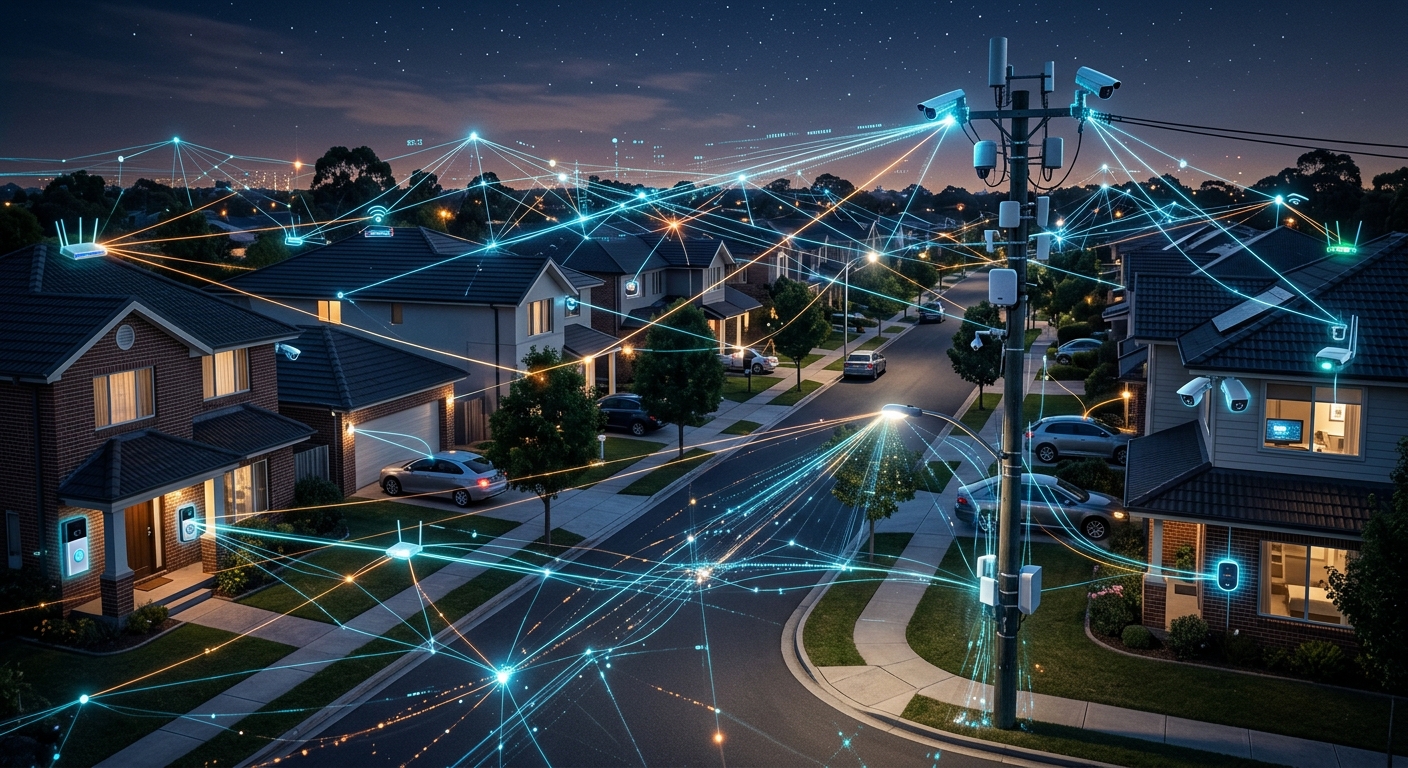
For years, the boundaries of a home’s wireless network were defined by the physical reach of a standard internet router. If a consumer stepped out into the backyard or down the street, their devices disconnected. Today, however, a quiet but profound transformation is taking place in residential communities across the globe. Technology giants are rapidly deploying neighborhood mesh networks, effectively bridging the connectivity gap between individual homes to create massive, continuous blankets of wireless coverage.
While this communal infrastructure promises heightened convenience—ensuring smart lighting stays illuminated when local routers fail, or helping owners locate misplaced fitness trackers—it also represents a significant escalation in corporate data collection. By pooling tiny slivers of bandwidth from millions of individual internet of things (IoT) devices, companies are weaving an invisible web of surveillance capabilities. As these ecosystems mature, they blur the line between private digital property and public networking, raising urgent questions regarding consumer consent, data security, and the unchecked expansion of tech-driven neighborhood surveillance.
The Mechanics of Community Networks
To grasp the implications of these vast, shared connectivity blankets, one must first understand the underlying technology. Traditional Wi-Fi operates as a localized hub, communicating only with devices in immediate proximity. In contrast, modern IoT ecosystems utilize alternative communication protocols like Bluetooth Low Energy (BLE) and the 900 MHz spectrum to create decentralized mesh networks.
When activated, everyday smart appliances act as digital bridge points. They route encrypted packets of data from a neighbor’s gadget—say, a smart dog collar, a mailbox sensor, or a remote key fob—to the wider internet, completely bypassing the need for a localized Wi-Fi connection. These community networks heavily rely on ubiquitous consumer electronics. Common bridge devices include:
- Voice Assistants and Smart Speakers: Stationary devices with constant power supplies and dedicated home internet connections.
- Outdoor Security Cameras and Video Doorbells: Devices positioned on the exterior of homes, which are physically ideal for broadcasting long-range radio signals out into the street.
- Smart Lighting Systems: Often placed on the perimeter of properties, effectively extending the mesh footprint outward.
While companies assert that the bandwidth siphoned from any single household is negligible—often capped at a fraction of a megabyte per month—the cumulative effect is a powerful, low-power wide-area network (LPWAN) owned, operated, and monetized entirely by the corporate sector.
Opt-Out by Default: The Friction of Choice
The most contentious aspect of these sprawling neighborhood networks is the manner of their deployment. Rather than asking users to consciously opt in and explicitly contribute their private internet bandwidth to a shared community pool, many tech conglomerates implement an opt-out mechanism by default. The moment a consumer plugs in a smart speaker or activates a new security camera, they are automatically enrolled as a bridge node.
Behavioral economists and consumer privacy advocates have long criticized default opt-in strategies. Human psychology dictates that the vast majority of consumers will never change the default settings on a piece of hardware. Whether due to technical intimidation, a sheer lack of awareness, or simply the inconvenience of navigating through complex, deeply buried mobile application menus, most people passively accept the baseline configuration provided by the manufacturer.
By weaponizing user friction, technology providers ensure maximum participation in their mesh networks. This aggressive onboarding strategy bypasses meaningful, informed consent. Users unwittingly pay for the underlying home internet service and the electricity required to power the devices, while the manufacturer reaps the benefits of a robust, crowdsourced infrastructure without laying a single foot of physical fiber-optic cable.
Analyzing the Deepening Privacy Implications
The expansion of shared network architectures introduces profound privacy risks that extend far beyond the walls of the individual home. Even if the actual payload data—such as the video feed from a camera or the audio command given to a voice assistant—is heavily encrypted, the network architecture relies on the constant exchange of metadata.
Metadata, often described as data about data, includes device identifiers, signal strength measurements, timestamp information, and connection logs. When aggregated on a massive scale, metadata can paint an astonishingly detailed picture of community behavior. As portable devices ping various bridge nodes while moving through a neighborhood, the underlying corporate entity can potentially track movement patterns, deduce daily schedules, and monitor the density of connected hardware in specific geographic areas.
The Federal Trade Commission (FTC) has repeatedly warned about the compounding privacy hazards associated with the IoT boom, emphasizing that the mass collection of seemingly innocuous data points can be weaponized to build comprehensive consumer profiles. A corporate network that inherently knows exactly when a user’s wearable device connects to a neighbor’s security camera has the capacity to continuously map out daily routines, personal associations, and physical locations.
Furthermore, this shared infrastructure normalizes the concept of ambient surveillance. We are rapidly migrating from a model where individuals selectively bring tracking devices into their homes to a reality where entire neighborhoods are saturated with corporate sensors. As these nodes automatically handshake and exchange data with any passing compatible gadget, the concept of physical anonymity in public spaces rapidly erodes.
Cybersecurity Concerns and the Threat Matrix
Beyond the slow erosion of privacy, the technical architecture of crowd-sourced mesh networks introduces a new array of severe cybersecurity vulnerabilities. Every digital bridge deployed in a home serves as a potential vector for malicious activity. While major companies publish extensive whitepapers detailing multi-layer encryption and data minimization techniques, the history of consumer IoT devices is riddled with critical security failures and exploited loopholes.
The National Institute of Standards and Technology (NIST) has outlined strict cybersecurity capability baselines for IoT devices, noting that edge endpoints are frequently targeted by bad actors due to their historically weak security postures. By interlinking millions of devices across varying levels of hardware sophistication, the overall attack surface expands exponentially.
Furthermore, the concept of a shared neighborhood mesh inherently involves Man-in-the-Middle (MitM) architecture, where consumer devices act as intermediaries. If the cryptography securing these packets is ever deprecated or cracked, the intermediary node could potentially snoop on the transmitted payloads. Additionally, there is the persistent threat of physical device tampering. Because many of these bridge devices, such as smart locks and outdoor cameras, are located outside the physical security of the home, they are susceptible to physical extraction of cryptographic keys. Once an attacker compromises a single physical node, they may leverage it to map the wider neighborhood topology, exploiting the trusted status that the compromised node holds within the broader mesh framework. Moreover, consumers are effectively trusting a third party to securely segment the neighborhood traffic from their private home network. If this digital partition fails, lateral movement by an attacker into the consumer’s primary local area network (LAN) could lead to the exposure of personal computers, financial records, and private communications.
Regulatory Voids and the Future of IoT Connectivity
The rapid deployment of these community networks highlights a glaring regulatory vacuum. Current data protection frameworks and telecommunications laws were predominantly drafted in an era before standard household appliances formed autonomous, continent-spanning communication webs. Presently, these networks are privately owned but rely heavily on public and private residential spaces for transmission.
There is limited governmental oversight regarding how the aggregated network topology data is stored, exactly how long it is retained, or with whom it might be shared—including data brokers or law enforcement agencies. Without comprehensive federal privacy legislation mandating explicit consent and rigid data compartmentalization, technology companies are largely left to self-regulate.
The contrast between different global jurisdictions further complicates the matter. While the European Union’s General Data Protection Regulation (GDPR) mandates strict, explicit consent for data processing and sharing, the United States currently operates under a patchwork of state-level laws. This fragmented legal landscape allows massive tech conglomerates to enforce sweeping opt-out network participation in regions without stringent consumer protections. Lawmakers must consider implementing universal baselines for IoT network deployments. Such regulations should mandate unambiguous opt-in requirements, transparent data retention policies, and independent third-party security audits to ensure that community networks serve the public interest rather than solely enriching corporate data monopolies.
Reclaiming Your Digital Footprint: Steps to Protect Your Home
For consumers concerned about the involuntary recruitment of their hardware into neighborhood-wide networks, proactive measures are necessary. Reclaiming control over your digital footprint requires routinely auditing the smart appliances actively running within your home.
Below is a table outlining the primary risks associated with shared IoT networks and the immediate mitigation strategies consumers can implement:
| Identified Risk | Potential Impact | Mitigation Strategy |
|---|---|---|
| Default Enrollment | Unwitting participation in a shared bandwidth pool, leading to unwanted data transmission and sharing of network resources. | Immediately navigate to the account settings of the companion mobile application (e.g., voice assistant apps, camera hubs) and manually disable shared community network features. |
| Metadata Tracking | Corporate entities mapping movement, associations, and routines via automatic device handshakes across mesh nodes. | Disable Bluetooth and Wi-Fi on wearable or portable smart devices when not in active use to prevent them from constantly pinging neighbor gateways. |
| Network Contamination | A compromised IoT device serving as an entry point into your private home network, allowing lateral movement by attackers. | Implement strict network segmentation. Use a modern router to place all smart home devices on a dedicated Guest Wi-Fi network, completely isolated from personal computers and phones. |
| Outdated Firmware | Exploitation of known vulnerabilities within the communication protocols of the smart gadget by automated botnets. | Enable automatic updates for all IoT devices and routinely check the manufacturer’s official website for critical security patches or hardware recalls. |
By taking these decisive steps, users can continue to enjoy the localized benefits of home automation without unwittingly serving as a structural pillar for corporate-owned surveillance infrastructure.
Conclusion: Balancing Innovation with Autonomy
The transition toward interconnected neighborhood mesh networks represents a brilliant feat of software engineering and wireless communication. However, this technological achievement must not eclipse fundamental human rights to privacy and digital autonomy. The convenience of a seamless, wide-area IoT connection simply does not justify the subtle transformation of private homes into relay stations for corporate data aggregation.
Consumers must remain continuously vigilant, actively auditing the permissions they grant to the devices they invite into their living spaces. Simultaneously, lawmakers and regulatory bodies must step forward to draft modern legislation that directly addresses the unique complexities of crowdsourced network topologies. Only through a combination of informed consumer action and robust legal safeguards can society strike a sustainable balance between harnessing the vast benefits of a connected world and preserving the fundamental sanctity of the private home.
Frequently Asked Questions (FAQs)
What exactly is an IoT mesh network?
An IoT mesh network is a decentralized communication system where individual smart devices (such as outdoor security cameras or voice assistants) act as independent nodes. Instead of communicating exclusively with a central indoor router, they pass encrypted data back and forth to each other to extend internet coverage over a much wider physical area, such as an entire neighborhood.
Does participating in a neighborhood network slow down my home Wi-Fi?
Most major tech companies heavily restrict the amount of bandwidth siphoned by these shared networks, usually capping it at a fraction of a megabyte per month. Therefore, it is highly unlikely to impact your home internet speeds noticeably. The primary concerns raised by experts revolve around privacy, corporate surveillance, and metadata tracking rather than simple bandwidth consumption.
How do I know if my devices are sharing my internet with the neighborhood?
If you own smart home gadgets—particularly voice assistants, smart lighting, or Wi-Fi-enabled security cameras from major brands—they may be enrolled in a shared network by default. You must check the specific mobile application used to control the device, navigate to the privacy or account settings menu, and look for features labeled shared network, community finding, or mesh connectivity to explicitly opt out.
Can hackers access my personal files through a shared IoT network?
While reputable companies use heavy encryption to separate community traffic from your personal local area network (LAN), any internet-connected device represents a potential vulnerability. To maximize your home security, it is strongly recommended to isolate all IoT gadgets on a separate guest Wi-Fi network so they cannot communicate directly with your personal computers, financial records, or smartphones.
References
- Amazon Sidewalk Privacy and Security Whitepaper — Amazon. 2021-09-15. https://m.media-amazon.com/images/G/01/sidewalk/final_privacy_security_whitepaper.pdf
- Internet of Things: Privacy & Security in a Connected World — Federal Trade Commission. 2015-01-27. https://www.ftc.gov/system/files/documents/reports/federal-trade-commission-staff-report-november-2013-workshop-entitled-internet-things-privacy/150127iotrpt.pdf
- IoT Device Cybersecurity Capability Baseline (NISTIR 8259A) — National Institute of Standards and Technology. 2020-05-29. https://nvlpubs.nist.gov/nistpubs/ir/2020/NIST.IR.8259A.pdf
- Privacy and the Internet of Things — Center for Long-Term Cybersecurity (CLTC) Berkeley. 2019-01-01. https://cltc.berkeley.edu/privacy-and-the-internet-of-things/
Similar Articles








Read full bio of Sneha Tete


