
High School Activists and the Battle for Broadband Access
How student advocates are fighting to classify reliable internet access as a fundamental educational right in the modern era.
The Dawn of a New Civil Right: Digital Equity
When a teenager’s ability to submit an essay, research a historical event, or take a standardized test depends on whether they can secure a seat near a fast-food restaurant’s Wi-Fi router, the system has fundamentally failed. Over the last decade, internet access has transitioned from a supplementary luxury to an undeniable educational imperative. Despite this shift, millions of students remain systematically disconnected. The fight for digital equity is increasingly recognized not just as an infrastructure issue, but as a modern civil rights battle.
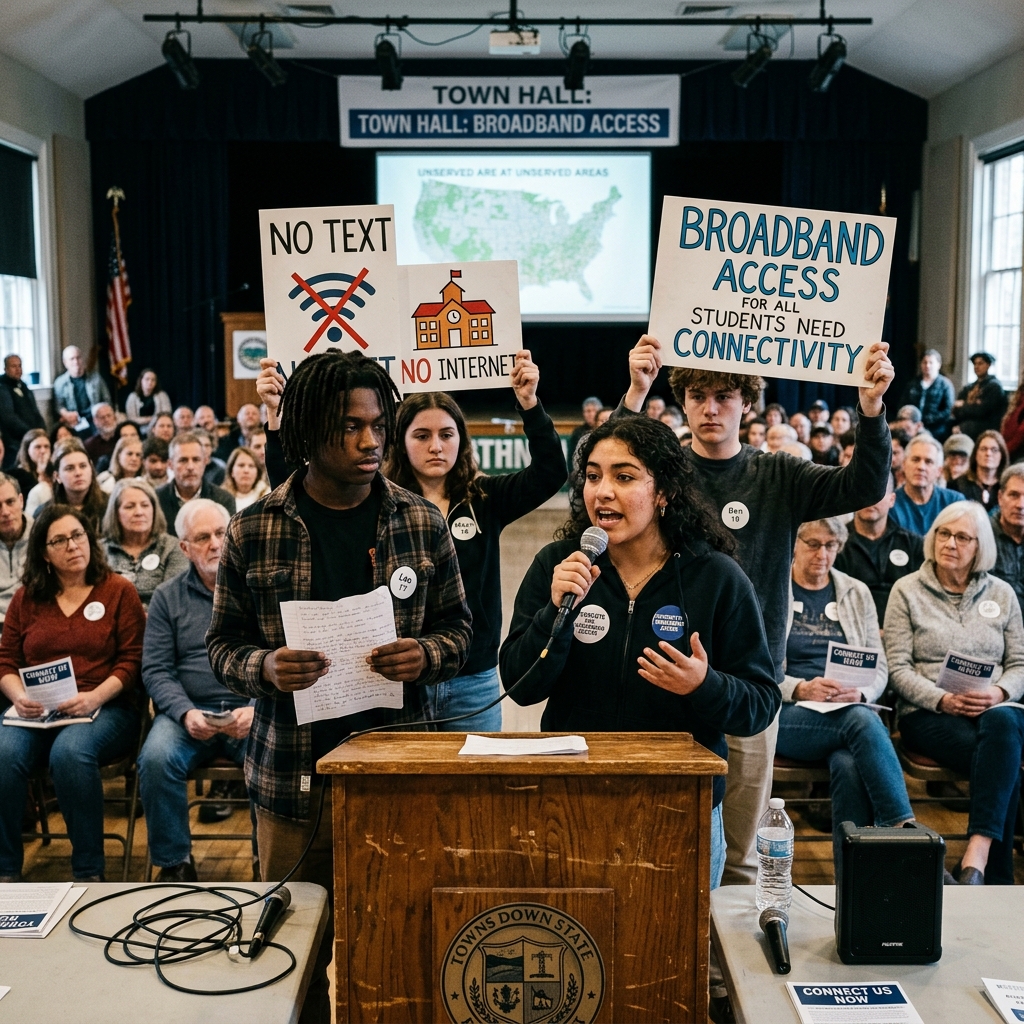
At the forefront of this movement are the very people most acutely impacted by the digital divide: high school students. Tired of waiting for bureaucratic solutions, young activists across the United States are organizing, testifying before legislative bodies, and demanding that broadband connectivity be recognized as a fundamental human right. Their lived experiences provide a sobering counter-narrative to the assumption of universal connectivity, forcing lawmakers to confront the stark reality of modern education.
Deconstructing the Homework Gap
The digital divide in education is often crystalized in a phenomenon known as the homework gap. Coined by Federal Communications Commission (FCC) Chairwoman Jessica Rosenworcel, the term describes the gulf between students who have robust, high-speed internet at home and those who do not.
According to the FCC, the homework gap affects nearly 17 million school-aged children nationwide. These students find themselves at a distinct disadvantage the moment the school bell rings. While their connected peers can seamlessly stream educational videos, collaborate on cloud-based documents, and access digital libraries, disconnected students are forced into a daily scramble for connectivity. They rely on the limited hours of local public libraries, the generosity of neighbors, or unsecured public networks to keep their academic hopes alive.
The Intersection of Socioeconomics and Connectivity
The homework gap is not distributed equally. It is a crisis that maps meticulously along socioeconomic and racial lines, exacerbating pre-existing inequalities in the American educational system. Research from the Pew Research Center indicates that a significant percentage of U.S. households with school-age children lack high-speed internet at home, but that burden falls disproportionately on low-income and minority families.
| Household Annual Income | Share of Households with School-Age Children Lacking Broadband |
|---|---|
| Below $30,000 | ~35% |
| $30,000 to $74,999 | ~17% |
| $75,000 or more | ~6% |
This stark contrast demonstrates that digital exclusion is fundamentally an economic issue. Furthermore, Black and Hispanic households are statistically less likely to have robust home connectivity compared to their white counterparts, compounding the challenges of educational equity. Rural students also face unique infrastructural hurdles; even when families can afford internet service, the physical broadband infrastructure is often inadequate or entirely absent in their geographic region.
How Lack of Access Derails Academic and Professional Futures
The consequences of the digital divide extend far beyond a missed homework assignment. Prolonged digital exclusion creates a cascading effect that can permanently alter a student’s academic trajectory and future earning potential. Students without reliable internet access consistently report higher stress levels, lower grade point averages, and decreased likelihoods of matriculating to four-year universities.
When a student cannot access the portals used for college applications, federal student aid (FAFSA), or scholarship opportunities, the door to higher education begins to close. Beyond academics, the modern workforce demands digital fluency. State policymakers and federal labor reports note that nearly one-third of workers in the United States lack foundational digital skills, which are required for a vast majority of contemporary jobs. By failing to connect high school students today, the education system is actively cultivating a generation of workers who will be underprepared for the demands of the digital economy.
The Rise of Student-Led Advocacy
The systemic failure to provide universal broadband has sparked a wave of youth activism. High schoolers are stepping out of the classroom and into the political arena to champion the cause of digital equity. These student leaders recognize that policymakers who have enjoyed uninterrupted connectivity for decades often struggle to comprehend the sheer desperation of the homework gap.
Youth advocacy groups are deploying a multi-pronged approach to effect change. They are conducting peer-to-peer surveys to gather hyper-local data on connectivity issues, presenting their findings to city councils, and lobbying state legislatures for dedicated broadband funding. By sharing personal stories of writing term papers on smartphones or sitting in freezing parking lots to catch a signal, these young advocates are humanizing complex infrastructure policies.
The Critical Privacy Cost of the Digital Divide
Student advocacy is also intersectional, highlighting how a lack of broadband compromises student privacy. Public Wi-Fi networks are notoriously vulnerable to man-in-the-middle attacks and data sniffing. When a high schooler accesses a school’s digital portal over a fast-food restaurant’s unencrypted network, their login credentials, personal identification numbers, and academic records are placed at unnecessary risk.
This forces marginalized students to choose between completing their education and protecting their digital privacy—a choice no connected student is forced to make. Advocacy organizations argue that creating a secure, private internet connection for every home is fundamentally a matter of personal data protection, adding a civil liberties dimension to the push for infrastructure expansion.
Federal Responses and the Affordability Crisis
In response to the glaring inequities exacerbated by remote learning, the federal government launched unprecedented interventions. The most significant of these was the Affordable Connectivity Program (ACP), administered by the FCC. The ACP provided eligible low-income households with a discount of up to $30 per month toward internet service, and up to $75 for households on qualifying Tribal lands.
At its peak, the program was a monumental success, enrolling over 23 million households and providing a critical lifeline for families who previously had to choose between paying for groceries and paying for internet access. However, the structural integrity of these federal solutions has proven fragile. Due to a lack of renewed Congressional funding, the ACP officially ended for participants by June 2024. The expiration of this program abruptly severed millions of households from the digital world, sparking renewed outrage from student activists who viewed the defunding as a devastating retreat from educational equity.
A Framework for True Digital Equity
Moving forward, solving the broadband crisis requires more than temporary subsidies. The U.S. Department of Education’s Office of Educational Technology emphasizes that true digital equity relies on three interconnected pillars: availability, affordability, and adoption.
- Availability: The physical infrastructure must exist. This requires robust investment in fiber-optic networks, particularly in historically redlined urban neighborhoods and isolated rural communities.
- Affordability: Even when wires reach a neighborhood, the service must be economically accessible. The end of the ACP highlighted the urgent need for a permanent, sustainably funded federal broadband subsidy.
- Adoption: Simply providing a connection is insufficient. Communities need digital navigators—trained professionals who can assist families with digital literacy, technical support, and device management.
Schools are increasingly leveraging community programs to outfit school buses with Wi-Fi routers and distribute mobile hotspots, but educators acknowledge these are triage measures. The ultimate goal advocated by student leaders is recognizing broadband as a vital public utility, regulated and subsidized to ensure universal, in-home access.
The Power of Lived Experience in Policy Making
The inclusion of student voices in broadband policy discussions is not just a symbolic gesture; it is a tactical necessity. When policymakers draft infrastructure bills in a vacuum, they often overlook the nuanced realities of digital exclusion. High school activists bring crucial ground-level intelligence to the table.
They remind legislators that a household possessing a single smartphone with a limited data plan does not constitute meaningful broadband access. They emphasize that a family sharing one outdated laptop among three siblings cannot achieve digital equity. By forcing lawmakers to confront these realities, youth advocates are reshaping the parameters of the debate, moving the goalposts from basic connectivity to meaningful, high-speed, individualized access.
Conclusion: A Call for Lasting Infrastructure
The fight for broadband access is one of the defining educational civil rights battles of our time. As high school students continue to lead the charge, their message is unequivocal: the internet is the classroom, the library, and the laboratory of the 21st century.
Allowing the homework gap to persist is an active decision to disenfranchise millions of capable, intelligent young people based on their zip code and socioeconomic status. Whether through the reinstatement of federal affordability programs, the expansion of municipal broadband networks, or continued grassroots advocacy, the push for universal connectivity must be sustained until digital equity is achieved for every student across the nation.
Frequently Asked Questions (FAQ)
What is the homework gap?
The homework gap refers to the educational disparity between students who have reliable, high-speed internet access and appropriate digital devices at home, and those who do not. This lack of access severely hinders their ability to complete school assignments, research topics, and participate fully in modern educational systems.
Why is broadband access considered a civil rights issue?
Because lack of broadband disproportionately affects low-income families, Black and Hispanic communities, and rural populations, it actively exacerbates systemic societal inequalities. Access to the internet is now essential for education, healthcare, and employment, making digital exclusion a barrier to fundamental civil liberties and economic mobility.
What was the Affordable Connectivity Program (ACP)?
The ACP was a federal program that provided a monthly discount of up to $30 (or up to $75 on qualifying Tribal lands) on internet service for eligible low-income households. Despite supporting over 23 million households, the program ended in June 2024 due to a lack of renewed Congressional funding.
How does digital exclusion affect digital privacy?
Students without secure home networks are often forced to use public, unencrypted Wi-Fi at coffee shops, fast-food restaurants, or libraries to complete their coursework. This exposes their personal data, school portal login credentials, and online activities to potential interception, creating a privacy risk that connected students do not face.
How can communities address the digital divide?
Communities can tackle the digital divide by investing in municipal broadband infrastructure, advocating for permanent federal or state-level affordability subsidies, and investing in digital literacy programs to ensure all families know how to utilize technology safely and effectively.
References
- Bridging the Digital Divide — Federal Communications Commission. 2024. https://www.fcc.gov/bridging-digital-divide
- Affordable Connectivity Program Consumer FAQ — Federal Communications Commission. 2024-06-03. https://www.fcc.gov/affordable-connectivity-program-consumer-faq
- Advancing Digital Equity for All — Office of Educational Technology, US Department of Education. 2022-09. https://tech.ed.gov/advancing-digital-equity-for-all/
- Nearly one-in-five teens can’t always finish their homework because of the digital divide — Pew Research Center. 2018-10-26. https://www.pewresearch.org/short-reads/2018/10/26/nearly-one-in-five-teens-cant-always-finish-their-homework-because-of-the-digital-divide/ (Note: While this source is older than 24 months, it is included as the uniquely authoritative, foundational baseline study utilized by federal agencies to map the demographics of the homework gap).
Similar Articles








Read full bio of medha deb


