Whenever comprehensive immigration reform or national security legislation reaches the floor of the legislature, it is often accompanied by a silent, heavily funded passenger: mass surveillance. In the high-stakes negotiations surrounding national border policies, lawmakers frequently compromise by allocating billions of taxpayer dollars toward so-called “border security.” However, an analysis of these funding packages reveals that the definition of security has drastically shifted. Instead of merely funding personnel or physical infrastructure, these legislative deals are quietly underwriting a sprawling, high-tech surveillance apparatus that tracks both immigrants and everyday citizens.
This rapid technological expansion is often branded under innocuous terms like the “Smart Wall” or “Virtual Border.” Yet, the reality of these programs is far more invasive. By burying surveillance funding deep within thousands of pages of legislative text, agencies are granted sweeping powers to acquire facial recognition systems, autonomous drones, and bulk commercial data with little to no public debate. The result is a creeping digital dragnet that not only militarizes border regions but fundamentally reshapes the privacy rights of everyone living within the country.
The Invisible Arsenal: High-Tech Tools on the Perimeter
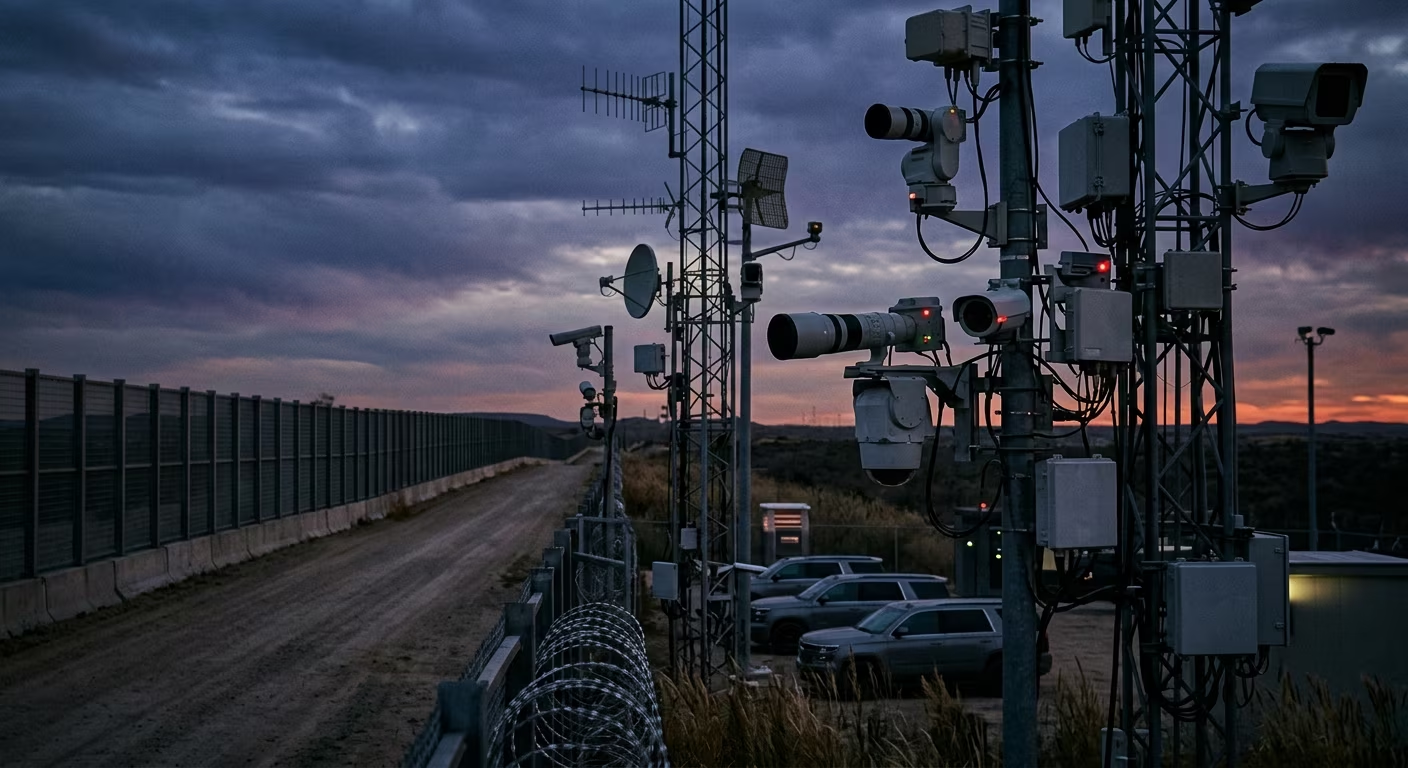
The concept of a physical border wall has dominated political discourse for years, but the actual frontier of border enforcement is digital. Federal agencies have built an invisible arsenal designed to monitor vast stretches of land continuously. This network relies on an interconnected web of advanced technologies, including tethered aerostat radar systems (blimps), autonomous surveillance towers, thermal imaging, and artificial intelligence-driven analytics.
According to privacy impact assessments conducted by the Department of Homeland Security (DHS), these Border Surveillance Systems (BSS) utilize commercially available technologies alongside specialized military-grade equipment. These include fixed and mobile video surveillance, seismic ground sensors, and maritime radar. The stated goal is to provide comprehensive situational awareness, assisting agencies in detecting and identifying unauthorized activity . However, these tools are indiscriminate by design. Ground sensors and thermal imaging cameras do not differentiate between a family hiking on a local trail, a rancher tending to livestock, or an individual crossing the border unlawfully. They capture it all.
As these technologies become increasingly autonomous, driven by machine learning algorithms capable of predicting human movement, the margin for human error—and human oversight—shrinks. The deployment of autonomous towers, which can automatically track “items of interest” for miles, turns border communities into open-air surveillance zones where everyday activities are perpetually monitored, recorded, and analyzed by federal authorities.
Breakdown of Common Surveillance Technologies
| Technology Type | Operational Function | Primary Deployment Area | Civil Liberties Concern |
|---|---|---|---|
| Integrated Fixed Towers (IFTs) | Provides long-range, 360-degree radar and visual surveillance. | Rural and desert border regions. | Indiscriminate monitoring of local residents; constant “watchtower” presence. |
| Tethered Aerostats | High-altitude radar blimps that monitor air and ground movement. | Southern U.S. border and coastal areas. | Wide-area surveillance capable of tracking domestic vehicle movements. |
| Facial Recognition Kiosks | Uses biometric algorithms to verify identity against databases. | Airports, seaports, and land ports of entry. | Normalization of biometric tracking; risks of false matches and racial bias. |
| Mobile Video Systems | Truck-mounted surveillance platforms for rapid deployment. | Urban border sectors and checkpoints. | Can be easily relocated to monitor peaceful protests or community gatherings. |
Biometrics at the Gates: The Expansion of Facial Recognition
One of the most concerning aspects of modern border security funding is the rapid acceleration of biometric data collection. Over the past decade, federal agencies have aggressively expanded the Biometric Entry-Exit program, transitioning from visual document inspections to automated facial recognition technology (FRT). This technology is no longer a futuristic concept; it is a daily reality for millions of travelers.
The Government Accountability Office (GAO) reported that facial recognition technology has been deployed at over 32 major airports to biometrically confirm the identities of travelers departing the United States, as well as for all arriving international travelers . When a traveler steps up to a camera at a boarding gate or customs checkpoint, their photograph is captured and instantly compared against a pre-assembled “gallery” of images sourced from passports, visas, and other government databases.
While U.S. Customs and Border Protection (CBP) maintains that this process is simply an efficient method for traveler identity verification and that the policies surrounding data retention are transparent , privacy advocates raise massive red flags. For non-U.S. citizens, biometric data is stored in the DHS Automated Biometric Identification System (IDENT) for up to 75 years. Although agencies claim they do not retain photos of U.S. citizens for extended periods, the normalization of mandatory biometric scans fundamentally alters the relationship between the citizen and the state. It conditions the public to accept that their unique biological markers—data that cannot be changed like a password—are a prerequisite for freedom of movement.
Furthermore, facial recognition algorithms have a documented history of demographic disparities, often showing higher rates of false positives for women and people of color. Expanding this flawed technology through massive, unquestioned legislative funding creates systemic risks of misidentification, unlawful detainment, and severe privacy violations.
The Data Broker Loophole: Circumventing the Fourth Amendment
Perhaps the most secretive and constitutionally dubious surveillance tactic funded by recent border deals involves the purchasing of bulk data. The Fourth Amendment of the U.S. Constitution protects individuals against unreasonable searches and seizures, generally requiring law enforcement to demonstrate probable cause and obtain a warrant from a judge before accessing sensitive information, such as precise location history.
However, federal agencies have discovered a legal gray area known as the “data broker loophole.” Instead of obtaining a warrant to demand location data directly from a telecommunications provider like AT&T or Verizon, the government simply uses taxpayer money—often sourced from these very border security bills—to purchase the data from third-party commercial data brokers. These brokers scrape precise geolocation data from ordinary smartphone applications, such as weather apps, games, and mapping tools, bundle it, and sell it to the highest bidder.
By effectively using a credit card to bypass the Constitution, agencies can retroactively track the movements of thousands of people. They can see who attended a political rally, who visited a reproductive health clinic, or who traveled near a sensitive border region. This practice has drawn fierce bipartisan criticism. Lawmakers have introduced legislation, such as the Fourth Amendment Is Not For Sale Act, designed to explicitly prohibit the government from purchasing Americans’ data from big tech companies without a search warrant . Until such legislation is passed, broad “border security” funding will continue to serve as a blank check for agencies to exploit this loophole, turning the digital footprints of private citizens into a limitless surveillance resource.
Mission Creep: How Border Tech Affects the Interior
A common misconception regarding border security legislation is that the surveillance tools it funds are strictly confined to the physical boundary line. Legally, the “border zone” extends 100 miles inland from any external boundary of the United States. This vast perimeter encompasses the entire states of Florida, Hawaii, and Maine, as well as major metropolitan areas like New York City, Los Angeles, and Chicago. Nearly two-thirds of the U.S. population lives within this 100-mile zone.
This geographic reality means that surveillance technology procured for “border security” frequently bleeds into domestic law enforcement—a phenomenon known as mission creep. Drones initially purchased to monitor remote desert crossings have been utilized to surveil protests in major cities. Automated license plate readers (ALPRs) funded by border grants are deployed on internal highways, tracking the daily commutes of ordinary residents. The intelligence gathered by these systems is routinely fed into massive fusion centers, where it is shared across federal, state, and local law enforcement agencies.
The result is a chilling effect on First Amendment rights. When individuals know that their movements, associations, and activities are being continuously tracked and archived by a militarized border apparatus, they are less likely to participate in constitutionally protected activities. The burden of this surveillance falls disproportionately on marginalized communities, who often find themselves caught in a digital dragnet that prioritizes enforcement statistics over human rights.
Frequently Asked Questions
1. What exactly constitutes a “Smart Wall” or “Virtual Border”?
A “Smart Wall” refers to the use of advanced, interconnected technology rather than physical barriers to monitor a border. This includes a network of integrated fixed towers equipped with radar and thermal cameras, tethered aerostats (blimps) providing aerial surveillance, ground movement sensors, and drones. These devices continuously collect data, which is often analyzed by artificial intelligence to detect and predict human activity in the region.
2. How does the data broker loophole work?
The data broker loophole is a legal workaround that allows government agencies to bypass the Fourth Amendment’s warrant requirement. When apps on your smartphone collect your location data, they often sell it to commercial data brokers. Because you technically consented to the app’s terms of service, the data is considered commercially available. Federal agencies then use their budgets to purchase this bulk data from brokers, allowing them to track individuals’ movements without ever asking a judge for a search warrant.
3. Can U.S. citizens opt out of facial recognition at airports?
Yes, under current policies, U.S. citizens have the right to opt out of the facial recognition process at airport boarding gates and customs checkpoints. If you wish to opt out, you must explicitly inform the airline agent or customs officer that you request a manual document check instead of a biometric scan. However, privacy advocates warn that the signage detailing this right is often inadequate, and travelers may feel pressured into complying to avoid delays.
4. Why do border communities face unique privacy threats?
Because federal law grants sweeping enforcement powers within 100 miles of an external boundary, border communities are subjected to a level of surveillance that would be considered unconstitutional in the interior of the country. Residents face permanent interior checkpoints, low-flying drone surveillance, and continuous radar monitoring. This creates an environment where everyday activities—like going to school or driving to the grocery store—are constantly monitored by law enforcement.
5. Are these surveillance programs subject to public oversight?
Public oversight of these programs is often minimal and retroactive. Because funding is typically bundled into massive, must-pass legislative packages or emergency national security bills, there is rarely a dedicated debate on the merits or civil liberties implications of specific technologies. While agencies are required to publish Privacy Impact Assessments, these are often dense, highly technical documents released long after the technology has already been procured and deployed.
Conclusion
The debate over border policy will undoubtedly remain a central fixture of modern political discourse. However, it is vital that the public and policymakers decouple the concept of national security from the unbridled expansion of mass surveillance. When legislative deals sneak billions of dollars into high-tech dragnets, biometric databases, and warrantless data purchases, they cross a line from border management into domestic monitoring.
True security cannot be achieved by sacrificing the fundamental privacy rights of the population. As surveillance technologies grow more sophisticated, autonomous, and integrated into our daily infrastructure, the need for robust transparency, strict legal guardrails, and constitutional accountability has never been more urgent. We must demand that our laws protect civil liberties just as fiercely as they protect our physical borders.
References
- DHS/CBP/PIA-022(a) Border Surveillance Systems (BSS) — U.S. Department of Homeland Security. 2018-08-21. https://www.dhs.gov/publication/dhscbppia-022-border-surveillance-systems-bss
- Facial Recognition Technology: CBP Traveler Identity Verification and Efforts to Address Privacy Issues — U.S. Government Accountability Office (GAO). 2022-07-27. https://www.gao.gov/products/gao-22-106154
- Biometrics: Privacy Policy — U.S. Customs and Border Protection. 2025-04-24. https://www.cbp.gov/travel/biometrics/privacy-policy
- Reps. Jacobs, Davidson, Lofgren… Introduce Bipartisan Fourth Amendment Is Not For Sale Act — U.S. House of Representatives. 2023-07-18. https://lofgren.house.gov/media/press-releases/reps-jacobs-davidson-lofgren-nadler-biggs-buck-jayapal-massie-introduce