
Federal Oversight Needed for Biometric Surveillance
Grassroots movements proved we can ban biased surveillance. Congress must act.
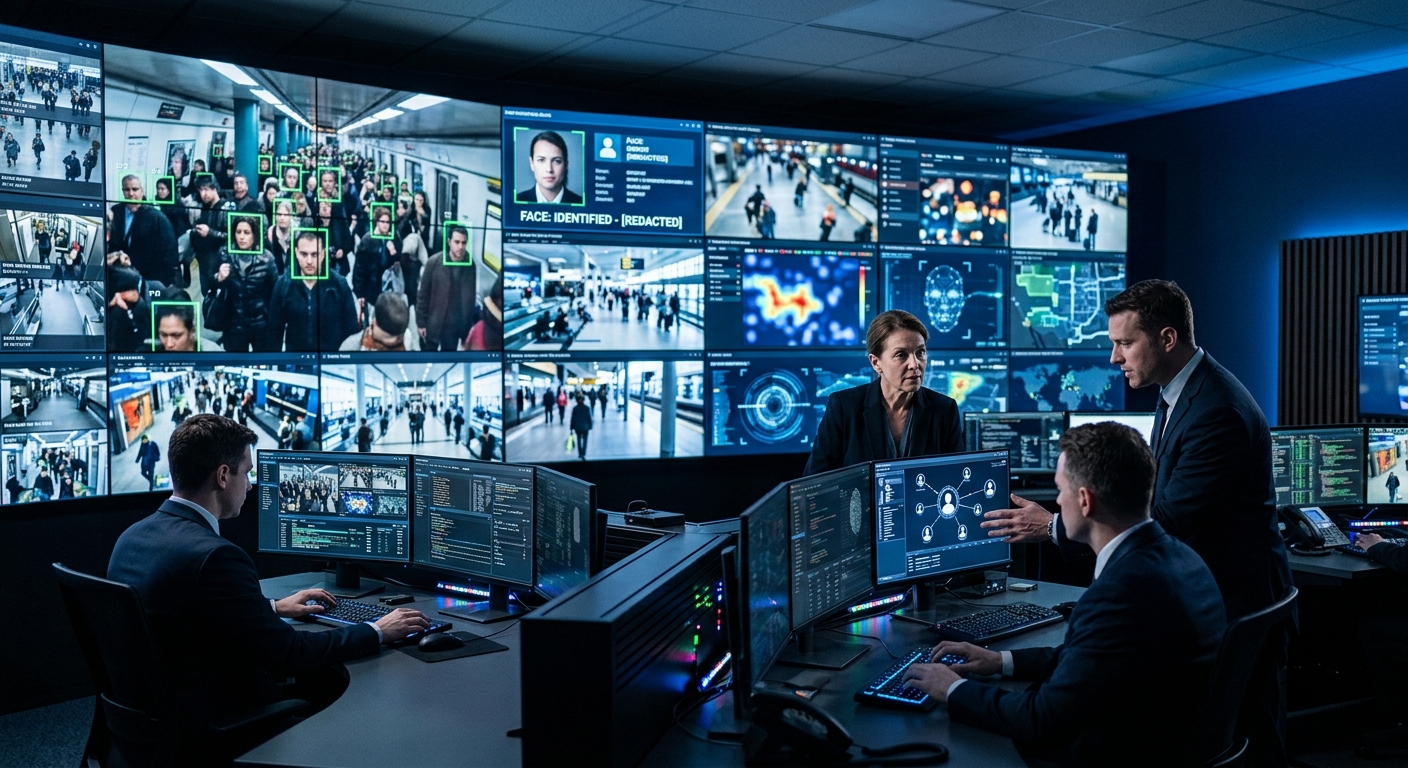
Over the past decade, facial recognition technology (FRT) has stealthily moved from the realm of science fiction into the everyday toolkit of law enforcement, government agencies, and corporate entities. From scanning crowds at sports stadiums to identifying individuals in police databases, biometric surveillance is becoming alarmingly ubiquitous. However, this unchecked and rapid expansion has triggered profound concerns regarding civil liberties, fundamental privacy rights, and systemic discrimination. While communities across the United States have mobilized to resist the implementation of these invasive systems at the local level, the broader battle is far from won. The localized patchwork of regulations is simply not enough to protect citizens from federal overreach or the rapid commercialization of biometric data. It is abundantly clear that relying solely on city ordinances and state laws is a temporary fix for a massive structural problem. To safeguard democratic freedoms, ensure equitable treatment under the law, and preserve the right to public anonymity, it is time for Congress to intervene decisively and establish comprehensive federal oversight of biometric surveillance technologies.
Unmasking the Flaws: Bias and Inaccuracy in Algorithms
The narrative often pushed by developers and proponents of facial recognition technology is that their algorithms provide an objective, infallible method for identifying suspects and securing public spaces. The reality, however, paints a much more troubling and complex picture. Artificial intelligence systems are only as objective as the data sets on which they are trained. Because historical data is inherently flawed and heavily skewed toward certain demographics, the resulting algorithms inevitably replicate, and often amplify, these human biases.
The National Institute of Standards and Technology (NIST), a premier federal laboratory, conducted one of the most comprehensive evaluations of facial recognition algorithms to date . Their findings completely dismantled the illusion of technological neutrality. The NIST report revealed significant demographic differentials, proving that false positive rates—situations where the software incorrectly matches two completely different people—are substantially higher for marginalized groups. Specifically, algorithms were found to be up to 100 times more likely to misidentify Black, Asian, and Native American individuals compared to white males. Furthermore, the technology exhibited noticeably higher error rates when analyzing the faces of women, the elderly, and children.
The consequences of these algorithmic inaccuracies are not merely academic; they are devastatingly real and alter human lives. There have been multiple documented cases across the United States where innocent individuals, disproportionately Black men, were wrongfully arrested, detained, and interrogated based entirely on a faulty facial recognition match. Beyond the immediate and severe trauma of a wrongful arrest, the psychological toll of knowing one could be arbitrarily identified as a criminal suspect creates a massive chilling effect on everyday life. People become hesitant to attend peaceful protests, participate in political rallies, or simply walk freely through their own neighborhoods. When the very infrastructure of a city treats every resident as a suspect in a perpetual digital lineup, the fundamental presumption of innocence is effectively destroyed.
Grassroots Resistance: Cities Taking the Lead
Recognizing the severe threat posed by unregulated facial recognition, ordinary citizens, digital rights organizations, and community activists have refused to sit idly by. In the glaring absence of federal leadership, a vibrant grassroots movement has emerged, demanding accountability and strict transparency from local governments. This groundswell of relentless activism has proven that organized public pressure can successfully challenge the deployment of experimental and invasive surveillance tools.
In 2019, San Francisco made history by becoming the first major American city to outright ban the use of facial recognition technology by city agencies, including the municipal police department. This landmark legislative decision sent a powerful ripple effect across the nation, proving that prioritizing civil rights over technological convenience was not only necessary but a politically viable stance. Following San Francisco’s courageous lead, several other major jurisdictions—including Boston, Massachusetts; Portland, Oregon; and Austin, Texas—enacted their own strict prohibitions. More recently, local legislatures have expanded their focus beyond police use. In May 2026, Syracuse, New York, expanded these civil protections by prohibiting businesses that are open to the public from using facial recognition to screen customers, highlighting a growing public awareness of unregulated corporate surveillance.
These local victories are a profound testament to the power of community organizing. Activists have successfully argued that the deployment of experimental, racially biased technology on the public without explicit consent or democratic oversight is fundamentally unacceptable. However, municipal bans have their operational limitations. A recent investigative report highlighted a concerning jurisdictional loophole: police departments in cities where facial recognition is officially banned have occasionally asked neighboring jurisdictions, state agencies, or regional intelligence centers to run facial recognition searches on their behalf . This clever workaround completely bypasses the democratic will of the local voters and underscores the fragility of municipal bans when faced with a sprawling, interconnected, and well-funded law enforcement ecosystem.
A Snapshot of Local and State Interventions
| City / Jurisdiction | Year Enacted | Scope of the Ban / Restriction |
|---|---|---|
| San Francisco, CA | 2019 | Prohibits the acquisition and use of facial recognition technology by all municipal departments, including the police. |
| Portland, OR | 2020 | Bans government use as well as the deployment by private corporate entities in spaces of public accommodation. |
| Boston, MA | 2020 | Bans municipal government use, explicitly citing the technology’s well-documented racial bias and threat to equity. |
| Syracuse, NY | 2026 | Prohibits commercial enterprises and businesses open to the public from utilizing facial recognition on customers. |
The Regulatory Void at the Federal Level
While local activists are forced to play an exhausting game of defense in their respective cities, federal law enforcement agencies have operated in a startling regulatory vacuum. Massive federal agencies such as the Federal Bureau of Investigation (FBI), the Department of Homeland Security (DHS), and Immigration and Customs Enforcement (ICE) have accumulated vast databases of biometric information. Often, these agencies scrape millions of images from state driver’s license repositories without the knowledge, let alone the explicit consent, of the general public.
A series of alarming, detailed reports by the U.S. Government Accountability Office (GAO) has shed light on the reckless manner in which federal agencies deploy these powerful biometric tools. A GAO investigation found that multiple federal law enforcement agencies were using facial recognition services—often provided by third-party commercial vendors—without implementing basic safeguards to protect the civil liberties of the public . Incredibly, the GAO discovered that agencies cumulatively conducted tens of thousands of facial recognition searches before ever requiring the personnel conducting these searches to undergo any specific training regarding the technology’s inherent limitations or biases.
Operating incredibly powerful surveillance tools without rigorous training, clear operating policies, or public transparency is a recipe for disaster. When federal agents are permitted to cross-reference billions of social media photos or driver’s license pictures without a targeted warrant or established probable cause, the Fourth Amendment is effectively bypassed entirely. The federal government’s uninhibited use of FRT normalizes mass surveillance, creating a pervasive tracking system that operates entirely in the shadows. Without a unified federal policy, there is absolutely nothing stopping agencies from integrating facial recognition with other surveillance tools, such as automated license plate readers and cell-site simulators, to create an inescapable, Orwellian web of monitoring.
A Call to Action for Congress: The Moratorium Act
The current legislative dynamic—where a handful of progressive cities ban the technology while the federal government deploys it relentlessly and commercial vendors sell it to the highest bidder—is unsustainable and dangerous. The incredible momentum generated by local activists must now be directed with full force toward Capitol Hill. Congress has a fundamental constitutional duty to protect the privacy and civil liberties of the American people, and its prolonged, inexplicable silence on biometric surveillance represents a profound failure of oversight.
The most viable, immediate path forward is the enactment of a sweeping federal pause on the technology. The Facial Recognition and Biometric Technology Moratorium Act, which has been introduced and refined in Congress over several legislative sessions, offers a robust and necessary legislative solution . If passed, this vital legislation would immediately prohibit the federal government’s use of facial recognition and other biometric surveillance systems unless explicitly authorized by a subsequent, strictly regulated Act of Congress. Crucially, the bill also attempts to curb state and local misuse by withholding certain federal public safety grant funding from municipalities that refuse to implement their own moratoria.
Enacting a federal moratorium is not an anti-technology stance; rather, it is a deeply pro-democracy measure. It simply acknowledges that the current iteration of facial recognition is far too flawed and far too dangerous to be unleashed on the public without restraint. A moratorium hits the necessary pause button, forcing technology vendors to finally address the inherent biases in their products and giving lawmakers the necessary time to deliberate on appropriate legal frameworks. It rightfully shifts the burden of proof onto the government and the tech companies to demonstrate that these systems can be used safely, accurately, and equitably before they are deployed, rather than rushing them to market and issuing hollow apologies for the inevitable collateral damage later.
Building a Framework for the Future
While a moratorium is the absolutely essential first step, Congress must eventually define what, if any, acceptable use of facial recognition looks like in a free society. A comprehensive federal framework must include, at a bare minimum, the following strict guardrails:
- Mandatory Judicial Warrants: Law enforcement must be required to obtain a specific judicial warrant based on probable cause before running a facial recognition search, treating it with the same severity as a wiretap.
- Independent Auditing: Algorithms must be subjected to continuous, independent testing for demographic bias by impartial agencies like NIST. Systems that fail to meet strict equity standards must be permanently disqualified from government use.
- Strict Data Minimization: Agencies must be prohibited from creating massive, centralized biometric databases. Any data collected must be destroyed immediately if it does not result in a verified, lawful match to a suspect.
- Civilian Oversight: The public must have a prominent seat at the table. Any deployment of surveillance technology must be preceded by open public hearings and require formal approval from civilian oversight boards.
- Private Right of Action: Individuals who are misidentified or wrongfully surveilled must have the legal right to sue both the government agencies and the private vendors responsible for the harm, ensuring financial accountability.
Frequently Asked Questions (FAQ)
What exactly is facial recognition technology (FRT)?
Facial recognition technology is a type of sophisticated biometric software that maps an individual’s unique facial features mathematically and stores the resulting data as a digital “faceprint.” It then uses algorithms to compare this faceprint against a massive database of known faces to either verify a person’s identity (like unlocking a smartphone) or identify an unknown person in a photograph or surveillance video.
Why is facial recognition considered racially biased?
Extensive studies, including those by the federal government, have repeatedly shown that facial recognition algorithms are significantly less accurate when analyzing the faces of people of color, women, and older individuals. This bias occurs because the data sets used to train these artificial intelligence systems disproportionately consist of lighter-skinned, male faces. Consequently, the technology struggles to accurately differentiate features in demographics it was not adequately trained on, leading to higher, dangerous rates of false matches.
Can local bans completely stop the use of facial recognition?
While local bans are incredibly powerful and a necessary step in protecting civil liberties, they are not foolproof. They only restrict the specific municipal agencies (like the local police or housing authority) within that exact jurisdiction. They do not prevent federal agencies from using the technology in that city, nor do they always stop local police from asking outside agencies to run searches for them. This systemic loophole is exactly why a comprehensive federal law is desperately needed.
What would the proposed federal Moratorium Act actually do?
The Facial Recognition and Biometric Technology Moratorium Act would make it explicitly illegal for any federal agency to use biometric surveillance systems. It would also condition the receipt of specific, lucrative federal law enforcement grants on state and local governments enacting their own identical bans, effectively pushing a nationwide pause on the technology until strict congressional safeguards are put in place and proven effective.
References
- Face Recognition Vendor Test (FRVT) Part 3: Demographic Effects — National Institute of Standards and Technology (NIST). 2019-12-19. https://nvlpubs.nist.gov/nistpubs/ir/2019/NIST.IR.8280.pdf
- Facial Recognition Services: Federal Law Enforcement Agencies Should Take Actions to Implement Training, and Policies for Civil Liberties — U.S. Government Accountability Office (GAO). 2023-09-12. https://www.gao.gov/products/gao-23-105607
- H.R.1404 – Facial Recognition and Biometric Technology Moratorium Act of 2023 — U.S. Congress. 2023-03-07. https://www.congress.gov/bill/118th-congress/house-bill/1404
- These cities bar facial recognition tech. Police still found ways to access it. — The Washington Post. 2024-05-18. https://www.washingtonpost.com/technology/2024/05/18/facial-recognition-bans-police/
Similar Articles








Read full bio of Sneha Tete


