
Fake Jury Duty Websites: How to Spot and Stop the Scam
Scammers are turning jury duty lies into fake government websites to grab your data, your money, and your peace of mind.
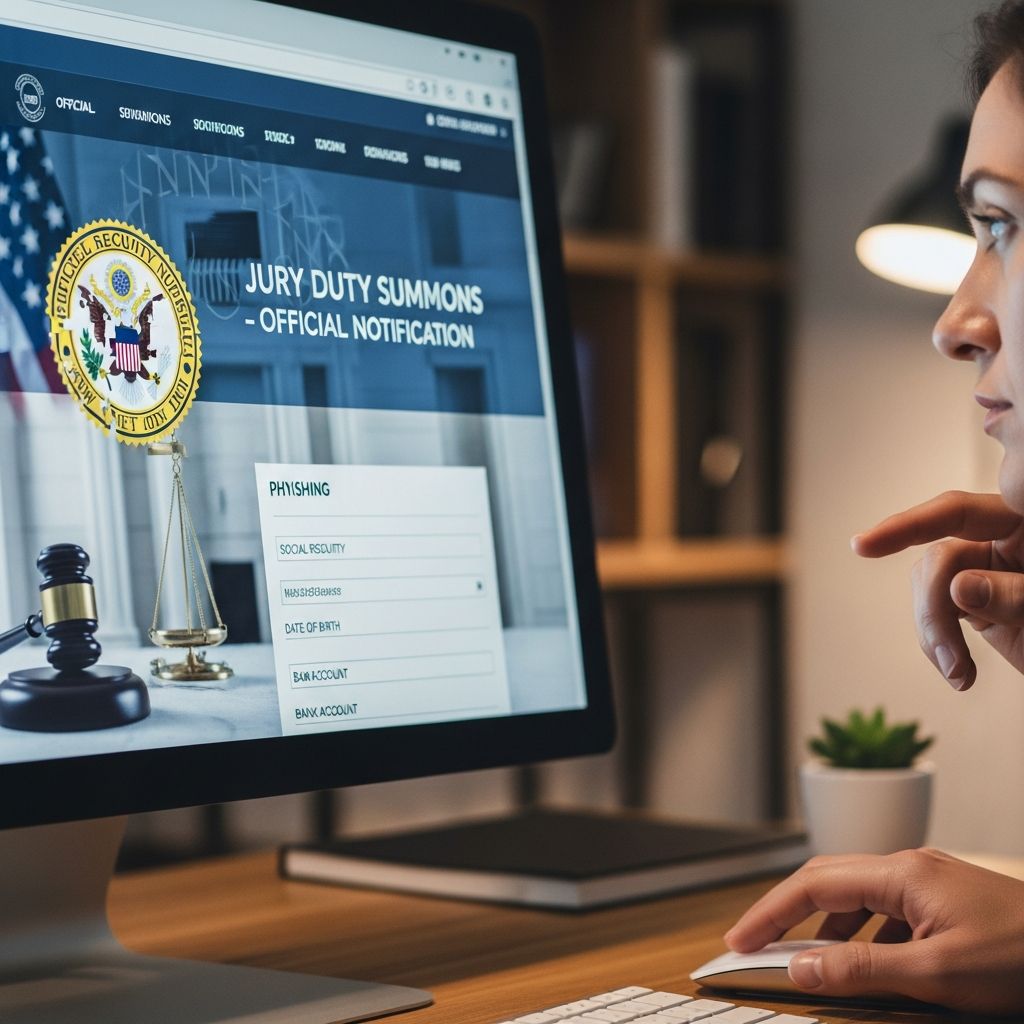
Across the United States, scammers are giving an old jury duty hoax a new digital twist by steering people to convincing fake government websites to collect personal data and money. These sites are designed to look official, complete with seals, legal language, and web addresses that resemble real court or law enforcement domains, but they exist solely to defraud you.
This guide explains how the scam works, what red flags to watch for, how legitimate jury duty contact really happens, and the steps you can take to protect yourself and your family.
1. What Is the New Jury Duty Website Scam?
Traditional jury duty scams often relied on threatening phone calls claiming you missed jury service and must pay a fine immediately. In the updated version, scammers still contact you by phone, text, or email, but now they push you to visit a fake website that pretends to be an official court or government page.
Once you are on the site, the scammers try to get you to:
- Type in sensitive information like your Social Security number and date of birth “to verify your identity.”
- Pay a supposed jury duty fine or “warrant fee,” sometimes up to thousands of dollars, using hard-to-trace payment methods.
- Follow instructions to use a made-up “government kiosk” or unusual online payment system that does not really exist.
The goal is twofold: steal your personal data for identity theft and grab as much money as possible in a single interaction.
2. How the Scam Usually Unfolds
While the exact script may vary, many cases follow a similar pattern documented by federal and state authorities.
2.1 The Initial Contact
Scammers typically reach out in one of these ways:
- A phone call from someone claiming to be a deputy sheriff, police officer, court clerk, or U.S. marshal.
- A text message warning about an urgent jury duty problem, with a link to “resolve it online.”
- An email that uses court or law enforcement logos and claims you failed to respond to a jury summons.
They may provide a fake badge number, case number, or employee ID to appear legitimate and often spoof caller ID so the number looks like a local court or police department.
2.2 The Threats and Pressure
Once they have your attention, scammers try to scare you into quick action by claiming:
- You missed jury duty and there is now a warrant for your arrest.
- You owe a large fine and will face jail time if you do not pay immediately.
- Your driver’s license or professional license will be suspended.
- You cannot hang up, talk to anyone else, or call back later.
This sense of urgency is intentional. They do not want you to stop and verify anything with the real court.
2.3 The Fake Website
Instead of simply demanding payment over the phone, newer scams direct you to a website that appears to be a legitimate government site.
Common features of these scam sites include:
- Official-looking seals, flags, or court logos copied from real agencies.
- Language about “jury compliance,” “case lookup,” or “warrant resolution.”
- Forms that ask for personal identifiers (date of birth, address, Social Security number).
- Payment pages requesting cryptocurrency, wire transfer, or gift card numbers instead of standard government payment options.
2.4 The Payment Demands
After getting your details, scammers frequently demand:
- Large “fines” that must be paid immediately to stop the arrest or warrant.
- Payment through:
- Cryptocurrency accounts or kiosks
- Gift cards (with you reading the numbers on the back)
- Payment apps or wire transfers such as Western Union or MoneyGram
- Prepaid debit cards or reloadable cash cards
Government agencies and courts do not demand payment using these methods. That demand alone is a strong sign of fraud.
3. How Real Courts Handle Jury Duty
Knowing what legitimate jury duty communication looks like helps you quickly spot scams. Information from federal courts and local judicial systems makes clear that real jury processes are much more formal and less urgent than scammers claim.
| Topic | Real Court Practices | Scam Behaviors |
|---|---|---|
| How you are contacted | Mostly through official U.S. mail; limited, neutral phone or email reminders. | Aggressive calls, texts, or emails demanding immediate action. |
| Requests for information | Courts do not ask for your full Social Security number, bank data, or passwords over the phone or in email. | Demands for full SSN, banking details, or online account credentials. |
| Handling missed jury service | If you miss jury duty, you may receive a mailed notice or be asked to appear in court at a later date. | Immediate threats of arrest unless you pay during the call or via a link. |
| Payment methods | Legitimate fines are set by a judge and paid through official court channels, often in person or via trusted online portals. | Demands for gift cards, cryptocurrency, wire transfers, or payment apps only. |
| Consequences | Non-appearance can lead to legal consequences, but they are handled through the court system, not surprise phone threats. | Immediate jail threats, license suspension, or immigration consequences used as pressure. |
4. Key Red Flags That Scream “Jury Duty Scam”
Use this checklist whenever you receive a jury-related communication that seems urgent or threatening.
4.1 Red Flags in Calls, Texts, or Emails
- The caller claims to be law enforcement, a court official, or a federal agent and opens with news about a warrant or missed jury service.
- You are told you will be arrested or jailed today unless you act immediately.
- The person refuses to let you hang up or check with anyone else.
- The message includes a link and insists you must use that exact link or website.
- The communication uses poor grammar, strange formatting, or unofficial-looking email addresses.
4.2 Red Flags on the Website Itself
- The URL is close to, but not exactly, a known government or court website.
- The site uses copied seals or logos but does not end in a trusted top-level domain (such as “.gov” for U.S. federal and many state governments).
- You must enter your full Social Security number or banking information to “look up” your record.
- The only payment options are cryptocurrency, gift cards, wire transfers, or payment apps.
- The site repeats alarming language about warrants, immediate arrest, or same-day enforcement.
5. How to Verify a Jury Duty Contact Safely
If you are worried the message could be real, do not use the phone numbers or links provided by the caller or in the email or text. Instead, verify independently using trusted sources.
5.1 Steps to Confirm Legitimacy
- Hang up or ignore the link. Do not engage further with the scammer.
- Look up the court directly. Use a search engine to find your local or federal court’s official website, or use known government directories such as the U.S. courts’ federal court finder.
- Call a published number. Use the phone number on the official court site, your jury summons, or a government directory—not the one that contacted you.
- Ask about your status. Explain what you were told and ask whether you actually missed jury duty or owe any fine.
- Check mail you have received. Authentic jury notices will generally arrive through the mail and provide clear instructions, deadlines, and official contact information.
5.2 What to Do During a Suspicious Call
- Refuse to provide any personal information or payment details.
- Write down the phone number that called you, if visible.
- Tell the caller you will verify the information directly with the court, then hang up.
6. Protecting Your Identity and Finances
Because this scam targets both your wallet and your personal information, it is important to take protective steps even if you only shared partial details.
6.1 If You Gave Out Personal Information
- Contact your bank and credit card issuers to alert them to possible fraud.
- Monitor your accounts and statements closely for unfamiliar charges.
- Consider placing a fraud alert or credit freeze with the major credit reporting companies to limit new accounts being opened in your name.
- Check your credit reports periodically for unfamiliar accounts or inquiries.
6.2 If You Sent Money
- Contact the payment provider immediately. Whether it was a bank, wire service, payment app, or cryptocurrency exchange, tell them it was a scam and ask if the transaction can be reversed or frozen.
- File a fraud report with your financial institution, which may have additional steps or protections.
- Save all documentation and screenshots in case law enforcement or regulators request evidence.
7. How and Where to Report Jury Duty Scams
Reporting these scams helps enforcement agencies spot patterns, warn the public, and sometimes stop ongoing fraud. Even if you did not lose money, your report is valuable.
- Federal Trade Commission (FTC) — The FTC collects fraud reports, including jury duty scams and fake websites, to support investigations and consumer alerts.
- Local or state court — Many courts encourage people to notify the jury office or clerk’s office if they receive suspicious jury-related calls or messages.
- Local law enforcement — You can report the scam to your local police or sheriff’s office, especially if someone used their name or badge number.
When filing a report, provide as much detail as possible: dates, phone numbers, website addresses, what the person said, and any money or information you provided.
8. Practical Tips to Stay Ahead of Fake Jury Duty Websites
Adopting a few habits can drastically lower your risk of falling for online impostors, whether they pretend to be courts, tax agencies, or other government offices.
- Be skeptical of unsolicited urgency. Real government agencies rarely demand same-day decisions over the phone.
- Type in web addresses yourself. If you need to visit a court or agency site, enter the URL manually or use a trusted bookmark rather than clicking a link in a message.
- Check for .gov domains. In the U.S., many official federal and state government sites use the
.govdomain, which is restricted to government entities. - Guard your Social Security number. Treat it as highly sensitive; do not provide it in response to calls, texts, or emails.
- Talk to family members. Older adults and people under stress can be more vulnerable to high-pressure tactics. Share what you know so they can recognize the signs, too.
Frequently Asked Questions (FAQs)
Q1: Can I really be arrested for missing jury duty?
Consequences for missing jury duty vary by jurisdiction and are handled through the court system, not surprise phone threats. If you actually miss jury service, the court may send a mailed notice or schedule a hearing, but legitimate enforcement does not begin with a demand for immediate payment over the phone or online.
Q2: Do courts ever call people about jury duty?
Some courts may call or email potential jurors with reminders or scheduling information, but they typically do not ask for sensitive data or payment in those contacts. Most official communication still arrives through the U.S. mail, and any phone or email outreach from real court staff will not include threats or demands for Social Security numbers or banking information.
Q3: How can I be sure a jury duty website is real?
Start by navigating to the site independently—through a known government directory, search engine, or the address printed on a mailed jury summons—rather than clicking a link sent by an unknown source. Confirm that the address matches your local court’s official site and that it does not ask for unusual payments or highly sensitive data just to check your status.
Q4: I already filled out forms on a suspicious site. What should I do now?
Assume the information you provided may be misused. Contact your financial institutions, consider placing a fraud alert or credit freeze with credit bureaus, monitor your accounts and credit reports, and report the scam to the FTC and your local court or law enforcement. Acting quickly can limit the damage and create a record of the incident.
Q5: Why do scammers insist on gift cards or cryptocurrency?
Gift cards, wire transfers, and cryptocurrency are difficult to trace and nearly impossible to recover once sent, which makes them ideal for criminals. Legitimate courts and government agencies do not demand payment through these channels; if someone claiming to be an official insists on these methods, it is almost certainly a scam.
References
- Scammers are using fake websites in a twist on jury duty scams — Federal Trade Commission. 2025-08-04. https://consumer.ftc.gov/consumer-alerts/2025/08/scammers-are-using-fake-websites-twist-jury-duty-scams
- Juror Scams — United States Courts. 2023-11-09. https://www.uscourts.gov/court-programs/jury-service/juror-scams
- Sophisticated Scammers Targeting Potential Jurors — Judicial Branch of Arizona in Maricopa County. 2025-04-09. https://superiorcourt.maricopa.gov/posts/press-releases/2025/sophisticated-scammers-targeting-potential-jurors/
- Be Aware of Jury Scams — North Dakota Court System. 2025-08-08. https://www.ndcourts.gov/news/north-dakota/legal-news/general-news/be-aware-of-jury-scams
- Consumer Alert: Don’t Fall for Jury Duty Scams — North Carolina Department of Justice. 2025-09-03. https://ncdoj.gov/consumer-alert-dont-fall-for-jury-duty-scams/
- Scam Alerts: How Do I? — Oregon Judicial Department. 2024-06-12. https://www.courts.oregon.gov/how/pages/id-theft.aspx
- FTC warns new jury duty scam uses fake websites to steal personal information — Legal News. 2025-08-12. https://legalnews.com/Home/Articles?DataId=1589185
Similar Articles








Read full bio of Sneha Tete


