
Fair Use vs Fair Dealing: Key Copyright Exceptions
Discover the critical differences between fair use in the US and fair dealing worldwide, and how they balance creator rights with public access.
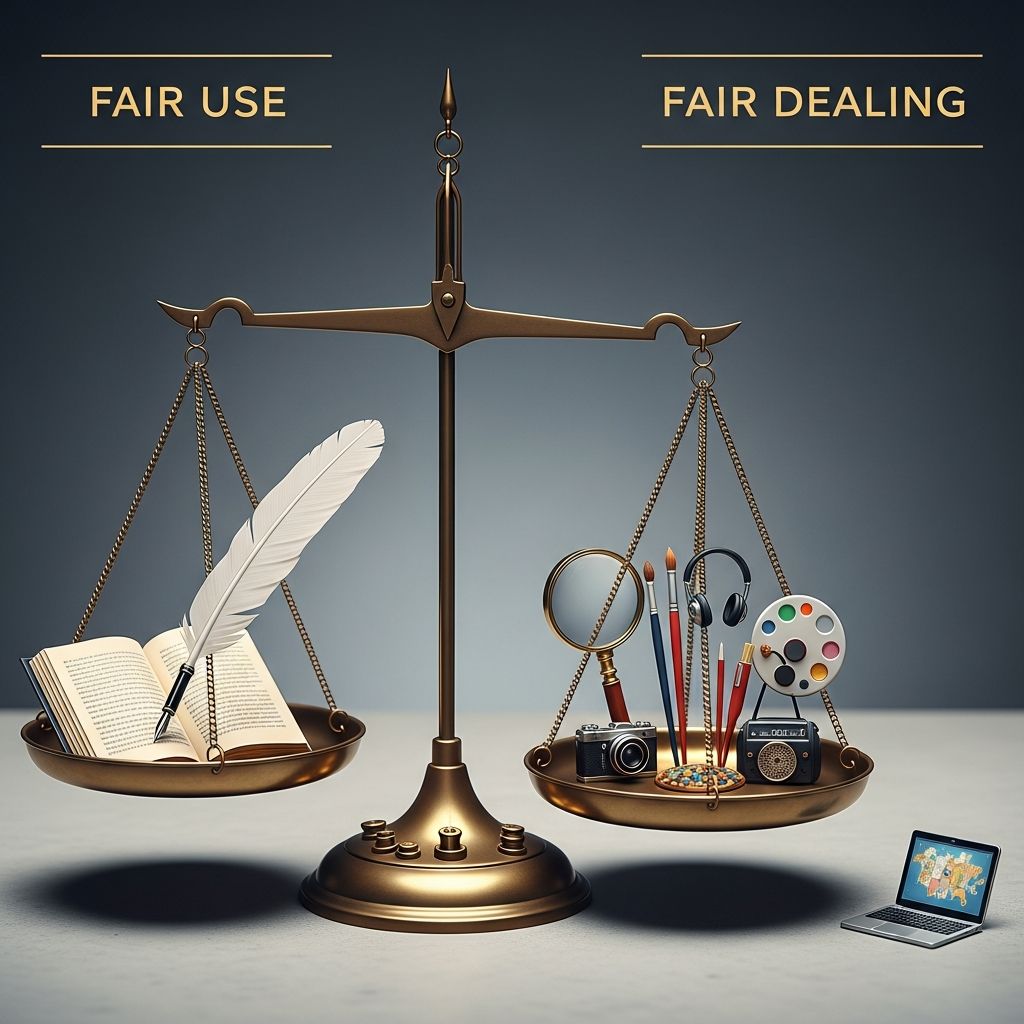
Copyright law grants creators exclusive rights over their original works, but exceptions like fair use and fair dealing allow limited use without permission to foster creativity, education, and free expression. Fair use, rooted in U.S. law, offers broad flexibility, while fair dealing in countries like Canada, the UK, and India provides narrower, purpose-specific allowances.
Foundations of Copyright Exceptions
Modern copyright protections emerge automatically when a work is fixed in a tangible form, such as writing, recording, or digital files. These rights prevent unauthorized copying, distribution, or adaptation. However, rigid enforcement could hinder progress, leading to doctrines that permit certain uses.
Fair use and fair dealing reconcile private ownership with public benefit. They enable criticism, scholarship, and innovation by allowing portions of works to be used transformatively. In the U.S., fair use is enshrined in Section 107 of the Copyright Act of 1976, promoting First Amendment values. Internationally, fair dealing appears in Berne Convention-compliant laws, tailored to national priorities.
Defining Fair Use in American Law
Fair use is a flexible U.S. doctrine permitting unlicensed use of copyrighted material for purposes like criticism, commentary, news reporting, teaching, or research. Unlike permissions-based systems, it functions as a right, not just a defense; copyright holders must consider it before issuing takedown notices under the DMCA.
Courts evaluate fair use through a four-factor balancing test:
- Purpose and character of the use: Transformative uses (adding new meaning) favor fair use. Commercial vs. nonprofit weighs against, but profit alone doesn’t disqualify.
- Nature of the copyrighted work: Factual works (news) are more fair-use friendly than creative fiction.
- Amount and substantiality: Small portions are preferable; ‘heart of the work’ (core essence) weighs against.
- Market effect: Uses harming the original’s sales or licensing potential are less likely fair.
In Lenz v. Universal Music Corp. (2015), the Ninth Circuit ruled fair use a statutory authorization, requiring good-faith consideration before DMCA claims. This underscores its role beyond mere litigation defense.
Understanding Fair Dealing Across Jurisdictions
Fair dealing operates in common law nations like the UK, Canada, Australia, India, and Ireland. It lists specific allowable purposes, such as research, private study, criticism, review, news reporting, parody, or satire.
Unlike fair use’s open-ended test, fair dealing requires two steps: (1) the use fits a permitted category, and (2) it is ‘fair.’ Fairness considers factors like amount used, commercial nature, and alternatives available. For example, Canada’s Copyright Act allows dealing for education but limits copying to what’s necessary.
| Jurisdiction | Key Permitted Purposes | Notable Features |
|---|---|---|
| Canada | Research, education, parody, news | Expansive post-2012 reforms; includes user-generated content. |
| UK | Criticism, review, quotation, caricature | CDPA Section 30; case-by-case fairness. |
| India | Private use, criticism, review (Section 52) | Inclusive list; judicial interpretation expands scope. |
| Australia | Research, parody, satire | Recent expansions for education and disability access. |
Fair dealing is narrower, providing predictability but less adaptability to new tech like AI training data.
Core Differences: Flexibility vs Specificity
The primary distinction lies in scope: U.S. fair use applies universally across works and uses via a proportionality test, making it broader and more unpredictable. Fair dealing is categorical—uses outside listed purposes fail outright.
U.S. courts weigh all factors holistically, favoring transformation and minimal market harm. Fair dealing jurisdictions first gatekeep by purpose, then assess fairness, often mirroring U.S. factors but rigidly.
- Prediction: Fair use invites litigation for borderline cases; fair dealing offers clearer ex-ante guidance.
- Innovation: Fair use better suits digital remixes; fair dealing evolves slowly via legislation.
- Global Trends: Israel and some fair dealing nations (e.g., Singapore) adopt hybrid ‘fair use’ models for flexibility.
Practical Applications and Real-World Examples
In education, U.S. teachers photocopy articles under fair use if limited and transformative. Fair dealing permits similar for ‘private study’ but caps excerpts.
Parody thrives under both: U.S. Campbell v. Acuff-Rose (1994) protected 2 Live Crew’s rap version of ‘Oh, Pretty Woman’ as transformative. UK courts allow satire if fair.
News reporting quotes sources freely under both, but thumbnails in search engines favor fair use’s market-substitution analysis. AI datasets challenge both: U.S. courts lean fair use for non-consumptive analysis; fair dealing may require purpose-fit.
Navigating Risks and Best Practices
Even favored uses risk lawsuits; defendants bear the burden in U.S. courts. Document your four-factor analysis: purpose (e.g., critique), portion (e.g., 10% quote), nature (factual), and no market harm (e.g., links back).
For international users, check jurisdiction—U.S. platforms often apply fair use, but uploads from fair dealing countries face scrutiny.
- Seek permissions for commercial uses.
- Use public domain or Creative Commons alternatives.
- Consult fair use checklists from Harvard or Stanford.
Future Directions Amid Digital Evolution
Technology blurs lines: deepfakes, NFTs, and generative AI test doctrines. Fair Use Week promotes awareness, highlighting mass digitization as fair. Reforms in fair dealing nations aim for U.S.-style breadth to handle streaming and social media.
These exceptions remain vital for balancing monopoly with progress, adapting to ensure copyright fosters, not fetters, culture.
Frequently Asked Questions
Is fair use the same as public domain?
No. Public domain works have expired copyrights; fair use permits limited use of protected works.
Can I use fair use for commercial YouTube videos?
Possibly, if transformative and low market impact, but courts scrutinize closely.
Does fair dealing apply in the European Union?
EU uses ‘exceptions and limitations’ (InfoSoc Directive), similar but not identical to fair dealing.
How much can I quote under fair use?
No fixed amount—depends on factors; brevity helps.
Is parody always fair use?
In the U.S., often yes if mocking the original; elsewhere, must fit permitted purposes.
References
- Fair use – Wikipedia — Wikipedia contributors. 2026 (ongoing). https://en.wikipedia.org/wiki/Fair_use
- What Constitutes “Fair Use” and “Fair Dealing”? — Songtrust. Accessed 2026. https://help.songtrust.com/knowledge/what-constitutes-fair-use-and-fair-dealing
- Comparison Between Fair Use and Fair Dealing — IP Matters. 2023. https://www.theipmatters.com/post/comparison-between-fair-use-and-fair-dealing
- Copyright and Fair Use — Harvard University Office of the General Counsel. Accessed 2026. https://ogc.harvard.edu/pages/copyright-and-fair-use
- U.S. Copyright Office Fair Use Index — U.S. Copyright Office. Accessed 2026. https://www.copyright.gov/fair-use/
- Fair Use/Fair Dealing Week — Fair Use Week. Accessed 2026. https://www.fairuseweek.org
Similar Articles








Read full bio of medha deb


