
The Digital Panopticon: AI and Big Data in Policing
Explore how AI and big data are transforming law enforcement and privacy.
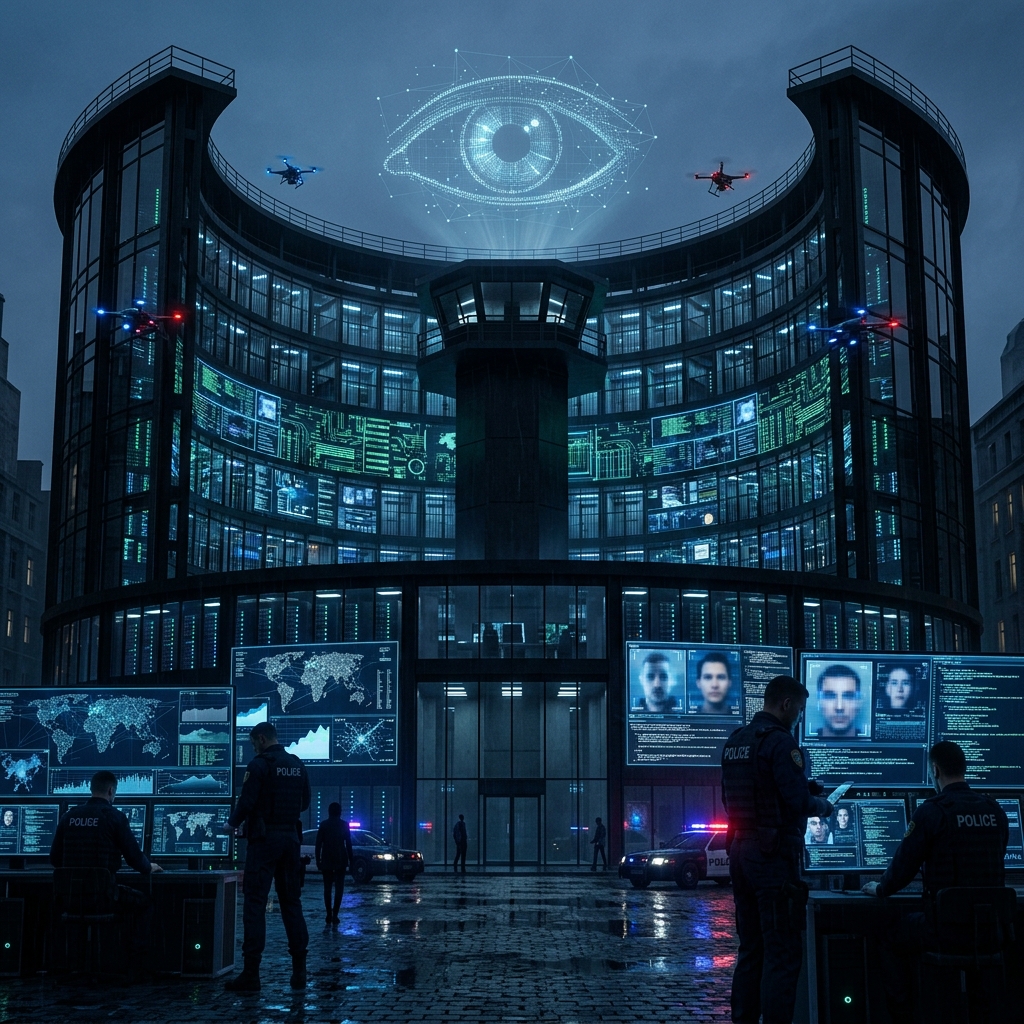
Law enforcement agencies across the United States are undergoing a profound metamorphosis. Gone are the days when policing relied solely on foot patrols, physical evidence, and human intuition. In their place, a sprawling, interconnected web of artificial intelligence (AI), machine learning algorithms, and massive data repositories has emerged. This new era of big data policing promises unprecedented efficiency and the tantalizing possibility of stopping crimes before they happen. However, this high-definition, artificially intelligent, all-seeing future raises profound ethical, legal, and constitutional questions. The transformation of law enforcement into a digital panopticon threatens to erode the foundational privacy rights democratic societies hold dear. The rapid deployment of these technologies often outpaces regulatory frameworks, leaving vulnerable communities at the mercy of algorithms that may inherit and amplify historical prejudices.
The Architecture of Omniscience: Modern Surveillance Tools
The modern police department is increasingly equipped with a dizzying array of high-tech surveillance tools. These devices capture, categorize, and cross-reference massive amounts of information without public consent. The true power of this architecture lies in fusing multiple data streams to create comprehensive profiles of individuals’ movements, habits, and associations.
Visual Surveillance and the Erosion of Anonymity
Facial recognition technology (FRT) stands at the forefront of this visual revolution. Powered by deep learning algorithms, FRT instantly compares faces captured on closed-circuit television cameras, body-worn cameras, or social media against massive databases containing millions of mugshots and driver’s license photos. While proponents argue this technology is crucial for identifying suspects in crowded areas or solving cold cases, critics point to severe risks of misidentification and the total loss of public anonymity. The deployment of FRT has been notably haphazard; a report by the U.S. Government Accountability Office (GAO) found that several federal law enforcement agencies used facial recognition services without requiring staff to undergo specialized training or establishing policies to protect civil liberties. This regulatory void means individuals can be tracked, identified, and potentially detained based on the opaque calculations of a proprietary algorithm.
Tracking the Digital Exhaust
Beyond visual identification, law enforcement actively harvests the digital exhaust we leave behind in our daily lives.
- Automated License Plate Readers (ALPRs): Mounted on police cruisers, streetlights, and highway overpasses, ALPRs capture thousands of license plates per minute, logging the date, time, and GPS coordinates of every passing vehicle. This allows authorities to reconstruct a person’s travels over weeks, revealing intimate details about their medical visits and personal relationships.
- Cell-Site Simulators (Stingrays): These devices mimic legitimate cell phone towers, tricking nearby mobile devices into connecting with them. Once connected, Stingrays can intercept location data and call logs from all phones in the vicinity, not just the target suspect’s.
- Data Brokers: Police departments increasingly bypass warrant requirements by purchasing location data, app usage statistics, and browsing histories directly from commercial data brokers, blurring the line between corporate data collection and government surveillance.
Algorithmic Arbiters: The Rise of Predictive Policing
Predictive policing represents one of the most controversial applications of AI in law enforcement. These systems ingest massive volumes of historical crime data, weather patterns, and socioeconomic indicators to forecast where crimes are likely to occur, or even who is likely to commit them.
The allure of predictive policing is its promise of objectivity—a mathematical approach to resource allocation that supposedly removes human bias. However, the reality is far more complex and troubling. Machine learning models are only as unbiased as the data they are trained on. Because historical crime data is often skewed by decades of disproportionate policing in minority and low-income neighborhoods, predictive algorithms frequently create a self-fulfilling prophecy.
A study published in Nature Human Behaviour by University of Chicago researchers demonstrated this phenomenon. The study found that while algorithms could predict crime accurately, they also revealed deep-seated biases in police responses; crimes in wealthier neighborhoods resulted in more arrests, whereas crimes in disadvantaged areas saw a drop in arrests, indicating that the data reflects enforcement bias rather than actual crime rates. When algorithms direct officers to patrol specific hot spots more heavily, they inevitably discover more minor infractions. These new arrests are fed back into the system, further validating the algorithm’s biased predictions and locking marginalized communities into an endless cycle of over-policing and heightened suspicion.
| Technology | Function | Primary Privacy Concern |
|---|---|---|
| Facial Recognition | Matches facial features against databases | Misidentification, racial bias, loss of anonymity |
| ALPRs | Scans and logs vehicle license plates | Persistent tracking of movement and associations |
| Stingrays | Intercepts cellular device signals | Mass collection of bystander data without a warrant |
| Predictive AI | Forecasts crime locations and suspects | Reinforcement of historical bias and over-policing |
| Drone Surveillance | Aerial monitoring of public events | Intrusive observation of peaceful protests |
Unmasking the Flaws: Bias in Facial Recognition
The assumption that artificial intelligence is inherently neutral is fundamentally flawed, especially concerning facial recognition. Extensive research demonstrates that these systems suffer from severe demographic differentials. Algorithms often perform exceptionally well on white male faces but struggle significantly with women, children, and people of color.
A comprehensive study by the National Institute of Standards and Technology (NIST) analyzed demographic effects across 189 facial recognition algorithms. The report, Face Recognition Vendor Test (FRVT) Part 3: Demographic Effects, concluded that the majority of algorithms exhibited empirical evidence of demographic differentials. Specifically, false positive rates—incorrectly matching two different people—were significantly higher for West African, East Asian, and African American faces compared to Eastern European demographics.
In a law enforcement context, a false positive is not merely a technical glitch; it can result in wrongful arrest, detention, and lasting trauma. The fact that the burden of these algorithmic failures falls disproportionately on historically marginalized groups highlights the urgent need for critical oversight and, in some cases, outright bans on the use of FRT in policing until these inherent flaws are rectified.
The Intersection of Privacy and Civil Liberties
The integration of big data and AI into policing fundamentally alters the relationship between the state and its citizens, raising severe constitutional concerns.
- The Fourth Amendment in the Digital Age: The Fourth Amendment protects citizens from unreasonable searches and seizures. Historically, this meant police needed a warrant to search a physical space like a home. However, the digital age has complicated this standard. When police can track a person’s movements via ALPRs or purchase location history from a data broker, they bypass the traditional warrant requirement. Legal scholars advocate for a mosaic theory of privacy, suggesting that while individual data points might not warrant protection, the aggregation of these points creates a comprehensive picture of a person’s life that should require judicial oversight.
- The Chilling Effect on First Amendment Rights: The pervasive use of surveillance technology also threatens First Amendment freedoms of speech and association. When citizens know they are watched, recorded, and analyzed by government algorithms, they are less likely to participate in lawful protests or associate with controversial groups. This chilling effect is particularly pronounced when police deploy drones and FRT at peaceful demonstrations, effectively treating the exercise of democratic rights as inherently suspicious behavior.
The Regulatory Void and the Path Forward
Technology traditionally advances at a breakneck pace, while legislation crawls. This dynamic creates a regulatory void where law enforcement agencies adopt invasive technologies with minimal public transparency, oversight, or legislative approval. Contracts with surveillance vendors are often shielded by non-disclosure agreements, leaving city councils and taxpayers uninformed about the tools their police departments are using and what safeguards, if any, are in place.
However, there is a growing movement to rein in the digital panopticon. At the federal level, the White House Office of Science and Technology Policy released the Blueprint for an AI Bill of Rights, outlining principles to protect the public from algorithmic harms. The Blueprint explicitly emphasizes that automated systems should be designed to protect civil rights, civil liberties, and privacy, and that citizens should be free from unchecked surveillance.
At the local level, advocacy groups are pushing for Community Control Over Police Surveillance (CCOPS) laws. These ordinances require police departments to publicly disclose any new surveillance technology, detail how it will be used, and obtain explicit approval from elected city councils before deployment. Several jurisdictions have even enacted outright bans on government use of facial recognition technology, recognizing that the risks to civil liberties currently outweigh the theoretical benefits to public safety.
Conclusion
The shift toward a high-definition, artificially intelligent, all-seeing future of big data policing is not inevitable; it is a series of choices made by vendors, police departments, and policymakers. While technology can undoubtedly aid in solving crimes and maintaining public safety, it must not come at the cost of our fundamental democratic values. A society in which every movement, association, and facial expression is cataloged and analyzed by opaque algorithms is fundamentally incompatible with the principles of freedom and privacy. As we navigate this complex digital frontier, we must demand transparency, insist on robust legal frameworks, and ensure that technology serves the public interest rather than subjecting citizens to perpetual, unchecked surveillance.
Frequently Asked Questions (FAQs)
What is predictive policing?
Predictive policing involves using machine learning algorithms and historical crime data to forecast where and when future crimes might occur, or to identify individuals statistically more likely to commit or become victims of crime.
Why is facial recognition technology considered controversial?
Facial recognition exhibits severe demographic bias, often resulting in higher rates of false positives for women and people of color. This can lead to wrongful arrests and violations of civil rights. Additionally, widespread use functionally eliminates public anonymity.
How do Automated License Plate Readers (ALPRs) impact privacy?
ALPRs automatically capture the license plate, time, and location of passing vehicles. Aggregated over time, this data creates a detailed map of a person’s movements, revealing private information such as medical visits, political affiliations, and personal associations.
What is the Blueprint for an AI Bill of Rights?
The Blueprint for an AI Bill of Rights is a framework introduced by the White House providing non-binding guidelines to protect the public from the potential harms of automated systems, focusing on data privacy, safe system design, and protection against algorithmic discrimination.
What are CCOPS laws?
Community Control Over Police Surveillance (CCOPS) laws are local ordinances requiring law enforcement agencies to obtain approval from elected officials and the public before acquiring or deploying new surveillance technologies.
References
- Facial Recognition Services: Federal Law Enforcement Agencies Should Take Actions to Implement Training, and Policies for Civil Liberties — U.S. Government Accountability Office (GAO). 2023-09-05. https://www.gao.gov/products/gao-23-105607
- Event-level prediction of urban crime reveals a signature of enforcement bias in US cities — Nature Human Behaviour / Chattopadhyay, I. et al. 2022-06-30. https://www.nature.com/articles/s41562-022-01372-0
- Face Recognition Vendor Test (FRVT) Part 3: Demographic Effects — National Institute of Standards and Technology (NIST) / Grother, P. et al. 2019-12-19. https://nvlpubs.nist.gov/nistpubs/ir/2019/NIST.IR.8280.pdf
- Blueprint for an AI Bill of Rights — The White House Office of Science and Technology Policy. 2022-10-01. https://www.whitehouse.gov/ostp/ai-bill-of-rights/
Similar Articles








Read full bio of Sneha Tete


