
Digital Health Verification: Risks & Equity
Examining the hidden privacy and equity costs of digital health credentials.
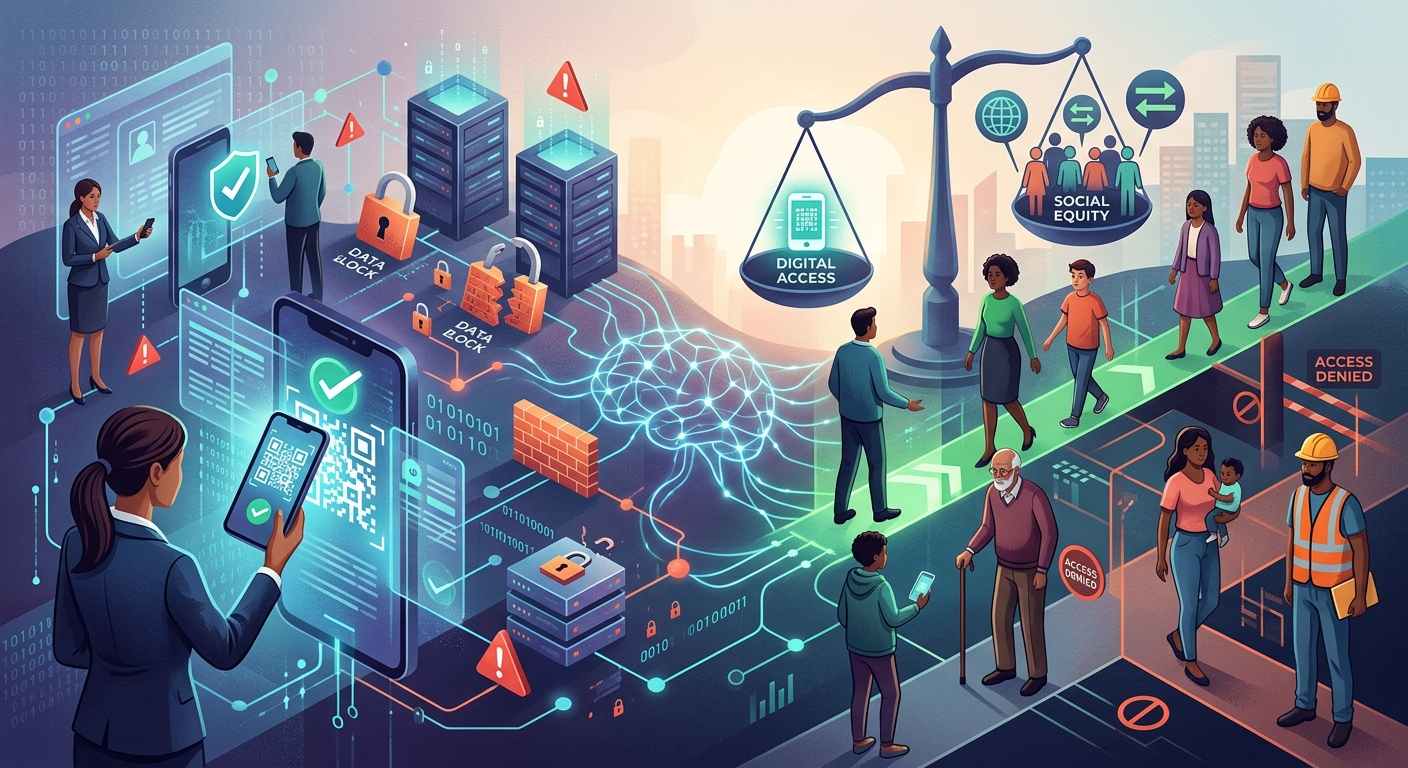
Navigating the Digital Health Credential Landscape
As the world increasingly digitizes core infrastructural functions, the implementation of digital health verification systems has moved from theoretical discussions to tangible reality. Originally brought to the forefront of public consciousness as emergency measures during global health crises, these digital architectures—often referred to as digital health credentials, health wallets, or verification passes—are now being proposed for long-term use in travel, employment, and access to public spaces. Proponents consistently argue that transitioning away from analog records to digital health passes will streamline verification processes, reduce instances of fraud, and enhance overall public safety. However, the aggressive rush to deploy these technologies introduces severe, often irreversible risks to civil liberties.
Without meticulous, privacy-first design, these systems threaten to normalize mass biometric surveillance, compromise deeply sensitive personal health data, and permanently widen the digital divide. The transition from a simple paper document to an app-based verification ecosystem is not merely a technological upgrade; it is a fundamental shift in how individuals interact with society. It is imperative to deeply scrutinize the underlying frameworks, data policies, and socioeconomic impacts of these digital credentials before they become an unavoidable and mandatory layer of everyday civic participation.
The Vulnerabilities of Centralized Data Honeypots
One of the most pressing dangers of modern digital health verification lies in the architecture of data storage. Many early iterations of health passes relied on centralized databases. In these systems, a single government agency or corporate entity aggregates the health status, identity documents, and location data of millions of citizens. In the realm of cybersecurity, such massive data silos are known as “honeypots”—highly attractive targets for malicious actors, state-sponsored hackers, and organized cybercriminals.
When a digital health credential relies on a cloud-based, centralized verification protocol, every instance of an individual presenting their pass triggers a digital handshake with a remote server. This constant pinging generates an intricate, highly revealing breadcrumb trail of a person’s movements, social associations, and daily routines. If that centralized database is breached, the fallout is catastrophic, leading to widespread identity theft and the permanent exposure of immutable medical data.
Furthermore, the involvement of third-party vendors in building and maintaining these systems introduces an entirely separate layer of vulnerability. When users are forced to upload government-issued identification alongside their medical history to proprietary platforms, they frequently lose autonomy over their digital footprint. As highlighted by the Electronic Frontier Foundation (EFF), relying on third-party verification services often means users have no direct control over how their data is stored, where it is routed, or whether it will be securely deleted once the immediate verification process concludes. The fundamental rule of data security is that information collected is information at risk, and centralized health credentials collect far more data than is strictly necessary.
The Threat of Technological Scope Creep
Perhaps the most insidious danger associated with the mainstream adoption of digital health credentials is “scope creep.” This is a well-documented phenomenon in technology policy where infrastructure built for a specific, often temporary, purpose gradually expands to encompass entirely unrelated areas of civic life. History repeatedly demonstrates that surveillance infrastructure, once established and normalized during a crisis or specific public health event, is rarely dismantled when the original justification subsides. Instead, the technology is aggressively repurposed.
If society normalizes the routine act of scanning a biometric profile or digital barcode to enter a grocery store, attend a concert, or board a domestic flight, the underlying identity architecture can easily be co-opted for other forms of monitoring. A system originally designed to verify a specific immunization status could seamlessly transition into a generalized digital identity wallet. From there, it is an incredibly short conceptual and technological leap to integrating age verification, financial credit scores, or even social behavioral metrics into the exact same access-control mechanism. This mission creep transforms a seemingly benign public health tool into a permanent checkpoint society. The EFF has warned that entangled digital identity infrastructures block web information access and normalize a surveillance regime that conditions the public to accept constant tracking as the standard price of admission to everyday life.
Marginalization by Design: Widening the Digital Divide
Beyond privacy and surveillance, the widespread mandate of digital health credentials poses a profound and immediate threat to social equity. The fundamental assumption underlying most app-based verification systems is that every citizen has reliable access to a modern smartphone, a stable data connection, and the digital literacy required to navigate complex user interfaces. This assumption is deeply flawed and ignores the stark realities of the digital divide.
Significant disparities in technology adoption remain rigidly entrenched across income, education, and age brackets. According to the Pew Research Center, substantial divides exist based on income and formal education levels, with millions of lower-income individuals either not owning a smartphone at all or operating as “smartphone-dependent” users who lack home broadband and face severe limitations on data plans and device capabilities. Furthermore, elderly populations, undocumented immigrants, unhoused individuals, and marginalized rural communities frequently lack the consistent technological access and connectivity required to maintain an active digital health wallet.
When basic access to public transit, employment, educational institutions, or government services is suddenly made contingent upon presenting a digital pass, those without the requisite technology are abruptly and systematically disenfranchised. This dynamic creates a deeply unjust two-tiered society: a digitized upper class that can seamlessly navigate the physical world using the latest hardware, and a marginalized underclass that is locked out of the public square simply because they cannot afford or operate the necessary technology.
Architectural Solutions: Verifiable Credentials and Data Minimization
If digital health verification is to exist without actively dismantling civil liberties, it must be rebuilt from the ground up using strict privacy-first architectures. The prevailing and most promising standard for this is the concept of “Verifiable Credentials,” a framework championed by the World Wide Web Consortium (W3C) and increasingly recognized by standard-setting institutions like the National Institute of Standards and Technology (NIST).
Unlike dangerous centralized systems, verifiable credentials rely on decentralized cryptographic proofs. In this sophisticated model, a recognized health authority (the issuer) provides a secure digital signature to the user’s local mobile device (the wallet). When the user needs to prove their health or identity status to a venue or employer (the verifier), the application generates a cryptographic token. This token confirms the user’s status locally, without ever needing to phone home to a central database or reveal extraneous personal details.
Crucially, this architecture inherently supports “selective disclosure.” If a venue only needs to know whether a person meets a specific minimum health requirement or age threshold, the digital pass can verify a simple “yes” or “no” without exposing the user’s full legal name, exact date of birth, home address, or comprehensive medical history. The World Health Organization (WHO) has actively highlighted the importance of robust public key infrastructure (PKI) and internationally recognized standards for privacy and data protection in establishing trusted, decentralized digital health networks that protect user autonomy. By keeping the sensitive data securely stored locally on the user’s personal device and requiring explicit cryptographic consent for every single interaction, decentralized architectures drastically mitigate the risks of mass surveillance and identity theft.
Comparing Digital Credential Architectures
Understanding the technical differences between credential architectures is vital for policymakers and the public. The method of data storage directly dictates the level of privacy risk.
| Feature / Risk Profile | Centralized Databases | Decentralized Verifiable Credentials |
|---|---|---|
| Data Storage | Aggregated on remote third-party or government servers. | Stored locally on the individual’s personal device. |
| Verification Process | Requires internet connection; ‘phones home’ to check status. | Can occur offline using localized cryptographic proofs. |
| Data Minimization | Often shares full profiles; high risk of over-sharing. | Supports selective disclosure (e.g., sharing only a ‘yes/no’ status). |
| Tracking Potential | High. Central server logs every scan, creating a movement map. | Low. Verification happens peer-to-peer without central logging. |
The Absolute Necessity of Analog Alternatives
Even if policymakers and technologists successfully mandate the most robust, privacy-preserving digital architecture imaginable, technology can and will fail. Smartphone batteries die, cellular networks experience catastrophic outages, devices are lost or stolen, and software updates routinely break application functionality. Therefore, under no circumstances should digital health credentials ever be established as the sole, exclusive method of verification.
Robust, accessible, and completely non-stigmatizing analog alternatives—such as secure, universally recognized paper certificates—must be permanently maintained alongside any digital rollout. These paper alternatives cannot be treated as a burdensome afterthought or designed in a way that deliberately flags the user for additional, humiliating scrutiny at checkpoints. They must offer the exact same level of seamless access, legal validity, and societal respect as their digital counterparts. Preserving a paper-based option is not an inherently anti-technology stance; rather, it is a vital, non-negotiable safeguard for civil rights, ensuring that unavoidable technological barriers do not seamlessly translate into physical and societal exclusion.
Establishing Firm Legislative Guardrails
Technology alone, no matter how elegantly designed, cannot unilaterally solve deeply entrenched policy problems. To prevent digital health credentials from slowly evolving into a compulsory national digital identity system, robust and enforceable legislative guardrails are urgently required. Policymakers at both the federal and state levels must enact strict data minimization laws that explicitly and permanently prohibit the sharing of health verification data with law enforcement, immigration agencies, or marketing brokers.
Furthermore, proactive legislation must categorically ban private businesses, venues, and employers from indefinitely storing the verification data of their patrons or employees. Once a person’s health status or identity is successfully verified at the point of entry, the digital transaction record must instantly vanish. Without these legally binding protections and the threat of severe financial penalties for non-compliance, the immense financial incentives for data brokers to harvest, aggregate, and monetize credential data will eventually overwhelm any voluntary corporate privacy frameworks.
Frequently Asked Questions (FAQ)
What is ‘scope creep’ in the context of digital technology?
Scope creep refers to the gradual expansion of a technology’s purpose beyond its original intent. In the context of digital health credentials, it means a system built temporarily for public health verification could eventually be used by governments or corporations to track attendance, enforce age-gating, monitor financial status, or restrict physical movement based on unrelated civic metrics.
Why are centralized databases considered a severe privacy risk?
Centralized databases pool millions of highly sensitive personal records into a single location. This creates a massive, high-value target for hackers. Additionally, centralized systems typically log every time a user’s credential is scanned, allowing the database owner to build a comprehensive map of the user’s daily life, locations, and habits.
How do W3C Verifiable Credentials protect user data?
W3C Verifiable Credentials utilize decentralized cryptographic proofs. Instead of a venue checking a central database to verify your status, your personal device holds a cryptographically signed token. You can present this token directly to a verifier to prove a claim (like your age or health status) without revealing your full identity, and without the transaction being recorded on a central government or corporate server.
Can society simply rely on smartphones for broad identity verification?
No. Relying exclusively on smartphones ignores the reality of the digital divide. Millions of individuals—particularly the elderly, lower-income families, and marginalized communities—lack reliable access to smartphones, data plans, or the digital literacy required to use app-based credentials. Mandating smartphone use for essential access effectively shuts these vulnerable populations out of society.
References
- Technical Consultation on Verifiable Digital Health Wallets and the WHO Global Digital Health Certification Network — World Health Organization (WHO). 2025-07-01. https://www.who.int/news-room/events/detail/2025/07/01/default-calendar/technical-consultation-on-verifiable-digital-health-wallets
- Does the Tech Even Work? — Electronic Frontier Foundation (EFF). 2026-01-06. https://www.eff.org/deeplinks/2026/01/does-tech-even-work
- Digital Identities: Getting to Know the Verifiable Digital Credential Ecosystem — National Institute of Standards and Technology (NIST). 2026-01-07. https://www.nist.gov/blogs/cybersecurity-insights/digital-identities-getting-know-verifiable-digital-credential
- Americans’ Use of Mobile Technology, Home Broadband — Pew Research Center. 2024-01-31. https://www.pewresearch.org/internet/2024/01/31/americans-use-of-mobile-technology-home-broadband/
Similar Articles








Read full bio of medha deb


