
The Data Broker Loophole: How Government Agencies Bypass Privacy Laws
How law enforcement agencies purchase commercial data to sidestep the Fourth Amendment and track citizens without a warrant.
Introduction: The Crisis of Unchecked Digital Surveillance
In our increasingly interconnected world, almost every digital interaction leaves behind a persistent trace, creating a landscape where personal privacy faces an unprecedented crisis. Every day, smartphones meticulously track our locations, utility companies log our residential addresses, and countless applications record the most intimate details of our daily routines and preferences. Most users consent to these digital footprints under the assumption that their information will be utilized exclusively for delivering the immediate services they rely upon. However, a shadowy, multi-billion-dollar industry of commercial data brokers has emerged, harvesting this information from thousands of disparate public and private sources.
These brokers repackage this raw data into comprehensive, easily searchable dossiers, and subsequently sell it to the highest bidder. Crucially, among their most eager and deep-pocketed customers are federal, state, and local law enforcement agencies, including U.S. Immigration and Customs Enforcement (ICE). This lucrative, largely unregulated partnership has effectively established a digital surveillance dragnet that functions entirely outside the traditional guardrails of the American judicial system. By aggressively purchasing access to massive databases of commercially available information (CAI), government agencies are sidestepping fundamental legal requirements, raising profound questions about the future of civil liberties, the erosion of sanctuary laws, and the survival of privacy rights in the digital age.
The Modern Digital Dragnet
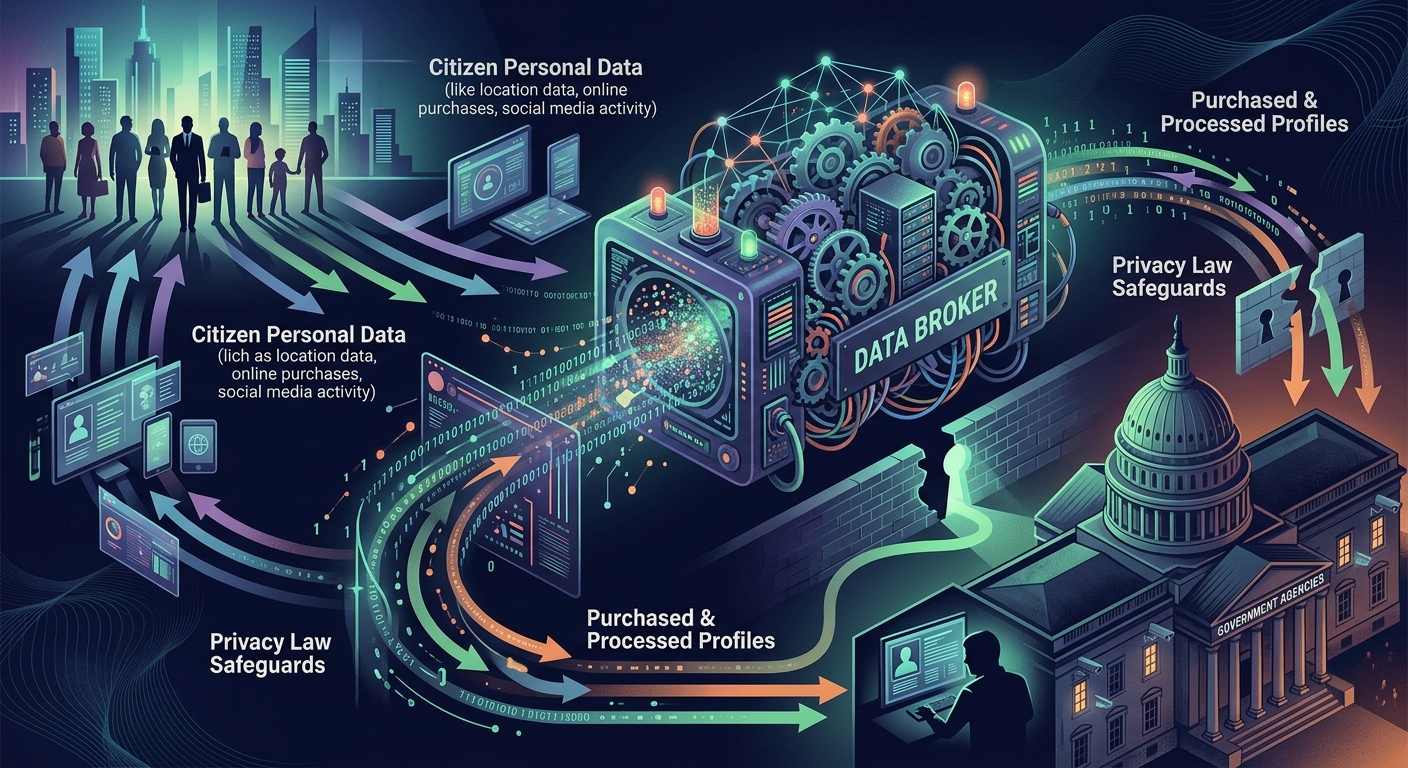
The sheer scale of modern data collection is staggering and difficult to fully comprehend. Multi-billion-dollar companies, alongside numerous lesser-known data aggregators, continuously compile billions of public and non-public records on almost every individual living in the United States. These firms pull granular data points from a vast array of sources: credit headers, utility bills, vehicle registrations, property records, location pings from smartphone applications, and even seemingly innocuous social media activity. The aggregated result is not merely a collection of isolated facts, but a continuously updated, profoundly detailed map of individuals’ personal lives.
When a person pays a water bill, updates their forwarding address with the postal service, or simply carries their mobile phone while driving across town to a medical clinic or a place of worship, those actions are quietly logged and monetized. The commercial data broker industry thrives on acquiring this information in bulk, without the explicit, informed consent of the subjects. This aggregation goes far beyond traditional public records; it pieces together fragments of digital exhaust to create a holistic, deeply revealing view of a person’s associations, habits, financial stability, and daily movements.
For federal agencies tasked with tracking individuals for law enforcement or immigration enforcement purposes, these commercial databases offer an irresistible and highly efficient tool. Instead of sending agents to conduct physical surveillance, obtain subpoenas, or engage in time-consuming traditional investigations, they can simply search a commercial database from a desktop computer. Federal agencies can acquire highly sensitive location and communication data without any court oversight, an acquisition practice that fundamentally alters the balance of power between the state and the individual.
Sidestepping the Fourth Amendment
The Fourth Amendment of the United States Constitution is purposefully designed to protect people against “unreasonable searches and seizures,” explicitly requiring law enforcement to obtain a warrant supported by probable cause before conducting an invasive search of a person’s home, papers, or effects. For centuries, this warrant requirement served as a critical, non-negotiable check on government overreach. However, the rapid rise of commercial data brokers has exposed a massive, highly exploitable loophole in this foundational constitutional protection.
Because individuals are deemed to “voluntarily” provide their data to third-party companies—such as mobile applications, utility providers, and telecommunications companies—the legal framework known as the “third-party doctrine” historically suggested that individuals possess a significantly reduced expectation of privacy regarding that shared information. While the Supreme Court’s landmark 2018 ruling in Carpenter v. United States determined that law enforcement must obtain a warrant to access historical cell-site location information compelled directly from wireless carriers, government agencies have adopted a remarkably narrow interpretation of this ruling. They maintain that purchasing data on the open commercial market is fundamentally different from compelling a company to hand it over via a judicial subpoena or warrant.
As a result of this legal maneuver, agencies bypass the judicial system entirely. By securing multi-million-dollar contracts with data brokers, they seamlessly acquire real-time access to the exact same—or often far more extensive—information they would otherwise need a judge’s explicit approval to obtain. A comprehensive 2023 report commissioned by the Office of the Director of National Intelligence (ODNI) acknowledged that the government’s widespread acquisition of commercially available information poses significant risks to privacy and civil liberties. The report noted that the sheer volume and sensitive nature of the purchased data closely resemble the results of invasive physical surveillance. This “purchasing loophole” allows the state to effectively buy its way around constitutional constraints, undermining the foundational premise of due process and creating a two-tiered system where constitutional protections only apply if the government cannot afford to bypass them.
Categories of Information Sold by Data Brokers
To understand the depth of this surveillance, it is crucial to examine the exact types of data points being commodified and utilized by government entities.
| Data Category | Examples of Data Points | Surveillance Application |
|---|---|---|
| Location and Movement | App geolocation pings, cell-site tracking, license plate reader data | Tracking individuals to their homes, workplaces, or medical facilities |
| Financial and Consumer Data | Credit header data, purchase histories, utility billing records | Locating current unlisted addresses and establishing financial profiles |
| Associations and Relationships | Shared addresses, familial linkages, social media connections | Identifying relatives, roommates, or associates of a primary target |
| Biometric and Identity Data | Facial recognition databases, state IDs, booking photos | Automating identity verification and tracking across multiple systems |
Impact on Marginalized Communities and Local Autonomy
The implications of this unchecked, commercialized surveillance fall disproportionately on vulnerable populations, particularly immigrant communities and communities of color. Over the past decade, numerous states and municipalities across the country have enacted “sanctuary” laws or “welcoming city” ordinances designed to limit local law enforcement cooperation with federal immigration authorities. These policies aim to build vital trust within local communities, ensuring that undocumented individuals can safely report crimes to the police, access public health care, and send their children to public schools without the paralyzing fear of deportation.
However, ICE’s heavy reliance on commercial data brokers effectively nullifies these hard-won local protections. When a sanctuary city legally refuses to hand over a police report, a jail roster, or a municipal ID database to ICE, the federal agency can often purchase the same information—or sufficient alternative data points—directly from a commercial vendor. If an undocumented individual registers a vehicle, sets up an electricity or water account for their apartment, or updates a mobile phone contract, those routine administrative records are frequently swept up by data brokers and subsequently fed into ICE’s targeting algorithms.
This unregulated data pipeline creates an environment of pervasive, unavoidable fear, where basic participation in modern society—such as securing stable housing or keeping the lights on—becomes a potential catalyst for family separation, detention, and deportation. Consequently, local governments find their democratic mandates and public safety initiatives completely undermined by private corporate contracts over which they have absolutely no regulatory control.
The Legal Pushback and Legislative Efforts
The growing revelation of these invasive practices has sparked intense, organized backlash from civil rights organizations, privacy advocates, and concerned lawmakers across the political spectrum. Advocacy groups have initiated aggressive litigation, filing class-action lawsuits alleging that data brokers are violating state consumer protection and privacy laws by aggregating and selling highly sensitive personal information without explicit, informed consumer consent. For instance, landmark legal challenges in states like Illinois have specifically targeted major data brokers for allegedly creating a massive, privatized surveillance state that poses a severe threat to fundamental civil liberties.
Simultaneously, grassroots movements are pushing hard for corporate accountability and municipal divestment. These campaigns pressure local governments and private enterprises to sever existing contracts with any data vendors that facilitate mass surveillance or support immigration enforcement operations. On the federal legislative front, there is a growing, bipartisan consensus that the current legal framework must evolve to meet the realities of the digital age.
This momentum has led to the introduction of pivotal bills like the “Fourth Amendment Is Not For Sale Act” in the United States Congress. This proposed legislation seeks to definitively close the data purchasing loophole by explicitly prohibiting law enforcement and intelligence agencies from acquiring Americans’ data from commercial brokers without a valid court order. Such statutory reforms are deemed absolutely crucial by legal experts, as relying solely on slow-moving judicial interpretation has proven dangerously inadequate to keep pace with the rapid, unchecked expansion of the data brokerage industry.
Frequently Asked Questions (FAQ)
What exactly is a commercial data broker?
A commercial data broker is a private company that specializes in collecting, aggregating, and analyzing personal information from a wide variety of public and non-public sources. They build extensive, detailed profiles on millions of individuals and then sell or license this data to third parties, which include marketing firms, insurance companies, and government law enforcement agencies.
How does purchasing data bypass the Fourth Amendment?
The Fourth Amendment generally requires law enforcement to obtain a warrant from a judge, based on probable cause, before conducting an invasive search. However, government agencies argue that because data brokers acquire information that consumers “voluntarily” gave to third parties (like smartphone apps or utility companies), the government can simply purchase this data on the open market, thereby avoiding the need to demonstrate probable cause to a judge.
Why are sanctuary cities specifically impacted by this practice?
Sanctuary cities enact local laws to restrict the sharing of municipal and local law enforcement data with federal immigration authorities, aiming to protect immigrant communities. However, federal agencies can bypass these local laws by purchasing the exact same information—such as current addresses from utility records or location data—directly from private data brokers, rendering local sanctuary protections largely ineffective.
What is the “Fourth Amendment Is Not For Sale Act”?
The “Fourth Amendment Is Not For Sale Act” is a proposed piece of bipartisan federal legislation designed to close the data purchasing loophole. If passed, it would legally prohibit federal, state, and local law enforcement and intelligence agencies from purchasing personal data from commercial brokers without obtaining a valid court order or warrant, effectively forcing the government to adhere to constitutional standards regardless of the data’s source.
Conclusion
The expansive, unregulated pipeline between private data brokers and government agencies represents one of the most critical civil rights and privacy challenges of the 21st century. The fundamental constitutional right to privacy is profoundly compromised when the state can successfully circumvent the judicial system and constitutional constraints simply by opening its checkbook. As federal agencies relentlessly continue to harness the immense, unchecked power of commercially available information, the once-clear distinction between private corporate data collection and state-sponsored government surveillance has effectively collapsed. Protecting constitutional liberties in the modern era requires swift, decisive legislative action to close the purchasing loophole and forcefully re-establish the absolute necessity of probable cause and judicial oversight. Until the legal framework comprehensively catches up with technological realities, the deeply personal digital footprint of every individual remains a tradable commodity available for government acquisition, threatening the very foundation of a free, secure, and democratic society.
References
- Wyden: DNI Report Confirms Government Purchases of Private Data Threaten Privacy and Constitutional Rights; Congress Must Adopt New Protections Against Unchecked Surveillance of Commercial Data — United States Senate. 2023-06-12. https://www.wyden.senate.gov/news/press-releases/wyden-dni-report-confirms-government-purchases-of-private-data-threaten-privacy-and-constitutional-rights-congress-must-adopt-new-protections-against-unchecked-surveillance-of-commercial-data
- LexisNexis illegally collected and sold people’s personal data, lawsuit alleges — CBS News. 2022-08-16. https://www.cbsnews.com/news/lexisnexis-illegally-collected-sold-personal-data-lawsuit-alleges/
- Wyden, Paul and Bipartisan Members of Congress Introduce The Fourth Amendment Is Not For Sale Act — United States Senate. 2021-04-21. https://www.wyden.senate.gov/news/press-releases/wyden-paul-and-bipartisan-members-of-congress-introduce-the-fourth-amendment-is-not-for-sale-act-
Similar Articles








Read full bio of medha deb


