
Dangers of Flawed Government Biometric Surveillance
Unregulated data harvesting and biased algorithms are eroding civil liberties.
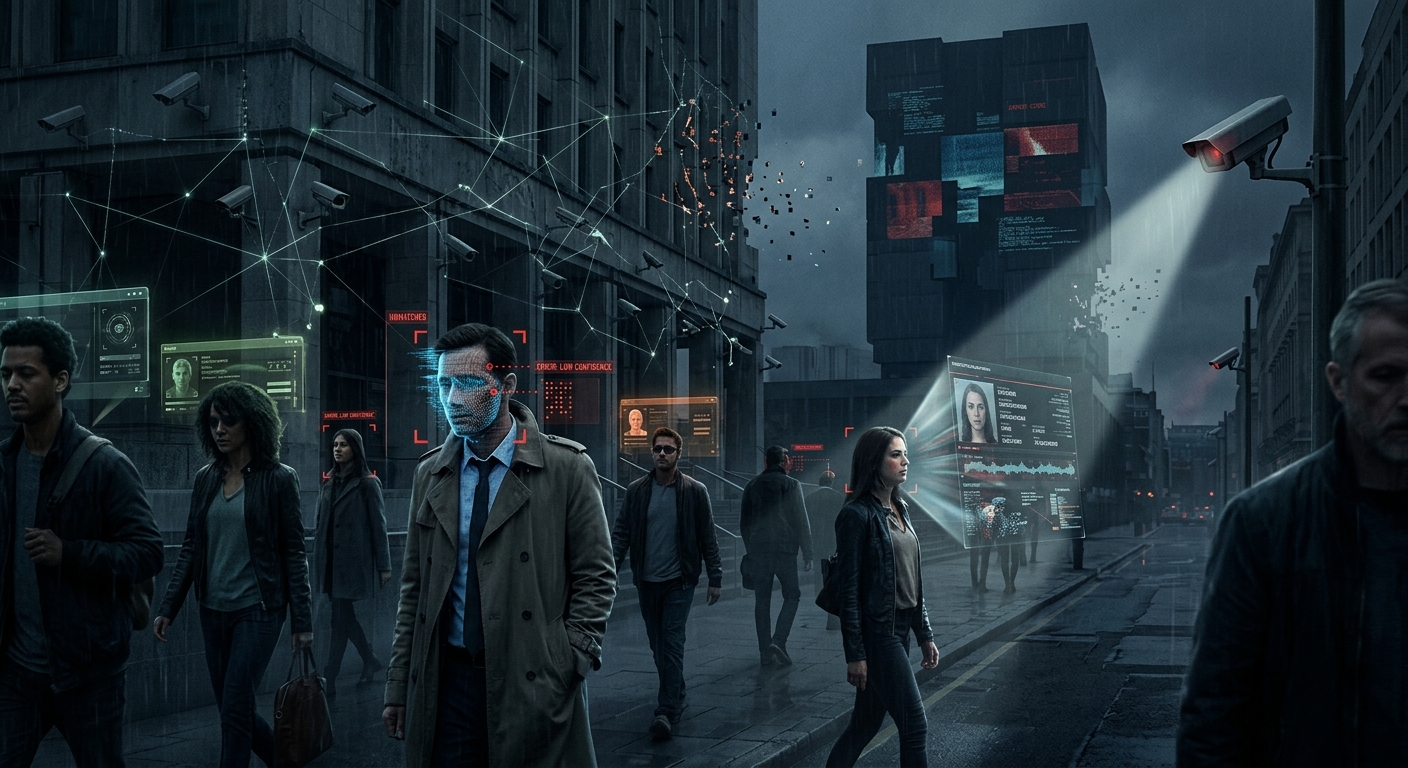
The Creeping Normalization of State Surveillance
In an era defined by rapid technological advancement, the normalization of biometric surveillance has crept into our daily lives with alarming stealth. We use our faces to unlock smartphones, authorize banking transactions, and tag friends in social media posts, often equating this newfound convenience with general progress. However, a profound and perilous shift occurs when these same biometric capabilities are weaponized by the state for mass surveillance and law enforcement operations. In recent years, government agencies have increasingly turned to private technology firms to supercharge their investigative capabilities. These private firms offer access to sprawling databases containing billions of facial images, promising unprecedented efficiency in identifying criminal suspects.
Yet, beneath this veneer of high-tech, futuristic policing lies a labyrinth of critical constitutional problems. The government’s reliance on unregulated, deeply flawed facial recognition services threatens to dismantle fundamental civil liberties, eviscerate basic privacy expectations, and heavily exacerbate systemic biases within the criminal justice system. By contracting with private entities that operate far outside the bounds of traditional constitutional constraints, the state is effectively creating a ubiquitous surveillance apparatus. This unchecked accumulation of biometric data demands immediate public scrutiny, judicial intervention, and robust legislative action to protect citizens from unwarranted tracking.
The Mass Commodification of Human Faces
Every time an individual uploads a photograph to a social networking site, attends a crowded public event, or appears in a digital news article, they inadvertently feed a massive, unregulated commercial engine. Private tech companies deploy sophisticated web-crawling algorithms that continuously scrape billions of images from the public internet, building monumental, ever-expanding databases of human faces. These platforms operate in a heavily contested legal gray area; they do not ask for user consent, nor do they offer a meaningful, accessible opt-out mechanism for the average citizen.
When government and law enforcement agencies purchase access to these proprietary systems, they effectively bypass the traditional legal frameworks and warrant requirements that have historically restricted state surveillance. The inherent problem lies in a blatant violation of contextual integrity—the foundational privacy principle that information should only be used in ways that closely align with the context in which it was originally shared. A citizen sharing a vacation or wedding photograph online intends for it to be viewed by a specific audience of friends and family. They do not consent to their likeness being harvested, mathematically analyzed, and permanently cataloged in a digital, privatized police lineup.
By leveraging this unrestrained data harvesting, law enforcement agencies can conduct mass surveillance on a scale previously deemed unconstitutional. This practice strips away the public’s right to anonymity in the digital age, treating every citizen as a potential suspect whose biometrics are available to the highest government bidder. It fundamentally flips the presumption of innocence, placing the burden on the public to hide their faces rather than on the state to justify its surveillance.
The Illusion of Algorithmic Infallibility
A pervasive and dangerous myth surrounding modern biometric technology is the public assumption that machine learning models are inherently objective, mathematically neutral, and infallibly accurate. In reality, these artificial intelligence systems inherit, internalize, and significantly amplify the deep-seated biases present in the datasets on which they were initially trained. Rigorous scientific evaluations by leading authorities, including extensive performance testing conducted by the National Institute of Standards and Technology (NIST), have repeatedly demonstrated significant demographic differentials in the performance of facial recognition algorithms.
The technology routinely exhibits drastically higher false-positive error rates when attempting to identify women, the elderly, and people of color. When law enforcement agencies rely on these structurally flawed algorithms to generate investigative leads, the real-world consequences are devastating. A false match generated by a computer is not merely a harmless technical glitch; it translates directly into profound human trauma. Innocent individuals have been subjected to wrongful arrests, invasive police interrogations, public humiliation, and extended incarceration solely because a proprietary computer program misidentified their face in a low-resolution security feed.
The psychological phenomenon known as “automation bias”—where human operators instinctively and blindly defer to the judgment of a machine—severely exacerbates this technical issue. Police officers and investigators, heavily trusting the perceived objectivity of the software, may ignore contradictory physical evidence or solid alibis in favor of the algorithm’s output. This dangerous feedback loop cements the technology’s inherent racial and gender biases firmly into the criminal justice process, disproportionately harming vulnerable communities.
Operating in the Shadows: The Erosion of Due Process
Perhaps the most alarming aspect of the government’s eager embrace of privatized facial recognition is the pervasive, deliberate secrecy surrounding its deployment. Across the country, federal, state, and local law enforcement agencies have integrated these powerful, life-altering investigative tools into their daily operations with little to no public oversight, democratic debate, or explicit legislative authorization. A staggering and consequential series of reports issued by the U.S. Government Accountability Office (GAO) revealed that numerous federal law enforcement agencies utilized commercial facial recognition services for years without requiring their staff to undergo any formal training on civil rights protections, privacy laws, or the inherent technical limitations of the software.
This clandestine, “wild west” approach severely undermines the bedrock principles of due process and the constitutional right to a fair trial. In the American criminal justice system, defendants possess a fundamental right to examine and rigorously challenge the evidence used against them. However, because these facial recognition platforms are built on proprietary, closed-source algorithms fiercely protected by vendors as trade secrets, defense attorneys are routinely denied the opportunity to scrutinize the underlying code for flaws, biases, or systemic matching errors.
Often, prosecutors fail to disclose that facial recognition technology was even used to initiate an investigation. Instead, they characterize the algorithm’s output merely as an “anonymous tip” or a “standard police lead.” This highly deceptive practice effectively shields the technology from judicial review, prevents meaningful cross-examination, and strips criminal defendants of their constitutional ability to mount a robust, informed defense.
The Chilling Effect on First Amendment Freedoms
The unchecked proliferation of biometric surveillance fundamentally alters the power dynamic between the state and the citizenry, casting a long, chilling shadow over civic participation and democratic expression. The First Amendment of the U.S. Constitution fiercely protects the rights to free speech, peaceful assembly, and the petitioning of the government for the redress of grievances. However, the stark realization that law enforcement possesses the active capability to instantly identify, track, and permanently log the attendance of every single individual at a political rally, labor strike, or peaceful protest drastically changes the calculus of civic engagement.
When public spaces and town squares are transformed into pervasive, invisible identity checkpoints, individuals are far less likely to exercise their constitutional rights for fear of retribution, workplace harassment, or covert inclusion on permanent government watchlists. This chilling effect does not distribute itself equally across the population; it disproportionately impacts marginalized communities, civil rights activists, and political dissidents who are historically already vulnerable to state overreach and aggressive policing tactics.
The mere presence—or even the suspected presence—of unregulated facial recognition technology in the public square creates a modern panopticon effect. Citizens police their own behavior, stifling dissent and ultimately weakening the vibrant democratic fabric of society that fundamentally relies on the freedom to assemble without the persistent, chilling gaze of the surveillance state.
Charting a Path Forward: The Imperative for Strict Guardrails
The ongoing integration of flawed, unregulated biometric systems into the massive machinery of government represents a profound and escalating crisis of civil liberties, but it is a crisis that is not completely irreversible. Addressing these existential dangers requires urgent, comprehensive, and decisive legislative action at both the state and federal levels. First and foremost, lawmakers must enact immediate and strict moratoriums on the government’s procurement and use of facial recognition technologies, particularly those platforms that heavily rely on the non-consensual scraping of public data.
The state must not be permitted to outsource mass surveillance to private corporate entities as a convenient loophole to bypass the Fourth Amendment’s explicit protections against unreasonable searches and seizures. Furthermore, there is a critical, long-overdue need for robust, overarching federal data privacy legislation that definitively empowers individuals with full control over their biometric information. Private technology companies must be legally compelled to obtain explicit, opt-in, and fully informed consent before harvesting, analyzing, and monetizing the unique geometry of human faces.
If biometric tools are ever to be permitted for use by law enforcement in the future, such use must be heavily restricted to narrow, highly specific criminal circumstances explicitly authorized by a judge’s warrant. This framework must demand absolute transparency, mandate regular public reporting, and require rigorous, independent, third-party audits to continuously assess the algorithms for bias and accuracy. The burden of proof must lie squarely with the state and its corporate partners to rigorously demonstrate that these technologies do not violate fundamental rights, rather than unfairly forcing ordinary citizens to defend their privacy retroactively in the courts.
Frequently Asked Questions (FAQ)
What makes biometric surveillance significantly different from traditional security cameras?
Traditional closed-circuit television (CCTV) cameras record passive video footage that must be manually reviewed and interpreted by human operators. In sharp contrast, biometric surveillance uses advanced artificial intelligence and complex mathematical algorithms to automatically map unique facial features and instantly cross-reference them against massive, global databases. This effectively transforms anonymous public observation into active, continuous, and automated mass identification of entire populations without their prior knowledge or consent.
Why is facial recognition technology widely considered to be racially and demographically biased?
Facial recognition systems heavily rely on machine learning models that are trained on vast datasets of human faces. Historically, these training datasets have disproportionately featured lighter-skinned, male subjects. As a direct result, the algorithms are poorly optimized for accurately analyzing the facial structures of marginalized demographics. Independent testing by government bodies has clearly shown that these systems have significantly higher error rates when identifying women, older adults, and people of color, directly leading to a much higher risk of false identification and wrongful arrest for these specific groups.
Is it legally permissible for private companies to scrape my photos from the internet?
The strict legality of mass data scraping exists in a highly contested, evolving gray area. While some states, most notably Illinois with its Biometric Information Privacy Act (BIPA), have implemented strict laws requiring explicit, written consent before biometric data can be collected, there is currently no comprehensive federal privacy law in the United States prohibiting the practice outright. Consequently, many tech companies legally argue that publicly accessible internet images are “fair game” for data harvesting, a controversial stance that is heavily challenged by civil liberties advocates and privacy watchdogs.
How does facial recognition software undermine a criminal defendant’s right to a fair trial?
The Sixth Amendment guarantees criminal defendants the right to cross-examine the evidence and witnesses presented against them in a court of law. However, when facial recognition software is utilized to identify a suspect, the technology companies often aggressively claim their algorithms are highly proprietary trade secrets. This legal maneuver routinely prevents defense attorneys from reviewing the underlying code to uncover potential biases, systemic errors, or matching inaccuracies that directly led to their client’s arrest, thereby severely undermining the foundational American principles of due process.
References
- Face Recognition Vendor Test (FRVT) Part 3: Demographic Effects (NISTIR 8280) — National Institute of Standards and Technology (NIST). 2019-12-19. https://doi.org/10.6028/NIST.IR.8280
- Facial Recognition Technology: Current and Planned Uses by Federal Agencies (GAO-21-526) — U.S. Government Accountability Office (GAO). 2021-08-24. https://www.gao.gov/products/gao-21-526
- Facial Recognition Services: Federal Law Enforcement Agencies Should Take Actions to Implement Training, and Policies for Civil Liberties (GAO-23-105607) — U.S. Government Accountability Office (GAO). 2023-09-12. https://www.gao.gov/products/gao-23-105607
Similar Articles








Read full bio of medha deb


