Navigating the Scope of Copyright Protection for Creative Expression
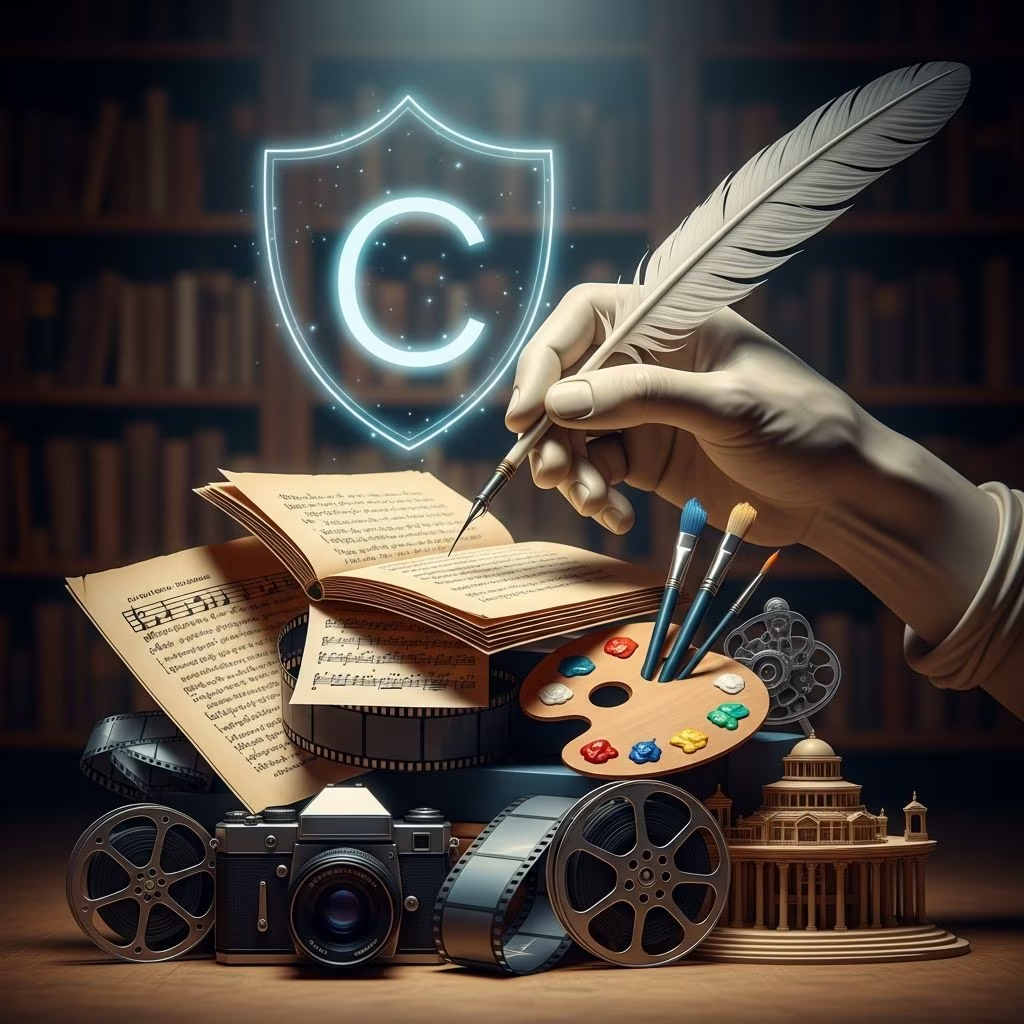
Copyright law exists to protect the original creative efforts of authors, artists, musicians, programmers, and other innovators. When you create something original and express it in a tangible medium, copyright protection attaches automatically in most jurisdictions. However, not all creative endeavors receive equal protection under copyright law. Understanding which types of works qualify for copyright protection, and which do not, is essential for anyone involved in creative industries or who uses creative content. This knowledge helps protect your own work from unauthorized use while ensuring you do not inadvertently infringe on someone else’s rights.
The Foundation: What Makes a Work Copyrightable
For a creative work to qualify for copyright protection, it must meet specific criteria established by law. First and foremost, the work must be an original creation of authorship. This means it cannot be copied from existing works, though it can be inspired by them. Second, the work must be fixed in a tangible medium of expression. This requirement means the creative content must be recorded, written, drawn, recorded digitally, or otherwise captured in a form that persists and can be perceived. A spontaneous musical performance, for example, is creative but may not be copyrightable unless it is recorded or notated.
The originality requirement does not demand that a work be entirely unprecedented or unique in its subject matter. Rather, it means the expression of ideas must come from the creator’s own effort and creativity. Two authors can write about identical themes, but each original manuscript receives its own copyright protection. The key distinction is that copyright protects the specific expression, not the underlying idea itself. An idea for a romance novel set in space is not copyrightable, but the actual written novel with its specific plot, characters, and dialogue is.
Literary and Textual Works: The Broadest Category
Literary works encompass a vast spectrum of written and symbolic creations. This category includes traditional books, novels, and short stories, whether they are fiction or nonfiction. Poetry, whether published in collections or appearing as individual pieces, receives copyright protection. Scholarly articles, academic papers, and research publications are protected. Instruction manuals, user guides, and technical documentation all fall under literary work protection.
The definition extends beyond traditional prose and verse. Advertising copy, marketing materials, and business communications such as emails and letters receive copyright protection. Directories, catalogs, and compilations of information are copyrightable, even though they may contain factual material, because copyright protects the original selection and arrangement of the information. Computer programs and software code are classified as literary works for copyright purposes, despite their functional nature. This classification ensures that programmers and software developers have legal protection for their code and applications.
Reference works such as dictionaries, encyclopedias, and databases qualify for copyright protection. The creative effort involved in selecting, organizing, and presenting information in these works receives legal recognition. Textbooks and educational materials are protected as literary works, safeguarding the intellectual effort invested by educators and authors in curriculum development.
Musical Compositions and Sound Recordings: Distinct but Related
Copyright law distinguishes between musical compositions and sound recordings, treating them as separate categories of work. A musical composition consists of the melody, harmony, rhythm, and musical structure created by a composer. This includes original songs, instrumental pieces, and musical scores written as sheet music. The lyrics accompanying a musical composition are also protected as part of the musical work.
Sound recordings, by contrast, are the actual audio recordings of performances of music or other sounds. A recording of a famous orchestra performing Beethoven’s symphony is a sound recording. The original Beethoven composition itself is in the public domain, but the specific recording of that composition, with its particular interpretation and sound quality, is copyrightable as a sound recording. This distinction is important because anyone may create a sound recording of a composition, provided they pay the composer an appropriate licensing fee.
Both musical compositions and sound recordings receive copyright protection immediately upon creation and fixation. Podcasts and audiobooks, which capture spoken performances, are also protected as sound recordings. This protection extends to the creative work of producers, engineers, and musicians who contribute to the final recorded product.
Visual and Graphic Arts: From Fine Art to Applied Design
Pictorial, graphic, and sculptural works form a diverse category that includes both traditional and contemporary visual arts. Paintings, drawings, prints, and sculptures receive copyright protection as expressions of artistic creativity. Photographs, whether artistic or documentary in nature, are protected. This protection applies regardless of the subject matter or whether the photograph was taken professionally or by an amateur.
The visual arts category extends to graphic designs, illustrations, and decorative artwork. Maps, diagrams, and technical drawings receive protection. Artistic blueprints and architectural renderings are covered. The category encompasses both two-dimensional works such as paintings and digital art, and three-dimensional works such as sculptures and carved objects.
An important principle in visual arts copyright is that the work must demonstrate conceptual separability from any functional purpose. This means that if an object serves a primarily functional purpose, the decorative elements must be separable from that function to receive copyright protection. For example, the ornamental design on a useful article such as a lamp base may be copyrightable if it can be identified as a distinct artistic expression separate from the lamp’s utilitarian function.
Dramatic Works and Performance-Based Creative Expression
Dramatic works include plays, screenplays, film scripts, and other written works that direct a performance through explicit instructions. The defining characteristic of a dramatic work is that it tells a story through performance and action, distinguishing it from purely literary works. A stage play script receives copyright protection both as a written work and for the dramatic narrative it conveys. Screenplays and film scripts are protected similarly.
Choreographic works represent another specialized category within performance-based creativity. Dance routines and choreography must be fixed through notation or video recording to receive copyright protection. A recorded dance performance captures the choreographer’s creative expression of movement and composition. The notation systems used in ballet and modern dance serve as the tangible fixation required for protection.
These performance-based works receive protection for their unique creative expression of narrative, emotion, and artistic intent. The playwright’s dialogue, stage directions, and dramatic structure are protected. The choreographer’s specific movements, formations, and artistic choices receive legal recognition.
Audiovisual and Motion Picture Works
Audiovisual works combine moving visual images with accompanying sound, creating a unified creative expression. Motion pictures and feature films are the most common examples, but the category is broader. Television shows, whether broadcast or streamed, receive copyright protection. Documentary films, animated films, and experimental video art all qualify. Online videos, including those shared on digital platforms, can be copyrightable.
Video games represent a modern audiovisual work that combines visual elements, sound design, narrative structure, and interactive programming. The creative expression embedded in game design, character development, storytelling, and artistic direction receives copyright protection. This extends to mobile games, web-based games, and console games.
An audiovisual work is defined as a series of related images intended to be shown through a machine or device, together with accompanying sounds. The protection covers the entire creative expression of the work, including its visual composition, editing, sound design, and narrative structure. Multiple types of authorship may be present in a single audiovisual work, such as the screenplay, cinematography, and musical score, but they can all be registered and protected together.
Architectural Works and Structural Design
Architectural works receive copyright protection as creative expressions of structural and spatial design. This category includes building designs, architectural blueprints, and construction plans. The original architectural conception that gives a building its distinctive character and aesthetic expression is protected. Architectural drawings and renderings that communicate the designer’s creative vision are copyrightable.
The protection for architectural works covers the design elements that constitute original artistic expression. The overall shape, form, and artistic features of a building design are protected. However, the functional aspects of a building, such as its structural engineering or systems, may not receive the same copyright protection as the creative architectural expression.
Computer Software and Digital Works
Software code and programming represent a specialized category within literary works, reflecting the modern expansion of copyright to protect digital creativity. Source code written by programmers is protected as literary expression, even though it also serves a functional purpose. Software applications, whether commercial or open-source, receive copyright protection for their underlying code and design.
This category includes various types of software: desktop applications, web applications, mobile apps, database management systems, and programming tools. The creative effort involved in designing algorithms, structuring code, and developing software architecture receives legal recognition. Software libraries and frameworks that represent significant creative and technical effort are also protected.
Website code and the programming that supports online platforms receive copyright protection. Database software and the code that manages data systems are copyrightable. Game engines and development tools created by software companies are protected works. The expanding recognition of software as a copyrightable work reflects the centrality of digital technology in modern creative and business endeavors.
What Copyright Law Does Not Protect
Understanding the boundaries of copyright protection is as important as knowing what is protected. Copyright law explicitly excludes certain categories of work that might seem to deserve protection but do not receive it. Ideas, procedures, methods, systems, and processes are not protected by copyright. The underlying concept behind a novel, the methodology in a business process, or the system used to organize information cannot be copyrighted. Only the specific expression of these ideas can be protected.
Facts, discoveries, and news events are not copyrightable. Factual information about historical events, scientific discoveries, and current news cannot be protected, though the specific way a journalist reports or writes about news can be. Short phrases, names, titles, and slogans generally do not receive copyright protection. Titles of books, movies, or songs are typically too brief to warrant protection, though they may be protectable under trademark law in specific contexts.
Familiar symbols and designs that are common or generic do not receive copyright protection. Works that are not fixed in any tangible medium lack copyright protection. A speech delivered verbally but never written down or recorded does not receive copyright protection, though recording it would fix it and make it copyrightable. Similarly, improvised performances of music or dance that are not recorded or notated are not protected.
Works created by the U.S. federal government are not protected by copyright and are considered public domain. This policy reflects the principle that government works funded by taxpayers should be freely accessible to the public. State statutes, court opinions, and other government legal documents are similarly excluded from copyright protection to ensure citizens have unrestricted access to the law.
Common Examples of Copyright Infringement
Copyright protection becomes meaningful through enforcement against infringement. Several common scenarios demonstrate how copyright violations occur. Copying and distributing music or movies without the creator’s permission violates copyright law. This includes downloading copyrighted films without authorization, sharing music files without licensing, or distributing copies of protected works.
Using images or photos from the internet on websites, blogs, or social media without proper licensing or permission constitutes infringement. Even if an image is publicly available online, it remains protected by copyright unless the creator has explicitly released it under a permissive license. Reproducing substantial portions of books, articles, or other literary works in publications or online without authorization violates copyright.
Sharing copyrighted software or applications without a valid license infringes copyright. Copying proprietary code or using software beyond the scope of a license agreement creates legal liability. These examples illustrate that copyright protection is not merely theoretical but has practical implications for anyone using creative works.
The Importance of Understanding Copyright Boundaries
Creators benefit from understanding exactly what their copyright protection covers and what remains unprotected. A novelist can copyright the specific text of a book but not the plot idea itself. A software developer can protect the code but not the underlying algorithm if it is considered a process or method. A musician can protect a specific song composition and recorded performance but not the musical genre or style.
Conversely, users and businesses must understand copyright restrictions to avoid inadvertent infringement. Using another’s creative work without permission or proper licensing can result in legal liability, damages, and injunctions. Understanding what is and is not protected helps navigate the digital landscape responsibly.
Frequently Asked Questions About Copyright Protection
Q: Does copyright protection require registration of the work?
A: No. Copyright protection attaches automatically to original works of authorship when they are fixed in a tangible medium. Registration with a government copyright office provides additional legal benefits and is recommended for enforcement purposes, but it is not required for protection to exist.
Q: How long does copyright protection last?
A: In most countries, copyright protection lasts for the life of the author plus an additional period (typically 50 to 70 years after death, depending on the jurisdiction). For works made for hire and anonymous works, protection generally lasts for a fixed term from publication.
Q: Can I use a copyrighted work if I give credit to the original creator?
A: Giving credit does not constitute permission or authorization. Using copyrighted material without permission remains infringement regardless of attribution. However, fair use provisions may permit limited use for purposes such as criticism, commentary, or education.
Q: Does copyright protect titles and slogans?
A: Generally, copyright does not protect short phrases, titles, or slogans. However, these may be protectable under trademark law if they serve as source identifiers for goods or services.
Q: What is the difference between copyright and intellectual property?
A: Copyright is one form of intellectual property. The broader category of intellectual property also includes patents (protecting inventions), trademarks (protecting brand identifiers), and trade secrets (protecting confidential business information).
References
- What are some examples of copyright works? — Business Queensland. 2024. https://www.business.qld.gov.au/running-business/risk/ip/ip-kit/browse-ip-topics/copyright-works/examples
- What Types of Works Are Protected By Copyright — Jones IP Law. 2024. https://www.jonesipl.com/article/what-types-of-works-are-protected-by-copyright/
- Copyrightable Works — U.S. Legal. 2024. https://copyright.uslegal.com/copyrightable-works/
- What is copyright? — Google Legal Help. 2024. https://support.google.com/legal/answer/3463239?hl=en
- Help: Type of Work — U.S. Copyright Office. 2024. https://www.copyright.gov/eco/help-type.html