
Unlocking Dissent: The Constitutional Crisis of Device Seizures on College Campuses
When student activism meets digital surveillance, fundamental rights to free speech and privacy hang in the balance.
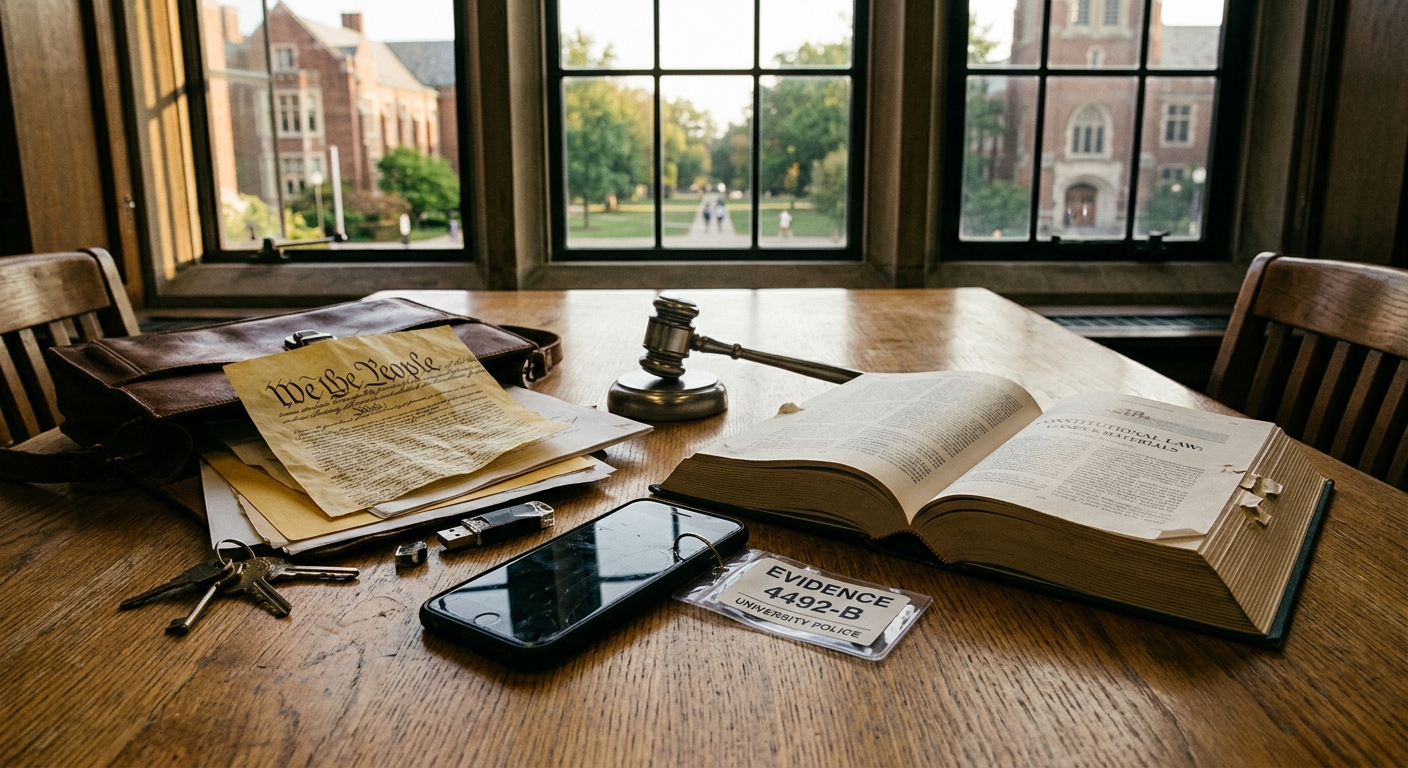
The Escalating Intersection of Activism and Digital Privacy
The modern college campus has long served as a crucial space for political activism and societal change. From historical anti-war movements to contemporary demonstrations demanding institutional accountability, students frequently utilize university spaces to exercise their democratic rights. However, as administrative responses to these demonstrations evolve, a deeply concerning frontier of discipline has emerged: the seizure and surveillance of personal digital devices.
When university law enforcement confiscates smartphones and laptops belonging to organizers, the intersection of campus security and constitutional rights becomes a battlefield. This escalation transforms physical protests into digital privacy crises, raising alarming questions about the First and Fourth Amendments. As institutions increasingly deploy broad search warrants to access years of private data under the guise of investigating minor infractions, legal advocates are pushing back. This article delves into the chilling effect of digital device seizures on free speech, the legal precedents shaping this ongoing conflict, and the vital necessity of protecting student privacy in a hyper-connected world.
The Escalation of Administrative Retaliation
Historically, university disciplinary measures for disruptive protests involved academic probation, fines, or temporary suspensions. Recently, however, the response to student activism has grown remarkably severe, often mimicking the tactics of municipal law enforcement dealing with serious criminal enterprises. During the widespread spring 2024 campus protests, university administrations across the nation resorted to summary campus bans. In California, for example, institutions utilized Section 626.4 of the penal code to instantly exclude students and faculty from campus property without prior individualized hearings.
These blanket bans instantly severed students from their academic resources, campus employment, and housing. But the disciplinary escalation did not stop at physical exclusion. Law enforcement agencies affiliated with universities began targeting the digital lives of organizers. By obtaining search warrants for personal electronics, campus police could theoretically uncover the organizational networks, private communications, and strategic plans of activist groups. This shift from physical crowd control to digital espionage represents a fundamental change in how universities handle internal dissent, effectively weaponizing access to technology against those who challenge administrative policies.
A Case Study in Overreach: The UCSC Surveillance Dispute
A prominent example of this digital escalation unfolded at the University of California, Santa Cruz (UCSC). Following a series of large-scale demonstrations in early 2024, dozens of students were subjected to mass campus bans, effectively derailing their academic progress. In response, a coalition of students and faculty, supported by civil rights organizations, filed a lawsuit challenging the constitutionality of these summary exclusions. They argued that the university violated fundamental due process and First Amendment rights by unilaterally punishing participants without a fair, individualized hearing.
The conflict took a startling turn shortly after the litigation commenced. Just weeks after a prominent student plaintiff joined the civil rights lawsuit against the university, campus police arrived at her residence with a warrant to seize her smartphone. The justification provided was an investigation into alleged vandalism that occurred during the protests months prior. Yet, the scope of the warrant was extraordinarily broad. It authorized law enforcement to extract and analyze virtually all data on the device, encompassing private emails, text messages, location history, and photographs dating back over a decade.
This timeline raised immediate red flags among civil liberties advocates. The temporal proximity between the student’s legal challenge against the university and the sudden, invasive seizure of her digital property suggested a potential retaliatory motive. Critics argued that the warrant was not a tailored investigative tool for a specific property crime, but rather a digital fishing expedition designed to intimidate a vocal critic. Following extensive litigation, a state judge eventually narrowed the scope of the warrant, acknowledging that the initial authorization was vastly overbroad. This high-profile dispute perfectly encapsulates the extreme vulnerability of students when universities leverage digital search warrants to monitor activism.
Constitutional Crossroads: The First and Fourth Amendments
The seizure of digital devices on college campuses sits squarely at the intersection of two foundational constitutional protections: the First Amendment right to free expression and the Fourth Amendment right against unreasonable searches and seizures. When examining these incidents, legal scholars frequently point to the unique nature of modern smartphones. A phone is not merely a communication device; it contains an individual’s entire life—their political affiliations, romantic relationships, medical records, and instantaneous location data.
Under the Fourth Amendment, a search warrant must be supported by probable cause and must be narrowly tailored to specify the exact places to be searched and the items to be seized. Allowing campus police to sift through ten years of a student’s personal data to find evidence of a localized vandalism incident blatantly violates this principle of particularity. Furthermore, state laws like the California Electronic Communications Privacy Act (CalECPA) mandate stringent limitations on digital searches, requiring law enforcement to specify time periods and specific types of information strictly relevant to the alleged crime.
Simultaneously, the First Amendment implications of these digital searches are profound. Freedom of speech and the right to peaceably assemble rely heavily on the freedom of association. If student activists believe that organizing a rally might result in the state confiscating their private messages and mapping their social networks, a chilling effect inevitably sets in. Students may self-censor, abandon organizing efforts, or entirely disengage from political discourse out of fear of digital retaliation. Additionally, when police seize a device belonging to an active plaintiff in a lawsuit against the university, they potentially gain backdoor access to privileged attorney-client communications. This egregious breach not only undermines the integrity of the ongoing litigation but also strips the student of their fundamental right to confidential legal counsel.
Precedents and Broader Legal Battles
The UCSC incident is not an isolated anomaly; rather, it reflects a broader national trend of law enforcement attempting to bypass digital privacy protections in the context of political protests. In a landmark victory for digital rights, the U.S. Court of Appeals for the Tenth Circuit recently ruled in a related case that sweeping warrants used to search a protester’s devices were fundamentally unconstitutional. In that instance, police had confiscated the phone of a protester accused of a minor physical altercation and obtained warrants to search months of digital data, utilizing overly broad keywords.
The appellate court determined that such warrants lacked necessary particularity and violated the Fourth Amendment, reinforcing the judicial standard that a minor physical offense does not justify unlimited access to an individual’s entire digital ecosystem. These judicial precedents serve as crucial guardrails. They remind university administrations and local police departments that the presence of a political demonstration does not suspend constitutional liberties. The digital trail left by a student activist is protected by the exact same legal frameworks that shield a journalist’s confidential notes or a political party’s private membership lists.
Constitutional Frameworks at Play
To fully understand the gravity of digital seizures, it is helpful to examine the specific constitutional principles tested during campus demonstrations.
| Constitutional Principle | Application to Campus Activism | Risk of Digital Seizures |
|---|---|---|
| First Amendment (Free Speech & Assembly) | Protects the right of students to organize, protest, and speak out against university policies or global conflicts. | Creates a “chilling effect” where students self-censor to avoid invasive surveillance of their personal networks. |
| Fourth Amendment (Search & Seizure) | Mandates that any search of private property, including digital devices, be supported by a highly specific warrant. | Overbroad warrants allow authorities to conduct “fishing expeditions” through years of unrelated personal data. |
| Fourteenth Amendment (Due Process) | Ensures students are not arbitrarily banned from campus or stripped of their educational access without a fair hearing. | Summary bans and subsequent device confiscations often occur before any formal guilt or liability has been established. |
Protecting Digital Privacy on Campus
As universities continue to grapple with the realities of modern student activism, there must be a fundamental recalibration of how campus security operates. Academic institutions inherently possess a dual mandate: to maintain a physically safe educational environment and to fiercely foster intellectual freedom. Resorting to invasive digital surveillance fundamentally betrays the latter.
To adequately protect student privacy, universities must implement strict internal policies that govern precisely when and how campus police can request digital search warrants. These policies should require independent administrative oversight and strictly prohibit the use of device seizures as a tool for retaliation. Furthermore, state legislatures should proactively strengthen digital privacy laws to explicitly address the unique dynamics of campus policing, ensuring that students do not automatically surrender their privacy at the campus gates. Until robust protections are uniformly enforced, students must remain vigilant, actively utilizing device encryption and thoroughly understanding their legal rights.
Frequently Asked Questions
Can university police legally seize a student’s phone without a warrant?
Generally, no. Under the Fourth Amendment, law enforcement—including campus police at public universities—must obtain a search warrant signed by a judge to search the contents of a digital device. While there are very narrow exceptions for immediate, life-threatening emergencies, investigating past protest activities or minor property damage does not meet this threshold.
How does attorney-client privilege factor into device seizures?
When authorities seize a phone, they may inadvertently (or intentionally) gain access to private communications between the device owner and their legal counsel. This violates attorney-client privilege. In civil rights disputes, viewing these communications can give the university an unfair advantage and undermine the integrity of the judicial process.
What is a Section 626.4 campus ban?
In California, Section 626.4 of the penal code allows university officials to temporarily withdraw consent for a person to remain on campus if there is reasonable cause to believe they are disrupting campus operations. However, applying these bans summarily without a hearing has sparked massive due process lawsuits.
What makes a digital search warrant unconstitutional?
A warrant is deemed unconstitutional if it lacks “particularity.” This means it fails to specify exactly what data is being sought and the specific time frame relevant to the crime. Warrants that allow police to scroll through years of unrelated photos, location data, and messages are typically considered overbroad and in violation of the Fourth Amendment.
What should students do to protect their digital privacy on campus?
Digital rights advocates recommend using strong alphanumeric passwords rather than biometrics (like Face ID or fingerprint scanners) to unlock devices, as courts have varying interpretations on whether law enforcement can compel biometric unlocking. Additionally, utilizing end-to-end encrypted messaging applications and minimizing the amount of sensitive data stored directly on a local device can significantly mitigate the risks of overbroad searches.
Conclusion
The digital life of a student is an intimate extension of their mind, their voice, and their community. When universities seize phones and laptops in the aftermath of political protests, they cross a dangerous line from maintaining order to enforcing ideological conformity through surveillance. The legal battles erupting over these seizures are not merely academic disputes; they are foundational fights for the future of free expression in the digital age. Ensuring that fundamental rights thrive on college campuses requires unwavering pushback against overbroad warrants, retaliatory policing, and administrative overreach. Ultimately, a university’s true strength lies in its capacity to tolerate dissent, not in its ability to digitally dissect the students who dare to speak up.
References
- ACLU Challenges Unconstitutional Seizure of UCSC Student’s Phone — ACLU Foundation of Northern California. 2025-03-05. https://www.aclunc.org/news/aclu-challenges-unconstitutional-seizure-ucsc-students-phone
- Ellutzi, et al. v. Regents of the University of California, et al. — Campus Speech Database. 2024-09-09. https://campusspeechdatabase.thefire.org/cases/ellutzi-et-al-v-regents-of-the-university-of-california-et-al/
- Judge modifies warrant in UCSC protester phone seizure case — Lookout Santa Cruz. 2025-05-01. https://lookout.co/judge-modifies-warrant-ucsc-protester-phone-seizure-laaila-irshad-thomas-seabaugh/
- Victory! Tenth Circuit Finds Fourth Amendment Doesn’t Support Broad Search of Protesters’ Devices and Digital Data — Electronic Frontier Foundation. 2026-02-26. https://www.eff.org/press/releases/victory-tenth-circuit-finds-fourth-amendment-doesnt-support-broad-search-protesters
Similar Articles








Read full bio of Sneha Tete


