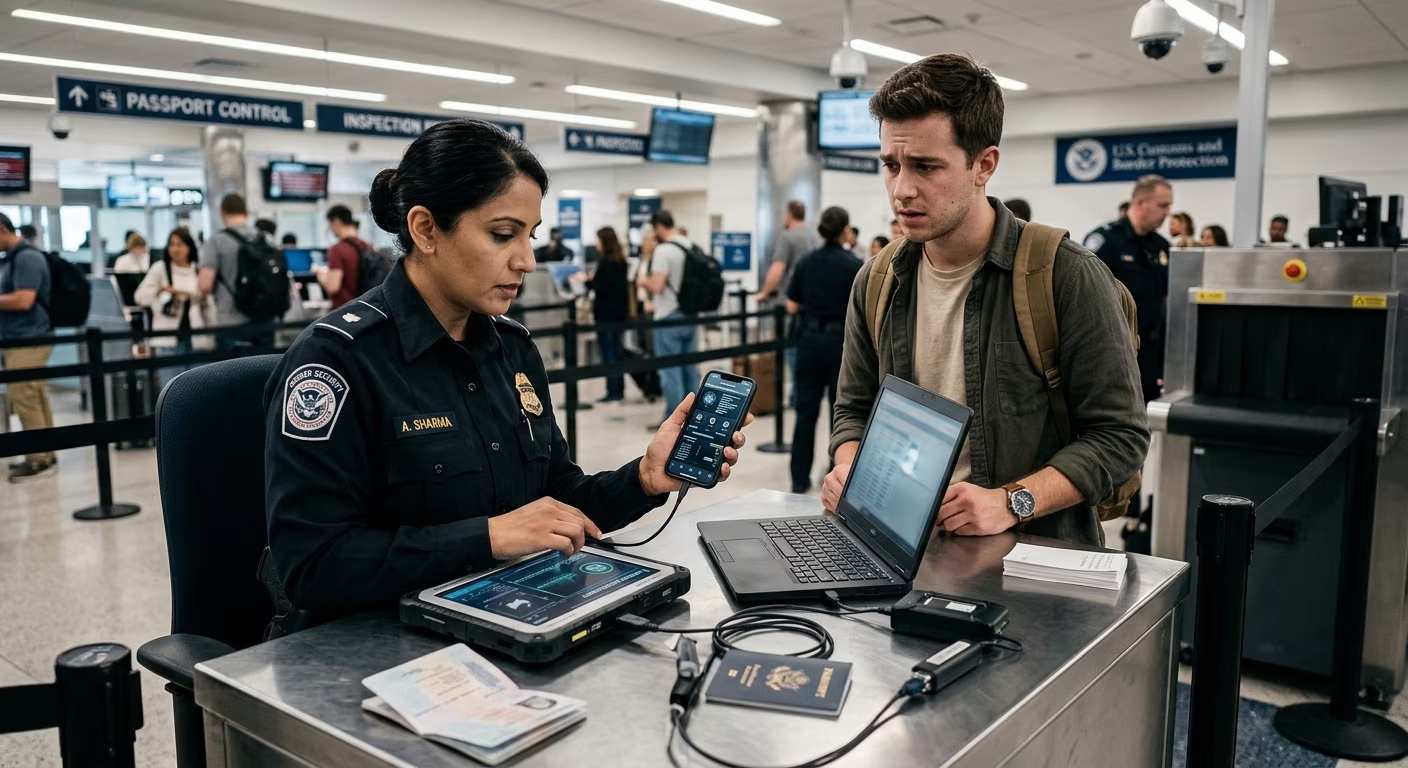
The Intersection of Digital Privacy and Border Security
The smartphone in your pocket is essentially a digital extension of your mind. It contains everything from intimate personal photographs and private correspondences to sensitive financial records, real-time location histories, and detailed medical files. A modern laptop can house the equivalent of millions of pages of text—a volume of information that no traveler could ever carry in physical form. As global travel becomes increasingly intertwined with our digital lives, the boundary between national security and personal privacy has emerged as one of the most hotly contested legal battlegrounds in the United States.
When you step up to a Customs and Border Protection (CBP) checkpoint at an international airport or a land border crossing, you enter a constitutionally unique zone. Historically, the rights you enjoy in your living room or walking down the street are significantly diminished at the border. But the pressing question for the digital age remains: Do you entirely leave your constitutional protections against unreasonable searches and seizures at the door when it comes to your digital devices? The evolving legal consensus suggests that while the government possesses expansive authority to protect its borders, the unfettered right to rummage through a traveler’s entire digital existence is facing unprecedented judicial scrutiny.
Understanding the Constitutional Boundaries at Ports of Entry
To grasp the magnitude of this debate, one must first understand the fundamental legal framework that governs physical and digital privacy in the United States. The Fourth Amendment is designed to protect citizens from unreasonable searches and seizures, typically requiring law enforcement to obtain a warrant based on probable cause before conducting an invasive search. However, courts have long recognized an important carve-out known as the “border search exception.”
The underlying rationale for the border search exception is rooted in the sovereign right of the United States to protect its territorial integrity. The government has a compelling, overriding interest in preventing the entry of contraband, illicit drugs, dangerous weapons, and individuals who pose a threat to national security. Because of this paramount interest, federal agents have historically been granted the authority to conduct routine, warrantless searches of a traveler’s luggage, vehicle, and physical person without needing a warrant, probable cause, or even reasonable suspicion.
For decades, this standard was relatively straightforward. If an agent wanted to inspect the contents of a suitcase to ensure a traveler was not smuggling undeclared agricultural products or illegal items, the intrusion on personal privacy was considered minimal and legally justified. However, as the world transitioned into the digital era, federal agencies attempted to apply this same physical-world logic to electronic devices. The government argued that a laptop or a smartphone was legally indistinguishable from a suitcase or a briefcase, and therefore, border agents should be permitted to open, inspect, and copy the contents of these devices for any reason—or no reason at all. Privacy advocates fiercely challenged this notion, arguing that a hard drive is not merely a container, but a comprehensive repository of human life.
How Modern Jurisprudence Treats Electronic Devices
The turning point in judicial thinking regarding digital privacy did not originally stem from a border dispute, but rather from a monumental ruling concerning local law enforcement. In 2014, the United States Supreme Court delivered a unanimous and landmark decision in the case of Riley v. California. The Court fundamentally rejected the idea that digital data could be treated exactly like physical objects. In his opinion, Chief Justice John Roberts noted that comparing a smartphone to a physical item is like “saying a ride on horseback is materially indistinguishable from a flight to the moon.”
The Supreme Court recognized that modern electronic devices hold the “privacies of life” and that searching them poses an unprecedented intrusion into a person’s private affairs. Following this ruling, civil liberties organizations and privacy advocates seized the momentum, arguing that the logic of Riley must logically extend to the international border. If digital devices are uniquely sensitive during a domestic arrest, they are equally sensitive during a border crossing.
This persistent advocacy culminated in critical legal victories, most notably a high-profile 2019 ruling by a federal district court in Massachusetts. In a case brought forth by privacy and civil rights groups, the court declared that the government’s practice of conducting suspicionless, arbitrary searches of electronic devices at ports of entry violated the Fourth Amendment. The judge ruled that agents could no longer engage in limitless “fishing expeditions” through a traveler’s device. Instead, the court mandated that agents must possess at least “reasonable suspicion” that the specific device contains digital contraband before initiating a search. This ruling represented a monumental paradigm shift, officially recognizing that the “digital is different” doctrine applies even at the nation’s heavily guarded borders.
The Current Reality: What Travelers Can Expect from CBP
Despite these legal challenges, Customs and Border Protection continues to conduct thousands of device searches every year. According to data analyzed by academic institutions and government transparency reports, CBP agents executed tens of thousands of electronic device searches on international travelers in recent years alone. To understand what is legally permissible during these encounters, it is crucial to examine the internal policies established by the Department of Homeland Security (DHS).
Under official CBP directives, electronic device searches are generally categorized into two distinct types: basic searches and advanced searches.
- Basic Searches: This involves a CBP officer manually scrolling through a traveler’s phone or laptop. The agent might open photo galleries, read downloaded text messages, or check local files. Under the agency’s interpretation of the law, officers often conduct these basic manual inspections with minimal justification, arguing that routine border screening encompasses a cursory look at the device.
- Advanced Searches: This is a highly invasive procedure where an officer connects the traveler’s electronic device to specialized forensic hardware or software. The purpose of an advanced search is to copy, extract, and analyze the data stored on the hard drive. Because of the profound privacy implications of cloning a device’s memory, CBP policy generally requires agents to have reasonable suspicion of a violation of the law or an overarching national security concern before proceeding with a forensic extraction.
It is important to note a critical limitation within CBP’s operational guidelines: agents are only permitted to search data that is physically resident on the device itself. They are not authorized to access data stored exclusively on remote servers or cloud networks. To enforce this, officers will frequently ask travelers to disable network connectivity or place their devices in “airplane mode” prior to the search, ensuring that only locally downloaded emails, photos, and files are subject to inspection.
Why Unfettered Access is Highly Problematic
The pushback against suspicionless device searches is not merely an academic legal debate; it is rooted in profound real-world consequences. Unfettered access to electronic devices places specific groups of travelers at severe risk of having highly confidential information compromised.
For attorneys traveling internationally, a laptop search could expose privileged communications with clients, undermining the foundational principles of the legal system. Journalists risk having their confidential sources exposed, which could endanger lives or silence whistleblowers. Business executives carrying proprietary trade secrets, financial models, or unreleased product designs could face corporate espionage risks if their data is mishandled or retained in federal databases. Even for the average citizen, a device search can reveal deeply personal medical diagnoses, intimate conversations with a spouse, or affiliations with political and religious groups.
Comparative Intrusiveness: Physical vs. Digital Searches
| Aspect of Search | Physical Luggage | Digital Electronic Device |
|---|---|---|
| Volume of Information | Limited by physical dimensions (e.g., a few books, clothing, physical documents). | Effectively limitless (e.g., thousands of photos, years of emails, entire hard drives). |
| Historical Depth | Only reveals items brought on the current, specific trip. | Can reveal location tracking, deleted messages, and habits spanning several years. |
| Nature of Content | Physical goods, commercial products, or printed paperwork. | Intimate medical records, banking data, passwords, and private correspondences. |
| Collateral Privacy Impact | Generally impacts only the individual whose bag is being searched. | Impacts family members, colleagues, clients, and anyone in the user’s contact list. |
The Shifting Legal Terrain and Federal Appellate Decisions
The legal landscape surrounding this issue remains highly volatile and fragmented. While the 2019 district court ruling was celebrated as a definitive victory for constitutional rights, the trajectory of the law is rarely a straight line. Subsequent federal appellate courts have weighed in on the issue, creating a complex patchwork of legal standards across different regions of the United States.
Some federal circuit courts have partially overturned broader privacy protections, ruling that “basic” manual searches of a device at the border do not necessarily require reasonable suspicion. These courts have leaned heavily on the traditional border search exception, asserting that agents need the flexibility to manually verify that a device is functioning normally and not harboring digital contraband like illegal imagery. However, even these courts have largely agreed that “advanced” forensic searches—those involving data extraction and copying—cross a significant threshold and must be justified by reasonable suspicion.
This circuit split means that a traveler’s Fourth Amendment rights at the border may currently depend on which airport they fly into or which state they are entering. Until the United States Supreme Court agrees to hear a definitive case explicitly addressing border device searches, or until Congress passes comprehensive digital privacy legislation regulating border security protocols, this state of legal ambiguity will persist.
Protecting Your Digital Footprint While Traveling
In light of this evolving legal environment, international travelers must adopt proactive strategies to safeguard their digital privacy. Cybersecurity and legal experts frequently recommend a practice known as “device minimization.” The simplest way to protect sensitive data at the border is to ensure it is not physically present on the device crossing the border.
Many professionals choose to travel with “burner” phones or clean, newly formatted laptops that contain only the essential applications and documents required for their specific trip. Once they reach their destination, they can securely access their broader databases via encrypted cloud connections.
For those who cannot travel with dedicated clean devices, logging out of cloud-based applications, clearing local browser histories, and removing sensitive local files can significantly mitigate risk. Because CBP policy limits searches to data residing physically on the hardware, ensuring that your most sensitive information is stored securely in the cloud rather than on the local drive is a vital defense mechanism.
Additionally, travelers should be aware of the difference between biometric security (like facial recognition or fingerprint scanners) and alphanumeric passcodes. Powering down a device completely usually forces the operating system to require a passcode upon reboot. While travelers maintain the right to refuse to provide their passwords to federal agents, doing so carries tangible consequences. A refusal will not legally justify an arrest on its own, but it grants CBP the authority to seize the device, detain it for forensic analysis off-site for weeks or months, and cause significant travel delays. Furthermore, non-U.S. citizens who refuse to cooperate may be denied entry into the country entirely.
The Road Ahead for Digital Rights
The ongoing battle over electronic device searches highlights the profound difficulty of applying 18th-century constitutional principles to 21st-century technological realities. The framers of the Fourth Amendment could never have envisioned a world where a traveler carries their entire life’s history on a piece of glass and silicon in their pocket. As courts continue to grapple with the tension between a nation’s sovereign right to protect its borders and an individual’s fundamental right to privacy, the rules of international travel will continue to shift. Until a uniform federal standard is established, travelers must remain vigilant, educated on their rights, and proactive in protecting their digital lives.
Frequently Asked Questions (FAQs)
Can a border agent force me to unlock my smartphone?
A Customs and Border Protection officer cannot physically force you to unlock your device or demand your password through physical coercion. However, if you refuse to provide access, agents have the administrative authority to seize your device and hold it for an extended forensic examination. If you are a foreign national or on a visa, refusing to unlock your device could result in you being denied entry into the United States.
Do federal agents need a warrant to search my laptop at the airport?
No. Under the current interpretation of the “border search exception” to the Fourth Amendment, federal agents do not need a warrant to search luggage or electronic devices at international ports of entry. The legal debate currently centers on whether they need “reasonable suspicion” of a crime, rather than a formal warrant, before conducting highly invasive data extractions.
Are CBP officers allowed to read my social media messages or cloud data?
According to official Department of Homeland Security policies, officers are only permitted to search data that is physically downloaded and stored on your device’s local memory. They are explicitly instructed not to search data hosted on remote servers or in the cloud. Officers will often ask you to place your device in airplane mode to ensure they do not accidentally access cloud-based information during a search.
How long can the government keep my device if they seize it?
If CBP decides to detain your electronic device for an advanced forensic search, they can hold it for a significant amount of time. While internal guidelines suggest returning devices within a few days to a few weeks, administrative backlogs and complex encryptions can result in devices being held for several months. Travelers are eventually provided with a receipt detailing the seizure and instructions on how to retrieve the device once the investigation concludes.
References
- Riley v. California, 573 U.S. 373 (2014) — Supreme Court of the United States. 2014-06-25. https://www.supremecourt.gov/opinions/13pdf/13-132_8l9c.pdf
- Privacy Impact Assessment for CBP Border Searches of Electronic Devices — U.S. Department of Homeland Security. 2018-01-04. https://www.dhs.gov/sites/default/files/publications/privacy-pia-cbp008-bsearch-january2018.pdf
- Border Searches of Electronic Devices — UNC School of Government. 2024-10-21. https://nccriminallaw.sog.unc.edu/border-searches-of-electronic-devices/