
The Rise of Bipartisan Biometric Privacy Laws
How bipartisan laws are strictly limiting facial recognition.
The Emergence of a Unified Privacy Coalition
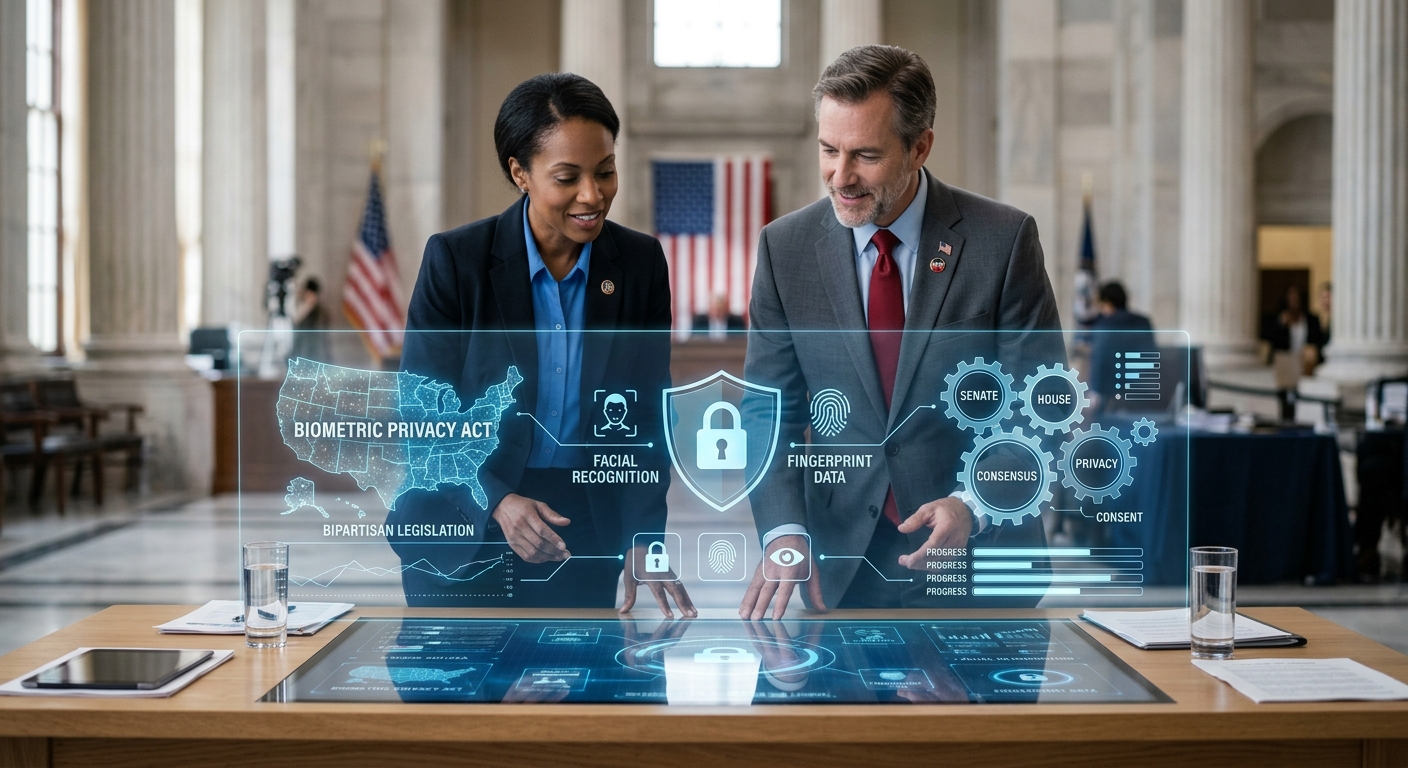
In an era characterized by intense political polarization, a surprising consensus has emerged around one of the most pressing technological issues of our time: the urgent need to regulate biometric surveillance. As facial recognition systems become increasingly sophisticated and ubiquitous, lawmakers across the ideological spectrum are uniting to establish robust privacy frameworks. This bipartisan momentum is driven by a shared recognition that the unchecked collection and analysis of biometric data poses an existential threat to fundamental civil liberties. From progressive strongholds to conservative heartlands, state legislatures are recognizing that the digital mapping of a citizen’s face without their explicit consent is an unacceptable overreach of both corporate and governmental power.
The push for biometric privacy transcends traditional party lines because it touches upon universal human concerns. For conservatives, the rapid expansion of facial recognition technology evokes a deep-seated wariness of an ever-expanding surveillance state and the erosion of individual autonomy. For progressives, the technology’s well-documented algorithmic biases and its disproportionate impact on minority communities raise critical questions about equity and systemic justice. Together, these convergent anxieties are driving a new wave of state-level legislation designed to rein in the deployment of facial recognition software. These emerging laws serve as critical models for national policy, demonstrating that the protection of constitutional rights in the digital age is a non-partisan imperative that demands immediate, decisive action.
The Evolving Landscape of Biometric Surveillance
For decades, the concept of widespread facial recognition was confined to the realm of science fiction, viewed purely as an authoritarian tool of dystopian futures. Today, it is a pervasive reality, deeply embedded in our smartphones, commercial retail spaces, and urban infrastructure. While initial implementations were often marketed under the guise of convenience and enhanced security, the rapid proliferation of biometric data collection has sparked a profound cultural and political backlash. The unique nature of biometric data—unlike a compromised password or a stolen credit card number—makes it fundamentally irreplaceable. You cannot simply reset your facial geometry, your voiceprint, or your iris pattern. This inherent permanence elevates the stakes of biometric privacy far beyond standard data protection concerns.
As technological capabilities have outpaced legal frameworks, society finds itself at a critical crossroads. The debate is no longer centered merely on whether the technology works efficiently, but rather on whether its unregulated deployment is compatible with a free and open society. Interestingly, this growing apprehension has forged unexpected political alliances. Libertarians, who harbor a deep-seated skepticism of government overreach and centralized power, have found common cause with progressive advocates focused on protecting marginalized groups from discriminatory policing. This shared anxiety over an omnipresent surveillance state has birthed a powerful bipartisan movement dedicated to establishing definitive legal boundaries around the use of facial recognition technology.
Civil Liberties Under the Digital Microscope
The deployment of facial recognition technology in public spaces fundamentally alters the traditional balance of power between the state and the individual. Unlike physical surveillance, which is inherently limited by human resources, geography, and logistics, biometric tracking operates continuously, creating what civil rights scholars describe as a perpetual digital lineup. Every citizen walking down the street, attending a political rally, or entering a place of worship is silently scanned, quantified, and cross-referenced against massive, opaque digital databases. This invisible architecture of surveillance poses a direct, measurable threat to First Amendment rights. The psychological knowledge that one’s presence at a peaceful protest is being recorded and permanently logged by government algorithms creates a profound chilling effect on free assembly and free expression. Individuals may choose to stay home rather than risk being added to a digital watch list simply for voicing their political dissent.
Furthermore, the technology aggressively challenges the core protections of the Fourth Amendment, which safeguards citizens against unreasonable searches and seizures. When biometric data is harvested without explicit consent or a standard of reasonable suspicion, it effectively bypasses the foundational legal requirement of probable cause. Bipartisan lawmakers consistently argue that a person’s face is their most permanent and visible identifier; seizing the mathematical map of that face without proper judicial oversight constitutes a massive breach of constitutional liberty. This fundamental redefinition of what constitutes a ‘search’ in the digital age is driving the push for stringent statutory constraints.
Examining the Algorithmic Bias Crisis
The technological limitations of biometric surveillance are not merely theoretical anomalies; they have profound, irreversible real-world consequences. A landmark analysis conducted by the National Institute of Standards and Technology (NIST)—which remains the uniquely authoritative foundational standard for evaluating demographic algorithmic bias—revealed pervasive demographic differentials across the vast majority of facial recognition algorithms . The comprehensive Face Recognition Vendor Test, which evaluated software from over ninety developers, provided empirical evidence that the technology does not perform equally across all population subsets. False positive rates—instances where the algorithm incorrectly matches a subject’s face to an unrelated individual in a database—were found to be disproportionately higher for women, people of color, and the elderly.
This algorithmic bias creates an inherently unequal surveillance landscape where marginalized communities bear the brunt of technological inaccuracies. When law enforcement agencies rely on flawed algorithms, a false positive is not just a software glitch; it can easily result in wrongful detainment, unconstitutional searches, and severe reputational damage. The intersection of these technological flaws with civil rights has united advocates from across the political spectrum, as neither progressives concerned with systemic discrimination nor conservatives focused on individual liberty can tolerate a government apparatus equipped with biased tracking capabilities. A bipartisan consensus has thus firmly emerged, demanding that until these algorithms can definitively prove their absolute accuracy across all demographic lines without exception, their deployment in public sectors must be severely restricted or outright banned.
The Federal Vacuum and State-Level Innovation
As facial recognition technology has rapidly advanced, the federal government has largely failed to implement comprehensive regulatory frameworks, leaving a significant, dangerous policy vacuum. The urgency of this issue was highlighted in a pivotal report by the U.S. Government Accountability Office (GAO), which rigorously audited the use of biometric technologies by federal law enforcement agencies . The GAO discovered that numerous federal agencies were actively utilizing facial recognition systems provided by external vendors or state databases with alarmingly little oversight. Furthermore, the report noted that agencies often lacked systematic mechanisms to track how and when their employees deployed these powerful surveillance tools. Without stringent federal guidelines mandating privacy impact assessments or transparency logs, the potential for unchecked government overreach became a glaring vulnerability.
In the absence of decisive congressional action, individual states have stepped up to serve as laboratories of democracy, crafting robust, bipartisan legislation to fill the regulatory void . Lawmakers in states with widely divergent political leanings have recognized the imminent threat posed by unregulated biometric surveillance, leading to a massive wave of state-level privacy acts. These legislative efforts frequently prioritize strict prohibitions on the unchecked scraping of biometric data and mandate that any government use of facial recognition be tethered to specific, judicially authorized parameters. By taking the initiative, these states are mapping out a viable blueprint for eventual federal legislation.
Comparative Framework: Lax vs. Strict Regulations
Understanding the profound impact of these emerging laws requires a comparison between jurisdictions that allow unfettered use of facial recognition and those that have adopted strict, bipartisan regulatory frameworks. The differences are stark, impacting everything from individual privacy to the operational protocols of law enforcement agencies. Below is a comparative analysis highlighting the essential elements of robust biometric regulation.
| Regulatory Feature | Unregulated Environment | Strict Bipartisan Framework |
|---|---|---|
| Public Deployment | Continuous, indiscriminate scanning. | Banned by default; limited to specific emergencies. |
| Judicial Oversight | No warrant required for database searches. | Probable cause and judicial warrants mandated. |
| Algorithmic Auditing | Proprietary algorithms hidden from public view. | Mandatory independent bias and accuracy audits. |
| Consent Requirements | Data harvested without user knowledge. | Strict opt-in required for private corporate use. |
Guardrails for Investigative Operations
Despite the stringent restrictions favored by privacy advocates, there is a recognized need to balance civil liberties with legitimate public safety concerns. Strong bipartisan frameworks do not necessarily seek to eradicate the technology entirely but rather to constrain it firmly within constitutional boundaries. When state laws permit exceptions for law enforcement use, they typically mandate robust, unbreakable guardrails to prevent abuse. The absolute cornerstone of these protections is the strict requirement of a judicial warrant based on probable cause. Law enforcement officers must present concrete evidence to a judge demonstrating that the technology is necessary for the investigation of a severe crime, rather than deploying it casually for low-level offenses or speculative, wide-net fishing expeditions.
Additionally, comprehensive regulations require transparency and accountability through independent auditing. Police departments utilizing biometric tools must maintain detailed, publicly accessible logs of their searches, including the legal justification for the scan and the demographic data of the individuals targeted. These logs are often subject to periodic review by civil rights commissions or legislative oversight committees. By strictly defining the scope of allowable use and enforcing rigorous public reporting, bipartisan legislation ensures that the technology remains a specialized, tightly controlled investigative tool rather than an instrument of mass public surveillance. This pragmatic approach satisfies both the conservative demand for law and order and the progressive mandate for civil rights protection.
The Future of Biometric Privacy Standards
The momentum generated by state-level biometric privacy laws signals a fundamental shift in how American society views digital surveillance. As more states adopt these bipartisan frameworks, the pressure on the federal government to establish a unified, nationwide standard continues to intensify. The patchwork of state regulations, while highly effective locally, creates a complex compliance environment for technology developers and federal agencies alike. Ultimately, the principles championed by these state laws—mandatory warrants, strict bans on continuous public surveillance, and uncompromising audits for algorithmic bias—are likely to form the structural foundation of future federal policy.
The ongoing dialogue surrounding facial recognition is a testament to the resilience of democratic institutions when confronted with disruptive technology. By prioritizing the protection of civil liberties over the mere convenience of technological advancement, lawmakers are reaffirming the fundamental rights that underpin a free society. The continued collaboration between diverse political factions will be essential in ensuring that the tools of the future do not become the chains of the present.
Frequently Asked Questions (FAQs)
- What is facial recognition technology?
Facial recognition is an advanced form of biometric software that maps an individual’s facial features mathematically and stores the resulting data as a unique faceprint. The algorithm then compares this faceprint against vast databases of images to identify or verify a person’s identity. - Why is biometric data treated differently from other personal information?
Unlike passwords, email addresses, or social security numbers, biometric data (such as fingerprints, iris scans, and facial geometry) is biologically unique and permanent. If a biometric database is compromised, an individual cannot simply change their face, making the privacy risks associated with this technology uniquely severe and lifelong. - How do facial recognition algorithms exhibit demographic bias?
Machine learning algorithms are trained on vast datasets that often lack sufficient demographic diversity. As a result, the software becomes highly accurate at identifying the demographics most heavily represented in the training data (typically white males) while exhibiting significantly higher error rates—known as false positives—when attempting to identify women and people of color. - What makes a biometric privacy law bipartisan?
Biometric privacy laws attract broad bipartisan support because they address multiple ideological priorities simultaneously. They appeal to conservative values by severely limiting government overreach and protecting individual liberty, while also satisfying progressive goals by preventing racially biased policing and safeguarding the constitutional right to peaceful protest. - Can law enforcement still use facial recognition under strict privacy laws?
Yes, but only under highly restricted, legally defined conditions. Strong privacy frameworks typically forbid routine or mass surveillance but include narrow statutory exceptions allowing law enforcement to use the technology only after obtaining a judicial warrant supported by probable cause, and such use is typically restricted exclusively to investigations of serious criminal offenses.
References
- Face Recognition Vendor Test (FRVT) Part 3: Demographic Effects — National Institute of Standards and Technology (NIST). 2019-12-19. https://www.nist.gov/publications/face-recognition-vendor-test-part-3-demographic-effects
- Facial Recognition Technology: Federal Law Enforcement Agencies Should Better Assess Privacy and Other Risks (GAO-21-518) — U.S. Government Accountability Office. 2021-06-03. https://www.gao.gov/products/gao-21-518
- With no federal facial recognition law, states rush to fill void — CapRadio / NPR. 2025-08-28. https://www.capradio.org/articles/2025/08/28/with-no-federal-facial-recognition-law-states-rush-to-fill-void/
Similar Articles








Read full bio of Sneha Tete


