
The Rise of Biometric Travel: Analyzing Facial Recognition at Airports
As airport security transitions to biometric facial recognition, civil liberties advocates warn of looming privacy threats and unresolved algorithmic biases.
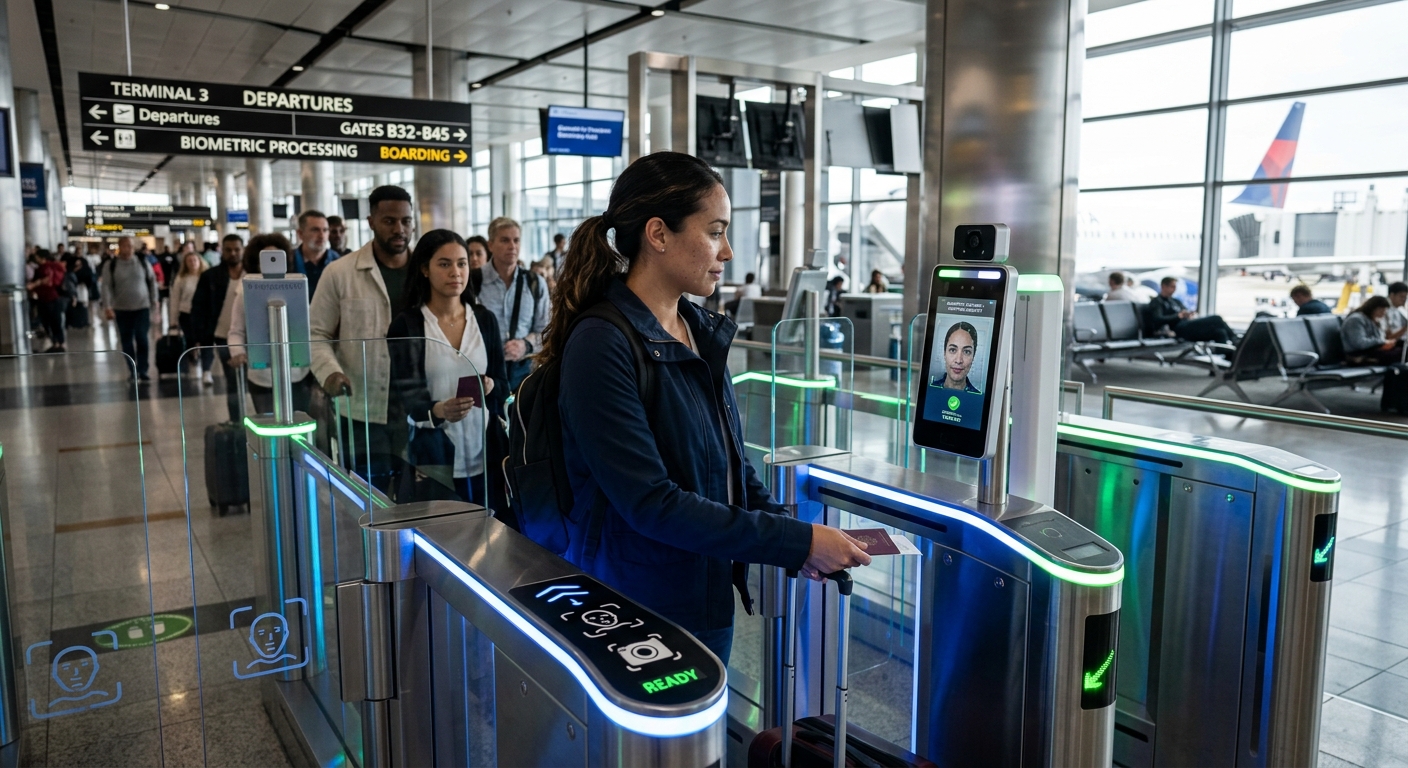
The transformation of global travel has moved from the physical to the digital, and now, to the biological. For decades, paper boarding passes and government-issued physical passports served as the gold standard for verifying traveler identity. However, a rapid paradigm shift is underway across United States transit hubs. Federal agencies, most notably U.S. Customs and Border Protection (CBP) and the Transportation Security Administration (TSA), have enthusiastically embraced facial recognition technology to expedite security checkpoints, international departures, and domestic screenings.
While proponents champion the seamless, frictionless experience of moving through an airport using only one’s face, a growing coalition of civil liberties advocates, privacy researchers, and legislative watchdogs are sounding the alarm. The transition toward ubiquitous biometric surveillance raises profound questions regarding constitutional rights, the mechanics of informed consent, and the inherent demographic biases embedded within algorithmic matching systems. Understanding this technological pivot requires examining not just the convenience it offers, but the massive, decentralized web of data collection it necessitates.
Understanding the Biometric Architecture at Transit Hubs
The integration of facial comparison technology into American transit infrastructure is primarily driven by two distinct but overlapping federal initiatives. First is the CBP’s Biometric Entry-Exit Program, which aims to create a comprehensive biometric record of foreign nationals entering and leaving the country. Second is the TSA’s PreCheck Touchless ID initiative, a heavily expanding program aiming to modernize domestic security screening.
When a traveler approaches a biometric terminal, the system does not randomly search a massive, global database of human faces. Instead, it utilizes a localized, pre-staged gallery. CBP relies on the Traveler Verification Service (TVS), a cloud-based facial matching service. Flight manifest data is used to pull existing passport, visa, and prior encounter photos to build a temporary gallery for a specific flight. As passengers step up to the camera, their live photo is compared against this curated gallery. If the system confirms a match, the passenger boards the plane.
Similarly, the TSA’s Touchless ID program, which saw a massive expansion to 65 airports in early 2026 in preparation for surges in global travel, allows enrolled PreCheck members to bypass physical document checks. Travelers simply opt-in, approach a biometric pod, and have their identity instantly verified against federal databases.
Federal Biometric Programs at a Glance
| Program Feature | CBP Biometric Entry-Exit | TSA PreCheck Touchless ID |
|---|---|---|
| Primary Objective | Immigration enforcement and visa overstay tracking | Streamlined domestic and international security screening |
| Target Demographic | Originally foreign nationals, now encompassing U.S. citizens | Opt-in TSA PreCheck members |
| Data Matching System | Traveler Verification Service (TVS) against manifest galleries | Direct biometric verification via trusted traveler profiles |
| Opt-Out Availability | Yes, but historically criticized for poor signage and friction | Yes, inherently opt-in with physical ID alternatives available |
The Core Civil Liberties and Privacy Concerns
Despite assurances from federal agencies that these systems are secure and efficient, the deployment of facial recognition in public transit spheres has sparked intense debate. The primary arguments against the unchecked expansion of these systems center on the erosion of privacy, the realities of algorithmic bias, and the vulnerabilities associated with massive biometric data collection.
The Consent Dilemma and Informational Obscurity
One of the most persistent criticisms of airport facial recognition programs is the illusion of meaningful consent. While U.S. citizens are legally entitled to opt out of CBP’s facial scanning and utilize traditional document verification, exercising this right in a bustling airport environment is often fraught with friction.
Audits conducted by the U.S. Government Accountability Office (GAO) have consistently highlighted deficiencies in how agencies inform the public. Investigations have revealed that privacy signage is frequently outdated, poorly placed, or altogether absent. In many instances, signs detailing how a traveler might opt out are positioned at the exact location where the facial scan occurs, affording passengers virtually no time to make an informed decision or request manual processing without holding up a line of impatient travelers. This structural friction results in a system that is mandatory in practice, even if voluntary in policy.
Demographic Bias and Algorithmic Imperfections
Perhaps the most severe technological criticism levied against facial recognition is its disparate performance across different demographic groups. Facial recognition models are trained on massive datasets, and if those datasets lack diversity, the resulting algorithm will inevitably demonstrate bias.
The National Institute of Standards and Technology (NIST) conducted an exhaustive evaluation of these technologies in its Face Recognition Vendor Test (FRVT). Evaluating hundreds of algorithms, NIST uncovered empirical evidence that the majority of facial recognition systems exhibit demographic differentials. Specifically, researchers found that false-positive rates—where the system incorrectly identifies two different people as the same person—were disproportionately higher among West African, East Asian, and East African demographics. Furthermore, false-positive rates were generally higher in women than in men, and elevated among the elderly and children.
In the high-stakes environment of an airport, a false positive or a false negative is not merely a technical glitch; it directly translates to increased scrutiny, secondary interrogations, and potential delays for marginalized groups. While top-tier algorithms have significantly reduced these disparities, transit authorities rely on a patchwork of vendors, meaning the risk of discriminatory screening remains a tangible threat to travelers.
Cybersecurity and the Threat of Data Breaches
Unlike passwords or PINs, biometric data is immutable. You can reset a compromised password, but you cannot change your facial geometry. The centralization of biometric templates makes them an incredibly lucrative target for malicious actors, state-sponsored hackers, and cyber syndicates.
Federal agencies maintain that traveler photos are stored temporarily—often deleted within 12 to 24 hours for U.S. citizens—while foreign national data is retained longer for immigration enforcement. However, the ecosystem involves multiple third-party stakeholders, including commercial airlines, cloud infrastructure providers, and independent contractors. Each additional node in this data-sharing network introduces a new vector for potential breaches. If a commercial partner’s server is compromised, the downstream effects on traveler privacy could be devastating, leading to identity theft or the unauthorized tracking of individuals’ movements.
The Legislative Vacuum: A Case of Mission Creep
Another profound concern is the regulatory framework—or lack thereof—governing the domestic use of biometric surveillance. The legislative mandate for a biometric entry-exit system traces back to the 1996 Illegal Immigration Reform and Immigrant Responsibility Act, and was heavily reinforced by the recommendations of the 9/11 Commission. The explicit statutory purpose of these laws was to track the arrival and departure of foreign nationals to identify visa overstays and secure the borders.
However, the modern rollout of facial recognition at airports has resulted in the scanning of millions of U.S. citizens. Privacy advocates argue that Congress never explicitly authorized the mass facial recognition of American citizens for domestic or international travel. This phenomenon is widely viewed as “mission creep,” where a technology authorized for a narrow national security purpose is quietly expanded to capture the general populace without rigorous public debate or explicit statutory approval.
Forging a Path Forward: Balancing Innovation with Rights
The trajectory of air travel points inextricably toward biometric integration. However, balancing operational efficiency with constitutional protections requires immediate, systemic reforms. To mitigate the severe risks to civil liberties, policymakers and technology advocates suggest several crucial implementations:
- Explicit Congressional Mandates: Lawmakers must pass comprehensive legislation specifically defining the boundaries of biometric data collection on U.S. citizens, rather than relying on outdated statutes intended for foreign nationals.
- Frictionless Opt-Out Procedures: Transit authorities must redesign checkpoints to make manual document verification an equally accessible and prominently advertised alternative, ensuring that opting out does not subject a traveler to undue delays or suspicion.
- Rigorous Independent Auditing: Government agencies and commercial airlines must submit to frequent, independent audits to assess algorithmic bias, ensuring that vendors failing to meet stringent demographic fairness standards are disqualified from federal contracts.
- Strict Data Retention Limits: Legislation must enforce irreversible cryptographic hashing of biometric data, coupled with hard-coded deletion protocols that prevent third parties from monetizing or storing traveler faces.
Ultimately, the convenience of leaving a passport in your pocket must not cost the public their fundamental right to privacy. Without robust, legally binding safeguards, the airport of the future risks becoming an inescapable apparatus of surveillance.
Frequently Asked Questions (FAQs)
Can I opt out of facial recognition scanning at the airport?
Yes, U.S. citizens have the right to opt out of facial recognition checkpoints operated by CBP and TSA. You can request manual processing from an officer, which involves presenting your physical passport or ID. However, you should notify the agent before approaching the camera, as the scanning process is often instantaneous.
What is TSA PreCheck Touchless ID?
TSA PreCheck Touchless ID is a voluntary program expanding across U.S. airports that allows enrolled travelers flying on participating airlines to move through security checkpoints using only their face. It matches a live photo taken at the checkpoint against a secure biometric template created from government records.
Is facial recognition technology racially biased?
Extensive testing by the National Institute of Standards and Technology (NIST) has shown that while the most advanced algorithms have minimal bias, the majority of facial recognition systems exhibit demographic differentials. Historically, these systems have shown higher error rates for women, the elderly, and people of color, raising concerns about discriminatory security screening.
Does the government save my face scan permanently?
According to current agency policies, CBP and TSA do not permanently store the live photos of U.S. citizens captured at airport checkpoints. TSA protocols generally require the deletion of the data within 24 hours of flight departure, though privacy groups continue to push for stricter legislative guarantees.
References
- Facial Recognition Technology: CBP Traveler Identity Verification and Efforts to Address Privacy Issues — U.S. Government Accountability Office (GAO). 2022-07-27. https://www.gao.gov/products/gao-22-106154
- Face Recognition Vendor Test (FRVT), Part 3: Demographic Effects — National Institute of Standards and Technology (NIST). 2019-12-19. https://doi.org/10.6028/NIST.IR.8280
- OIG-22-48 – CBP Complied with Facial Recognition Policies to Identify International Travelers at Airports — Department of Homeland Security Office of Inspector General. 2022-07-05. https://www.oig.dhs.gov/sites/default/files/assets/2022-07/OIG-22-48-Jul22.pdf
- TSA PreCheck Touchless ID — Transportation Security Administration. Accessed 2026. https://www.tsa.gov/travel/frequently-asked-questions/what-tsa-precheckr-touchless-id
- TSA facial scanning PreCheck lane expanding to more airports — The Washington Post. 2026-01-28. https://www.washingtonpost.com/travel/2026/01/28/tsa-facial-recognition-precheck-airports/
Similar Articles








Read full bio of medha deb


