
Biometric Scans in Stadiums: The Privacy Cost
How facial recognition is replacing tickets and eroding personal privacy.
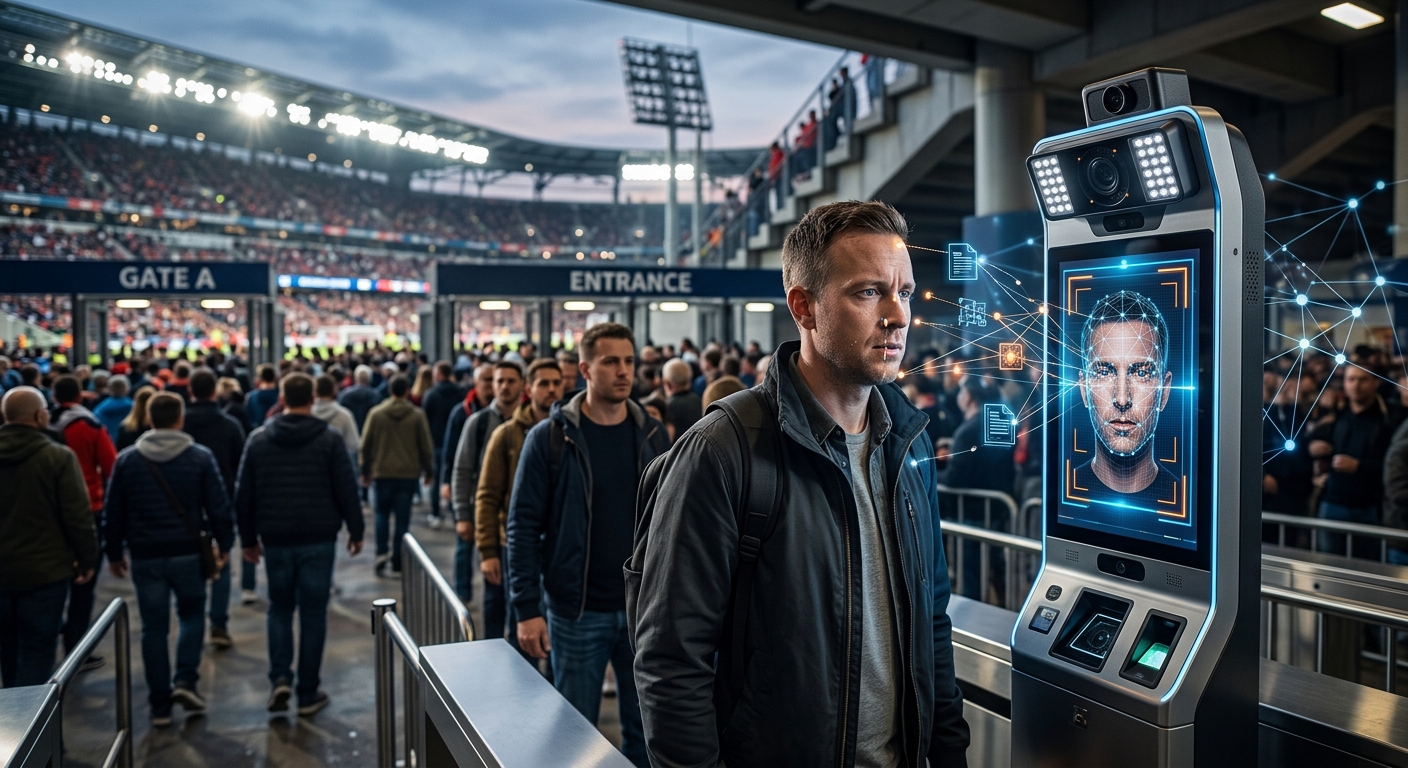
Imagine walking up to the gates of a massive sports stadium. Instead of fumbling through your pockets for a digital ticket, loading an application, or presenting a physical identification card, you simply look at a camera, and the turnstile opens. There is no line, no barcode scanner, and no physical interaction with a security guard. This frictionless vision of the future is no longer a hypothetical scenario; it is rapidly becoming the reality at entertainment venues, sports arenas, and public gathering spaces across the United States. Facial recognition technology (FRT) is steadily replacing traditional ticketing and identification methods, fundamentally altering how we access public life.
Proponents of this technological shift argue that it brings unparalleled convenience to the consumer experience. They point out that biometric ticketing drastically reduces wait times, eliminates the stress of lost tickets, and enhances physical security by identifying known bad actors before they can enter a crowded venue. However, this seamless experience masks a profound transformation in personal privacy. By trading our physical tickets for biometric scans, we are participating in the rapid normalization of mass surveillance. The cost of skipping a five-minute queue may be the permanent exposure of our most sensitive, unalterable personal data: our faces.
As this technology creeps out of high-security environments, such as border control checkpoints or law enforcement databases, and into the mundane activities of buying a hot dog at a baseball game, society must grapple with the implications. The invisible turnstile is here, but the debate over who controls our biometric data has only just begun.
The Allure of Frictionless Access: Why Venues Are Adopting Facial Recognition
The push toward biometric integration in entertainment venues is primarily driven by the promise of frictionless access. In an era where consumers are accustomed to the instant gratification of digital services, physical bottlenecks like standing in a queue for twenty minutes to enter a concert are increasingly viewed as unacceptable friction points. Venue operators are acutely aware of this, and they view facial recognition as the ultimate solution to crowd management.
From a logistical standpoint, the benefits for stadium owners are immense. Moving thousands of people through a choke point efficiently is one of the most significant challenges in event management. By deploying facial recognition cameras, venues can process attendees at a walking pace. The technology functions by mapping the geometric features of a person’s face, such as measuring the distance between the eyes, the shape of the cheekbones, and the contour of the jawline, and instantly comparing that mathematical template against a database of registered ticket holders. If there is a match, the system triggers the turnstile to open in a fraction of a second.
Furthermore, the post-pandemic landscape accelerated the adoption of contactless technologies. Health concerns regarding touchpoints at kiosks and security checkpoints provided the initial catalyst for many venues to upgrade their infrastructure. What began as a sanitary precaution has morphed into a permanent operational upgrade. Beyond crowd flow, venues are also lured by the promise of operational efficiency and the vast amounts of consumer data they can compile.
Beyond the Ticket: Age Verification, Payments, and Personalized Experiences
The ambitions of biometric technology vendors extend far beyond the entrance gate. Once a venue has successfully linked a patron’s face to their digital identity, that face becomes an all-access pass to the entire stadium ecosystem. The most immediate expansion of this technology is in age verification and frictionless payments at concession stands.
Traditionally, purchasing alcohol at a sporting event requires a fan to present a physical driver’s license to verify they are over the legal drinking age, followed by swiping a credit card or using a mobile payment application. Facial recognition systems are streamlining this into a single, momentary glance. Fans who opt into these programs upload a selfie and their government-issued ID to a third-party application prior to the event. The software authenticates the ID, links the user’s payment information to their facial geometry, and stores this profile. At the concession stand, a camera scans the buyer’s face, verifies their age, and processes the payment simultaneously.
While marketed as a premium experience, this integration represents a massive expansion of biometric data usage. The commercial ecosystem is tying our physical bodies directly to our financial accounts and government records. This creates a highly lucrative environment for targeted marketing. If a venue knows exactly who you are, where you sit, what you drink, and how often you attend games, they can tailor hyper-specific advertising and promotional offers directly to your profile. What is introduced as a voluntary convenience for buying a soda can quickly become the default method of interaction within a public space.
The Hidden Cost of Convenience: Deep Privacy and Security Risks
The transition to biometric authentication carries profound privacy and security risks that are often overshadowed by the marketing hype surrounding convenience. The fundamental problem with using your face as a key is that, unlike a password or a physical ticket, you cannot change your face if it is compromised.
The Permanent Data Trail: You Cannot Change Your Face
When you surrender your facial geometry to a ticketing company, sports franchise, or third-party vendor, you are trusting them with immutable personal data. If a hacker breaches a stadium’s database and steals credit card numbers, banks can issue new cards and freeze the compromised accounts. If a bad actor steals a database of biometric faceprints, the damage is irreparable. You cannot be issued a new identity.
This permanent data trail makes biometric databases incredibly attractive targets for cybercriminals. The more venues that collect and store this information, the wider the attack surface becomes. Furthermore, the terms of service governing these biometric opt-ins are frequently buried in lengthy digital agreements that users rarely read. The data may be shared with marketing partners, corporate affiliates, or technology providers, creating a sprawling web of entities that hold your most sensitive personal information.
Algorithmic Bias and the Danger of Misidentification
Another critical flaw in the widespread deployment of facial recognition technology is its alarming history of algorithmic bias and inaccuracy. Numerous studies, including extensive evaluations by the National Institute of Standards and Technology (NIST), have demonstrated that many facial recognition algorithms suffer from demographic differentials. This means the software can perform less accurately on certain groups of people, particularly women and individuals with darker skin tones.
Algorithms are trained on vast datasets of human faces, but if those datasets lack diversity, the system becomes less adept at distinguishing the nuances of faces from underrepresented demographic groups. In a stadium setting, a false positive, where the system incorrectly identifies an innocent fan as someone on a banned list, can lead to unjust ejection, public humiliation, or even detention by law enforcement. The reliance on this technology in public spaces disproportionately impacts marginalized communities, exacerbating existing societal inequalities under the guise of technological progress.
Normalization of Mass Surveillance and the Slippery Slope
Perhaps the most insidious threat posed by the deployment of facial recognition at entertainment venues is the normalization of mass surveillance. By making biometric scanning a routine part of leisure activities, society becomes desensitized to the constant monitoring of public spaces. The erosion of anonymity changes how people behave and interact in public.
This creates a dangerous slippery slope. If we accept that it is normal to have our faces scanned to watch a basketball game, we lower the psychological barriers to accepting biometric surveillance in supermarkets, shopping malls, public transit systems, and city streets. The boundary between private commerce and state surveillance is also notoriously porous. Stadiums are private venues, but they frequently collaborate closely with local, state, and federal law enforcement agencies for event security.
There is a looming risk that the massive biometric databases compiled by sports teams and ticketing giants could be accessed by police departments. If law enforcement agencies tap into stadium cameras to run real-time checks against criminal databases, the stadium ceases to be merely an entertainment venue and effectively becomes a dragnet for the state. This erosion of anonymity in public spaces chills freedom of association and movement.
The Regulatory Vacuum: Can Lawmakers Keep Pace with Innovation?
The rapid rollout of biometric technology in public spaces is occurring largely in a regulatory vacuum. In the United States, there is currently no comprehensive federal law specifically governing the collection, storage, and use of biometric data by private entities. Instead, citizens are protected by a patchwork quilt of state and local regulations that vary wildly in their efficacy.
A few states, such as Illinois with its Biometric Information Privacy Act (BIPA), have enacted stringent laws that require explicit consent before biometric data can be collected and provide a private right of action if those rules are violated. However, in the vast majority of the country, private venues operate with significant leeway. Privacy advocates are calling for urgent legislative action to establish clear boundaries, including mandatory opt-in requirements and strict limitations on data retention.
Protecting Your Digital Identity in a Contactless World
In the absence of strong legal protections, individuals must take proactive steps to protect their digital identities. The most effective measure is simply to refuse the convenience. Whenever presented with the option to use a biometric fast lane, opt for the traditional physical or digital ticket, even if it means waiting in a slightly longer line. It is crucial to read the terms of service when purchasing tickets or downloading venue applications. Look for clauses related to biometric data, facial scans, or age verification partnerships.
Frequently Asked Questions (FAQ)
- What exactly is facial recognition technology (FRT)?
Facial recognition technology is a type of biometric software that maps an individual’s facial features mathematically and stores the data as a “faceprint.” It uses artificial intelligence to compare a live capture or digital image of a face against a database of stored faceprints to verify or identify a person. - Are stadiums legally allowed to scan my face?
In most of the United States, yes. Because sports stadiums and concert halls are private property, operators can generally set the terms of entry. Unless you live in a state with specific biometric privacy laws, private companies have significant leeway in collecting this data, provided it is disclosed in the terms of service. - Can I opt out of biometric scanning at events?
Currently, most venues rolling out this technology offer it as an “opt-in” feature for faster entry. You can usually choose to use a standard mobile barcode or paper ticket instead. However, privacy advocates worry that as the technology becomes more prevalent, the opt-out alternatives may become increasingly difficult to use. - What happens to my biometric data after the game is over?
This depends entirely on the specific venue and the third-party technology vendor they partner with. Some claim to delete the data shortly after the event, while others may store it indefinitely, link it to your consumer profile, or share it with corporate affiliates. Always review the specific privacy policy of the ticketing or venue application you are using. - Is facial recognition technology accurate?
While accuracy has improved in laboratory settings, real-world deployment still faces challenges. Government studies have shown that many algorithms have higher rates of false positives and false negatives for women and people with darker skin tones, raising serious concerns about algorithmic bias.
References
- Face Recognition Vendor Test (FRVT) Part 3: Demographic Effects — National Institute of Standards and Technology (NIST). 2019-12-19. https://nvlpubs.nist.gov/nistpubs/ir/2019/NIST.IR.8280.pdf
- GAO-24-106293, BIOMETRIC IDENTIFICATION TECHNOLOGIES: Considerations to Address Information Gaps and Other Stakeholder Concerns — U.S. Government Accountability Office (GAO). 2024-04-22. https://www.gao.gov/products/gao-24-106293
- MLB testing hands-free entry for fans utilizing facial authentication, AI security — Associated Press (AP). 2023-08-31. https://apnews.com/article/mlb-facial-authentication-phillies-go-ahead-entry-2ec2b55f5f3e493390c5f210515e024f
- GAO-20-522, Facial Recognition Technology: Privacy and Accuracy Issues Related to Commercial Uses — U.S. Government Accountability Office (GAO). 2020-07-13. https://www.gao.gov/products/gao-20-522
Similar Articles








Read full bio of medha deb


