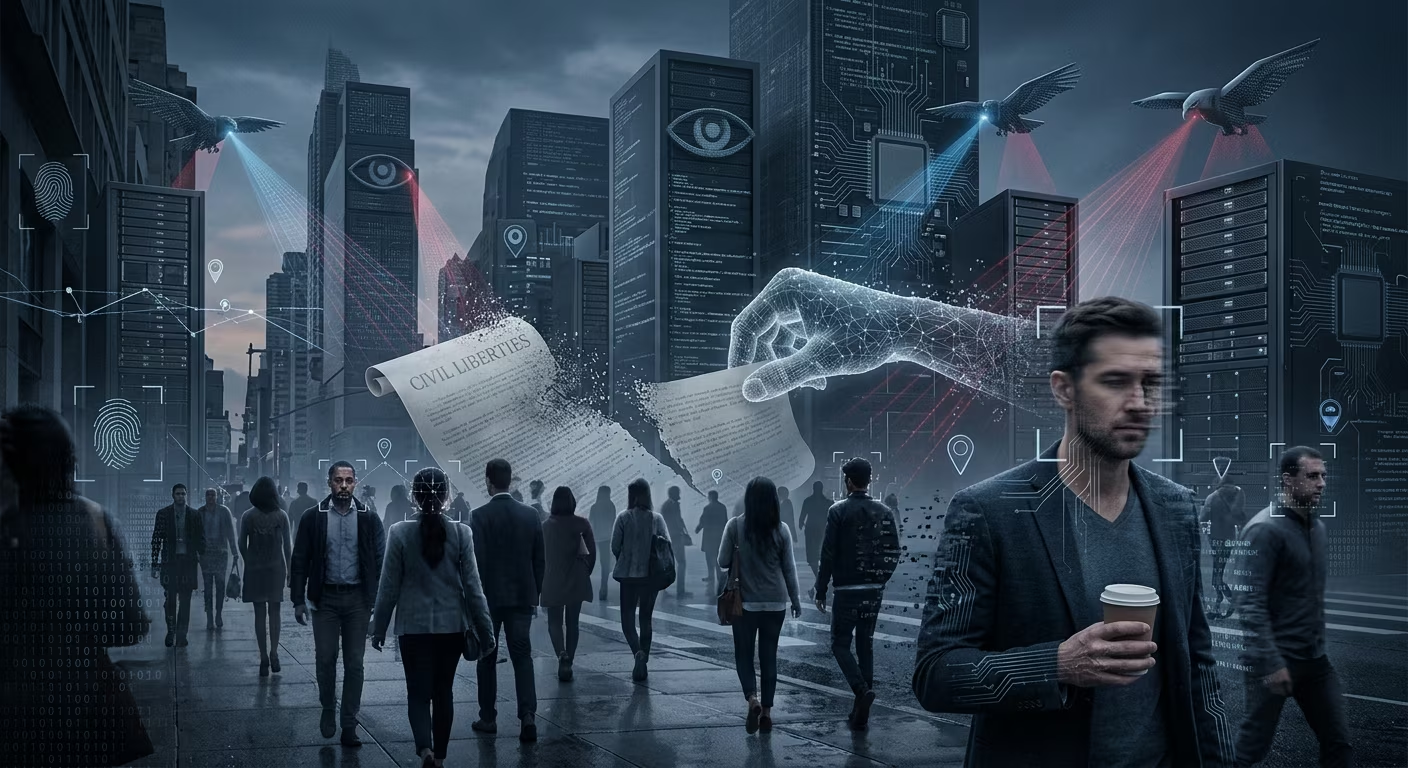
Artificial intelligence is no longer the stuff of speculative fiction; it has rapidly become the invisible architecture of our modern reality. From the moment we wake up and unlock our smartphones with a brief glance, to the deeply consequential decisions made by distant financial institutions about our creditworthiness, algorithmic systems dictate the boundaries of our daily lives. The technological promises driving this adoption are undeniably grand: optimized societal efficiency, unprecedented consumer convenience, and the complete eradication of flawed human error. However, a much darker reality simmers beneath the glossy veneer of this technological progress.
As advanced AI systems become more entrenched in the critical pillars of society—encompassing law enforcement, housing markets, employment opportunities, and the justice system—they pose a profound, existential threat to our fundamental civil liberties. Rather than acting as purely objective, infallible tools, these complex computational systems often serve as digital mirrors, reflecting, automating, and amplifying the deep-seated biases and historical inequalities of the society that engineered them. The most pressing question we must confront in this era is not merely whether artificial intelligence will dramatically transform the world, but whether the unchecked deployment of these technologies will systematically make us measurably less free.
The Dangerous Myth of Algorithmic Neutrality
One of the most pervasive and politically dangerous myths surrounding artificial intelligence is the widespread assumption of technological neutrality. Because algorithms process massive sets of data using complex mathematical formulas, the general public and many policymakers inherently assume that these systems are completely objective, successfully stripped of the emotional prejudices that plague human decision-making. This comforting illusion could not be further from the truth. An artificial intelligence model is entirely dependent upon, and only as fair as, the underlying data on which it is continuously trained.
When a machine learning algorithm is fed vast amounts of historical data—data generated over decades in a society marked by systemic discrimination, racial profiling, and severe economic inequality—it inevitably learns to identify these biased societal outcomes as the acceptable baseline for its future decisions. Consequently, the technology automates and mathematically legitimizes historical prejudice. The United States Department of Justice has formally recognized this critical intersection, explicitly noting that while emerging technologies offer immense societal utility, their unmonitored application frequently results in unlawful discrimination across multiple sectors . When a human acts with obvious prejudice, there is often a traceable intent or a legal avenue for recourse. But when an algorithm discriminates, it operates within a proprietary “black box,” cloaking its bias in the unassailable authority of computer science. This profound lack of transparency strips individuals of their autonomy, rendering them powerless against judgments they cannot see, understand, or effectively contest.
Predictive Policing and the Peril of Pre-Crime Surveillance
Perhaps the most alarming and direct application of automated decision-making lies squarely within the realm of criminal justice and local law enforcement. In a desperate bid to optimize dwindling resources and proactively reduce local crime rates, numerous police departments across the country have eagerly adopted so-called “predictive policing” technologies. These AI-driven systems analyze vast, intersecting datasets—including past geographical arrest records, neighborhood crime statistics, and even real-time social media activity—to forecast precisely where future crimes are likely to occur and, in some cases, who might commit them. On its face, anticipating criminal activity before it happens seems like a genuine public safety triumph.
However, the on-the-ground reality of predictive policing is deeply flawed and heavily racialized. Because historical arrest data is disproportionately skewed against low-income neighborhoods and communities of color—a direct result of decades of targeted over-policing—the predictive algorithm inevitably flags these exact same areas as permanent “high risk” zones. Law enforcement then continuously deploys more patrol officers to these specific neighborhoods, inevitably leading to more arrests for low-level, non-violent offenses. This creates a devastating, self-fulfilling feedback loop of perpetual surveillance and criminalization. A landmark academic study from researchers at the University of Chicago demonstrated this phenomenon vividly; they developed an algorithm capable of predicting crime with remarkable accuracy, but in doing so, their models revealed a stark, deeply ingrained bias in police response metrics, showing that crime in wealthier areas historically resulted in more thorough investigations and arrests compared to disadvantaged neighborhoods . The widespread deployment of predictive AI essentially treats certain citizens as active suspects by default, eroding the foundational presumption of innocence.
Digital Redlining: The Automation of Financial Exclusion
The insidious threat to personal liberty extends far beyond physical law enforcement surveillance and directly targets the economic bedrock of our lives. Access to capital—whether it takes the form of a reasonable mortgage to purchase a family home or a business loan to launch a small enterprise—is a fundamental, non-negotiable pillar of economic mobility. For generations, overtly discriminatory practices like neighborhood redlining systematically denied these wealth-building opportunities to minority communities. While the Fair Housing Act and the Equal Credit Opportunity Act officially outlawed explicit racial redlining, the practice has unfortunately been resurrected in a highly sanitized, digital form.
Today, major financial institutions rely almost entirely on automated underwriting systems and advanced machine-learning models to determine an applicant’s creditworthiness and assign subsequent interest rates. These modern systems evaluate thousands of obscure data points, many of which secretly serve as highly accurate proxies for race or socioeconomic status. Variables such as specific zip codes, granular online shopping habits, or even the type of device an applicant uses to browse the internet can heavily influence the final calculation. The tragic result is a system capable of systematically denying mortgages or charging exorbitant interest rates to minority applicants without ever explicitly factoring in their race. Researchers at the Massachusetts Institute of Technology (MIT) have actively highlighted this growing economic crisis, definitively demonstrating that biases bleeding into machine-learning models possess far-reaching, destructive consequences for housing fairness, prompting the urgent development of novel techniques to successfully “de-bias” training datasets .
The Modern Gatekeeper: AI in Employment and Education
The traditional gates of professional employment and higher education are increasingly guarded by silent, automated sentinels rather than human beings. The recruitment process for the vast majority of Fortune 500 corporations now begins not with a human resources manager reviewing credentials, but with an AI screening tool rapidly processing hundreds of applications per second. These automated systems aggressively scan resumes for specific industry keywords, analyze the micro-facial expressions and vocal tonality of applicants during automated video interviews, and arbitrarily rank candidates based on opaque metrics of “cultural fit” and predicted longevity.
The inherent danger in this ecosystem is twofold. First, these unmonitored systems are notoriously prone to replication bias. If a large company’s historical hiring data indicates that its most successful, long-tenured employees have been predominantly white men from a select group of Ivy League universities, the algorithm naturally penalizes brilliant applicants who deviate from this established profile. This effectively screens out highly qualified women, racial minorities, and older workers before a human ever sees their names. Second, these specialized tools routinely fail to account for basic human neurodiversity or physical disabilities. A facial analysis AI might unjustly penalize an applicant with a mild speech impediment or autism, automatically flagging their non-standard responses as “unconfident” or “untrustworthy.” The U.S. Department of Education has similarly issued severe warnings regarding the discriminatory use of artificial intelligence within educational settings, strongly emphasizing the absolute necessity for school communities to ensure predictive technologies do not inadvertently contribute to systemic discrimination based on race, biological sex, or documented disability .
The Erosion of Privacy and the Global Surveillance State
To function efficiently, artificial intelligence requires an absolutely insatiable diet of personal data. This endless demand has aggressively fueled a golden age of mass corporate and governmental surveillance, fundamentally altering the traditional concept of personal privacy. Every single digital interaction—every private search query, GPS location ping, online retail purchase, and fleeting social media interaction—is meticulously harvested, permanently aggregated, and fed directly into algorithmic models intentionally designed to predict and ruthlessly manipulate our future behavior. The rapid proliferation of facial recognition technology currently represents the most physically invasive frontier of this data collection.
This unprecedented level of omnipresent surveillance exerts a massive, undeniable chilling effect on freedom of expression and the right of peaceful association. If average citizens operate under the constant assumption that their physical movements are being meticulously tracked, categorized, and permanently recorded by an unfaltering digital eye, they become significantly less likely to attend lawful protests, express dissenting political viewpoints, or engage in any civic activities that actively challenge the current status quo. The U.S. State Department’s recently published “Risk Management Profile for Artificial Intelligence and Human Rights” warns explicitly that powerful AI tools can be intentionally misused by various actors to severely infringe on established human rights, including facilitating illegal mass surveillance and enforcing digital censorship . The collective loss of societal privacy is not merely a loss of personal secrecy; it is the deliberate erosion of the critical psychological space necessary for free thought, open debate, and healthy democratic participation.
Reclaiming Our Digital Autonomy
The current narrative of artificial intelligence absolutely does not have to end in a dystopian, unavoidable surrender of our cherished civil liberties. Technology remains entirely a human creation, and it must forever remain strictly subject to human governance and ethical oversight. To ensure that AI genuinely enhances rather than actively diminishes our fundamental freedom, we must urgently demand a comprehensive, legally binding framework of algorithmic accountability:
- Mandate Absolute Transparency: The unaccountable era of the algorithmic “black box” must swiftly end. Individuals possess a fundamental, unalienable right to know exactly when an AI system is making a high-stakes decision about their life, housing, or liberty, and precisely how that specific conclusion was mathematically reached.
- Implement Robust Auditing Mechanisms: AI systems must be rigorously, independently tested for inherent bias and discriminatory outcomes both before they are ever deployed to the public and continuously throughout their operational lifecycle. Third-party technical auditors must be legally empowered to investigate and immediately halt the use of demonstrably harmful technologies.
- Establish Clear Legal Liability: If a deployed AI system unlawfully denies an applicant a job based strictly on their gender, or actively flags a minority neighborhood for aggressive, unwarranted policing based on geographic proxies, the corporate creators and institutional deployers of that specific technology must be held fully accountable under existing and future civil rights legislation.
Conclusion
Artificial intelligence holds undeniable, transformative potential to eventually cure devastating diseases, revolutionize clean energy grids, and solve complex global logistical challenges. But as a society, we cannot allow the intoxicating seduction of rapid technological progress to completely blind us to the profound, existential threats it continuously poses to our fundamental human rights. If left entirely unchecked, AI will silently construct a rigid, unforgiving society governed almost entirely by the encoded prejudices of our flawed past, perfectly masking systemic discrimination behind a false veil of mathematical objectivity. The defining fight for civil liberties in the 21st century will not only be bravely waged in traditional courtrooms and on the physical streets; it will be fiercely fought deep within the proprietary code, the massive training datasets, and the silent algorithms that increasingly govern our interconnected world.
Frequently Asked Questions (FAQs)
Can artificial intelligence ever be completely unbiased?
No algorithm can currently be considered entirely free of bias because they are fundamentally designed by flawed human beings and trained exclusively on data generated by a flawed human society. Since all historical data inherently contains documented societal biases, any AI system will inevitably reflect some degree of prejudice unless it is actively, meticulously engineered and continually audited by independent bodies to actively counteract those specific biases.
What exactly is predictive policing, and why is it controversial?
Predictive policing involves the active use of massive data analytics and artificial intelligence to mathematically forecast potential criminal activity before it occurs. Local law enforcement agencies utilize these complex algorithms to determine exactly where to deploy limited patrol officers or which specific individuals to monitor. Critics strongly argue that because the underlying data is deeply flawed, the practice merely perpetuates and mathematically justifies endless cycles of over-policing in historically marginalized and minority communities.
What is meant by the term “digital redlining”?
Digital redlining directly refers to the modern practice where automated financial systems and lending algorithms create highly disparate, discriminatory impacts in mortgage lending or residential housing. By relying on proxy data—such as specific zip codes, internet browser types, or granular digital shopping habits—these opaque systems effectively deny critical financial services or actively charge considerably higher interest rates to marginalized demographic groups, perfectly mirroring the illegal, historical practice of geographic redlining.
References
- Artificial Intelligence and Civil Rights — Department of Justice. 2025-02-03. https://www.justice.gov/crt/artificial-intelligence-and-civil-rights
- Algorithm predicts crime a week in advance, but reveals bias in police response — University of Chicago. 2022-06-30. https://news.uchicago.edu/story/algorithm-predicts-crime-week-advance-reveals-bias-police-response
- Fighting discrimination in mortgage lending — MIT News. 2022-03-30. https://news.mit.edu/2022/machine-learning-mortgage-bias-0330
- Avoiding the Discriminatory Use of Artificial Intelligence — Department of Education. 2025-01-09. https://www.ed.gov/ocr
- Risk Management Profile for Artificial Intelligence and Human Rights — State Department. 2024-07-25. https://www.state.gov/risk-management-profile-for-artificial-intelligence-and-human-rights/