
The Algorithmic Panopticon: How Facial Recognition Automates Inequity
Biometric surveillance tools are quietly reshaping law enforcement and borders.
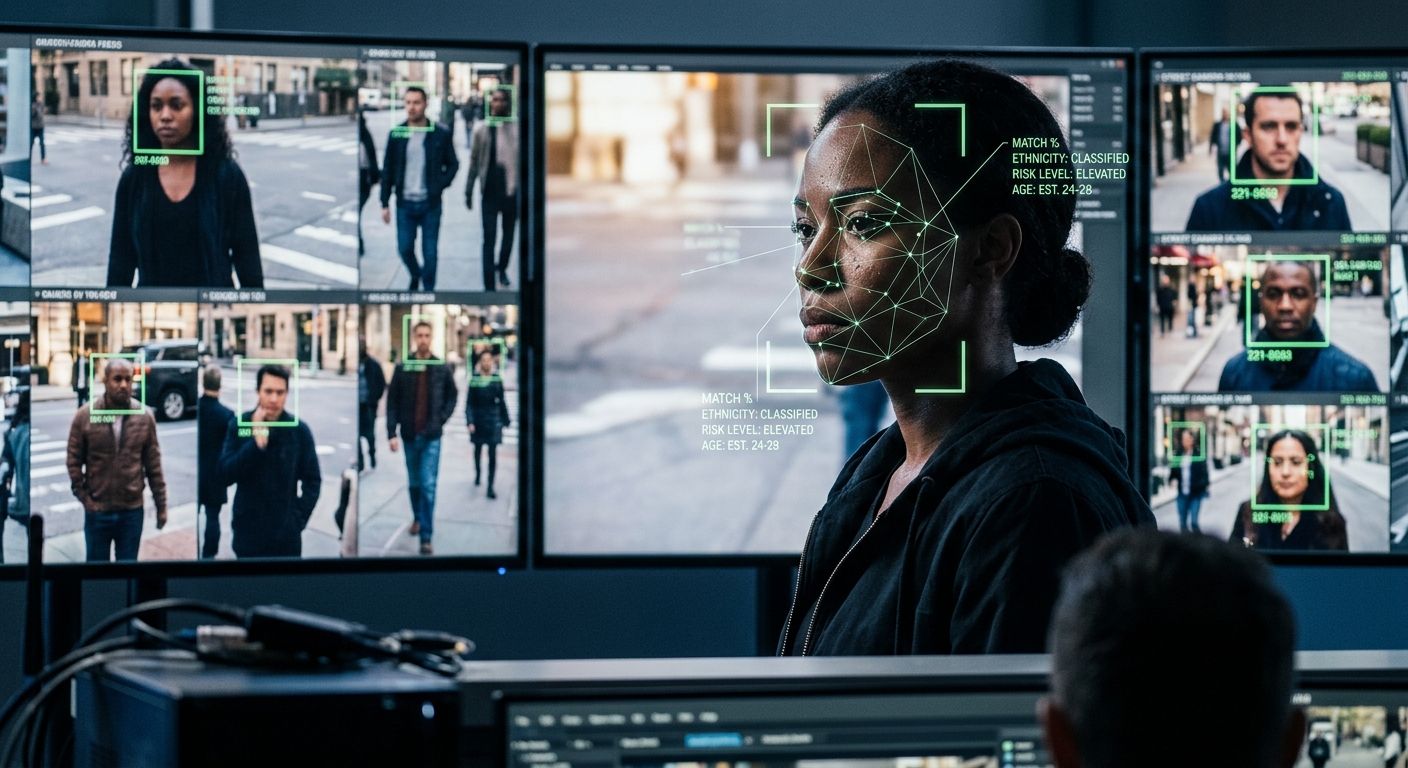
The Dawn of the Biometric Panopticon
In an era where digital footprints are meticulously tracked, the physical world has increasingly become a domain of algorithmic observation. Biometric surveillance, most notably facial recognition technology (FRT), has quietly transitioned from the realm of science fiction into the daily operations of local police departments, federal agencies, and border patrol outposts. Ostensibly deployed to streamline security and identify suspects, this powerful technology operates with minimal oversight, fundamentally altering the relationship between the state and the individual.
Traditionally, the Fourth Amendment has protected citizens from unreasonable searches, requiring specific suspicion and judicial oversight before law enforcement can invade a person’s privacy. However, the passive nature of biometric scanning subverts this legal threshold. Cameras can seamlessly map the geometric features of thousands of pedestrians in real-time, effectively running background checks on entirely innocent populations. Far from being an objective tool of modern justice, facial recognition acts as a digital magnifier for existing societal inequities. By automating identification at an unprecedented scale, biometric systems risk embedding historical biases into the very infrastructure of law enforcement and immigration control, demanding urgent legislative intervention before these digital panopticons become an irreversible fixture of civic life.
Unmasking Algorithmic Bias: The Flaws in the Machine
The pervasive myth surrounding artificial intelligence is that machines are inherently neutral, calculating outcomes free from human prejudice. In the context of facial recognition, this assumption is demonstrably false. Facial recognition algorithms rely on deep learning neural networks that must be trained on vast datasets of human faces to recognize patterns, calculate geometries, and output a statistical probability of a match. However, the datasets used to train these models historically suffer from severe demographic imbalances, predominantly featuring the faces of white men.
The Demographic Divide in Accuracy
When an algorithm is trained on a skewed demographic foundation, its ability to accurately identify individuals outside of that specific group plummets. This is not a theoretical concern but a mathematically proven flaw. In December 2019, the National Institute of Standards and Technology (NIST) published a landmark technical study—NIST Interagency Report 8280—evaluating the demographic effects in facial recognition algorithms. The study assessed 189 software algorithms from 99 developers, effectively covering the majority of the commercial industry. The findings were stark: the overwhelming majority of facial recognition algorithms exhibited significant demographic differentials.
Specifically, the NIST report found that false positive rates were highly elevated for faces belonging to women, the elderly, and people of color. Environmental factors exacerbate these algorithmic flaws. Poor lighting, low-resolution closed-circuit television (CCTV) cameras, and unusual camera angles drastically reduce image quality in real-world scenarios. When a low-quality image of a person of color is fed into an algorithm already struggling with demographic accuracy, the statistical likelihood of an algorithmic failure skyrockets.
The Ripple Effects of False Positives
A false positive occurs when the software incorrectly matches an unknown face to a completely different individual in a database. While a false negative (failing to recognize a face) might simply lock a user out of their smartphone, a false positive in a law enforcement database can have catastrophic consequences. When an algorithm incorrectly flags an innocent citizen as a criminal suspect, it initiates a terrifying chain reaction of police action.
Armed officers may show up at an individual’s home or workplace based entirely on a flawed mathematical probability. The burden of proof is implicitly shifted onto the citizen to prove they are not the person the machine claims they are, effectively weaponizing the technology against communities of color who already face disproportionate rates of police scrutiny and systemic marginalization.
Law Enforcement Integration: Policing by Pixel
The integration of facial recognition into daily policing has transformed neighborhood streets into invisible checkpoints. In the past, identifying an unknown suspect required painstaking detective work, community outreach, and traditional forensics. Today, agencies can feed a grainy surveillance photo or a cell phone video into an automated system that cross-references the image against millions of state driver’s licenses, passport photos, and mugshot databases in mere seconds. This practice effectively places the entire population into a perpetual lineup.
The Erosion of Public Anonymity
This deployment is vast, rapidly expanding, and largely unregulated. A comprehensive 2021 report by the U.S. Government Accountability Office (GAO-21-518) revealed the staggering scope of federal utilization. The GAO surveyed 42 federal agencies that employ law enforcement officers and found that 20 of them reported using facial recognition systems. Troublingly, the report highlighted that agencies frequently utilized external systems owned by non-federal entities, such as local police databases or commercial vendors, often without any centralized tracking, specialized training, or privacy impact assessments.
The GAO report explicitly noted that several agencies used these systems to identify individuals participating in the widespread civil rights protests following the death of George Floyd in 2020. Using biometric surveillance to scan crowds at political demonstrations raises profound First Amendment concerns, as the loss of anonymity creates a severe chilling effect on the fundamental right to assemble and petition the government.
Amplifying Historical Disparities
Furthermore, facial recognition exacerbates the historical cycle of over-policing in marginalized neighborhoods. Because these systems frequently search mugshot databases, communities that have been subjected to historically higher arrest rates—often for low-level offenses—are disproportionately represented in the digital architecture being queried. When surveillance cameras are disproportionately concentrated in lower-income areas and the databases they search are skewed, the resulting algorithmic outputs inevitably target Black and Hispanic individuals at higher rates.
The technology creates a dangerous feedback loop: biased policing generates the data, the data informs the algorithm, and the algorithmic matches direct further policing. The use of this technology is also frequently shrouded in secrecy. Because facial recognition is often classified by police simply as an “investigative lead” rather than the sole probable cause for an arrest, prosecutors routinely fail to disclose its use to defense attorneys. This lack of transparency violates a defendant’s right to due process, preventing them from challenging the accuracy of the algorithmic match or examining the potential flaws in the system that identified them.
Border Control: The Weaponization of Identity
The expansion of biometric surveillance is not limited to domestic law enforcement; it has become a central, aggressive pillar of the United States immigration enforcement apparatus. The Department of Homeland Security (DHS), alongside U.S. Customs and Border Protection (CBP) and Immigration and Customs Enforcement (ICE), has rapidly scaled the use of facial recognition technologies at airports, seaports, and terrestrial border crossings.
Automated Systems in Immigration Enforcement
Under the banner of modernization, efficiency, and national security, CBP has implemented sweeping programs like “Simplified Arrival,” which automates the manual document checks historically required for entry into the United States. While the agency frames this as a touchless, frictionless travel facilitation tool, privacy advocates view it as the perilous normalization of mass biometric data collection. According to CBP’s own documentation on biometric entry and exit programs, the agency is actively expanding this infrastructure to mandate the capture of facial templates for virtually all non-citizens arriving and departing the country.
For immigrant populations, asylum seekers, and undocumented individuals, the stakes of algorithmic surveillance are exceptionally high. ICE has been known to utilize facial recognition software to scan state Department of Motor Vehicles (DMV) databases—even in sanctuary states that deliberately issue driver’s licenses to undocumented immigrants. This action transforms a basic civic utility, intended to ensure all drivers are adequately trained and insured, into a covert dragnet for mass deportation.
The chilling effect this has on immigrant communities cannot be overstated. When marginalized individuals realize that engaging with state institutions—like applying for a driving permit, seeking medical care, or attending a public hearing—could result in their biometrics being fed into a federal deportation machine, they are forced further into the shadows. This dynamic reduces overall public safety, severs civic trust, and replaces the human element of administrative discretion with a rigid, automated pipeline capable of tearing families apart based on algorithmic thresholds.
The Regulatory Vacuum: A Call for Legislative Action
Despite the profound and well-documented risks to civil liberties, facial recognition technology operates in a virtual regulatory vacuum in the United States. The blistering pace of technological advancement has far outstripped the deliberative legislative process and the established frameworks of modern jurisprudence. In the absence of decisive federal guardrails, a fragmented patchwork of local regulations has emerged.
Why State-Level Bans Are Insufficient
Several progressive cities and a handful of states have passed outright bans or severe restrictions preventing municipal agencies and local police from deploying facial recognition. However, these localized efforts are inherently insufficient to address a nationwide infrastructure. The deeply interconnected nature of modern data sharing means that a police department operating under a strict local ban can often simply request that a neighboring jurisdiction, a state fusion center, or a federal agency run a facial recognition search on their behalf, effectively bypassing local democratic oversight.
The Push for a Federal Moratorium
To close these pervasive loopholes and protect constitutional rights on a national scale, a comprehensive federal response is absolutely necessary. Civil rights organizations, technologists, and privacy advocates are increasingly coalescing around the demand for a federal moratorium on biometric surveillance. Proposed legislative frameworks seek to explicitly prohibit federal agencies from procuring or using biometric surveillance systems, and to critically strip federal funding from state and local entities that insist on deploying them.
Proponents of a moratorium argue that until the technology can be unequivocally proven to be free of demographic bias, and until rigorous, rights-respecting standards for its use are codified into federal law, the only responsible approach is to halt its deployment entirely. Prohibiting its use is not merely an act of caution, but a necessary defense of civil rights. The fundamental right to privacy, the presumption of innocence, and the guarantee of equal protection under the law must not be casually sacrificed at the altar of algorithmic efficiency.
Frequently Asked Questions (FAQs)
What exactly is facial recognition technology (FRT)?
Facial recognition is a sophisticated type of biometric software that maps an individual’s facial features mathematically—measuring distances between the eyes, nose, and jaw—and stores this unique data as a “faceprint.” This digital template can then be compared against a vast database of known faces to confirm an individual’s identity or to identify an unknown person captured in a photograph or video.
How does law enforcement facial recognition differ from consumer face unlock features?
Smartphone face unlock relies on “one-to-one” verification. The device stores a local, encrypted template of your face and simply asks, “Are you the authorized owner of this device?” In contrast, law enforcement utilizes “one-to-many” identification, scanning an unknown, often low-quality image against millions of unconsenting records—such as driver’s licenses and mugshots—to ask, “Who is this person?” The latter involves exponentially higher privacy risks and much higher algorithmic error rates.
Can algorithmic bias be completely eliminated if algorithms are trained on more diverse data?
While diversifying training datasets can statistically reduce demographic differentials, civil rights experts argue it cannot completely eliminate bias or the systemic harms of the technology. Even if a perfectly accurate facial recognition system were developed, it would still disproportionately harm marginalized communities if it is deployed primarily in over-policed neighborhoods or utilized to enforce structurally discriminatory policies.
Is there currently a federal law regulating facial recognition in the United States?
As of now, there is no comprehensive federal law governing the use of facial recognition technology by law enforcement, federal agencies, or private corporate entities in the United States. While several municipalities have enacted local bans, the federal landscape remains largely unregulated, prompting urgent calls for congressional intervention and a nationwide moratorium.
References
- Face Recognition Vendor Test (FRVT) Part 3: Demographic Effects (NISTIR 8280) — National Institute of Standards and Technology. 2019-12-19. https://nvlpubs.nist.gov/nistpubs/ir/2019/NIST.IR.8280.pdf
- Facial Recognition Technology: Federal Law Enforcement Agencies Should Better Assess Privacy and Other Risks (GAO-21-518) — U.S. Government Accountability Office. 2021-06-03. https://www.gao.gov/products/gao-21-518
- Biometrics: Enhancing Security with Advanced Biometrics — U.S. Customs and Border Protection. 2025-09-23. https://www.cbp.gov/travel/biometrics
Similar Articles








Read full bio of medha deb


