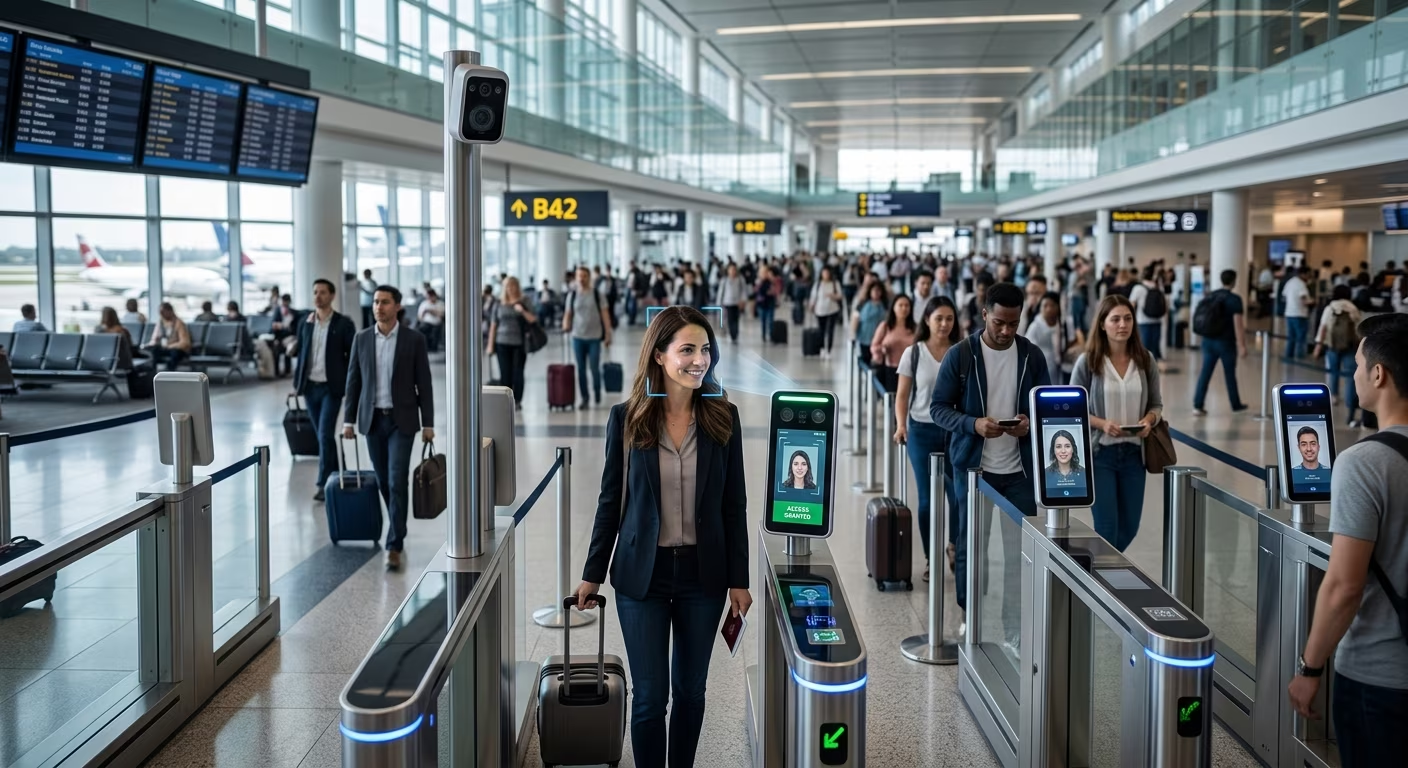
The modern travel experience is undergoing a profound and rapid transformation. Gone are the days when a simple paper boarding pass and a quick glance at a driver’s license were sufficient to board a commercial flight. Today, federal agencies are increasingly relying on your physical body—specifically your face—as your ultimate identification credential. As travelers navigate security checkpoints, they are increasingly met with glowing camera nodes rather than human agents. This technological shift, driven by widespread adoption of facial recognition technology across transportation hubs, represents one of the most significant expansions of public biometric surveillance in modern history. While government agencies and airline corporations often market this transition under the banner of enhanced security and traveler convenience, privacy advocates warn of a darker reality. The seamless integration of facial recognition into the everyday act of flying raises alarming questions about civil liberties, the right to privacy, and the creeping normalization of mass surveillance infrastructure in free societies.
Unpacking the Technology: How Aviation Biometrics Operate
To fully grasp the implications of this shift, one must understand how biometric verification systems function in practice. At aviation checkpoints, authorities are deploying Credential Authentication Technology, which utilizes advanced algorithms to process biometric data. When a passenger approaches a checkpoint, a high-definition camera captures a live photograph of their face. This image is immediately digitized into a biometric template—a mathematical map of unique facial geometry, measuring the distances between the eyes, nose, mouth, and jawline.
This live template is then compared against a pre-existing database. In a “one-to-one” (1:1) verification scenario, the system compares the live image strictly to the photograph on the passenger’s scanned identification card, such as a passport or driver’s license. However, in a “one-to-many” (1:N) identification scenario, the live image is cross-referenced against a much larger gallery of photographs, which may include state DMV records, visa applications, and global passport databases. This backend processing happens in milliseconds, communicating with secure cloud infrastructures to approve or deny the passenger’s identity. The sheer scale and speed of this data processing present unprecedented challenges to data minimization and personal privacy.
Mission Creep: From Border Security to Domestic Checkpoints
The proliferation of face-scanning technology at airports is a textbook example of “mission creep”—the gradual expansion of a project or mission beyond its original goals, often without explicit public debate or legislative approval. The initial justification for airport facial recognition was narrowly tailored to border security. Congress mandated the creation of a biometric entry-exit tracking system specifically to monitor foreign nationals and identify individuals overstaying their visas. U.S. Customs and Border Protection (CBP) was tasked with implementing this system, commonly known as the Traveler Verification Service.
However, what began as a mechanism to track non-citizens on international flights quickly expanded. CBP began sweeping U.S. citizens into the biometric dragnet, arguing that separating citizens from non-citizens at boarding gates was operationally inefficient. Consequently, millions of Americans traveling internationally found themselves subjected to face scans.
The creep did not stop at international borders. The Transportation Security Administration (TSA) has aggressively adopted the technology for routine, domestic travel. What started as limited pilot programs at a handful of major hubs has quietly expanded into a nationwide rollout. TSA now projects equipping hundreds of regional and major airports with facial recognition technology in the coming years. A program originally designed for border control and immigration enforcement is now becoming a standard checkpoint for an American flying domestically, fundamentally altering the relationship between the citizen and the state.
Core Privacy and Civil Liberty Threats
The deployment of these systems introduces a web of risks that extend far beyond the inconvenience of a missed flight. The core threats directly challenge foundational civil liberties.
The Normalization of Mass Surveillance
Perhaps the most insidious threat posed by the unchecked expansion of biometric screening is the normalization of mass surveillance. By integrating facial recognition into the mundane process of commercial travel, the government conditions the public to accept constant bodily scanning as a prerequisite for participation in modern society. This shifts the fundamental dynamic of a free society. Instead of moving freely without being tracked unless suspected of a crime, citizens are now implicitly required to continuously prove their innocence and identity to automated machines. This infrastructure, once fully entrenched, creates a turnkey surveillance network that could theoretically be repurposed for monitoring political dissidents, tracking journalists, or policing marginalized communities.
Algorithmic Bias and Demographic Discrimination
Facial recognition algorithms are not infallible, objective tools; they reflect the data on which they were trained. Extensive research has documented significant demographic disparities in the accuracy of these systems. A landmark 2019 report by the National Institute of Standards and Technology (NIST) evaluated hundreds of algorithms and found empirical evidence of severe demographic differentials. The study revealed that many algorithms had much higher rates of false positives for individuals of African, Asian, and Native American descent compared to white individuals.
In the context of airport security, an algorithmic bias is not merely a technical glitch—it is a civil rights violation. A false mismatch can lead to missed flights, invasive secondary interrogations, and unjust criminal suspicion. The burden of algorithmic failures disproportionately falls on minority travelers, exacerbating existing inequalities in how different demographics experience law enforcement and transportation security.
The Vulnerability of Immutable Data
When you surrender a password and it gets compromised in a data breach, you can simply change it. When you surrender your face, you cannot generate a new one. Biometric data is intrinsically immutable. By centralizing millions of high-resolution facial templates into government and private-contractor databases, authorities are creating irresistible targets for malicious actors, state-sponsored hackers, and cybercriminals.
This is not a hypothetical risk. In 2019, a subcontractor working for CBP suffered a major data breach, resulting in the theft of thousands of traveler facial images and license plate photos. Despite assurances of strict data retention policies and immediate deletion protocols, the reliance on third-party vendors and the complex web of cloud storage means that the absolute security of biometric data can never be fully guaranteed.
The Illusion of Opt-Out and Transparency Failures
In response to privacy concerns, federal agencies are quick to emphasize that facial recognition screening is entirely voluntary for U.S. citizens and that passengers can simply opt out. However, civil liberties advocates argue that this supposed choice is largely an illusion, undermined by poor communication and the coercive environment of airport security.
A 2020 report by the Government Accountability Office (GAO) criticized CBP and TSA for inadequate privacy signage. The GAO found that notices informing the public about the technology and their right to opt out were often missing, incomplete, or placed in areas where travelers could not easily read them before reaching the checkpoint.
Furthermore, the reality of navigating a high-stress, fast-paced airport line makes opting out incredibly difficult. Travelers are often fearful of angering security agents, causing delays, or being subjected to retaliatory secondary screening. Reports abound of passengers who explicitly request a traditional ID check, only to face resistance, confusion, or intimidation from officers who are pressured to maintain throughput speeds. When the default procedure is biometric, and the alternative requires asserting your rights against a uniformed officer in a crowded terminal, the process cannot be considered truly voluntary.
Comparative Breakdown: Traditional vs. Biometric ID Verification
To understand what is being lost in this transition, it is helpful to compare the two paradigms of identity verification currently present in American airports.
| Verification Feature | Traditional ID Check | Biometric Face Scan |
|---|---|---|
| Process | Human agent visually compares physical ID to the traveler. | Camera captures live photo, algorithm checks against database. |
| Data Retention | Zero data collected or stored; ID is handed back instantly. | Images are captured, processed, and potentially logged by vendors. |
| Privacy Risk | Minimal. Localized to the specific interaction. | High. Vulnerable to database breaches and algorithmic bias. |
| Ease of Refusal | Standard procedure. No special request needed. | Requires explicit opt-out, often facing resistance from staff. |
The Call for Legislative Guardrails
The rapid deployment of aviation biometrics is occurring in a regulatory vacuum. Currently, there is no explicit federal law that authorizes the TSA to implement facial recognition technology on domestic citizens. The program operates under broad, decades-old security mandates that were never intended to sanction nationwide biometric dragnet surveillance.
This lack of statutory authority has sparked significant pushback from a bipartisan coalition of lawmakers. Senators and representatives have introduced legislation aimed at halting the expansion of these programs until comprehensive privacy safeguards are established. Advocates are demanding strict, legally binding restrictions on data retention, independent audits of algorithmic bias, and mandatory, transparent opt-out procedures that do not penalize travelers. Without such legislative guardrails, the government is essentially writing its own rules for biometric surveillance, side-stepping the democratic process and public consensus.
Navigating the New Security Landscape
As the biometric infrastructure continues to expand, travelers must be proactive to protect their civil liberties. Awareness is the first line of defense. When approaching a security checkpoint, look for cameras and digital display screens. If you are a U.S. citizen and wish to protect your biometric data, you have the right to request alternative screening.
To minimize friction, have your physical ID and boarding pass ready, politely inform the officer that you are opting out of the facial scan, and request a standard document check. Arriving at the airport a few minutes early can help alleviate the pressure of potential delays caused by opting out.
Frequently Asked Questions (FAQs)
- Can I legally opt out of a facial scan at a TSA checkpoint?
Yes. According to current federal guidelines, U.S. citizens have the right to opt out of facial recognition screening at domestic TSA checkpoints and at CBP international departure gates. You must notify the agent that you prefer a manual ID check. - What happens to my biometric data after it is scanned?
Federal agencies state that live photos of U.S. citizens captured at domestic checkpoints are typically overwritten or deleted shortly after the identity is verified. However, the pre-existing gallery photos (sourced from passports and DMV records) remain in government databases, and historical audits have shown that third-party vendors do not always strictly adhere to deletion protocols. - Is facial recognition technology accurate for everyone?
No. Extensive research, including comprehensive studies by the National Institute of Standards and Technology, demonstrates that facial recognition algorithms often exhibit demographic bias. These systems frequently show higher error rates—such as false positives or false negatives—for people of color, women, and the elderly, compared to middle-aged white men. - Will biometric screening eventually become mandatory?
While agencies currently maintain that the programs are voluntary for citizens, privacy advocates warn of a slippery slope. As the technology becomes fully entrenched and physical alternative pathways are reduced to save costs, there is a significant risk that biometric screening could become a mandatory requirement for domestic travel without preemptive legislative action.
References
- Face Recognition Vendor Test (FRVT) Part 3: Demographic Effects (NISTIR 8280) — National Institute of Standards and Technology. 2019-12-19. https://doi.org/10.6028/NIST.IR.8280
- Facial Recognition: CBP and TSA are Taking Steps to Implement Programs, but CBP Should Address Privacy and System Performance Issues (GAO-20-568) — U.S. Government Accountability Office. 2020-09-02. https://www.gao.gov/products/gao-20-568
- Biometrics Overview and Privacy — U.S. Customs and Border Protection. 2024-05-16. https://www.cbp.gov/travel/biometrics