
Youth Activism and Free Speech in Public Schools
Understanding the boundaries of the First Amendment for student protesters.
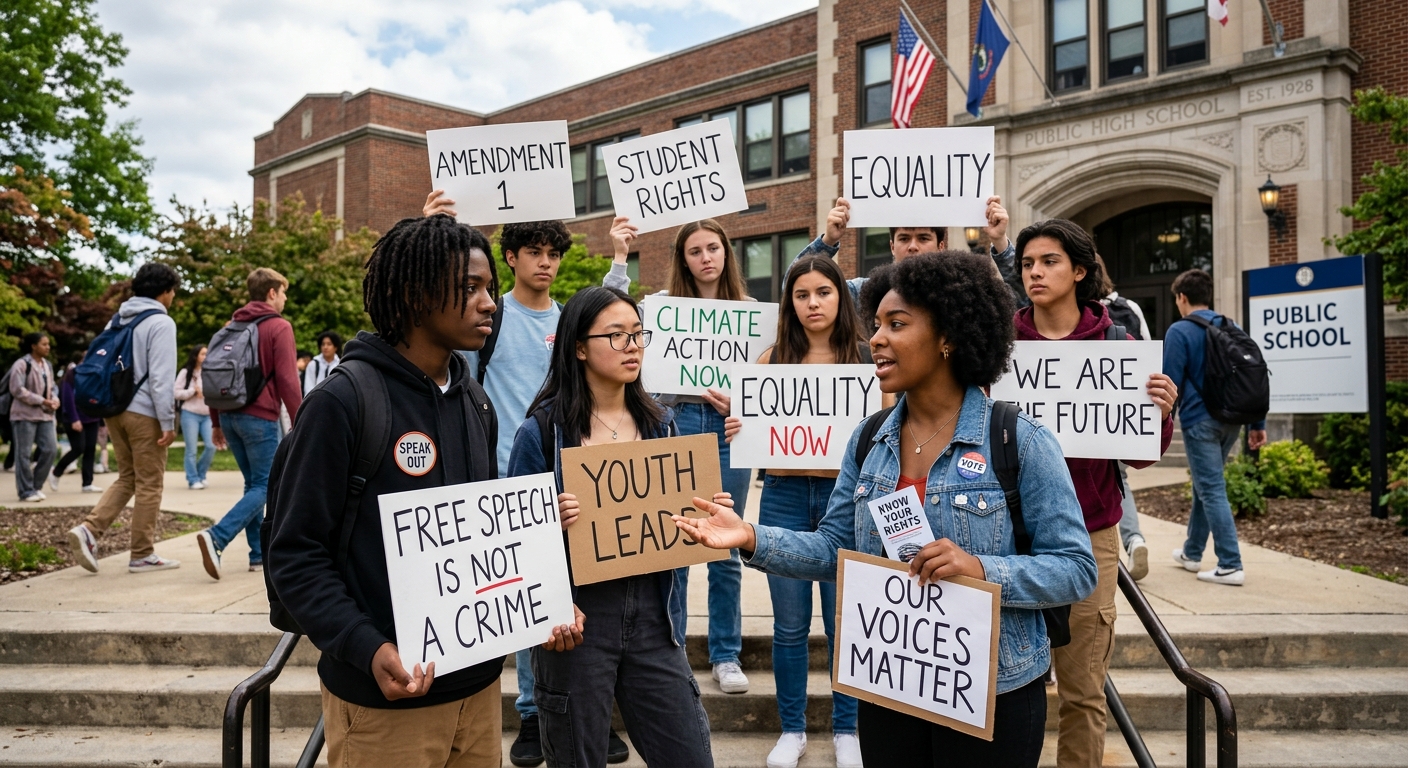
The Constitutional Classroom: Navigating Youth Activism and Free Speech
Public educational institutions serve as the primary training grounds for civic engagement and democratic participation. As societal debates surrounding climate change, social justice, gun legislation, and international conflicts intensify, young people are increasingly turning to activism to express their viewpoints. However, the intersection of compulsory education and constitutional freedoms creates a complex legal landscape. While the First Amendment broadly protects the freedom of expression, these protections are uniquely modified within the confines of a public school. Understanding the delicate balance between a student’s right to speak and a school’s obligation to maintain a safe, undisrupted learning environment is crucial for educators, parents, and the students themselves.
The core philosophy of student constitutional protections relies on the understanding that public schools are government entities. Therefore, school administrators act as state actors bound by the United States Constitution. Unlike private institutions, which possess broad discretion to regulate student conduct and speech without constitutional constraints, public schools must operate within the legal frameworks established by decades of federal jurisprudence. This article comprehensively explores the parameters of student activism, detailing the rights young people possess, the limitations schools can legally impose, and the ongoing evolution of these doctrines in the digital age.
The Legal Bedrock: The Disruption Standard
To grasp the modern realities of student speech, one must first look back to the foundational legal precedents that established the contemporary framework. The most critical doctrine governing student expression stems from the Vietnam War era. When a group of students decided to wear black armbands to school to protest the conflict, they were suspended, leading to a landmark Supreme Court decision that forever altered the landscape of educational law.
The resulting legal standard dictates that students do not shed their constitutional rights to freedom of speech or expression at the schoolhouse gate. However, this affirmation of rights came with a significant caveat: schools can prohibit or punish speech if it “materially and substantially interferes” with the operation of the school or infringes upon the rights of others. This is widely known in legal circles as the substantial disruption test.
In practical terms, “substantial disruption” is a high bar. It requires more than just a mild distraction, a theoretical fear of unrest, or the discomfort that often accompanies unpopular viewpoints. Administrators cannot preemptively ban peaceful protests simply because they anticipate controversy. There must be a demonstrable, objective threat to the educational process. For example, a student quietly wearing a shirt with a controversial political slogan is generally protected. Conversely, if a student uses a megaphone in the middle of a math class to broadcast a political manifesto, the school is fully within its rights to discipline the student, not for the content of the message, but for the disruption of the educational environment.
The Mechanics of On-Campus Demonstrations
The Complexities of the Student Walkout
In recent years, the student walkout has re-emerged as a popular and highly visible form of youth protest. Organizing a mass exit from classrooms to gather on football fields or march to local government buildings sends a powerful collective message. However, the legal protections surrounding walkouts are frequently misunderstood.
The act of leaving a classroom without permission violates basic school attendance policies. Because schools have a legal mandate to educate students and ensure their safety during school hours, administrators possess the authority to enforce attendance rules. Consequently, if a student participates in a walkout, the school can legally issue a consequence, such as an unexcused absence, detention, or other standard disciplinary measures associated with truancy.
The constitutional protection in this scenario lies in the principle of viewpoint neutrality. While a school can punish a student for missing class, it cannot punish the student more severely because of the political nature of the absence. If the standard punishment for skipping a period to go to the local convenience store is a one-hour detention, the school cannot impose a three-day suspension on a student who skipped a period to attend a political rally. Furthermore, administrators cannot selectively enforce attendance rules based on the cause being championed; they cannot grant leniency to students marching for environmental conservation while harshly penalizing those marching for opposing political causes.
Distributing Literature and Organizing on Campus
Activism often involves the dissemination of information, such as handing out flyers, passing around petitions, or organizing student groups. Public schools must allow students to distribute independent literature and express their views, but they are permitted to impose reasonable “time, place, and manner” restrictions.
- Time Restrictions: Schools can mandate that flyers only be distributed before or after school, or during lunch periods, to prevent interference with instructional time.
- Place Restrictions: Administrators might designate specific areas, like a cafeteria bulletin board or a courtyard, for the distribution of materials to keep hallways clear and safe.
- Manner Restrictions: Schools can prohibit the use of aggressive tactics to force literature on unwilling peers.
Importantly, these restrictions must be applied consistently. A school cannot ban the distribution of political pamphlets while simultaneously allowing students to hand out flyers for a commercial dance or a non-school-sponsored sports league. Additionally, schools generally cannot demand to review and approve independent, student-created literature prior to distribution unless they have a narrowly tailored policy designed to screen out specific, unprotected speech such as obscenity or legitimate threats.
Sartorial Statements: Dress Codes and Free Expression
Clothing is one of the most common and accessible mediums for youth expression. From hats and t-shirts to buttons and armbands, what a student wears can communicate powerful messages. Generally, the First Amendment protects the right of students to wear clothing that expresses political, social, or religious viewpoints.
However, schools are permitted to implement dress codes provided they are viewpoint-neutral and focus on maintaining a safe, educational environment. For instance, a school can enact a policy banning all hats inside the building. What a school cannot do is ban only hats bearing a specific political candidate’s name while allowing other hats.
There are also specific categories of speech on clothing that fall outside of constitutional protection within the school environment. Courts have consistently ruled that schools can ban clothing that:
- Promotes illegal drug use, alcohol consumption, or tobacco.
- Contains explicit obscenity, vulgarity, or sexually suggestive imagery.
- Constitutes a genuine threat of violence or severe harassment targeting specific individuals.
- Features gang-affiliated symbols that have a documented history of causing violence or disruption within the specific school community.
The Digital Frontier: Off-Campus Speech and Social Media
The proliferation of smartphones and social media platforms has radically shifted the boundaries of student speech. Historically, a student’s expression occurred either physically on campus or distinctly off campus. Today, a post made from a student’s bedroom on a Saturday night can instantly reach the entire student body, blurring the lines of school jurisdiction.
The legal consensus regarding off-campus digital speech emphasizes that public schools have significantly less authority to discipline students for what they say outside of school hours and off school property. Schools are not empowered to act as 24/7 monitors of student morality or behavior. If a student uses social media over the weekend to fiercely criticize school policies, use profane language to express frustration, or organize a peaceful off-campus protest, that speech is heavily protected.
Nevertheless, the protections for off-campus speech are not absolute. Courts have recognized narrow exceptions where schools can intervene and issue discipline for off-campus digital expression. These exceptions generally apply when the speech:
- Constitutes severe, targeted bullying or harassment of another student or staff member that makes it impossible for the victim to safely access their education.
- Contains a credible, true threat of physical violence against the school, students, or personnel.
- Involves hacking into school servers, academic dishonesty (such as distributing stolen test answers online), or other direct breaches of school security protocols.
In the absence of these severe factors, mere vulgarity, offensive opinions, or generalized complaints posted on personal social media accounts outside of school hours remain shielded by the First Amendment.
School-Sponsored Speech vs. Independent Speech
It is vital to distinguish between independent student speech (like a personal t-shirt or a self-published flyer) and school-sponsored speech. School-sponsored speech includes activities and publications that members of the public might reasonably perceive to bear the imprimatur of the school itself. Common examples include the official school newspaper, the yearbook, theatrical productions, and speeches given at school-sponsored assemblies or graduations.
Because these platforms represent the educational institution, administrators have a much broader authority to exercise editorial control over their content. Schools can censor or modify school-sponsored speech as long as their actions are reasonably related to legitimate pedagogical concerns. For instance, a principal could legally refuse to publish a student-written article in the official school paper if the article uses inappropriate language, violates the privacy of other students, or is poorly researched and factually inaccurate. This standard grants educators significant leeway to curate the environment of official school programs, a stark contrast to the robust protections afforded to independent student protests.
Actionable Steps for Students Facing Rights Violations
When young people believe their constitutional rights have been infringed upon by school administrators, it is important to respond strategically and peacefully. The first step is always clear documentation. Students should record the exact nature of the discipline, the stated reasons given by administrators, and any policies cited.
Next, students and their guardians should request a formal meeting with school leadership to seek clarification. Often, disputes arise from a misunderstanding of district policy or a misapplication of the law by a single staff member, and open dialogue can resolve the issue. During these discussions, remaining respectful but firm about one’s rights is essential. If internal appeals up to the level of the school board prove unsuccessful, individuals may consider reaching out to civil rights organizations or legal counsel specializing in education law to explore further remedies.
Frequently Asked Questions (FAQs)
Do students at private schools have the same First Amendment rights?
No. The First Amendment strictly prohibits the government from infringing on free speech. Because public schools are government entities, they must adhere to constitutional standards. Private schools, however, are non-governmental organizations and can generally set their own rules regarding student speech, protests, and expression as a condition of enrollment, bound only by their internal contracts and general civil rights laws prohibiting severe discrimination.
Can a school force a student to stand for or recite the Pledge of Allegiance?
No. Decades of Supreme Court precedent establish that public schools cannot compel students to participate in the Pledge of Allegiance. Students have the absolute constitutional right to sit quietly, remain silent, or politely decline to participate in the pledge. Schools cannot mandate that students provide a parent’s note to opt out, nor can they punish students for exercising this right of refusal.
What happens if other people cause a disruption because of my peaceful protest?
This is known legally as a “heckler’s veto.” Generally, a student cannot be punished for peaceful expression simply because others react poorly or aggressively to it. If a student wears a legally protected political shirt and another student attacks them or creates a disruption in response, the school’s primary legal duty is to discipline the student who caused the disruption, not to force the peaceful student to remove the shirt.
Can student athletes be punished for kneeling during the national anthem?
Under current interpretations of public school law, peaceful protests like kneeling during the national anthem are considered protected symbolic speech. As long as the act of kneeling does not substantially disrupt the athletic event or interfere with the game’s execution, public school coaches and administrators cannot constitutionally punish or bench a player solely for this form of silent protest.
References
- Facts and Case Summary – Tinker v. Des Moines — United States Courts. 2024-01-01. https://www.uscourts.gov/educational-resources/educational-activities/facts-and-case-summary-tinker-v-des-moines
- Mahanoy Area School District v. B. L. — Supreme Court of the United States. 2021-06-23. https://www.supremecourt.gov/opinions/20pdf/20-255_g3bi.pdf
- Facts and Case Summary – Hazelwood v. Kuhlmeier — United States Courts. 2024-01-01. https://www.uscourts.gov/educational-resources/educational-activities/facts-and-case-summary-hazelwood-v-kuhlmeier
Similar Articles








Read full bio of medha deb


