The Dawn of a New Advocacy Era
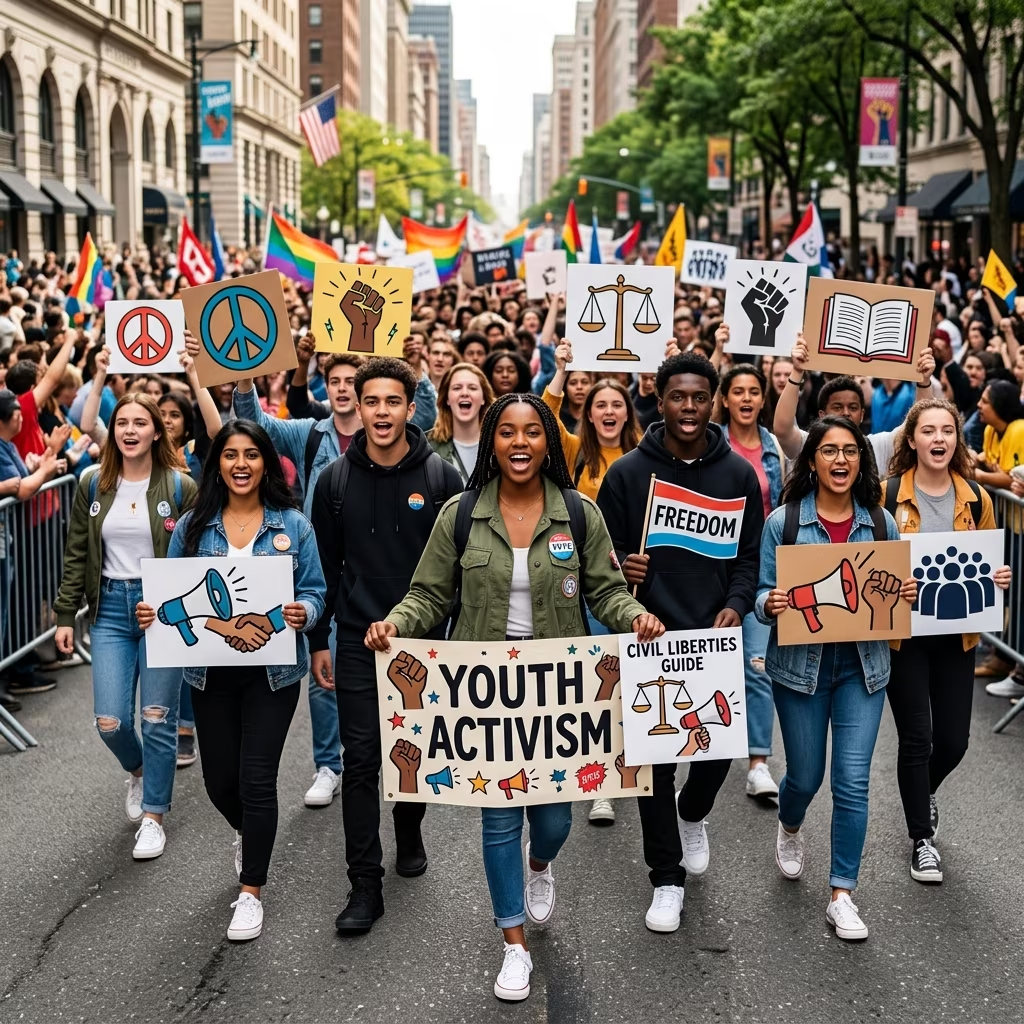
Youth activism is experiencing an unprecedented global renaissance, driven by a generation that refuses to wait for adults to solve systemic and existential crises. While older generations often view political participation strictly through the lens of electoral politics and party affiliation, today’s young people are forging a markedly different path. According to research from the United Nations, young individuals frequently bypass conventional political arenas—often feeling marginalized, disenfranchised, or ignored by traditional political structures—in favor of issue-based advocacy . They are channeling their boundless energy into single-issue causes they hold deeply, such as climate change, racial justice, economic inequality, and civil liberties.
This ideological shift represents a fundamental transformation in civic engagement. Rather than writing letters to representatives and waiting for legislative gridlock to clear, modern youth activists are taking to the streets, organizing coordinated walkouts, and leveraging digital platforms to demand immediate, tangible action. Their approach is direct, deeply personal, and highly effective at capturing public attention. However, this new era of advocacy requires a comprehensive understanding of civil liberties. For young activists to safely and effectively challenge the status quo, they must be equipped with concrete knowledge about their constitutional rights, the legal boundaries of free expression, and the strategies necessary to protect themselves from modern threats like digital surveillance and doxxing.
The Legal Bedrock: Student Free Speech Rights
The foundation of student activism in the United States is inextricably linked to the landmark 1969 Supreme Court decision in Tinker v. Des Moines. This historic case established the enduring legal principle that students do not shed their constitutional rights to freedom of speech or expression at the schoolhouse gate . The case originated when 13-year-old Mary Beth Tinker and several other students wore black armbands to school to peacefully protest the Vietnam War. When the school district suspended them for their actions, the resulting legal battle went all the way to the nation’s highest court, resulting in a sweeping victory for student civil liberties.
The Tinker decision fundamentally altered the power dynamic between school administrators and students. It affirmed that public schools are state actors, meaning they are explicitly bound by the First Amendment and cannot censor student speech simply because they find it uncomfortable, controversial, or unpopular. This constitutional protection extends to various forms of expression, including wearing political clothing, organizing student groups, distributing flyers, and peacefully protesting on campus grounds .
However, it is crucial for young advocates to understand the legal distinction between public and private educational institutions. Because the First Amendment protects individuals specifically from government censorship, its provisions directly apply to public elementary, secondary, and higher education institutions. Private schools, on the other hand, are not government entities. Students attending private institutions do not enjoy the same constitutional protections; instead, their rights to free expression are typically governed by the school’s private code of conduct or student handbook. While private schools may voluntarily adopt policies that protect free speech, they possess far more legal leeway to discipline students for participating in protests or expressing dissenting views.
Understanding the Boundaries: The Material Disruption Standard
While the Tinker standard guarantees robust protections for student speech, these rights are not absolute. The Supreme Court established a critical caveat: school officials can lawfully intervene and censor student speech if it causes a material and substantial disruption to the educational process . This standard requires schools to prove that the expression in question significantly interfered with the daily operation of the school or collided with the rights of other students to learn in a safe, uninterrupted environment.
The line between protected expression and substantial disruption can sometimes be blurry, but courts have provided clear guidance over the decades. Peaceful, passive protests—such as wearing a t-shirt supporting a political movement, sitting quietly during the Pledge of Allegiance, or handing out informational leaflets outside the cafeteria—are generally protected. Conversely, actions that actively prevent classes from taking place, such as using megaphones in academic hallways, blocking the entrances to school buildings, or encouraging violence, cross the line into unprotected territory.
To better navigate these boundaries, young activists must carefully consider the time, place, and manner of their advocacy.
| Advocacy Action | Protected Expression (Generally) | Material Disruption (Unprotected) |
|---|---|---|
| Political Clothing | Wearing a shirt with a political or social slogan | Wearing a shirt promoting illegal drug use or containing profanity |
| Protesting on Campus | Participating in a silent sit-in in a common area | Blocking main doorways or shouting disruptively through academic wings |
| Distributing Literature | Handing out political zines outside before school | Forcing flyers onto unwilling students, causing major litter and delays |
Organizing in the Digital Age: Amplification and Privacy
The advent of digital technology and social media has completely revolutionized how young people organize. Platforms like Instagram, TikTok, and Discord allow student activists to bypass traditional media gatekeepers, disseminate critical information rapidly, and mobilize thousands of peers for walkouts or demonstrations within mere hours. This digital infrastructure has democratized activism, giving young advocates an unprecedented global reach and the ability to coordinate across state and national lines.
However, this heavy reliance on digital organizing introduces significant new risks to privacy and personal safety. One of the most prevalent threats faced by modern activists is doxxing—the malicious gathering and publicizing of personal, identifiable information (such as home addresses, phone numbers, or family details) by hostile third parties intended to invite harassment or violence . Furthermore, school administrators and law enforcement agencies increasingly monitor public social media accounts to track student organizing efforts and anticipate physical protests.
To protect their civil liberties and personal safety, young activists must adopt rigorous digital hygiene practices. This includes utilizing end-to-end encrypted messaging applications for sensitive planning discussions, rather than relying on standard text messages or unencrypted group chats. Activists should also routinely audit their social media privacy settings, minimize the amount of personally identifiable information linked to public advocacy accounts, and employ virtual private networks when accessing the internet on public networks. The New York City Public Advocate’s office emphasizes that while doxxing may not be entirely preventable, taking proactive measures to obscure digital footprints can drastically reduce an activist’s vulnerability to retaliatory harassment and intimidation .
Safe and Effective Protest Strategies
Taking advocacy from the digital realm to the physical streets requires careful planning, disciplined execution, and a deep understanding of local laws. The right to peaceably assemble is a cornerstone of American civil liberties, but municipalities often enforce reasonable time, place, and manner restrictions. For instance, while protesting on public sidewalks or in public parks is generally legally protected, activists may need to secure a formal permit if their demonstration will block vehicular traffic or involve the use of amplified sound equipment.
Before participating in or organizing a physical protest, young activists should establish a clear, comprehensive safety plan. This includes designating a buddy system to ensure no one is left alone, bringing essential supplies (such as water, basic first aid, and emergency contact information written directly on one’s arm), and identifying clear exit routes from the demonstration area in case of an emergency.
Furthermore, understanding how to interact safely with law enforcement is paramount. Activists should remain calm, keep their hands visible, and avoid sudden movements if approached by police. If detained, individuals have the constitutional right to remain silent and should clearly state that they wish to speak with an attorney before answering any questions. Engaging in nonviolent de-escalation tactics—both with aggressive counter-protesters and law enforcement officers—is a critical skill that helps maintain the strategic focus on the movement’s core message rather than inviting unnecessary conflict.
The Global Impact of Youth Voices
The impact of youth activism extends far beyond local school board meetings or city council chambers; it has become a formidable, undeniable force on the global stage. Young people possess a unique moral authority that resonates deeply with the broader public. They speak not just as constituents, but as the very generation that will inherit the long-term consequences of today’s policy decisions and environmental stewardship.
This dynamic is particularly evident in the global youth climate movement. Research analyzing the communicative power of youth activists demonstrates that young people are uniquely adept at connecting abstract, highly technical climate science with profound personal and local experiences . By framing scientific consensus through the emotional and urgent lens of generational survival, youth advocates have carved out an autonomous, highly influential voice in international policy arenas. Their unwavering dedication challenges older generations to look past short-term economic gains and confront long-term existential threats.
Whether they are fighting for racial equity, advocating for LGBTQ+ rights, or demanding comprehensive climate action, young activists are bridging the gap between grassroots organizing and global impact. By steadfastly exercising their civil liberties, they force society to confront uncomfortable truths and significantly accelerate the pace of institutional change.
Frequently Asked Questions (FAQs)
- Can my public school punish me for something I post on social media outside of school hours?
Generally, public schools have very limited authority to discipline students for off-campus speech. However, if a social media post constitutes a true threat of violence against the school or severely disrupts the school environment (e.g., cyberbullying another student to the point they cannot attend class), administrators may have legal grounds to intervene. - Do I have the right to organize a student walkout?
While the First Amendment protects your right to express political opinions, schools also have a legal mandate to require attendance. If you walk out of class, you can be disciplined for the unexcused absence, just as you would be for skipping class for any other reason. However, the school cannot legally give you a harsher punishment specifically because your absence was related to a political protest. - Can I distribute political flyers in the school hallway?
Yes, in public schools, you generally have the constitutional right to distribute literature. However, the school can impose neutral, standardized rules regarding the time, place, and manner of distribution—such as requiring you to hand them out before or after school, or at a specific table, to prevent hallway congestion and maintain order. - What should I do if a police officer demands to search my phone at a protest?
You have the constitutional right to refuse a warrantless search of your electronic devices. You should clearly but politely state, “I do not consent to a search of my device.” Law enforcement generally requires a warrant to search the digital contents of a cell phone, even if you are under arrest. - What rights do I have if I attend a private school?
Students at private schools do not have First Amendment protections against their school administrators, as the First Amendment only applies to government actors. Your rights are determined by the contract you or your parents signed, typically found in the student handbook. While some private schools explicitly promise free speech protections in their guidelines, they generally maintain broad authority to restrict protests.
References
- Young People’s Civic and Political Engagement and Global Citizenship — United Nations. 2018-01-18. https://www.un.org
- Tinker v. Des Moines — United States Courts. 2024-01-01. https://www.uscourts.gov/educational-resources/educational-activities/tinker-v-des-moines
- Rights of Students — The First Amendment Encyclopedia – Free Speech Center. 2023-08-11. https://firstamendment.mtsu.edu/article/rights-of-students/
- Know Your Rights: Civil Liberties — Public Advocate – NYC.gov. 2025-05-22. https://pubadvocate.nyc.gov
- Voices of a generation the communicative power of youth activism — National Center for Biotechnology Information (PMC). 2021-11-02. https://www.ncbi.nlm.nih.gov/pmc/articles/PMC8562306/