
Woodrow Wilson’s Fourteen Points: A Vision for Global Peace
Discover how President Wilson's 1918 Fourteen Points reshaped post-WWI diplomacy, promoting self-determination and lasting world peace.
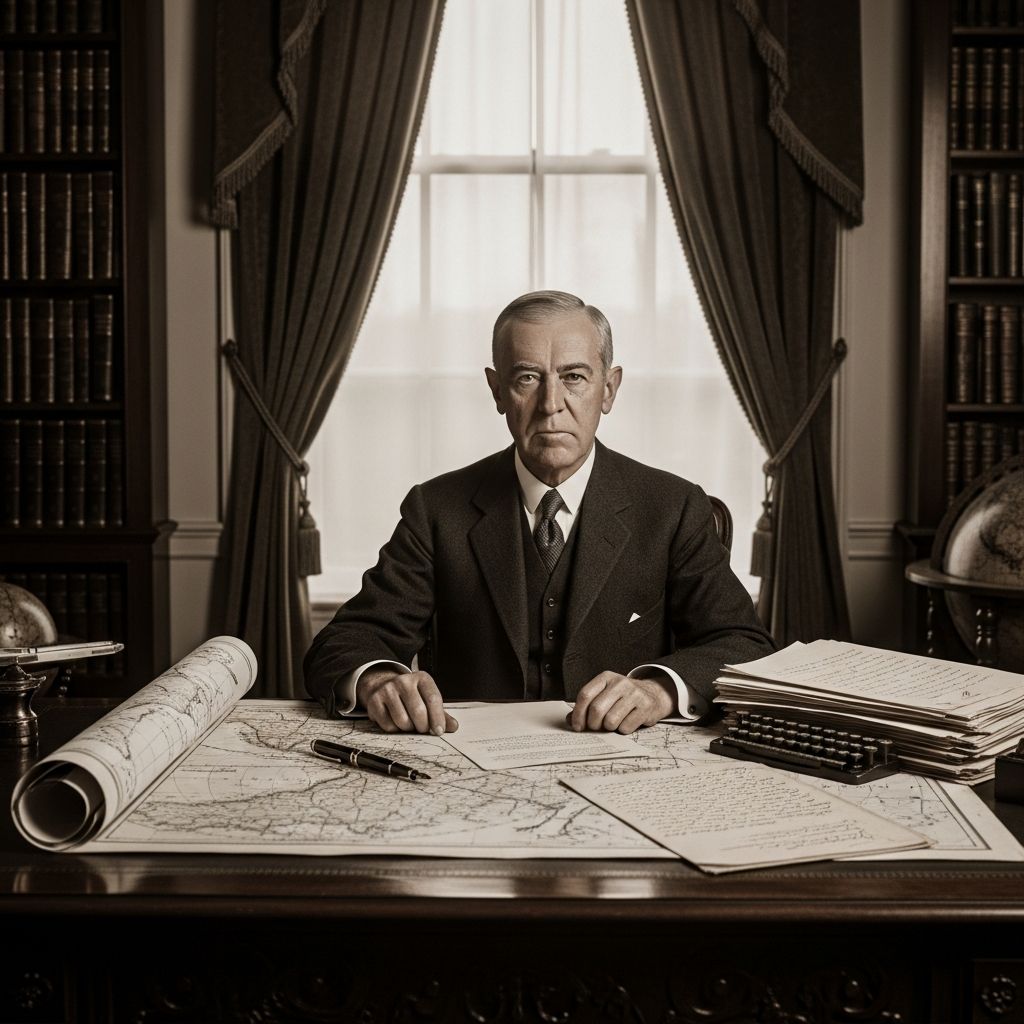
President Woodrow Wilson’s Fourteen Points, delivered on January 8, 1918, to a joint session of Congress, presented a comprehensive framework for achieving lasting peace after World War I. This address outlined specific principles aimed at addressing the war’s root causes and preventing future conflicts through ideals like open diplomacy and national self-determination.
The Historical Context of Wilson’s Bold Proposal
By early 1918, World War I had ravaged Europe for over three years, with staggering casualties and economic devastation. The United States entered the conflict in April 1917, shifting the balance toward the Allies. However, Russia’s Bolshevik Revolution led to its exit via the Treaty of Brest-Litovsk, creating a power vacuum that threatened Allied unity. Wilson seized this moment to articulate a moral vision for peace, countering Bolshevik propaganda and bolstering morale among troops and civilians.
Wilson collaborated with ‘The Inquiry,’ a team of over 150 experts in politics, economics, and geography, to craft these points. The speech was not merely rhetorical; it was broadcast globally, dropped via leaflets behind enemy lines, and aimed to undermine the Central Powers’ resolve while inspiring hope for a just postwar order.
Core Principles Guiding the Fourteen Points
At its heart, Wilson’s plan rejected punitive measures in favor of fairness and reconstruction. He emphasized distinguishing between governments and peoples, portraying ordinary citizens as victims of militaristic leaders. This rhetoric highlighted themes of democracy versus autocracy, influencing American foreign policy for generations.
- Open Covenants: Ending secret treaties to foster transparency in international relations.
- Freedom of the Seas: Ensuring neutral navigation rights during peacetime and war.
- Free Trade: Removing economic barriers to promote global commerce.
- Disarmament: Reducing arms to the minimum needed for domestic security.
- Colonial Adjustments: Balancing imperial claims with the interests of affected populations.
These foundational ideas set the stage for the specific territorial and political recommendations that followed.
Detailed Examination of the Fourteen Points
Wilson’s speech systematically listed fourteen interconnected proposals. Here’s a breakdown:
| Point | Key Proposal | Objective |
|---|---|---|
| I | Open peace treaties, no secret diplomacy | Transparency to build trust |
| II | Absolute freedom of navigation | Secure seas for all nations |
| III | Removal of economic barriers, equal trade | Global economic equality |
| IV | Armaments reduced to lowest safe levels | Prevent arms races |
| V | Impartial colonial adjustments | Fairness for colonies and powers |
| VI | Russian evacuation, self-determination | Support for Russian autonomy |
| VII | Restore Belgian sovereignty | Rectify invasions |
| VIII | Evacuate French territory, return Alsace-Lorraine | Restore French borders |
| IX | Readjust Italian frontiers by geography | Secure Italy’s natural boundaries |
| X | Autonomy for Austro-Hungarian peoples | Self-rule within the empire |
| XI | Evacuate Balkans, relations by sympathies | Regional self-determination |
| XII | Suzerainty for Ottoman territories, autonomy for non-Turkish areas | End Turkish oppression |
| XIII | Independent Poland with sea access | Polish statehood guaranteed |
| XIV | League of Nations for mutual security | Global collective defense |
This structured approach addressed immediate territorial grievances while laying groundwork for systemic change.
Immediate Reactions and Global Impact
The Fourteen Points resonated widely. In Germany, they fueled hopes for an armistice based on these terms, contributing to the Kaiser’s abdication in November 1918. Allied leaders initially welcomed the morale boost, but tensions arose at the Paris Peace Conference. French Premier Clemenceau sought harsh reparations, while Britain’s Lloyd George prioritized naval dominance and empire preservation.
Wilson’s insistence on Point XIV—the League of Nations—forced compromises. The final Treaty of Versailles incorporated the League but deviated sharply on reparations and borders, leading to German resentment and Hitler’s rise.
Challenges at the Paris Peace Conference
Arriving in Paris in December 1918, Wilson faced ‘The Big Four’: himself, Clemenceau, Lloyd George, and Italy’s Orlando. France demanded Rhineland annexation and massive indemnities; Britain eyed German colonies. Wilson traded concessions on Points III, IV, and VIII for the League Covenant.
Edward House’s memo clarified interpretations, like economic equality applying only among League members, highlighting pragmatic limits to idealism. Despite compromises, the Points influenced mandates for former colonies and Poland’s creation.
Long-Term Legacy and Modern Relevance
The Fourteen Points pioneered self-determination, inspiring anticolonial movements in Asia and Africa, though Wilson envisioned it primarily for Europe. The League of Nations, flawed without U.S. membership, evolved into the United Nations.
Critics note inconsistencies, like Point VI’s ambiguity toward Bolsheviks, foreshadowing Cold War tensions. Yet, the Points marked a shift from balance-of-power politics to collective security, enduring in international law.
Criticisms and Unfulfilled Promises
Detractors argued the Points ignored economic realities and empowered nationalists excessively. Colonial leaders, like Ho Chi Minh, invoked self-determination vainly at Versailles. U.S. Senate rejection of Versailles, led by isolationists, doomed League participation.
Nevertheless, Wilson’s vision humanized diplomacy, prioritizing people over empires.
Frequently Asked Questions (FAQs)
What was the main goal of Wilson’s Fourteen Points?
The primary aim was to establish a just, lasting peace by addressing war causes like secret alliances and imperialism, while promoting democracy and self-determination.
Why did the U.S. Senate reject the Treaty of Versailles?
Senators like Henry Cabot Lodge feared League entanglement in foreign wars, prioritizing American sovereignty.
How did the Fourteen Points influence the United Nations?
Point XIV directly inspired the League, whose structure and collective security principles underpin the UN Charter.
Were the Fourteen Points applied to non-European colonies?
Largely no; European powers retained mandates over colonies, disappointing global anticolonial aspirations.
What role did ‘The Inquiry’ play in the speech?
This expert group provided data-driven recommendations on borders, economics, and governance for Wilson’s blueprint.
References
- Woodrow Wilson’s 14 Points, 1918 — SHAFR. 1918-01-08. https://shafr.memberclicks.net/wilsons-14-points
- President Woodrow Wilson’s 14 Points (1918) — National Archives. 1918-01-08. https://www.archives.gov/milestone-documents/president-woodrow-wilsons-14-points
- Fourteen Points | Text & Significance — Britannica. 2025-12-01. https://www.britannica.com/event/Fourteen-Points
- The Fourteen Points — National WWI Museum and Memorial. N/A. https://www.theworldwar.org/learn/peace/fourteen-points
- The Fourteen Points: Woodrow Wilson’s Blueprint for Peace — Woodrow Wilson House. 2026-01-12. https://www.woodrowwilson.org/blog-podcast/2026/1/12/the-fourteen-points-woodrow-wilsons-blueprint-for-peace
- Memo from Edward House: Interpretation of President Wilson’s Fourteen Points — Teaching American History. 1918-10-29. https://teachingamericanhistory.org/document/interpretation-of-president-wilsons-fourteen-points/
- January 8, 1918: Wilson’s “Fourteen Points” — Miller Center. 1918-01-08. https://millercenter.org/the-presidency/presidential-speeches/january-8-1918-wilsons-fourteen-points
Similar Articles








Read full bio of Sneha Tete


