
Why the U.S. Drinking Age Is 21: History, Impact, and Facts
Understand how the minimum legal drinking age of 21 came to be, what it does, and why it still matters for safety and public health.
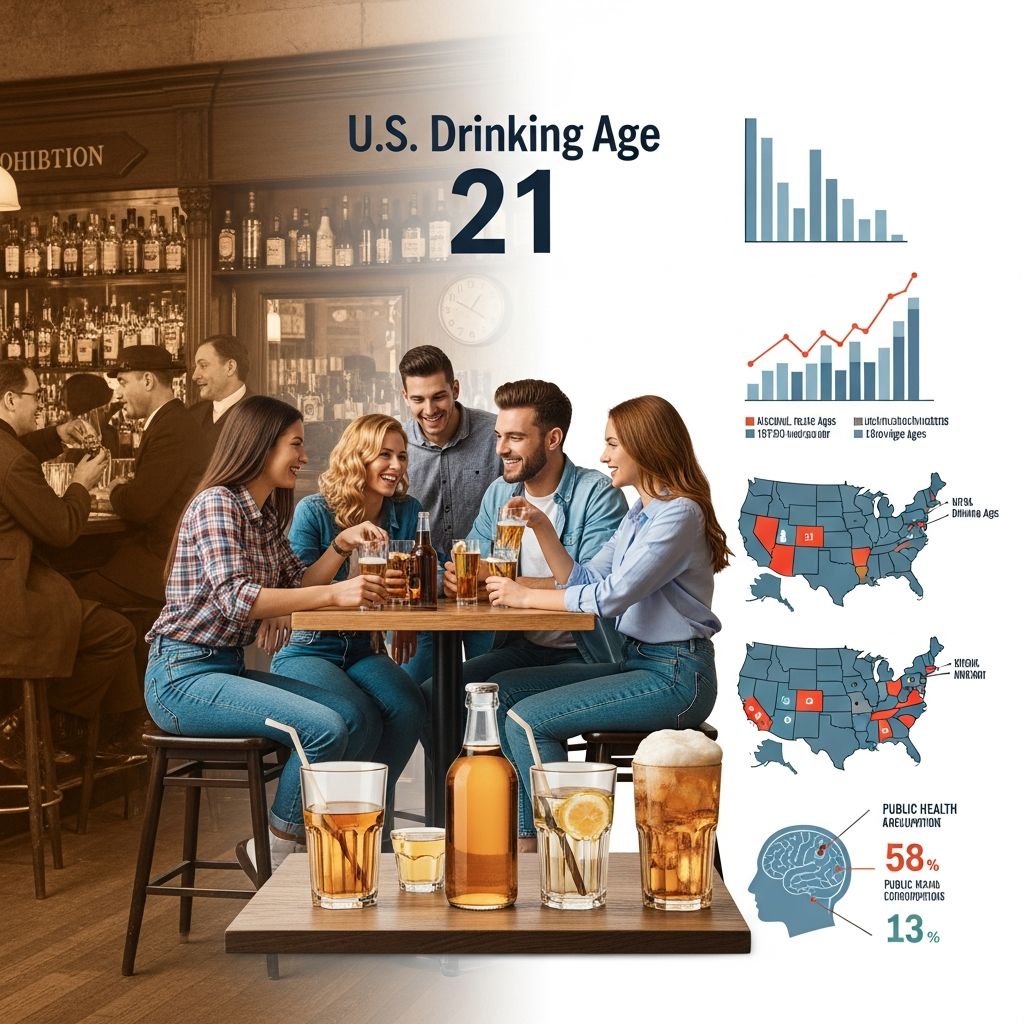
The minimum legal drinking age in the United States is 21 in all 50 states and the District of Columbia, and this rule shapes how alcohol is sold, advertised, and consumed across the country.
This article explains how the age-21 standard came about, what problems it was meant to solve, how it affects teens and young adults, and what exceptions and responsibilities still exist for families, communities, and businesses.
1. What the “Legal Drinking Age” Actually Means
In U.S. law, people often use the phrase “legal drinking age” loosely, but it usually refers to the minimum legal drinking age (MLDA) of 21 for purchasing and, in many states, publicly possessing alcohol.
1.1 Key elements of MLDA-21
- Purchase age: The minimum age at which a person can legally buy alcohol from licensed retailers is 21 in every state.
- Public possession: Many states also prohibit people under 21 from possessing alcohol in public places, with some exceptions (such as with a parent or for religious ceremonies).
- Serving and handling: Some states allow people under 21 to serve or handle alcohol as part of a job (for example, restaurant staff or store clerks), even though they cannot legally buy it for themselves.
- Private consumption: Certain states allow limited underage drinking in private settings such as the family home, often with a parent or guardian’s consent.
Because of these differences, a person might be allowed to handle or serve alcohol at work while still being prohibited from purchasing or openly drinking it.
2. How the Age-21 Standard Developed
The current age-21 framework is the result of nearly a century of changing alcohol policy at the state and federal levels.
2.1 After Prohibition: Age 21 becomes the norm
After national Prohibition ended in 1933, states regained control over alcohol policy. Most states adopted a minimum legal drinking age of 21 for purchasing alcoholic beverages during the mid-20th century.
2.2 The 1970s: Lower ages and rising crash rates
Between 1970 and 1975, many states lowered their drinking ages to 18, 19, or 20, in part to align with the new voting age of 18.
Researchers and highway safety officials soon documented a significant rise in crashes and fatalities involving young drivers in states that had lowered their drinking ages. Evidence showed that when 18- to 20-year-olds gained easier access to alcohol, alcohol-related traffic deaths in that group increased.
2.3 Advocacy and pressure for change
As concerns grew, highway safety organizations, medical experts, and citizen advocacy groups pushed for states to raise their drinking ages again.
- Some states responded in the late 1970s and early 1980s by raising their drinking ages back toward 21.
- Others chose not to act, creating a patchwork of different ages across state borders.
This inconsistency made it easy for teens to cross state lines to drink in lower-age states and then drive home, contributing to serious roadway risks.
2.4 The National Minimum Drinking Age Act of 1984
To address these problems, Congress passed the National Minimum Drinking Age Act of 1984 (NMDAA).
| Feature | Description |
|---|---|
| Core requirement | States must set a minimum legal purchase age of 21 for alcohol to receive full federal highway funding. |
| Enforcement mechanism | States that allowed under-21 purchases risked losing a portion of their federal highway funds. |
| State authority | States retained the power to write their own alcohol laws, but financial penalties discouraged them from setting lower ages. |
| Nationwide adoption | By July 1988, all 50 states and D.C. had laws setting the purchase age at 21. |
A 1988 review by the U.S. Government Accountability Office reported that raising state drinking ages was linked to reductions in youth drinking, drinking and driving, and alcohol-related traffic crashes among young people.
3. What Changed After the Drinking Age Rose to 21
Since the age limit was standardized at 21, changes have appeared in both teen drinking behavior and traffic safety outcomes.
3.1 Shifts in youth drinking patterns
National school-based surveys have tracked teen drinking over several decades. After the adoption of MLDA-21:
- The share of high school seniors who reported drinking alcohol in the past year declined substantially from earlier levels.
- Rates of binge drinking (for example, five or more drinks on one occasion) among high school seniors also dropped compared to the early 1980s.
The National Institute on Alcohol Abuse and Alcoholism (NIAAA) reports that MLDA-21 laws have reduced drinking and drinking-related harm among adolescents and young adults, including traffic crashes, injuries, crime, and school problems.
3.2 Improvements in road safety
Alcohol-impaired driving is a leading cause of death among young drivers, and reducing access to alcohol is one of the main strategies used to address it.
- The National Highway Traffic Safety Administration (NHTSA) cites strong evidence that MLDA-21 reduces drinking and driving and alcohol-related crashes and injuries among youth.
- Studies have consistently found lower rates of fatal crashes involving 18- to 20-year-old drivers in states that raised the drinking age.
These benefits persist even as other safety measures (like seat belt laws and safer vehicles) also contribute to fewer traffic deaths, which is why MLDA-21 remains a central part of federal and state highway safety strategies.
4. Why 21? The Rationale Behind the Age Limit
There is ongoing public debate about whether 21 is the “right” age. However, several key arguments are frequently cited to support MLDA-21.
4.1 Brain development and risk-taking
Research in neuroscience shows that parts of the brain involved in decision-making and impulse control continue to develop into the mid-20s.
- Heavy drinking during adolescence can interfere with brain development and is associated with problems in memory, learning, and emotional regulation.
- Early onset of drinking is linked with a higher likelihood of developing alcohol use disorder later in life.
Limiting widespread alcohol access to those under 21 is intended to reduce heavy and frequent drinking during a vulnerable developmental period.
4.2 Public health and long-term outcomes
The NIAAA and other public health agencies report that MLDA-21 laws are associated with reductions in multiple harms among young people, not just traffic crashes.
- Fewer injuries, violence incidents, and suicide attempts related to alcohol use.
- Lower rates of school dropout and academic problems linked to heavy drinking.
- Evidence that relaxing age restrictions can be associated with heavier drinking later in adulthood.
From a public health perspective, age-21 rules function as a population-wide prevention tool, not just a traffic safety measure.
4.3 International comparisons
Countries vary widely in their drinking age policies, but the United States is among those with the highest national minimum purchase age at 21.
- Some nations use ages 16, 18, or 20 for various types of alcohol or purchase settings.
- In the U.S., territories like Puerto Rico and the U.S. Virgin Islands have purchase ages of 18 for some or all alcoholic beverages, even as the 50 states and D.C. enforce 21.
Global practices differ, but the U.S. has chosen a more restrictive approach based primarily on its particular history with traffic crashes and youth drinking.
5. Common Exceptions and Variations in State Laws
Although MLDA-21 is universal at the state level for public purchase, state statutes differ on when underage drinking might be allowed.
5.1 Typical types of exceptions
Depending on the state, laws may allow exceptions such as:
- Religious ceremonies: Some states permit underage consumption as part of a bona fide religious observance, like a communion service.
- Parental or guardian presence: Certain states allow people under 21 to drink in private locations when a parent, legal guardian, or sometimes a spouse over 21 is present.
- Medical use: Limited exceptions exist where alcohol is used for medical or pharmaceutical purposes under supervision.
- Private residences: A number of states focus restrictions on public possession, permitting consumption in a private home under specific conditions.
- Employment-related handling: In some jurisdictions, under-21 employees may serve, sell, or handle alcohol as part of a lawful job at a licensed business, even though they may not drink it.
Because details vary widely, families and businesses must consult their own state and local laws—or tools like the NIAAA’s Alcohol Policy Information System—for precise requirements.
5.2 What is still illegal
Even when limited exceptions exist, certain behaviors remain unlawful in all states:
- Underage purchase of alcohol from retailers (except where narrow legal defenses apply).
- Using false identification to buy alcohol.
- Adults intentionally supplying alcohol to minors outside of lawful exceptions (for example, furnishing alcohol to teens at an unsupervised party).
- Driving under the influence of alcohol, often with zero-tolerance thresholds for drivers under 21.
6. Enforcement Tools and Community Strategies
MLDA-21 alone does not prevent underage drinking; enforcement and education strategies are needed to make the law effective.
6.1 Law enforcement approaches
NHTSA and state agencies highlight several methods used to reduce youth access to alcohol:
- Compliance checks: Law enforcement or regulators send supervised underage decoys to attempt purchases, citing or sanctioning businesses that sell to them.
- Shoulder tap operations: Underage decoys ask adults outside stores to buy alcohol for them; adults who agree may be cited or arrested.
- Social host laws: Some communities penalize adults who host parties where underage drinking occurs, even if they did not personally serve the alcohol.
- Keg registration: A few states track keg sales so that law enforcement can identify the purchaser if the keg is found at an underage party.
6.2 Education and prevention
Public health organizations stress that legal restrictions must be paired with education and family communication.
- Parents and caregivers are encouraged to talk to teens about alcohol risks and family expectations before high school and throughout young adulthood.
- Schools and colleges often provide prevention programs, counseling services, and policies addressing underage drinking and impaired driving.
- Community partnerships among law enforcement, schools, health agencies, and retailers can help reduce illegal sales and dangerous drinking environments.
7. Practical Tips for Parents, Teens, and Young Adults
Understanding the law is only one part of staying safe. The following tips summarize practical steps different groups can take.
7.1 For parents and caregivers
- Learn your state’s specific rules about underage possession, exceptions, and social host liability.
- Set clear household rules about alcohol and communicate the reasons behind them, including safety and legal consequences.
- Avoid providing alcohol to anyone under 21 outside of clearly lawful exceptions; doing so can create both legal and civil liability.
- Offer safe transportation options if your teen is ever in a situation where someone has been drinking.
7.2 For teens and young adults
- Know that laws are enforced: citations, fines, license consequences, and school discipline can follow underage drinking or using fake IDs.
- Never ride with a driver who has been drinking, no matter their age.
- If you are over 21, do not buy alcohol for those who are underage—this can lead to criminal charges and civil responsibility if harm occurs.
- On or near college campuses, understand school policies on alcohol, as these can be stricter than state law.
Frequently Asked Questions (FAQs)
Q1: Is it ever legal for someone under 21 to drink alcohol in the U.S.?
Yes. While the purchase age is 21 everywhere, some states allow limited underage drinking—for example, during religious ceremonies, at home with a parent or guardian, or for certain educational or employment-related purposes. The exact rules depend on state law.
Q2: Why is the drinking age 21 when the voting age is 18?
The voting age was lowered to 18 by constitutional amendment in 1971, and many states briefly lowered their drinking ages to match. However, sharp increases in youth traffic crashes and other harms led to strong pressure to raise drinking ages back to 21, culminating in the National Minimum Drinking Age Act of 1984.
Q3: Do age-21 laws really reduce drunk driving?
Yes. Evaluations cited by NHTSA and the NIAAA show that raising the minimum drinking age reduces drinking by young people, decreases driving after drinking, and lowers alcohol-related crashes and injuries among 18- to 20-year-olds.
Q4: Are there places in the U.S. where the drinking age is not 21?
In all 50 states and the District of Columbia, the minimum age to purchase alcohol is 21. Some U.S. territories, such as Puerto Rico and the U.S. Virgin Islands, use a purchase age of 18 for certain beverages, but they are governed by different laws.
Q5: Can parents be held responsible if teens drink at their house?
In many states, parents or other adults can face civil or criminal penalties if they furnish alcohol to minors or host parties where underage drinking takes place, especially if an injury or crash occurs. Social host and furnishing laws vary, so adults should know their state’s specific rules.
References
- 21 is the Legal Drinking Age — Federal Trade Commission. 2022-02-28. https://consumer.ftc.gov/articles/21-legal-drinking-age
- U.S. History of Alcohol Minimum Purchase Age by State — Alcohol Policy Information System / Wikipedia summary. 2023-05-10. https://www.apis.health.org/
- Minimum Legal Drinking Age Laws — National Alcohol Beverage Control Association (NABCA). 2021-08-01. https://www.nabca.org/collection/minimum-legal-drinking-age-laws
- 21 Minimum Legal Drinking Age 21 Laws — National Highway Traffic Safety Administration (NHTSA). 2020-12-01. https://www.nhtsa.gov/book/countermeasures-that-work/alcohol-impaired-driving/countermeasures/legislation-and-licensing-5
- Minimum Legal Drinking Age (MLDA) — National Institute on Alcohol Abuse and Alcoholism (NIAAA). 2021-06-15. https://pubs.niaaa.nih.gov/publications/arh27-2/101-107.htm
- Legal Drinking Age in the United States — International Alliance for Responsible Drinking (IARD). 2022-03-01. https://iard.org/science-resources/detail/minimum-legal-age-limits
- Underage Drinking: Laws — Alcohol.org / American Addiction Centers. 2022-04-20. https://alcohol.org/laws/underage-drinking/
Similar Articles








Read full bio of Sneha Tete


