
Why TSA Swabs Your Hands: Security, Science, and Your Rights
Understand TSA hand-swab testing, how explosive trace detection works, and what it means for your privacy and legal rights.
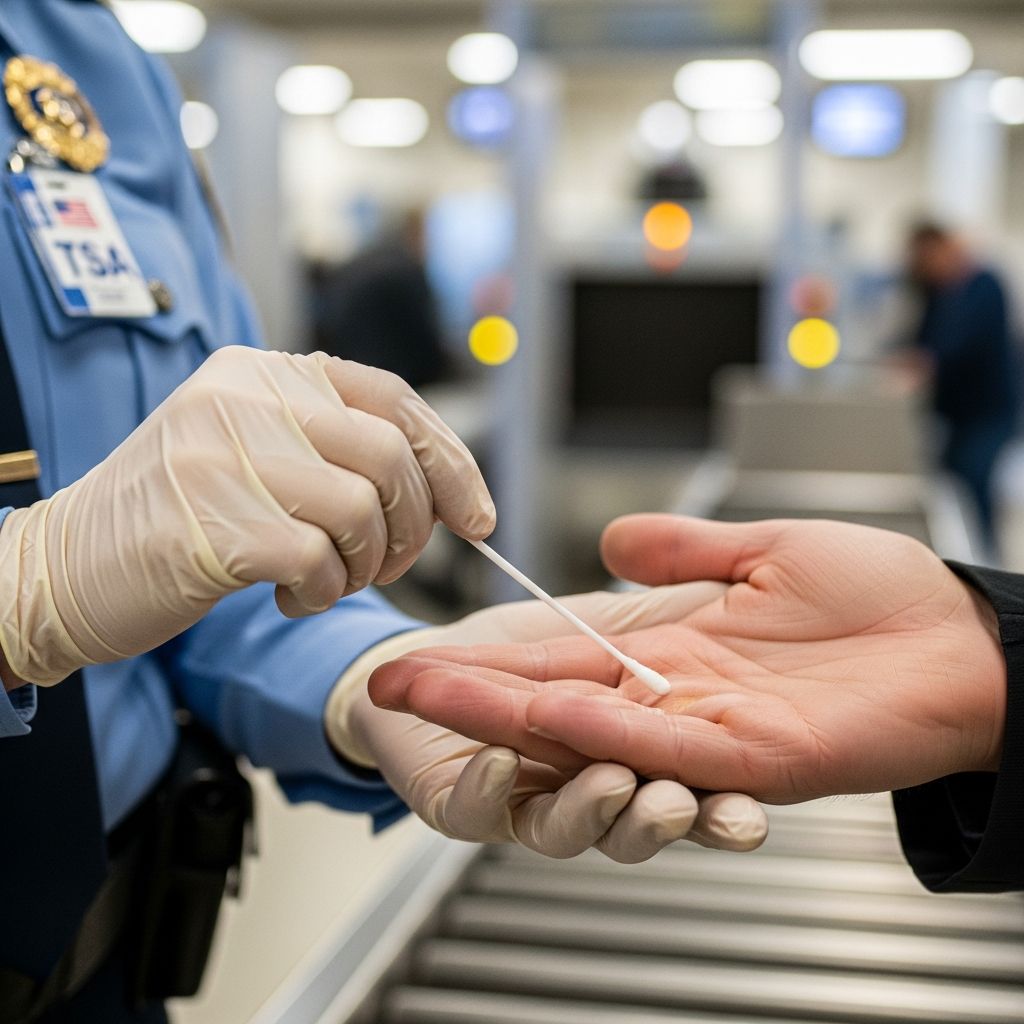
Many travelers are comfortable with metal detectors and body scanners, but become anxious when a Transportation Security Administration (TSA) officer unexpectedly asks to swab their hands. This brief interaction is part of a technology-driven screening method called explosive trace detection (ETD), and it raises important questions about safety, privacy, and legal rights.
This article explains, in plain language, what TSA hand swabs are, how the technology works, why you might be selected, and how U.S. law and TSA policy shape what officers can and cannot do during these checks.
What Is a TSA Hand Swab and Explosive Trace Detection?
A TSA hand swab is a short screening procedure in which an officer wipes your hands, clothing, or belongings with a small cloth or paper swab to test for microscopic traces of explosives or related chemicals.
- The swab is used on your palms, fingers, or luggage surfaces.
- The cloth is then inserted into a specialized machine designed to detect extremely small quantities of explosive materials.
- Results are typically available in just a few seconds, either clearing you or prompting additional screening.
In U.S. airports, this process is generally conducted by TSA officers as part of their responsibility to screen passengers and baggage under federal law.
The Technology Behind TSA Hand Swabs
The machines used after the swab are typically based on Ion Mobility Spectrometry (IMS), a sensitive analytical technique capable of identifying trace amounts of specific chemicals. Explosive trace detection systems have been widely deployed in airports worldwide for many years and are considered a routine security measure.
| Step | What Happens | Purpose |
|---|---|---|
| 1. Swabbing | Officer wipes hands or items with a small pad. | Collects microscopic chemical residues from surfaces. |
| 2. Insertion into ETD | Swab is placed in the explosive trace detection machine. | Machine prepares and analyzes collected particles. |
| 3. Ion Mobility Spectrometry | Chemicals are ionized and passed through a drift tube. | Measures ion travel time to identify substances by their signature. |
| 4. Automated Comparison | Instrument compares detected ions with a library of explosives and related markers. | Determines if any targeted explosive compounds are present. |
| 5. Result and Action | System flags a positive or negative result within seconds. | Guides TSA on whether to clear or further screen the passenger. |
Explosive trace detection is meant to complement, not replace, other layers of security such as metal detectors, advanced imaging technology, canines, and behavioral observation.
Why TSA Swabs Your Hands: Security Rationale
Hand swabs are primarily used to look for explosives and related compounds that might not be detected through metal detectors or imaging alone. According to TSA and other security commentators, ETD systems are designed to detect a wide variety of explosives and explosive precursors.
Key reasons for hand swabs include:
- Detecting non-metallic threats such as plastic explosives or homemade devices that may not set off metal detectors.
- Checking for residue on hands or personal items that might indicate recent contact with explosive materials.
- Supporting random screening policies to make security less predictable, reducing the chance that a deliberate attacker can game the system.
Following high-profile attempted attacks involving explosives on aircraft, U.S. airport security increased the use of ETD technology as an additional safeguard.
When and How Passengers Are Selected
Not all travelers will experience hand swabbing, and those who do are often chosen for a mix of reasons. TSA public materials and news reporting indicate that selection may involve:
- Random selection at checkpoints or boarding gates, to maintain unpredictability.
- Additional screening after an alarm on another device (for example, body scanners or luggage X-ray).
- Screening of certain items such as laptops, cameras, or other electronics that officers wish to test more closely.
- Behavioral or situational cues that prompt extra attention under TSA screening procedures.
TSA does not publish every detail of its selection methods, in part to preserve the effectiveness of security measures. However, the agency has stated that some use of random and unpredictable screening is deliberate.
What Chemicals Are They Looking For?
While TSA does not list every substance tested, open-source descriptions of explosive trace detection indicate that ETD machines commonly look for:
- Common military and commercial explosives, such as TNT or RDX.
- Nitrate- and nitrite-based compounds, which can be used in certain improvised explosive devices.
- Plastic explosive components and related plasticizers.
- Chemical markers added to some explosives to aid detection.
Travel and security organizations note that some chemicals tested for can also be present in everyday products such as soaps, lotions, and fertilizers, which helps explain the possibility of false positives.
False Positives and Everyday Products
One of the most confusing aspects of TSA hand swabs is that you can test positive even if you have never touched anything you consider dangerous. Media reports and airport security guidance emphasize that false positives are a known feature of ETD systems:
- Ingredients such as glycerin or certain nitrates are common in cosmetics, soaps, and shampoos.
- Fertilizers or agricultural products can leave residual nitrates on shoes or clothing.
- Some household cleaners and industrial products may contain chemicals that resemble explosive markers.
Because the instruments are designed to be extremely sensitive, even very small amounts of these substances can trigger additional screening.
What Happens If the Swab Is Positive?
When the ETD machine registers a positive result, TSA officers typically respond with more intensive screening. While exact procedures can vary by airport and circumstances, you can expect some combination of the following steps:
- Questions about where you have been and what products you have used.
- Additional hand swabs or swabs of your clothing, shoes, or bags.
- More thorough bag inspection, including removal and testing of specific items.
- Pat-down screening or further checks in a separate area if necessary.
In most cases, once officers are satisfied that there is an innocent explanation, you are allowed to continue to your flight. Persistent, unexplained positive results or other red flags could lead to referral to law enforcement, but this is not the usual outcome for ordinary travelers.
Your Legal Rights and the TSA’s Authority
Airport screening in the United States operates under a legal framework often described as the “administrative search” or “special needs” exception to the Fourth Amendment’s warrant requirement. Federal courts have generally upheld airport security screening as constitutional so long as it is limited to the purpose of aviation safety and conducted in a reasonable manner.
Key points for travelers to understand are:
- By entering the security checkpoint, you are considered to have consented to screening as a condition of air travel.
- TSA’s authority focuses on security threats; it is not a general law-enforcement agency, though it may refer matters to law enforcement when appropriate.
- Searches must stay reasonably related to the goal of detecting weapons and explosives; excessive or unrelated intrusion can raise constitutional concerns.
TSA’s public guidance states that passengers must complete screening in order to enter the secure area of the airport, and that refusal may result in denial of access to the flight, although travelers can typically choose between different permissible screening methods (such as a pat-down instead of a body scanner, when allowed by current policy).
Practical Tips to Minimize Problems
Because some positive results can be triggered by harmless products, a few practical steps may reduce the chance of delays, though they cannot guarantee that you will not be selected for random checks.
- Wash and rinse hands thoroughly before heading to the checkpoint, making sure to remove excess soaps or lotions.
- Be mindful of fertilizers or industrial chemicals on shoes or clothing if you work in agriculture, landscaping, or similar fields.
- Keep medications and medical devices accessible and bring documentation if you regularly handle substances that could conceivably test positive.
- Allow extra time at the airport so that, if you are pulled aside for additional screening, you are less likely to miss your flight.
- Stay calm and cooperative; most secondary screenings are resolved quickly once officers complete the required checks.
Common Misconceptions About Hand Swabs
Confusion around TSA hand swabs often stems from misunderstandings about what the test can show and how the results are used. It helps to separate myth from reality.
| Misconception | What Actually Happens |
|---|---|
| Hand swabs mean you are suspected of a crime. | Swabs are generally used as a routine security measure, often selected randomly or after equipment alarms, not solely because you are under suspicion. |
| A positive test proves you handled explosives. | Positive results can reflect benign products like soaps, lotions, or fertilizers and are often resolved through additional screening and questions. |
| You can refuse all screening and still board. | In general, refusing required security screening means you will not be allowed into the secure area or onto the aircraft under TSA policy. |
| Swabs test your DNA or medical status. | Explosive trace detectors are designed to identify specific chemical signatures, not genetic information or medical conditions. |
How Hand Swabs Fit Into the Larger Security Picture
Modern aviation security is often described as a “layered” system, meaning no single measure is expected to stop every threat on its own. Explosive trace detection via hand swabs is one of several overlapping defenses used to reduce risk.
Other layers can include:
- Identity and document checks at check-in and boarding.
- Carry-on and checked baggage X-ray and computed tomography (CT) scanning.
- Walk-through metal detectors and advanced imaging technology.
- Behavior detection and visible law-enforcement presence.
- Random gate screening and canine teams trained to detect explosives or other threats.
From a criminal-defense perspective, hand swabs are notable because they generate objective, machine-based readings that can be relevant if a passenger is detained or charged with an offense related to prohibited items. Understanding that these instruments can produce false positives and depend on proper calibration and operation is important in assessing any legal implications.
Frequently Asked Questions (FAQs)
Q: Can I refuse a TSA hand swab?
If you decline a particular screening step, TSA may offer an alternative method if one is available under current procedures; however, refusing required screening generally means you will not be permitted to enter the secure area or board your flight.
Q: Does a hand swab mean I am on a watchlist?
No. Many hand swabs are random or follow an equipment alarm. Being selected for a swab does not by itself indicate you are on any list or under investigation.
Q: How long does the hand-swab test take?
The actual swabbing takes only a few seconds, and most ETD machines produce results within a few seconds after the swab is inserted. Secondary screening can add a few more minutes, depending on what officers need to check.
Q: Will TSA keep my fingerprints or DNA from the swab?
Explosive trace detection machines are designed to analyze chemical residues, not to collect or store DNA, fingerprints, or other biometric identifiers. Publicly available descriptions and official guidance focus on their use for explosive detection rather than forensic data collection.
Q: What should I do if the test is positive but I have done nothing wrong?
Stay calm, answer questions clearly, and allow officers to complete any additional screening. Many positive tests are traced to ordinary products like soaps or lotions and are resolved after brief follow-up checks.
References
- Trace Detection with Swabbing — Blacklane Travel Blog. 2019-09-12. https://www.blacklane.com/en/blog/travel/airport-security-processes-explained/
- Hand swab testing to start at Sunport — KRQE News 13. 2010-02-19. https://www.youtube.com/watch?v=rkwJQT7YNfY
- What is a TSA Hand Swab? — USA TODAY / 10Best. 2018-08-31. https://www.youtube.com/watch?v=Rk8iG1nNaiQ
- What It Means If A TSA Agent Swabs Your Hands — Islands. 2023-07-18. https://www.islands.com/what-it-means-if-tsa-agent-swabs-hands-reason/
- Explosives Trace Detection for Aviation Security — U.S. Department of Homeland Security (Science and Technology Directorate). 2014-06-01. https://www.dhs.gov/science-and-technology/news/2014/06/01/feature-article-explosives-trace-detection-aviation-security
Similar Articles








Read full bio of medha deb


