
Why Modern Law Firms Rarely Need Physical Court Runners
Discover how electronic filing and digital court technology are replacing traditional court runners and transforming legal operations.
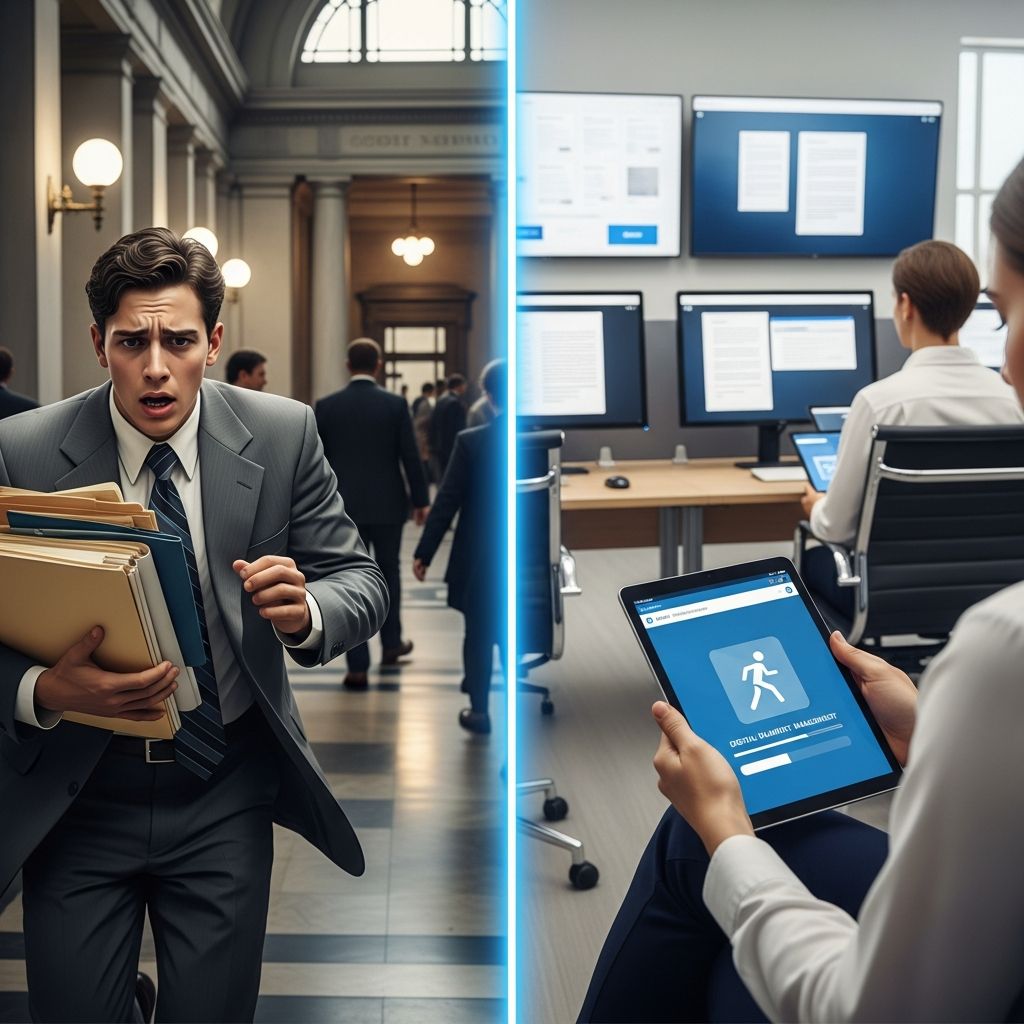
For decades, law firms relied on couriers and court runners to deliver paper filings, stand in line at the clerk’s window, and confirm that documents were accepted. Today, electronic filing (eFiling) and broader court digitization have largely replaced those in-person trips, allowing legal professionals to submit and track documents from any connected device. As more courts mandate or strongly encourage eFiling, the business case for routinely using traditional court runners is shrinking fast.
This article explains why you rarely need court runners anymore, what eFiling offers instead, and how to transition your firm to a primarily digital filing workflow without sacrificing reliability or compliance.
The Shift from Physical Filing to Digital Workflows
Courts across the United States have been gradually adopting electronic filing systems to replace or supplement paper-based filing. These systems let litigants submit pleadings, motions, and other documents online, often through a secure court portal or an authorized electronic filing service provider (EFSP). Many jurisdictions now accept – and in some cases require – eFiling for most civil matters.
This shift aligns with a broader government trend toward digital administration aimed at reducing costs, improving public access, and enhancing records management. As eFiling becomes standard procedure, the role of court runners has naturally diminished, especially for routine filings that no longer require a physical appearance at the courthouse.
Core Advantages of eFiling Over Court Runners
Electronic filing delivers clear benefits that are difficult, if not impossible, for physical court runners to match consistently.
1. Time Savings and Faster Court Processing
With eFiling, documents reach the court within minutes instead of hours or days. Courts using electronic systems can provide:
- Instant submission confirmations
- Rapid clerk review and acceptance or rejection
- Quicker access for judges and court staff
- Automatic notifications to parties and counsel
By comparison, relying on a runner involves travel, queues, and manual confirmation steps. Even small delays can increase the risk of missing tight deadlines in litigation.
2. Around-the-Clock Filing Access
Most eFiling platforms operate 24/7, allowing legal teams to submit filings outside regular courthouse hours. This flexibility is particularly valuable when:
- Deadlines fall on early mornings or just after weekends and holidays
- Attorneys are working across time zones
- Emergency motions need to be filed without waiting for the courthouse to open
Court runners are inherently constrained by operating hours, traffic, and geography, which makes them far less adaptable than online systems.
3. Cost Reductions and Predictable Expenses
Traditional filing involves a long list of direct and indirect costs:
- Printing and copying lengthy exhibits
- Court runner or courier fees
- Staff time preparing physical bundles and instruction sheets
- Storage and retrieval expenses for paper files
Electronic filing dramatically reduces or eliminates many of these costs by keeping documents digital from creation through submission and archiving. Although eFiling services may charge modest transaction or convenience fees, these are typically outweighed by savings in printing, courier services, and manual labor.
4. Improved Accuracy and Fewer Rejected Filings
Modern eFiling systems incorporate automated checks to reduce common filing errors, such as missing fields, incorrect case numbers, or improper document types. Many platforms can:
- Validate required fields before submission
- Flag incompatible file formats
- Automatically calculate certain fees
- Prompt for missing attachments or signatures
When relying on a court runner, error prevention depends heavily on the clarity of instructions and the runner’s familiarity with court rules. A misunderstanding or oversight can result in rejected filings and urgent, costly re-submissions.
5. Better Security and Audit Trails
Well-designed eFiling systems use encryption, controlled access, and digital logs to safeguard sensitive case information and provide traceability. Typical security and compliance features include:
- Role-based user accounts and strong authentication
- Encryption of data in transit and at rest
- Time-stamped records of who filed what and when
- Disaster recovery and backup mechanisms
By contrast, paper documents carried by court runners are vulnerable to loss, misdelivery, or unauthorized viewing. While reputable couriers manage risk carefully, digital systems provide a more robust and easily auditable chain of custody.
6. Stronger Document Management and Searchability
Digital court records are significantly easier to organize, search, and retrieve than paper files stored in boxes and cabinets. Integrated eFiling platforms often support:
- Full-text searching across submissions
- Standardized naming conventions
- Instant retrieval of prior filings and orders
- Electronic sharing with colleagues and clients
These capabilities help law firms avoid redundant work, quickly confirm filing history, and present accurate information to courts and clients.
7. Environmental and Space Benefits
Replacing paper-heavy filings with electronic documents reduces paper consumption, physical storage demands, and transportation-related emissions. Courts implementing eFiling have cited significant potential savings in storage space and printing costs as part of broader sustainability and cost-control initiatives.
Comparing eFiling and Court Runners
| Factor | Electronic Filing | Traditional Court Runners |
|---|---|---|
| Speed | Near-instant submission and confirmation | Dependent on travel time and courthouse queues |
| Availability | Typically 24/7 access via online portal | Limited to business hours and local coverage |
| Cost | Reduced printing, courier, and storage costs | Ongoing courier fees plus printing and handling |
| Error Prevention | Built-in validation and format checks | Manual review, more prone to human error |
| Security | Encryption, access controls, audit logs | Physical risk of loss, theft, or viewing |
| Record Management | Searchable, centralized digital records | Paper files requiring manual indexing and retrieval |
Digital Filing in Remote and Hybrid Law Offices
Remote and hybrid work models have accelerated the adoption of electronic court filing. When teams are distributed, relying on a single person to physically deliver documents quickly becomes impractical. eFiling solves many of these coordination challenges by enabling:
- Submission from any location with internet access
- Real-time status tracking of pending filings
- Seamless integration with cloud-based case management tools
- Simultaneous collaboration across offices and time zones
These capabilities are particularly important for firms managing high volumes of litigation or operating across multiple jurisdictions, where in-person filing would be prohibitively time-consuming and expensive.
When Might You Still Need a Court Runner?
Although eFiling has reduced the need for physical runners, they have not disappeared entirely. Situations where a court runner may still be appropriate include:
- Non-eFiling courts or case types: Some courts or specific proceedings still require paper filing.
- Original documents: Filings that must include an original will, bond, or other physical exhibit may demand in-person delivery.
- Very urgent, last-minute filings: When a deadline is minutes away and eFiling is unavailable or down, a runner may be the only option.
- Special, judge-specific instructions: In rare instances, chambers may require hand-delivery of courtesy copies or special materials.
Even in these scenarios, runners often play a supplemental role, handling only the narrow set of tasks that cannot yet be completed electronically.
Practical Steps for Transitioning Away from Court Runners
To safely move from a runner-centric model to predominantly digital filing, law firms can follow a structured transition plan.
1. Map Court Requirements and eFiling Coverage
- Identify which courts and case types your firm handles most frequently.
- Determine where eFiling is mandatory, optional, or unavailable.
- Document any local rules on format, timing, and technical standards.
This mapping helps you understand where court runners remain necessary and where they can be phased out.
2. Select Reliable eFiling Service Providers
- Review official court lists of approved eFiling portals or EFSPs.
- Compare pricing, user interface, customer support, and integration options.
- Check security certifications and data protection practices.
Where courts offer their own portals, verify how they interact with your practice management, billing, or document management systems.
3. Standardize Internal eFiling Procedures
- Create checklists for document preparation, naming, and formatting.
- Define who is responsible for submitting, confirming, and recording filings.
- Establish backup procedures for system outages or rejected filings.
Written procedures reduce training time for new staff and help maintain consistency across matters and offices.
4. Train Attorneys and Staff
- Offer live demonstrations and practice submissions in test environments where available.
- Highlight common pitfalls (wrong case numbers, missing exhibits, incorrect document types).
- Clarify ethical responsibilities related to electronic signatures and confidentiality.
Training should be refreshed periodically to account for system updates and new court rules.
5. Monitor Performance and Adjust
- Track metrics such as rejection rates, time from drafting to filing, and staff hours spent on administrative tasks.
- Gather feedback from attorneys, paralegals, and clients on the new process.
- Refine workflows and documentation based on experience and rule changes.
Continuous improvement helps your firm fully capture the benefits of a digital-first filing model and avoid reverting to runners out of habit.
Risk Management in a Fully or Mostly Digital Filing Environment
Moving away from court runners does not remove risk; it simply changes its nature. Effective digital risk management should address:
- Data security: Use strong passwords, multifactor authentication, and secure networks for filing activities.
- Redundancy: Ensure multiple trained users can access filing systems so that vacations or absences do not endanger deadlines.
- Backups: Maintain independent backups of filed documents, confirmations, and orders in your own systems.
- Policy alignment: Update firm policies to cover eSignatures, electronic service, and digital records retention.
Handled thoughtfully, these measures can make digital filing more dependable than historical paper-and-runner methods, not less.
Frequently Asked Questions (FAQs)
Q1: Are court runners completely obsolete now?
No. While many routine filings can be handled electronically, some courts, case types, and original-document requirements still call for physical delivery. Court runners are less central than before but remain useful in specific, limited scenarios.
Q2: Is eFiling safer than sending a runner to the courthouse?
In most systems, yes. eFiling platforms typically use encryption, access controls, and robust audit logs that provide a clear record of what was filed and when. A physical runner’s work, by contrast, may rely on paper receipts and manual documentation.
Q3: What happens if an eFiling submission is rejected?
Courts generally include a reason for rejection, such as a missing document, formatting error, or incorrect case number. The filer can correct the issue and resubmit. Many systems provide rapid feedback, helping firms remedy problems before critical deadlines pass.
Q4: How do eFiling systems handle electronic signatures?
Courts usually define what constitutes an acceptable electronic signature through local rules or administrative orders. Common formats include typed names with designated indicators (for example, “/s/ Name”) or signatures created using secure digital tools. Filers must follow the governing rules in each jurisdiction.
Q5: Can small firms or solo practitioners benefit as much as large firms?
Yes. In fact, solo and small firms may benefit even more from lower overhead, reduced travel time, and simplified document management. eFiling allows them to compete effectively without maintaining large support teams or relying heavily on external runners.
References
- Court e-Filing and the Digital Shift in Process Serving — Firefly Legal. 2023-08-10. https://fireflylegal.com/insights/court-e-filing-system/
- The Benefits of Electronic Filing of Court Documents — North TX Civil Process. 2024-12-18. https://www.northtxprocessservice.com/blog/the-benefits-of-electronic-filing-of-court-documents
- Why Are eFiling Court Documents a Game-Changer for Remote and Hybrid Law Offices? — Bay Area File. 2023-11-02. https://bayareafile.com/efiling-court-documents/why-are-efiling-court-documents-a-game-changer-for-remote-and-hybrid-law-offices/
- E-Filing Gets the Green Light — Illinois State Bar Association. 2013-01-01. https://www.isba.org/ibj/2013/01/efilinggetsthegreenlight
- Maximizing E-Filing Efficiency: Six Insights for Court Professionals — Catalis. 2023-05-15. https://catalisgov.com/maximizing-e-filing/
- Between the Lines: Top 5 Advantages of E-filing — ABC Legal. 2022-07-20. https://www.abclegal.com/blog/between-the-lines-top-5-advantages-of-e-filing
- The Benefits of e-Filing — Extract Systems. 2020-09-14. https://www.extractsystems.com/the-benefits-of-e-filing/
Similar Articles








Read full bio of medha deb


