
When Police Can Legally Use Tasers: 4 Key Takeaways
Understand when officers may deploy Tasers, what limits the law imposes, and how excessive force claims are evaluated in court.
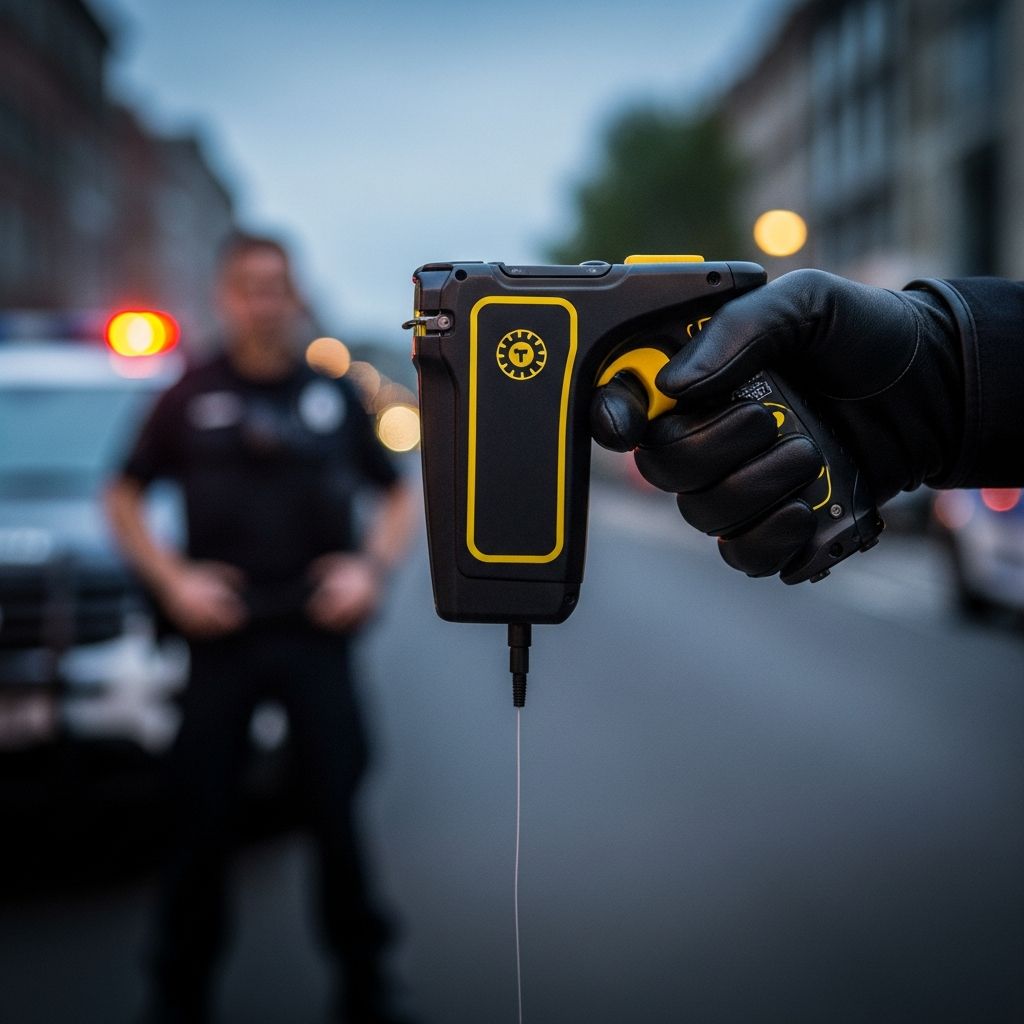
Tasers and other conducted energy weapons have become standard tools for many law enforcement agencies in the United States. These devices are promoted as a way to control dangerous situations without resorting to firearms, but their use is tightly bound by constitutional rules, department policies, and evolving court decisions.
This guide explains when police are generally allowed to use Tasers, how courts review those incidents, and what options people may have if they believe force went too far.
What Is a Police Taser and How Does It Work?
A Taser is a brand-name conducted energy weapon (often called a CEW) that delivers an electric shock to disrupt a person’s nervous system. Law enforcement versions usually operate in two primary modes:
- Probe mode — Two barbed probes are fired from the device and attach to the subject’s clothing or skin, delivering electrical pulses that can cause neuromuscular incapacitation.
- Drive-stun mode — The device is held directly against the body, causing intense localized pain without the same degree of full-body incapacitation.
Police often deploy Tasers from a distance of roughly 10–15 feet, allowing officers to attempt control without closing in physically. Although Tasers are marketed as “less-lethal,” they are not risk-free: serious injuries and deaths have been documented, especially when used on vulnerable individuals.
Legal Foundations: How the Constitution Limits Taser Use
Most claims about police misuse of Tasers are brought under the U.S. Constitution, particularly the Fourth Amendment, which protects against unreasonable seizures. Federal courts treat a Taser deployment as a form of force that must be reasonable under all the circumstances.
Key constitutional principles include:
- Objective reasonableness — Under the Supreme Court’s decision in Graham v. Connor, courts ask whether an officer’s use of force was objectively reasonable from the perspective of a reasonable officer on the scene, not in hindsight.
- Severity of the suspected crime — Force used to stop a violent felony will be evaluated differently than force used in response to a minor offense or mere noncompliance.
- Immediate threat — The most important factor is usually whether the person posed an immediate safety threat to officers or others.
- Resistance or flight — Courts distinguish between passive resistance (e.g., refusing to move) and active resistance or aggressive behavior.
Police departments generally incorporate these constitutional standards into written use-of-force and Taser policies, adding further internal restrictions on when officers may deploy these tools.
Typical Department Rules on When Tasers May Be Used
While exact wording varies, many law enforcement agencies follow similar guidelines for deciding when deployment is justified.
Common Preconditions for Taser Use
- The subject is actively resisting or physically aggressive, and lesser force has been or appears likely to be ineffective.
- The subject’s behavior reasonably suggests a potential for harm to officers, bystanders, or themselves if not brought under control.
- Officers can articulate why other available options (such as hands-on control or verbal commands) were insufficient or more dangerous under the circumstances.
- When practical, officers give a verbal warning that a Taser may be used and allow a brief opportunity for voluntary compliance.
These rules are often embedded in broader use-of-force continuums, where Tasers are placed above simple physical guiding or joint locks but below firearms.
Situations Where Taser Use Is Often Discouraged
Many policies caution officers to avoid or limit Taser use on people at higher risk of serious injury, unless the need to regain control is compelling.
- Pregnant individuals
- Elderly persons or very young people
- Individuals who are visibly frail, underweight, or have obvious medical vulnerabilities
- People in elevated locations, in water, or near traffic where a fall could be catastrophic
- Persons who appear to be in a state sometimes described as excited delirium — extreme agitation, unusual strength, profuse sweating, and apparent insensitivity to pain
Policies also generally warn against repeated or prolonged Taser cycles, encouraging officers to transition to control and restraint as quickly as possible once a subject is incapacitated.
Evaluating Force: Non-Deadly vs. Deadly Force
Tasers are generally classified as less-lethal or non-deadly force, but that does not mean they are trivial or automatically lawful. In some circumstances, repeated or risky deployments can be treated by courts as a very high level of force.
| Type of Force | Typical Legal Standard | How Tasers Usually Fit |
|---|---|---|
| Non-deadly force | Must be objectively reasonable given the threat, resistance level, and seriousness of the crime. | Taser use in brief, targeted deployments to stop active resistance or threats. |
| Deadly force | Permitted only where an officer has probable cause to believe the suspect poses a significant threat of death or serious physical injury, as in Tennessee v. Garner. | Rarely, very dangerous or repeated deployments in high-risk conditions may be argued to approximate deadly force. |
Examples of When Courts Have Approved Taser Use
Case law across federal circuits shows patterns in how judges evaluate Taser incidents. While specific holdings depend on the facts, courts are more likely to uphold Taser use where:
- The suspect is armed or credibly believed to be armed, and behaving in a volatile or threatening manner.
- Officers face a suspect who appears potentially homicidal or intent on inflicting serious harm, and the Taser is used as an alternative to gunfire.
- The Taser is activated briefly and used to prevent escalation, followed by rapid restraint and medical assessment.
Some appellate courts have explicitly noted that using a Taser to subdue an armed, dangerous suspect does not violate clearly established law and may fall well within constitutional bounds.
Examples of Questionable or Excessive Taser Use
Conversely, Taser deployments are more likely to be found excessive when the facts show comparatively low threat levels or disproportionate force. Reported incidents leading to successful civil rights suits or settlements often involve:
- Using a Taser on an unarmed, nonviolent individual who poses little immediate danger.
- Deployments against people who are merely verbally noncompliant or passively resisting, such as refusing to leave a location without threatening anyone.
- Multiple or prolonged shocks after a person has already fallen, been handcuffed, or otherwise stopped resisting.
- Strikes to the head, neck, chest, or groin without strong justification, increasing the risk of severe injury.
In some documented cases, individuals suffered serious injuries, including head trauma from falls or cardiac complications, prompting lawsuits and policy reforms.
Internal Policies, Training, and Documentation
Modern Taser policies are not limited to when an officer can press the trigger. They also address:
- Device marking and carry — Agencies often require Tasers to be carried on the side opposite a firearm and marked distinctly to reduce weapon-confusion incidents.
- Pre-use warnings — Many policies stress a clear verbal warning where feasible, both to encourage compliance and to alert other officers.
- Medical monitoring — After deployment, officers are generally instructed to check the subject’s condition, remove probes safely, and seek medical care when needed.
- Reporting and review — Taser incidents usually trigger a written report and supervisory review, and some agencies require automatic downloading of device data logs.
These systems help departments evaluate whether individual officers follow policy and whether broader training or policy changes are required.
Civil Liability and Qualified Immunity
Individuals who believe they were subjected to excessive Taser force may file civil lawsuits under federal law (commonly 42 U.S.C. § 1983) or state tort law. Courts will examine:
- Whether the force violated the Constitution under the Graham v. Connor factors.
- Whether the law was clearly established at the time of the incident, which affects an officer’s entitlement to qualified immunity.
- Whether a city or department’s policy or failure to train contributed to the violation (potential Monell liability).
In some earlier Taser cases, courts granted qualified immunity because there was little prior case law clearly defining the limits on Taser use in similar circumstances. Over time, as more decisions are published, officers and agencies lose that shield in scenarios where courts have already labeled certain uses of Tasers as unconstitutional.
Practical Guidance: What to Do If You Are Tased by Police
Every encounter is unique, but several basic steps can help protect both safety and legal rights.
Immediate Safety Steps
- Once able, follow lawful commands to reduce the risk of further force.
- Ask for medical attention, especially if you have heart conditions, are pregnant, or feel unwell.
- Note any visible injuries, such as burns, puncture marks, or injuries from a fall, and seek timely medical documentation.
Documenting the Incident
- Write down what happened as soon as possible, including what led up to the Taser use, any warnings given, and how many times you believe the device was activated.
- Record the names or badge numbers of officers if known, and the presence of any witnesses or video cameras (public, private, or bystanders).
- Preserve clothing or personal items that may show damage or evidence of probe placement.
Consulting a Lawyer
Because Taser incidents raise complex constitutional and evidentiary issues, many people consult a criminal defense or civil rights attorney. An attorney can:
- Review police reports, body-worn camera footage, and medical records.
- Assess whether department policies or national guidelines were violated.
- Advise about potential civil claims, complaint processes, or negotiation with the municipality.
Key Takeaways About Police Taser Authority
- Officers may use Tasers as a form of non-deadly force when reasonably necessary to control active resistance or credible safety threats.
- The legality of each deployment depends on factors such as threat level, resistance, the seriousness of the suspected crime, and the availability of safer alternatives.
- Policies often warn against Taser use on vulnerable populations or in high-risk situations without strong justification.
- Courts increasingly scrutinize repeated shocks, use on restrained people, and deployments against nonviolent subjects, sometimes finding such uses unconstitutional.
Frequently Asked Questions (FAQs)
Q: Are police allowed to use a Taser just because someone talks back or refuses to answer questions?
Generally no. Courts and policies distinguish between verbal noncompliance and active physical resistance. Most use-of-force frameworks do not justify Taser use based solely on disrespectful language or refusal to speak, absent safety threats.
Q: Can officers tase someone who is already handcuffed?
Using a Taser on a handcuffed person is viewed as a very high level of force and is usually allowed only in rare situations, such as when the person is still actively assaultive and poses a clear safety risk. Many courts have treated unnecessary Taser use on restrained individuals as excessive.
Q: Is being tased considered deadly force?
Tasers are usually classified as less-lethal devices, meaning they are designed not to be deadly in ordinary use. However, their deployment is still serious, and repeated or unsafe use in high-risk scenarios can be argued to approach deadly force, depending on the circumstances.
Q: What rights do I have if I think a Taser was used on me unlawfully?
You may file an internal complaint with the police department and, in appropriate cases, pursue civil claims in court. Success depends on the facts, available evidence, and whether a reasonable officer would have believed such force was necessary under clearly established law.
Q: Do officers receive special training before carrying Tasers?
Most agencies require officers to complete training on device operation, medical risks, and department policy before authorizing Taser carry. Training often includes scenario-based exercises and periodic recertification.
References
- TASER Guidelines, Medford Police Department Policy Manual — Lexipol/Medford Police Department. 2011-08-03. https://www.aclu.org/wp-content/uploads/document/30157-30162_Taser_Policy.pdf
- Taser — Office of Justice Programs, National Criminal Justice Reference Service Abstract. 1976. https://www.ojp.gov/ncjrs/virtual-library/abstracts/taser
- Use of Tasers by Law Enforcement Agencies: Guidelines and Recommendations — Stanford Criminal Justice Center. 2005. https://law.stanford.edu/wp-content/uploads/sites/default/files/child-page/164097/doc/slspublic/tasersv2.pdf
- When Are The Police Allowed to Use a Taser? — SQ Attorneys. 2020. https://sqattorneys.com/when-are-the-police-allowed-to-use-a-taser/
- Stun Guns, TASERs, and Other Conducted Energy Devices: Issues for Congress — Congressional Research Service. 2024. https://www.congress.gov/crs-product/IF12841
Similar Articles








Read full bio of medha deb




