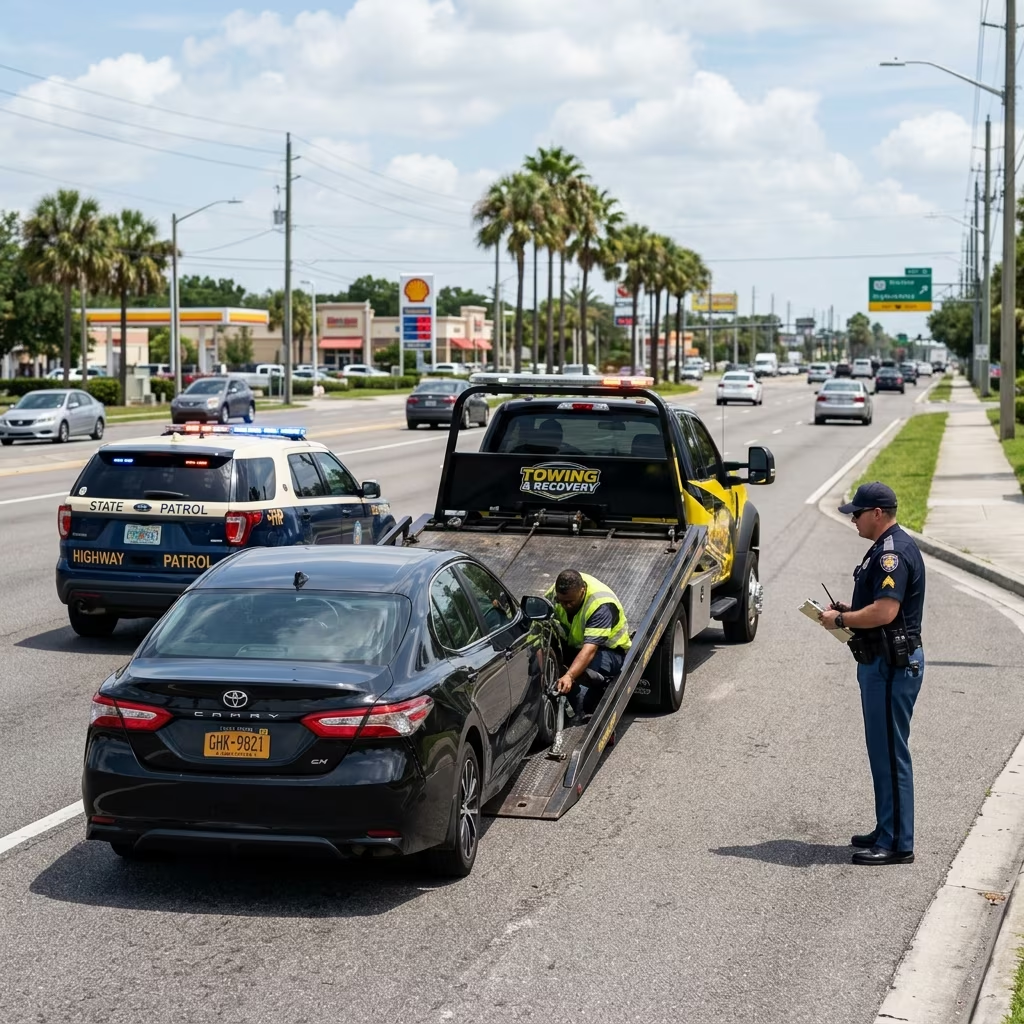
In Florida, police officers may only impound or tow a vehicle when specific legal conditions are met, usually related to public safety, traffic flow, or criminal investigations. Understanding these rules helps drivers protect their rights, avoid unnecessary costs, and respond appropriately if their car is taken to an impound lot.
Impoundment vs. Towing: Basic Concepts
Many people use the terms towing and impoundment interchangeably, but Florida law treats them differently.
- Towing generally refers to physically removing a vehicle from where it is located to a storage facility or other place of safety.
- Impoundment refers to holding a vehicle under the authority of law enforcement, often because it is related to an offense, an investigation, or a safety issue.
- A car can be towed by a private company due to parking rules, property owner requests, or trespass towing laws, without police placing a legal “hold” on it.
When police impound a car, both criminal law and specific motor vehicle statutes govern how long the vehicle may be held and how the driver or owner can get it back.
Key Legal Grounds for Police Impoundment in Florida
Florida law allows officers to impound or hold a vehicle only under defined circumstances. These grounds are scattered across several statutes and local ordinances but follow the same basic logic: the car must pose a safety, traffic, or legal compliance concern.
Impoundment after Driver Arrest
One of the most common situations is when the driver is arrested during a lawful traffic stop.
- DUI or DWI: If a driver is arrested for driving under the influence under Florida’s DUI statute, officers may impound the car when it would otherwise be left on the roadway or there is no safe, lawful alternative driver.
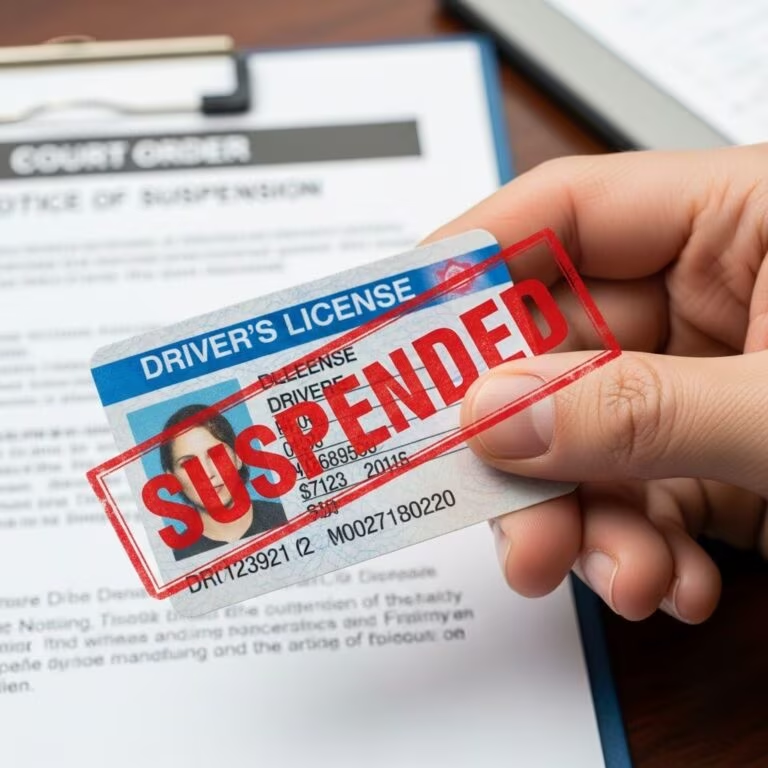
- No valid license or revoked license: When a person is arrested for driving with a suspended or revoked license, the vehicle can be impounded under Florida Statutes that address unlicensed driving and related penalties.
- No licensed passenger available: If no licensed passenger is present that can legally take control of the vehicle, police often choose impoundment to remove the car from the roadway and prevent unauthorized operation.
In these circumstances, impoundment is justified as a measure to prevent unlicensed or impaired driving and maintain traffic safety.
Vehicles That Block Traffic or Pose Hazards
Florida law, often implemented through local ordinances, allows police to remove vehicles that interfere with safe traffic flow or act as hazards.
- Cars disabled in a travel lane or intersection, creating an obstruction.
- Vehicles parked in prohibited zones marked by official signs or pavement markings.
- Cars left on the roadway in a way that restricts emergency responses, construction work, or normal public use.
In such cases, police may order the car to be towed to the nearest safe location or an authorized storage lot, and impoundment may follow if an investigation or a legal hold is required.
Abandoned or Long-Unattended Vehicles
Vehicles that appear to be abandoned or left unattended for long periods may be towed and impounded under Florida towing and lien laws.
- Cars left on public streets for extended periods, suggesting abandonment.
- Vehicles on private property without the owner’s consent, subject to trespass towing rules.
- Cars with no visible registration or signs of ownership that create safety or nuisance concerns.
Florida Statutes on towing and storage provide detailed rules on notice, lien rights, and the process for disposing of vehicles if the owner does not reclaim them.
Vehicles Connected to Felonies or Major Crimes
Police may impound vehicles that are linked to felony offenses, such as hit-and-run, vehicular homicide, or transportation of contraband.
- Cars used in the commission of felonies may be seized and held as potential evidence.
- Vehicles can be subject to forfeiture proceedings under Florida’s contraband or forfeiture laws in specific circumstances.
When a vehicle is evidence or alleged contraband, impoundment can last longer and is often controlled by court orders or agency policies.
How Long Can Florida Police Hold an Impounded Vehicle?
Florida statutes set limits on how long an investigating agency can keep a vehicle on hold at a wrecker operator’s facility without additional written steps.
| Legal Rule | Key Time Limit | What It Means for Owners |
|---|---|---|
| Initial law enforcement hold | Up to 5 days (excluding weekends and holidays) | Police may prevent release during this period for investigation or safety reasons. |
| Written extension requirement | Must be confirmed in writing to continue beyond 5 days | If no written extension is issued, the tow operator may release the vehicle according to towing and lien laws. |
| Towing and storage liens | Timeframes set under Florida towing and lien statutes | If fees are not paid and proper notice is given, the vehicle may eventually be sold or otherwise disposed of. |
These time limits are important because they prevent indefinite holds without written justification and provide a framework for owners to seek return of their vehicles.
Inventory Searches of Impounded Vehicles
When police lawfully impound a vehicle, they frequently perform an inventory search to document its contents. This is not supposed to be a criminal investigation but rather an administrative process.
Purpose of an Inventory Search
- Protect the owner’s property by documenting items in the vehicle.
- Protect the police and tow operators from claims of lost or stolen items.
- Identify dangerous items, such as weapons or hazardous materials, before storage.
According to United States Supreme Court decisions, inventory searches are constitutional only if they follow standardized procedures and are not used as a pretext for investigating crimes without a warrant.
Limits on Inventory Searches
The Supreme Court has emphasized key constraints on inventory searches through decisions involving Colorado and Florida cases.
- Departments must have clear written policies governing how inventory searches are conducted.
- Officers must follow those policies consistently; selective or ad hoc searching can violate constitutional protections.
- Inventory searches cannot be exploited as a way to circumvent warrant requirements or to engage in purely investigative rummaging.
If police fail to follow proper procedures, any evidence discovered during an inventory search may be suppressed, meaning it cannot be used against the defendant in court.
Owner Rights and Release of Impounded Vehicles
Florida law provides specific rights to vehicle owners whose cars have been impounded, especially when the impoundment is tied to certain driving offenses.
Recovering a Vehicle After License-Related Impound
When a vehicle is impounded because the driver was caught operating with a suspended or revoked license, Florida law allows the owner to reclaim the car by meeting defined conditions.
- The owner may recover the vehicle by presenting proof of insurance to the arresting law enforcement agency.
- If the owner has sold the vehicle, they may secure release by showing proof of insurance in the name of the buyer.
- In many cases, no separate court order is required; the statute explicitly authorizes release when the insurance proof is provided.
These rules aim to prevent uninsured or unauthorized drivers from reclaiming vehicles while allowing responsible owners to recover their property.
Towing, Storage Fees, and Liens
Even when a vehicle is legally impounded, the owner is typically responsible for towing and storage costs.
- Florida law recognizes a wrecker operator’s lien for reasonable towing and storage charges.
- Local codes often set maximum rates for towing and daily storage to prevent abuse.
- Owners may need to pay accrued charges in full to obtain release of the vehicle, depending on the outcome of any criminal case.
Some local governments publish standardized towing rates and require tow companies to answer phones and release vehicles during specified hours.
Private Property, Trespass Towing, and Police Involvement
Not all tows involve police placing a hold. Florida’s trespass towing laws allow property owners and managers to have unauthorized vehicles removed from their property, with or without police involvement.
When Vehicles May Be Towed from Private Property
- When a car is parked without permission on commercial property, and required signs are posted.
- When a vehicle blocks a business’s normal operations or access to driveways.
- In some cases, single-family residences may tow without posted signs if personal notice is provided.
These tows are usually arranged by property owners through private towing services, and police may only become involved if there is a dispute, safety concern, or criminal investigation.
Driver Protections During Trespass Towing
Florida law gives drivers certain rights when they return to their car as it is about to be towed from private property.
- If the tow truck has not yet left with the vehicle, the driver must be given a reasonable opportunity to pay a reduced “drop fee” to prevent the tow.
- This fee cannot exceed half of the posted towing rate for that type of vehicle.
- If the driver cannot or does not pay after being given a reasonable chance, the towing company may lawfully proceed with removal.
These protections are separate from police impound rules but often interact with them when law enforcement is called to the scene.
Practical Tips If Your Car Is Impounded in Florida
Facing an impound can be stressful and expensive. Taking organized steps helps protect your rights and minimize costs.
- Confirm the reason for impound: Ask the officer or agency which statute or ordinance justifies the impoundment.
- Obtain written documentation: Get copies of tow slips, hold orders, and any inventory forms, including the reason for the hold and the location of the impound lot.
- Check time limits: Note when the hold began and whether any written extension has been issued beyond the initial permissible period.
- Gather insurance and ownership proof: Be ready to show registration, valid identification, and insurance to reclaim the car, especially in license-related impounds.
- Request policy information: You may ask for the department’s written impound and inventory search policies, which can be relevant if you later challenge the legality of a search.
- Seek legal advice: A Florida attorney can determine whether the impound or search complied with law and whether any evidence should be suppressed.
Frequently Asked Questions (FAQs)
Can police impound my car just because they pulled me over?
A routine traffic stop alone does not justify impoundment. Police must have a legally recognized reason, such as an arrest, safety hazard, or abandoned vehicle, before towing and impounding your car.
How long can police hold my car without charges?
When a vehicle is stored at a wrecker operator’s facility under a law enforcement hold, the investigating agency generally has up to five days, excluding weekends and holidays, to decide whether to continue the hold in writing. Beyond that, towing and lien laws govern whether the vehicle must be released or may continue to be held.
Do police need a warrant to search my impounded vehicle?
Police can conduct an inventory search of a lawfully impounded vehicle without a warrant if they follow standardized policies and the search is administrative rather than investigative. If officers use the inventory as a pretext for investigation or fail to follow policy, the search may be unconstitutional and the evidence subject to suppression.
Can I get my car back if it was impounded because my license was suspended?
In many cases, yes. Florida law permits release of a vehicle impounded under certain license-suspension provisions when the owner presents proof of insurance to the arresting agency or, if the vehicle has been sold, proof of insurance in the buyer’s name.
Who pays for towing and storage when my case is over?
Owners are usually responsible for towing and storage costs. Florida law recognizes a lien for these fees and often requires full payment when the owner is convicted or pleads no contest to the offense that led to the impoundment. Local codes may also set maximum towing and storage rates.
What if I think the police wrongly impounded my car?
If you believe the impoundment was unlawful, you may challenge it through the court process in your criminal case or, in some situations, through civil proceedings. A lawyer can review whether the police had valid legal grounds, whether time limits and notice requirements were respected, and whether any inventory search complied with constitutional standards.
References
- When Can Police Impound a Car in Florida? — LegalMatch Law Library. 2024-01-01. https://www.legalmatch.com/law-library/article/when-can-police-impound-a-car-in-florida.html
- Florida Statutes Title XXIII, § 323.001 — Florida Legislature (Online Sunshine). 2023-07-01. https://www.leg.state.fl.us/statutes/
- Florida Statutes § 713.78 — Towing and Storage of Vehicles and Vessels — Florida Legislature (Online Sunshine). 2023-07-01. https://www.leg.state.fl.us/statutes/
- Release of Impounded/Immobilized Motor Vehicles — Florida Attorney General Opinions. 2005-06-20. https://www.myfloridalegal.com/ag-opinions/release-of-impoundedimmobilized-motor-vehicles
- Florida Towing Laws — Community Legal Services of Mid-Florida. 2022-05-01. https://www.legalaccessforall.org/get-help-post/debt-creditors/florida-towing-laws/
- Towing Information — Orange County Government, Florida. 2023-01-15. https://www.orangecountyfl.net/TrafficTransportation/TowingandParkingInformation/TowingInformation.aspx