
New York Car Warranties In 2025: 6 Systems Covered, Claims Tips
Understand how New York warranty rules, repair duties, and lemon-law remedies protect car buyers and lessees.
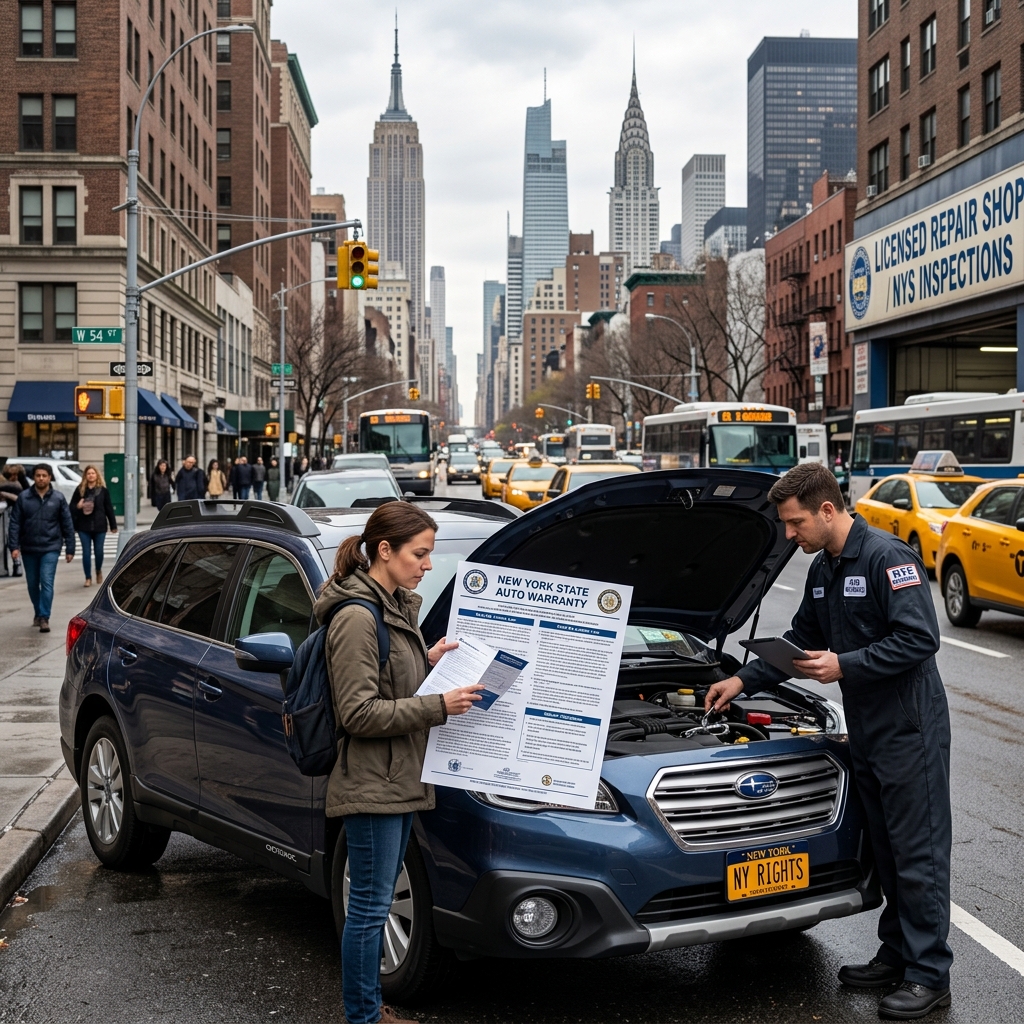
Buying a car in New York comes with legal protections that many consumers do not fully understand until something goes wrong. A written warranty can determine who pays for repairs, how long coverage lasts, and whether a buyer may later qualify for a refund or replacement vehicle. New York law also gives special remedies to drivers whose vehicles repeatedly fail to perform as promised.
This article explains the main rules that affect new and used vehicles, how warranty coverage is typically triggered, what counts as a serious defect, and which options may be available if repairs do not solve the problem. It also outlines practical steps consumers can take to protect their claims and resolve disputes efficiently.
Why warranty rules matter after a car purchase
Car ownership often begins with trust: a buyer expects the vehicle to function safely and reliably. When the engine, transmission, brakes, steering, or another major system fails soon after purchase, the warranty becomes the primary legal tool for getting repairs without paying out of pocket. New York’s consumer protections are designed to shift the cost of qualifying repairs away from the buyer and toward the party responsible for honoring the warranty.
These rules are especially important because warranty claims are not just about fixing one mechanical issue. They can also determine whether the consumer has stronger remedies if the same problem keeps returning. In some cases, the law may require the dealer or manufacturer to offer a refund, a replacement vehicle, or access to arbitration.
What a warranty usually covers
Warranty language varies depending on whether the vehicle is new or used, and whether the protection comes from the manufacturer or a dealer. In general, a warranty should identify the covered parts and explain the repair obligations in clear terms. For many vehicles, the most important coverage involves major components that affect drivability and safety.
- Engine components
- Transmission components
- Drive axle parts
- Braking systems
- Steering systems
- Ignition-related parts
Coverage is often limited to specific defects or systems, so not every repair problem will qualify. Cosmetic damage, routine maintenance, and issues caused by misuse may be excluded. That makes it essential to read the warranty terms closely and keep a copy of all purchase documents.
New cars and the lemon-law framework
New vehicles in New York can qualify for stronger protection when defects cannot be repaired after a reasonable number of attempts. The law focuses on whether the vehicle substantially fails to live up to the written warranty during the early ownership period. If a defect affects use, value, or safety and persists despite repair efforts, the vehicle may be treated as a lemon.
For a new-car claim, consumers generally need to show that the problem was reported while the vehicle was still within the applicable warranty period and that the dealer or manufacturer had a fair chance to fix it. The more carefully the owner documents the defect and repair history, the stronger the claim is likely to be.
Used vehicles have their own protection rules
Used cars are not left out of New York’s consumer protection system. When a used vehicle is sold by a New York dealer and meets the statutory conditions, the dealer must provide a written warranty. The length of that warranty usually depends on the mileage at the time of sale.
| Mileage at purchase | Typical warranty period |
|---|---|
| More than 18,000 and up to 36,000 miles | 90 days or 4,000 miles |
| More than 36,000 and up to 80,000 miles | 60 days or 3,000 miles |
| 80,000 to 100,000 miles | 30 days or 1,000 miles |
These periods are measured by whichever limit is reached first. A buyer should not assume that a vehicle is uncovered simply because it is used. If the car fits the statutory categories and is sold by a dealer, the written warranty can create enforceable repair duties.
When a defect becomes legally important
Not every malfunction creates a warranty dispute. The issue must usually be more than a minor inconvenience. Courts and agencies often look at whether the defect materially affects the car’s use, value, or safety. A broken radio may be annoying, but repeated brake failure, engine stalling, or transmission problems can be much more serious.
In practice, the strongest claims are the ones involving the same defect coming back after several repair attempts. A consumer who brings the same complaint to the dealer over and over may be demonstrating that the vehicle cannot be fixed in a reasonable way. That history matters because warranty law is meant to provide a real remedy, not just a cycle of repetitive service visits.
What consumers should do after noticing a problem
The first step is to report the problem as soon as possible. Waiting too long can create disputes about when the issue began and whether it was reported within the warranty period. Consumers should notify the dealer in writing whenever possible and ask for a repair order that describes the complaint in detail.
- Report the defect promptly
- Keep every repair invoice and work order
- Save written messages, emails, and letters
- Record the date, mileage, and symptoms each time the problem appears
- Continue making loan or lease payments unless a lawyer advises otherwise
Good records are often the difference between a successful claim and a rejected one. If the dealer or manufacturer later argues that the defect was never reported, clear documentation can help prove otherwise.
How refund or replacement remedies work
When repeated repairs fail, New York law may require a refund or a comparable replacement vehicle. This remedy is designed for situations where a buyer should not be forced to keep a defective car that cannot be fixed after a fair number of attempts. The refund typically aims to return the consumer to a financial position close to where they started, though deductions may apply in some situations.
A replacement vehicle may be appropriate when the consumer prefers to keep driving but does not want the defective car. The replacement should be comparable, not a stripped-down substitute with less value. Which remedy applies often depends on the facts, the consumer’s preference, and the procedure used to resolve the dispute.
When a dealer can refuse or limit relief
Dealers and manufacturers are not automatically responsible for every problem. Certain defenses can reduce or eliminate liability. For example, a claim may fail if the defect does not substantially affect the vehicle’s value or if the damage was caused by abuse, neglect, or unauthorized alterations.
A seller may also argue that the issue is outside the warranty’s scope or that the consumer did not give the dealer a fair chance to inspect and repair the vehicle. For this reason, a prompt report and a complete paper trail are critical. Consumers should also avoid making unauthorized repairs unless the situation is urgent and the warranty terms clearly permit them.
Arbitration as an alternative to court
Not every dispute has to go straight into litigation. New York provides arbitration options for certain vehicle warranty and lemon-law disputes. Arbitration can be faster and less formal than a lawsuit, while still giving the consumer a chance to present evidence and seek relief.
In an arbitration setting, the claimant usually submits forms, repair records, and supporting documents. An impartial decision-maker reviews the evidence and issues a ruling. This process can be helpful for consumers who want a structured path without the cost and delay that sometimes accompany court proceedings.
How a consumer dispute is usually built
Successful claims usually depend on a simple factual story supported by documents. The consumer bought or leased a qualifying vehicle, reported a covered defect, gave the dealer a chance to repair it, and still ended up with the same unresolved issue. That story becomes stronger when it is backed by repair orders, communications, and mileage records.
It also helps to show how the defect changed the vehicle’s use. For example, a repeated starting failure may leave a driver stranded, while a transmission issue may make the car unsafe or unreliable for daily use. The more serious the impact, the more persuasive the claim is likely to be.
Practical comparison of common remedies
| Remedy | Typical purpose | When it may apply |
|---|---|---|
| Warranty repair | Fix a covered defect at no cost | When the defect is reported during coverage |
| Refund | Return the buyer’s money or lease value | When the vehicle cannot be repaired after a reasonable number of attempts |
| Replacement vehicle | Provide a comparable substitute car | When a refund is not the preferred remedy |
| Arbitration | Resolve the dispute outside of court | When the consumer chooses a formal alternative process |
Tips for protecting your rights before the dispute grows
Many warranty problems become easier to resolve when the consumer acts early and keeps the repair history organized. The most effective approach is usually calm, consistent, and documented. A buyer does not need to understand every detail of the law to preserve a claim, but they do need to treat the problem like evidence from day one.
- Read the warranty and sales documents immediately after purchase
- Ask for every repair order before leaving the shop
- Note whether the car was out of service for multiple days
- Keep a log of repeated symptoms
- Escalate in writing when the same defect returns
If the dispute becomes serious, consumers may benefit from legal advice before signing settlement papers or agreeing to an exchange. Once a claim is resolved, it can be difficult to reopen.
Frequently asked questions
Does every used car in New York come with a lemon-law remedy?
No. The used vehicle must meet the statutory conditions, including purchase from a New York dealer and written warranty coverage. The mileage and sales-price rules also matter.
What if the warranty expires while the dealer still has the car?
In many situations, reporting the defect during the warranty period is what matters most. The fact that the warranty later expires does not necessarily erase a timely claim if the dealer was already given notice.
Can I keep using the car while the claim is pending?
Yes, many consumers continue to use the vehicle and make payments while trying to resolve the dispute. Stopping payments without legal advice can create separate problems that are unrelated to the defect.
Is arbitration mandatory?
It depends on the circumstances and the remedy being pursued. Some consumers choose arbitration because it is faster, while others prefer to litigate if the facts are disputed or the requested remedy is more complex.
What if I cannot get copies of the repair orders?
Request them from the dealer or the service department right away and keep written proof of your request. If needed, agency records or other documents may help fill gaps in the repair history.
Why preparation matters
Auto warranty disputes are rarely decided on a single conversation. They usually turn on timelines, repair attempts, and written proof. A consumer who acts quickly, tracks every service visit, and understands the difference between ordinary maintenance and covered defects is in a much better position to enforce their rights.
Whether the issue involves a new vehicle, a qualifying used car, or a repeated failure that has already consumed too much time, New York law gives buyers meaningful tools. The key is using them in an organized way and before the record becomes difficult to reconstruct.
References
- New York’s lemon laws — New York State Attorney General. 2025-01-01. https://ag.ny.gov/publications/new-yorks-lemon-laws
- Used-car lemon law: fact sheet — New York State Attorney General. 2025-01-01. https://ag.ny.gov/resources/individuals/car-auto/used-car-lemon-law-fact-sheet
- SECTION 198-B Sale or lease of used motor vehicles — New York State Senate. 2025-01-01. https://www.nysenate.gov/legislation/laws/GBS/198-B
- New York Joins States Permitting Dealers To Claim Warranty Reimbursement Using Third-Party Labor Time Guides — Seyfarth Shaw LLP. 2024-09-04. https://www.seyfarth.com/news-insights/new-york-joins-states-permitting-dealers-to-claim-warranty-reimbursement-using-third-party-labor-time-guides.html
- New York Car Warranties & Lemon Laws — New York City Bar. 2025-01-01. https://www.nycbar.org/get-legal-help/article/consumer-law/automobiles/warranties-lemon-laws/
Similar Articles








Read full bio of medha deb


