
Mistake of Fact in New York Contract Law
A practical guide to how mistakes of fact can affect contracts under New York law, including mutual and unilateral errors, remedies, and litigation issues.
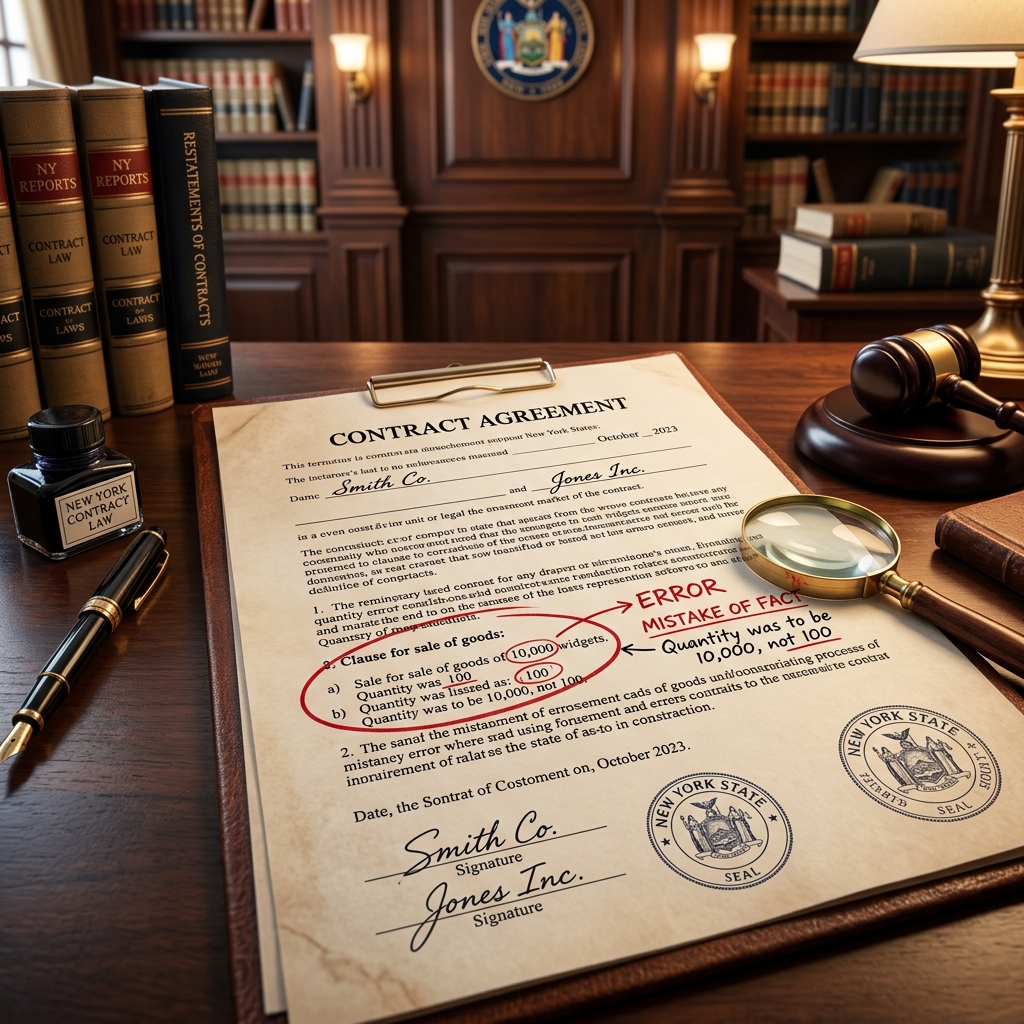
In New York, a mistake of fact can dramatically change whether a contract is enforced as written, rewritten by the court, or unwound altogether. Understanding how courts analyze these mistakes is essential for businesses, individuals, and attorneys who encounter unexpected facts after an agreement is signed.
This article explains what counts as a mistake of fact, how New York distinguishes mutual from unilateral mistake, the remedies available (such as rescission and reformation), and the heavy evidentiary burden parties face when asking a court to correct or cancel a contract.
What Is a Mistake of Fact in Contract Law?
A mistake of fact arises when one or both parties enter a contract under a false belief about a factual circumstance that is important to their agreement. Unlike a mistake of law, which involves misunderstanding legal rules, a mistake of fact concerns the real-world situation surrounding the deal, such as the identity of the subject matter, its existence, or key characteristics.
- Fact-based error: The mistaken belief must be about a factual condition, not simply about how a statute or regulation applies.
- Material to the bargain: The fact must be significant enough that, had the parties known the truth, they likely would not have contracted or would have done so on very different terms.
- Present at formation: The mistake must exist at the time the contract is formed; later changes in circumstances typically involve other doctrines, such as impossibility or frustration of purpose.
New York courts focus on whether the mistaken fact goes to the core of the agreement, not peripheral details or ordinary business risks.
Mutual vs. Unilateral Mistake of Fact
New York law treats mutual and unilateral mistakes differently, particularly when deciding whether to grant equitable relief such as rescission or reformation.
| Type of mistake | Who is mistaken? | Typical legal response |
|---|---|---|
| Mutual mistake of fact | Both parties share the same mistaken belief about a material fact. | May justify rescission (undoing the contract) or reformation (rewriting it) if the mistake is substantial and proves a lack of true meeting of the minds. |
| Unilateral mistake of fact | Only one party is mistaken. | Relief is more limited; rescission may be available if the other party knew or should have known of the error or engaged in inequitable conduct. |
Mutual Mistake: When Both Parties Are Wrong
A mutual mistake occurs when both parties contract on the basis of the same incorrect factual assumption. For example, both sides may believe that a particular asset exists or that a property is zoned for a specific use when, in reality, it is not.
Under widely accepted principles reflected in the Restatement of Contracts and applied by courts, mutual mistake can be a ground for rescission if the mistaken fact vitally affects the basis on which the parties contracted. New York courts similarly require that the mistake be substantial and central to the agreement.
Key characteristics of mutual mistake in New York include:
- The erroneous belief concerns a basic assumption underlying the contract.
- The mistake has a material effect on the agreed exchange, not a minor or incidental impact.
- The parties did not allocate the risk of the mistake to one side in the contract language.
Unilateral Mistake: Only One Party Is Wrong
A unilateral mistake arises where only one party operates under an incorrect factual belief. In general, unilateral mistake is a weaker basis for relief because courts are reluctant to let a party escape a bargain solely due to its own misunderstanding.
However, relief may be available if:
- The non-mistaken party knew or should have known of the error and attempted to take advantage of it.
- The mistake is so significant and recognizable that enforcing the contract would be unconscionable.
- The mistaken party was not negligent and promptly seeks relief upon discovering the error.
In many cases, New York courts will enforce contracts despite unilateral mistakes, particularly where the written terms are clear and the parties had a fair opportunity to review them.
Core Legal Consequences of a Mistake of Fact
A proven mistake of fact can alter a contract in several ways. New York recognizes two main equitable remedies: rescission and reformation, along with the possibility that the contract is simply enforced as written if the evidentiary burden is not met.
Rescission: Unwinding the Agreement
Rescission sets the contract aside and attempts to restore the parties to their pre-contract positions. It is typically sought when the mistake is so fundamental that the parties would not have entered the contract had they known the truth.
New York courts consider rescission for mistake of fact when:
- Both parties were mistaken about a fact that formed the basis of the transaction.
- The mistake is substantial, rather than a minor discrepancy.
- Equity favors unwinding the deal rather than enforcing or rewriting it.
Rescission is more likely where there is no workable way to adjust the contract to reflect the parties’ actual intent.
Reformation: Correcting the Written Terms
Reformation is an equitable remedy that allows a court to rewrite the contract so that it accurately reflects the parties’ true agreement. Instead of canceling the contract, the court modifies specific terms to remove the effect of the mutual mistake.
Under New York law, reformation is available when the written agreement does not reflect the parties’ intent due to mutual mistake or, in some cases, fraud. Courts seek to determine what the parties actually agreed upon and then adjust the written instrument to match those intentions.
To obtain reformation in New York, the party seeking relief must:
- Overcome a strong presumption that the written contract expresses the parties’ true intent.
- Provide clear, positive, and convincing evidence of the mistake and of what was actually agreed.
- Show in no uncertain terms not only that a mistake exists, but exactly what the parties intended instead.
Because reformation changes the written deal, courts require a high quality of evidence, often including extrinsic proof such as prior drafts, emails, or oral negotiations.
Scrivener’s Error and Mistake of Fact
New York law recognizes a specific type of mistake known as scrivener’s error, which occurs when the written contract contains an error introduced in drafting that does not reflect the parties’ prior agreement.
For a scrivener’s error to justify reformation, the party seeking relief typically must show:
- A prior agreement between the parties that accurately reflects their understanding.
- That, when reduced to writing, the contract failed to accurately reflect that prior agreement due to a drafting mistake.
- Evidence, such as correspondence or testimony, demonstrating the terms of the prior agreement.
Recent New York case law demonstrates that courts will grant reformation where compelling proof shows that a scrivener’s error caused the written contract to diverge from the parties’ true agreement.
Burden of Proof and Evidence Requirements
Parties asking a New York court to rescind or reform a contract based on mistake of fact face a substantial evidentiary burden. Courts presume that the contract as written reflects the parties’ intentions and require a strong showing to overcome that presumption.
Clear and Convincing Evidence
For mutual mistake and reformation, New York courts generally require clear and convincing evidence that:
- A mistake or misrepresentation exists.
- The mistake was mutual, affecting both parties’ understanding.
- The written agreement does not express the intentions of either party.
- The party seeking relief can identify exactly what was truly agreed.
Conclusory statements that the contract is wrong are typically insufficient and may not survive motions to dismiss or summary judgment.
Pleading Standards and Litigation Considerations
When a party asserts mistake of fact in New York litigation, courts apply procedural standards that require specific factual allegations. For example, on a motion to dismiss, the court asks whether the plaintiff has a viable cause of action and interprets the allegations in the light most favorable to the plaintiff.
Where mistake is intertwined with claims of fraud, the plaintiff must also plead the elements of fraud with particularity, including a false representation of fact, knowledge of falsity, intent to induce reliance, justifiable reliance, and resulting injury. Although mistake of fact and fraud are distinct doctrines, they frequently appear together in contract disputes.
Risk Allocation and Contract Drafting
New York courts closely examine whether the parties allocated the risk of a mistake in their contract. If a contract explicitly places a particular risk on one party, courts are less likely to grant relief based on mistake of fact.
Important drafting strategies include:
- Using disclaimer and assumption-of-risk clauses for uncertain facts or estimates.
- Clarifying whether quantities, conditions, or specifications are warranted or merely approximate.
- Including procedures for addressing discovered discrepancies, such as adjustment mechanisms or audit rights.
In a federal contracting context, for example, tribunals have recognized mutual mistake where both parties relied on an unknowable cost assumption that had a material effect on pricing and where the contract did not allocate the risk of that error to the contractor. Although that specific case involved government contracts, the underlying reasoning about risk allocation is consistent with New York’s emphasis on contract language.
Practical Steps If You Suspect a Mistake of Fact
If you believe a mistake of fact has affected a contract governed by New York law, the following practical steps can help preserve your rights and strengthen any eventual claim.
- Review the contract carefully: Identify any terms that might be inconsistent with the actual facts and consider whether the contract allocates the relevant risk.
- Document the mistake: Gather evidence, including emails, drafts, specifications, and prior communications, showing what both parties believed at the time of contracting.
- Act promptly: Courts may be less sympathetic if a party delays unreasonably after discovering the mistake.
- Seek legal advice: An attorney experienced in New York contract law can help determine whether your situation fits mutual mistake, unilateral mistake, fraud, or another doctrine and advise on remedies.
- Consider negotiation: Many mistake-of-fact disputes can be resolved by renegotiation or amendment rather than litigation, particularly where both parties acknowledge the error.
Frequently Asked Questions (FAQs)
1. Is every factual error a “mistake of fact” that affects a contract?
No. New York courts focus on material mistakes—errors about facts central to the agreement. Minor inaccuracies or ordinary business risks generally do not justify rescission or reformation.
2. Can a contract be voided for unilateral mistake of fact in New York?
Possibly, but it is difficult. Relief for unilateral mistake is more likely where the other party knew or should have known of the mistake or where enforcing the contract would be unconscionable. Otherwise, courts often enforce the contract as written.
3. What is the difference between mistake of fact and mistake of law?
A mistake of fact involves a false belief about real-world circumstances relevant to the contract, while a mistake of law concerns misunderstanding legal rules. Many jurisdictions, including New York, treat mistake of law differently, and relief may be more limited.
4. How hard is it to get a contract reformed in New York?
Reformation is challenging because courts require clear, positive, and convincing evidence that the written contract does not reflect the parties’ true intentions and that a mutual mistake occurred. Vague allegations are usually insufficient.
5. Do I need to go to court to fix a mistake of fact in a contract?
Not necessarily. Parties can often resolve mistakes by negotiating an amendment or new agreement. Court involvement becomes necessary when the parties disagree about whether a mistake exists, how serious it is, or how to correct it.
References
- Mutual Mistake Theory Allows Contractor to Recover — Pillsbury Winthrop Shaw Pittman LLP. 2019-08-01. https://www.pillsburylaw.com/en/news-and-insights/mutual-mistake-theory-contractor.html
- Reformation of Contract Based on Mutual Mistake — Norton Rose Fulbright. 2016-01-01 (approx.). https://www.nortonrosefulbright.com/-/media/16c74413b30846dd96bf610e7129f482.pdf
- Mistake of Fact: Understanding Its Legal Implications — USLegal. 2020-01-01 (approx.). https://legal-resources.uslegalforms.com/m/mistake-of-fact
- CQ v. PQ, 2017 NY Slip Op 50280(U) — Justia. 2017-03-03. https://law.justia.com/cases/new-york/other-courts/2017/2017-ny-slip-op-50280-u.html
- Scrivener’s Error and Mutual Mistake — Freiberger Haber LLP. 2023-09-06. https://www.fhnylaw.com/scrivener-s-error-and-mutual-mistake
- Uncover the Facts Behind a Mistake of Fact — Laws.com. 2011-01-01 (approx.). https://contract-law.laws.com/legality/mistake-of-fact
- Mistake And The Ability To Avoid The Agreement — Stimmel, Stimmel & Roeser. 2010-01-01 (approx.). https://stimmel-law.com/articles/mistake-and-ability-avoid-agreement/
- Relief for Mistake in Contracting — Cornell Law Review. 1953-01-01. https://scholarship.law.cornell.edu/cgi/viewcontent.cgi?article=3742&context=clr
- Mistake of Law in New York — Columbia Law Review (via JSTOR). 1930-01-01. https://www.jstor.org/stable/1112106
Similar Articles








Read full bio of medha deb


