
New York Breach of Contract Lawsuits: A Practical Guide
Understand how breach of contract claims work in New York, from key legal elements and penalties to practical examples and options for legal help.
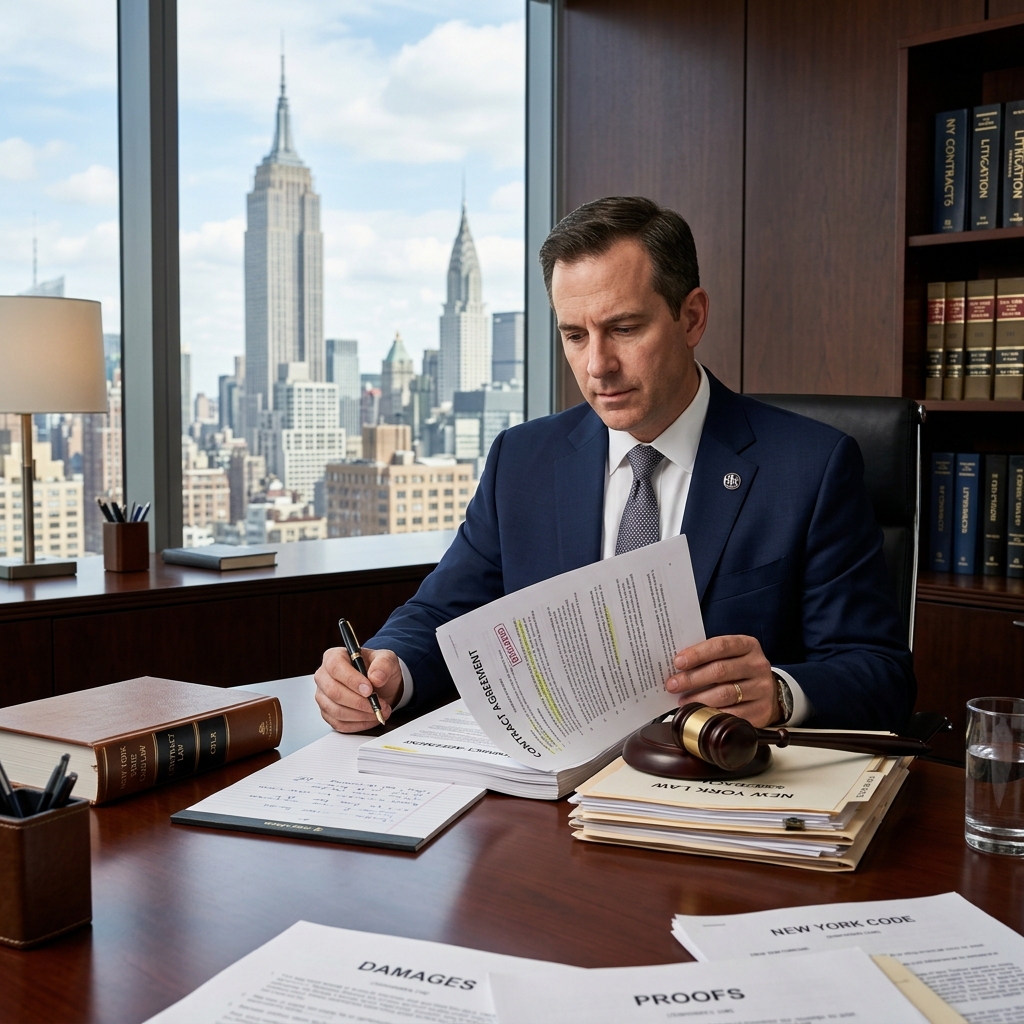
Breach of contract disputes are among the most common civil cases in New York, affecting individuals, employees, and businesses of every size. Understanding how these claims work is essential if you are dealing with an unpaid invoice, a broken promise in an employment agreement, a failed service contract, or any other situation where one party did not honor their obligations.
This guide explains the core legal rules that govern breach of contract lawsuits in New York, illustrates typical scenarios, outlines potential penalties and remedies, and describes how to seek legal help when a contract dispute becomes serious.
Core Concept: What Counts as a Breach of Contract in New York?
A breach of contract occurs when a party to a valid, legally binding agreement fails to perform a required obligation without a valid legal excuse. Not every disagreement or delay qualifies; New York courts focus on whether a material promise in the contract was broken and whether that failure caused measurable harm.
Key Elements of a Breach Claim
To succeed in a breach of contract lawsuit under New York law, the party bringing the claim generally must prove four elements.
- Existence of a valid contract – There must be an agreement with clear terms, mutual assent (offer and acceptance), and consideration (each side gives or promises something of value).
- Plaintiff’s performance or legal excuse – The claimant must show they performed their own obligations or were excused from performance by law or by the other party’s conduct.
- Defendant’s failure to perform – The other party must have failed to do something required under the contract, such as paying money, delivering goods, or providing services.
- Resulting damages – The breach must have caused economic loss or other legally cognizable harm.
New York courts also examine whether the breach concerns a material term rather than a trivial detail. A minor deviation that does not affect the core benefits of the bargain may not support a full breach of contract claim.
Types of Breach
New York breach of contract disputes often fall into several broad categories:
- Non-performance – One party completely fails to do what the contract requires, such as never delivering goods or never making promised payments.[10]
- Defective or partial performance – The party performs, but not in the agreed manner, quality, or timeframe (for example, a vendor delivers late or delivers non-conforming goods).
- Anticipatory breach – Before performance is due, a party clearly indicates they will not perform or makes performance impossible.
While contracts can be oral or written, written agreements are usually easier to enforce because they provide clear evidence of the parties’ intentions and obligations.
Illustrative Scenarios: Common New York Breach Disputes
Although every case turns on its specific facts and contract language, certain patterns recur frequently in New York courts and business settings.[10]
Business and Commercial Contracts
In commercial practice, breach claims often arise in relationships between vendors, customers, landlords, tenants, and professional service providers.[10]
- Unpaid invoices – A client receives professional services, consulting, or construction work but refuses to pay the agreed fee.
- Failure to deliver goods – A supplier takes payment for inventory but never delivers, delivers late, or ships the wrong products.[10]
- Lease disputes – A tenant stops paying rent or a landlord fails to provide promised services or access to premises.
Employment Agreements
Breach of contract claims also frequently involve employees who have written agreements for compensation, bonuses, severance, or job security.
- Non-payment of agreed compensation – An employer fails to pay wages, commissions, or bonuses promised in a contract.
- Violation of severance terms – A company does not honor the severance package outlined in an employment agreement.
- Misuse of non-compete or non-solicitation clauses – Either party may claim breach if restrictive covenants are not followed or are enforced beyond their terms.
Service and Professional Agreements
Contracts with consultants, designers, contractors, and other professionals can lead to disputes when expectations and deliverables are not met.[10]
- Incomplete projects – A contractor stops work midway through a renovation after taking payment.
- Substandard performance – A professional provides services that fall significantly below agreed standards.
- Scope creep without agreement – One party demands work beyond what the contract covers but refuses to pay additional fees.
Legal Standards and Proof: How Courts Evaluate Breach Claims
New York courts apply well-developed legal standards to determine whether a contract was breached and what consequences follow.
Evidence Commonly Used to Prove Breach
Successful plaintiffs typically rely on a combination of documentary and testimonial evidence.
- The written contract or emails memorializing the agreement.
- Invoices, payment records, delivery confirmations, and project schedules.
- Correspondence (emails, letters, text messages) showing requests, promises, or admissions.
- Internal business records demonstrating financial loss or disruption.
- Witness statements and, in complex cases, expert reports on industry standards or damages.
Courts expect the plaintiff to identify specific provisions that were violated and explain how the defendant’s actions deviated from what was promised.
Materiality and Causation
Even where a breach is established, the plaintiff must show that the breach was material and that it directly caused the claimed damages.
| Requirement | What New York Courts Look For |
|---|---|
| Materiality | Was the term central to the agreement? Did the breach significantly deprive the non-breaching party of the benefit of the bargain? |
| Causation | Are the losses a direct and foreseeable result of the breach rather than unrelated market events or independent factors? |
Where facts are undisputed, courts may resolve these issues at the summary judgment stage; otherwise, they are decided at trial based on the evidence presented.
Remedies and Penalties: What a Successful Claim May Achieve
New York contract law focuses on compensation rather than punishment. The central objective is to place the non-breaching party in the position they would have occupied if the contract had been properly performed.
Primary Monetary Remedies
- Compensatory (actual) damages – The most common remedy, covering direct financial losses such as unpaid charges, lost profits tied to the breach, and costs of obtaining replacement performance.
- Consequential damages – Losses that are not the immediate result of the breach but were reasonably foreseeable when the contract was made, such as downstream business losses caused by a missed delivery.
- Liquidated damages – A pre-agreed amount stated in the contract, enforceable if it is a reasonable estimate of anticipated harm and not a penalty.
Punitive damages are generally not available in ordinary breach of contract cases in New York unless the conduct also constitutes a separate tort with egregious wrongdoing.
Equitable Remedies
In certain circumstances, monetary damages may be insufficient to make the injured party whole. New York courts can then consider equitable relief.
- Specific performance – An order requiring the breaching party to fulfill the contract, often used where unique goods or real property are involved.
- Rescission – Cancellation of the contract, returning parties to their pre-contract positions when the agreement or the breach is fundamentally flawed.
- Declaratory relief – A judicial declaration of the parties’ rights and obligations under the contract.
Depending on the contract’s language, the prevailing party may also be able to recover attorneys’ fees and interest on amounts due.
Procedural Path: How a New York Breach Case Typically Moves Forward
From initial disagreement to potential trial, New York breach of contract lawsuits generally follow a recognizable sequence.
Pre-Litigation Steps
Before filing in court, parties often attempt to resolve disputes through informal communication or structured processes.
- Reviewing the contract terms and relevant correspondence.
- Sending demand letters or notices of default.
- Negotiating payment plans, revisions, or settlement agreements.
- Using mediation or arbitration if the contract requires alternative dispute resolution.
Filing the Lawsuit
Most commercial breach of contract cases are filed in the Supreme Court of the State of New York, which serves as the main trial-level court of general jurisdiction.
- The plaintiff files and serves a summons and complaint identifying the contract, describing the breach, and specifying damages.
- The defendant responds with an answer that may include denials, affirmative defenses, or counterclaims.
Discovery and Motions
Once the case is underway, both sides gather evidence and may seek early resolution through motions.
- Discovery – Exchange of documents, emails, contracts, and other evidence; depositions of witnesses; and, where relevant, expert reports.
- Motions – Requests to the court, such as motions to dismiss or for summary judgment, presented when one side argues that the law or undisputed facts warrant a decision without trial.
Settlement or Trial
Many breach of contract lawsuits end in settlement rather than trial, often after discovery clarifies strengths and weaknesses on both sides.
- Negotiated settlement – Direct negotiation or mediation leading to a compromise, such as partial payment or revised terms.
- Bench or jury trial – If settlement fails, the case proceeds to trial, where the court or a jury decides liability and damages based on the evidence.
Time Limits and Practical Constraints
Even strong breach claims can fail if they are not brought in time or if the plaintiff does not take reasonable steps to limit their losses.
Statute of Limitations
New York imposes strict time limits on when breach of contract lawsuits can be filed:
- General contract claims – Typically must be filed within six years from the date of the breach, under New York Civil Practice Law and Rules.
- Sale of goods – Contracts governed by the Uniform Commercial Code usually have a four-year limitations period.
Missing these deadlines can bar recovery even if the underlying claim is otherwise valid.
Duty to Mitigate Damages
Under New York law, the non-breaching party generally has a duty to take reasonable steps to reduce their losses rather than allowing damages to accumulate unnecessarily.
- Seeking replacement suppliers or alternative customers when a counterparty fails to perform.
- Attempting to re-let premises when a tenant defaults on rent.
- Exploring alternative employment opportunities when an employment contract is breached.
Failure to mitigate can reduce the amount of recoverable damages even if the breach is proven.
Securing Legal Help: When to Involve an Attorney
Because breach of contract disputes often involve complex facts, detailed records, and nuanced legal issues, many parties benefit from consulting a New York attorney experienced in contract litigation.
Situations Where Legal Advice Is Critical
- The contract contains highly technical or industry-specific terms.
- Significant sums of money or business relationships are at stake.
- There are competing interpretations of ambiguous provisions.
- The opposing party is already represented by counsel.
- The dispute involves potential class claims, multiple parties, or overlapping statutes.
An attorney can help evaluate the strength of the claim, gather and preserve evidence, navigate court procedures, and negotiate settlements that reflect the risks and costs of litigation.
Frequently Asked Questions (FAQs)
1. Do I need a written contract to file a breach of contract lawsuit in New York?
No. Oral contracts can be enforceable under New York law if they meet basic requirements like mutual assent and consideration, although certain agreements must be in writing under the Statute of Frauds. Written contracts are generally easier to prove because they clearly document the parties’ obligations.
2. Can I recover lost profits in a New York breach of contract case?
Yes, lost profits may be recoverable as compensatory or consequential damages if they were reasonably foreseeable at the time of contracting and can be proven with adequate evidence rather than speculation.
3. What if both sides breached the contract?
If both parties failed to perform, the court will examine whose breach occurred first, whether each breach was material, and how those breaches affected damages. A plaintiff who substantially performed or was legally excused can still recover for the other party’s breach.
4. Are punitive damages available for breach of contract in New York?
Ordinary breach of contract cases rarely result in punitive damages. New York courts typically award punitive damages only where the defendant’s conduct also constitutes a separate, egregious tort and involves public harm or moral wrongdoing.
5. How long does a breach of contract lawsuit usually take?
The timeline varies widely. Some disputes settle within months after filing, especially if facts are clear and the amounts are modest. More complex cases involving extensive discovery, motions, and trial can take several years to resolve in New York courts.
References
- How to Prove a Breach of Contract — New York City Bar Association. 2023-05-01. https://www.nycbar.org/get-legal-help/article/business-and-corporate-law/contract-litigation/
- Breach of Contract Litigation in NYC: Guide for Small Businesses — Goodspeed & Pine, LLP. 2024-02-15. https://www.goodpinelaw.com/insights/breach-of-contract-litigation-in-nyc-what-small-businesses-should-know
- New York Breach of Contract Attorney — Romano Law PLLC. 2023-11-10. https://www.romanolaw.com/disputes/breach-of-contract/
- NYC Breach of Contract Lawyer — Oberheiden P.C. 2024-01-20. https://federal-lawyer.com/business-litigation/new-york-city/contract-breach/
- Trusted New York Breach of Contract Lawyer — HKM Employment Attorneys LLP. 2023-06-30. https://hkm.com/new-york/breach-of-contract/
Similar Articles








Read full bio of Sneha Tete


