
Custody Rights of Single Mothers in Colorado
A practical legal guide explaining how custody, paternity, and parental responsibilities work for single mothers under Colorado law.
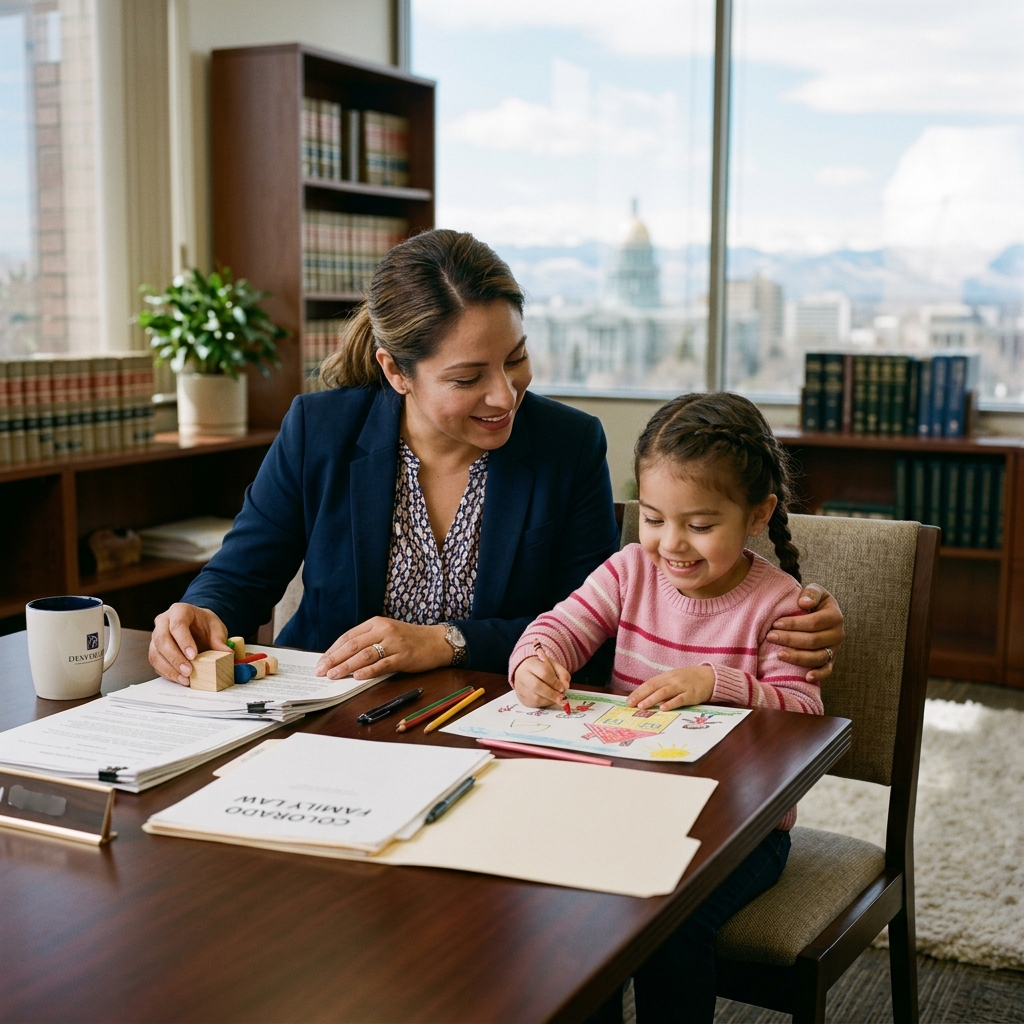
Colorado law treats child custody differently than many people expect. Instead of using the word custody, the law refers to allocation of parental responsibilities, which includes both decision-making authority and parenting time. For single mothers, especially those who are not married to the child’s father, understanding how these concepts work is critical to protecting their rights and their child’s well-being.
This guide explains how Colorado law approaches custody for single mothers, how paternity affects a father’s rights and responsibilities, what happens when a court becomes involved, and how issues like relocation, domestic violence, and child support fit into the picture.
Key Concepts Single Mothers Need to Know
Before looking at specific rights and procedures, it helps to understand a few core legal terms that appear in Colorado family law.
- Parental responsibilities: The Colorado term that includes both decision-making authority and parenting time rather than using the word “custody”.
- Decision-making responsibility: The right to make important choices for a child about education, health care, religion, and major activities.
- Parenting time: The schedule outlining when the child is with each parent, including overnights, holidays, and vacations.
- Paternity or parentage: The legal process that establishes who the child’s other legal parent is, which then triggers that parent’s rights and responsibilities.
- Best interests of the child: The guiding standard that Colorado judges must use when making or changing parental responsibility orders.
Starting Point: Rights of a Single Mother at Birth
For an unmarried mother, the legal situation at the time of birth is different than for married parents. If the mother is not married when the child is born and no other person is legally presumed or acknowledged as the parent, she generally has primary care and decision-making authority by default until a court says otherwise.
This default situation does not mean a court will always keep permanent sole custody with the mother. Once paternity is legally established and a case is filed, Colorado courts put both parents on relatively equal footing and decide future arrangements based on the child’s best interests, not gender.
Common misconceptions for single mothers
- That mothers always keep sole custody regardless of circumstances.
- That fathers can make parenting demands without establishing paternity.
- That informal verbal agreements are legally enforceable without a court order.
In reality, a single mother’s initial control can change once the father establishes legal parentage and asks the court to allocate parental responsibilities.
How Paternity Affects a Single Mother’s Rights
Paternity (called parentage in Colorado statutes) is crucial because an unmarried father generally has no enforceable rights to parenting time or decision-making until his legal relationship to the child is established.
Ways paternity can be established
Under Colorado law, parentage can be established through several methods, including a voluntary acknowledgment or court action.
- Voluntary acknowledgment of parentage (VAP): The person who gave birth and the other parent sign a form confirming parentage, often at the hospital or later with a government agency.
- Presumed parentage: A person can be presumed a parent if, for example, they are married or in a civil union with the birth parent at the time of birth, or if they are listed as a parent on the birth certificate with consent.
- Court-ordered parentage: Either parent, the child, or certain state agencies can ask a court to determine parentage, typically using genetic testing and other evidence.
Once paternity is legally confirmed, the father can request parenting time and decision-making authority, and the court can order child support.
Impact on a single mother after paternity is established
- The court can move from the mother’s de facto control to a formal arrangement shared between parents.
- Child support obligations can be ordered using state guidelines.
- The father gains standing to participate in decisions, request specific schedules, and seek modifications in the future.
What “Best Interests of the Child” Means in Colorado
When a court allocates parental responsibilities, it must base its decision on the best interests of the child. This standard applies to both married and unmarried parents and focuses on the child’s needs rather than the parents’ preferences.
Factors a judge may consider include:
- The child’s relationship with each parent and other important people in their life.
- Each parent’s ability to meet the child’s physical, emotional, and educational needs.
- History of caregiving: who has been responsible for day-to-day care.
- Each parent’s willingness to encourage a relationship between the child and the other parent (if safe).
- Any evidence of domestic violence, substance abuse, or unsafe behavior.
- The child’s wishes, when the child is mature enough for their view to be meaningful.
The law does not automatically favor mothers or fathers; instead, both parents generally start with equal legal standing once parentage is established.
Types of Parental Responsibility Arrangements
Colorado courts can create flexible arrangements to fit the child’s situation. These arrangements affect single mothers directly, particularly when the father becomes involved through the court system.
| Aspect | Possible Arrangement | Implications for a Single Mother |
|---|---|---|
| Decision-making | Sole, joint, or divided by topic (e.g., one parent handles education, the other health) | Determines whether the mother can make major decisions alone or must consult the other parent. |
| Parenting time | Primary residence with one parent plus scheduled time with the other, or near-equal time | Affects where the child lives most of the time and how often the other parent has the child. |
| Supervision | Unsupervised, supervised, or no contact in serious safety cases | Key for mothers concerned about domestic violence, substance abuse or child safety. |
How Single Mothers Can Ask the Court for Orders
Whether the parents never lived together or are separating, a single mother often needs a formal order to have clear, enforceable rules. In Colorado, this usually happens through a case for allocation of parental responsibilities or through a parentage case for unmarried parents.
Typical steps in a Colorado custody case
The process can vary by county, but generally looks like this:
- Filing the case
One or both parents file in the appropriate district court to ask for an allocation of parental responsibilities or relief in a parentage action. - Service and response
If only one parent files, the other must be formally served and then can file a response within a set deadline. - Initial schedules and temporary orders
The court may enter temporary orders about parenting time, decision-making, and support while the case is pending. - Mediation or negotiation
Courts commonly require mediation to help parents create a parenting plan, which sets out schedules, holidays, decision-making, and communication rules. - Hearing and final orders
If parents cannot agree, a judge hears evidence and issues a final order allocating parental responsibilities and child support.
For a single mother, filing a case can be important to prevent conflicts, clarify expectations, and create enforceable protections for the child.
Child Support and Financial Issues for Single Mothers
Once parentage is established, both parents are legally responsible for financially supporting the child. Colorado uses a set of child support guidelines that consider each parent’s income, the number of overnights, health insurance costs, and childcare expenses.
Key points about child support:
- Child support can be ordered as part of an allocation of parental responsibilities case or a separate support case.
- Establishing paternity is usually required before a court orders a father to pay support.
- Support can sometimes be modified later if there is a substantial change in circumstances, such as a significant income change or a major change in parenting time.
For single mothers, pursuing child support does not automatically give the father extensive parenting time, but the court will consider both parenting and financial issues together in light of the child’s best interests.
Domestic Violence, Safety, and Protection
When domestic violence or abuse is involved, the court’s primary responsibility is to protect the child and the abused parent. Colorado law allows judges to limit or condition parenting time and decision-making if there is evidence of violence or a safety risk.
Possible protections a court can use
- Ordering supervised parenting time for the abusive parent.
- Prohibiting overnight visits until safety concerns are addressed.
- Restricting decision-making authority or giving one parent sole decision-making.
- Issuing a civil protection order that may affect how parents exchange the child.
Colorado law also creates specific presumptions in certain extreme situations, such as when a child is conceived through sexual assault, limiting or preventing the offender from getting decision-making authority.
Relocation and Moving Out of State
A single mother may later want or need to move, for example for work, school, or family support. Once there is a court order about parental responsibilities, moving the child to another state or a distant part of Colorado usually requires either the other parent’s agreement or court approval.
In relocation disputes, courts still apply the best interests standard and may consider factors like:
- The reason for the move and whether it is made in good faith.
- The impact on the child’s relationship with the other parent.
- Educational, family, and community opportunities in each location.
- The feasibility of maintaining meaningful contact with the non-moving parent.
Single mothers should seek legal advice before relocating with a child if there is an existing court order or if the father is actively involved, because unauthorized moves can affect future court decisions.
When and How Orders Can Be Modified
Parental responsibility orders are not necessarily permanent. As children grow or circumstances change, either parent can ask the court to modify decision-making, parenting time, or child support. However, modifications typically require a substantial and continuing change in circumstances and must still meet the best interests standard.
Situations that may justify a modification include:
- Significant change in a parent’s work schedule or residence.
- New evidence of safety concerns or substance abuse.
- Changes in the child’s needs, such as health issues or school changes.
- Repeated failure by a parent to follow the existing order.
For single mothers, modification can be a tool to address evolving safety, stability, or practical challenges while maintaining legal protection for the child.
Practical Tips for Single Mothers Navigating Colorado Custody
Although every family is different, the following strategies often help single mothers protect their rights and support their child’s stability.
- Document caregiving: Keep records of appointments, school meetings, and time spent caring for the child in case the history of caregiving becomes an issue.
- Formalize agreements: Consider asking the court to approve a written parenting plan instead of relying only on informal arrangements, which can be hard to enforce.
- Understand paternity implications: Know that acknowledging paternity gives the father legal rights but also allows courts to order child support.
- Address safety proactively: If there is violence or control, seek legal advice about protection orders and safe parenting-time structures.
- Use mediation when appropriate: Cooperative parents can often design more flexible, child-focused plans in mediation than a judge might impose.
Frequently Asked Questions for Single Mothers in Colorado
Do single mothers automatically have full custody in Colorado?
If you are unmarried and there is no legally established second parent or existing court order, you will generally be the child’s primary caregiver by default. However, once paternity is legally established and a case is filed, the court does not automatically favor mothers; it decides future parental responsibilities based on the child’s best interests.
Can the father take the child without a court order?
Before a court order, and once the father has legal parentage, both parents may technically have equal rights, which can create conflicts and uncertainty. A formal allocation of parental responsibilities order clarifies each parent’s rights and provides a way to enforce the schedule if one parent acts improperly.
Do I have to let the father see the child if he has not established paternity?
Until paternity is legally established, an unmarried father does not have enforceable parental rights through the courts. Some mothers still choose to allow contact for the child’s benefit, but the legal obligation begins only when parentage is created and an order is entered.
Can I get child support without giving the father custody?
You usually need to establish paternity before obtaining a child support order. While seeking child support does open the door for the father to request parenting time and decision-making authority, the court will still base any final arrangements on the child’s best interests, not solely on the fact that support is ordered.
What if I am afraid the father will harm me or the child?
If there is a history of domestic violence or threats, you can ask the court for protective measures, such as a civil protection order and restricted or supervised parenting time. In serious cases, the court can limit or deny decision-making authority to the abusive parent and structure exchanges to minimize contact.
Do I need a lawyer to handle custody as a single mother?
Colorado provides self-help resources and standardized forms, and some cases can be handled without a lawyer. However, when there are safety issues, complex parenting schedules, or interstate moves, legal advice is especially important to protect your rights and your child’s interests.
References
- Colorado Custody — WomensLaw.org. 2023-01-01. https://www.womenslaw.org/laws/co/custody/all
- If There Is No Parenting Plan, Who Has Custody in Colorado? — New Leaf Family. 2023-05-01. https://www.newleaf.family/no-parenting-plan-custody/
- Who Has Primary Custody if the Parents are Unmarried? — C.O. Law. 2022-10-10. https://www.colo-law.com/blog/2022/10/who-has-primary-custody-if-the-parents-are-unmarried/
- The Rights of Unmarried Parents – Colorado — Child Welfare Information Gateway. 2022-08-10. https://www.childwelfare.gov/resources/rights-unmarried-parents-colorado/
- Paternity & Unmarried Parents – Colorado Family Law Guide — Graham.Law. 2023-02-15. https://www.colorado-family-law.com/parenting-custody/paternity-unmarried-parents
- Custody — Colorado Judicial Legal Help Center. 2022-09-01. https://lawhelp.colorado.gov/custody
- Why Unmarried Parents Who Split Need Custody Arrangements — Robinson & Henry. 2021-11-01. https://www.robinsonandhenry.com/blog/family-law/why-unmarried-parents-who-split-need-custody-arrangements/
Similar Articles








Read full bio of medha deb


