
Adult Children and Child Support Lawsuits in Minnesota
Understanding when and how an adult child in Minnesota may seek child support from a parent, and what the law realistically allows.
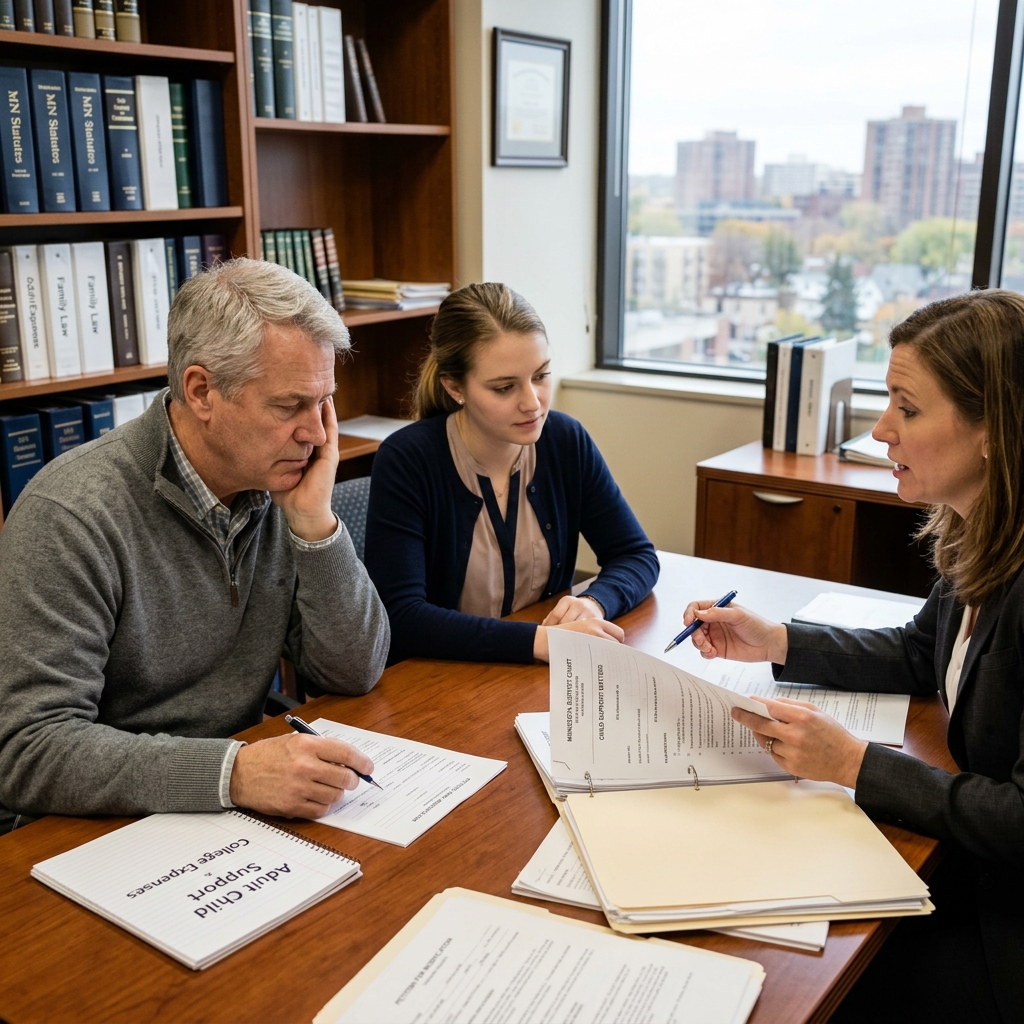
Questions about whether an adult child can bring a child support lawsuit in Minnesota are increasingly common, especially in families dealing with unpaid support or adult children with disabilities. Minnesota child support law is written primarily to protect the interests of a child while still legally a minor, but there are a few limited situations where issues continue into adulthood or where an adult child may have a practical stake in a case.
This article explains how Minnesota law treats child support, when support usually ends, what happens with disabled adult children, and how unpaid or retroactive support is handled. It also outlines where an adult child fits into these disputes and what legal options may realistically exist.
How Minnesota Defines a “Child” for Support Purposes
To understand whether an adult child can sue for support, it is critical to know when Minnesota law stops treating someone as a “child” for support purposes. Minnesota statutes tie child support obligations to the concept of emancipation rather than simply to birthdays.
Under Minnesota law, support obligations generally last until the child is no longer considered a “child,” which typically occurs at emancipation or upon reaching specific age and schooling milestones.
Typical End Date of Child Support
In most Minnesota cases, child support will end automatically when one of the following occurs:
- The child turns 18 and has finished high school, or
- The child is still in high school after turning 18, in which case support continues until graduation but never beyond the child’s 20th birthday.
County guidance and family law practitioners consistently describe this same structure: support normally ends at 18, but can continue to 20 if the young person is still in secondary school or has qualifying disabilities.
Emancipation and Its Effect on Support
Emancipation generally means that a young person is legally treated as an adult and is no longer entitled to support as a “child.” Minnesota county guidance notes that child support typically continues until 18, unless a court orders otherwise, and may extend to 20 when the child is still in high school or has a disability affecting self-support. After emancipation, the child support obligation ordinarily stops without any need for a further court order, unless a prior order or statute specifically keeps obligations in place for disability-related reasons.
Who Has the Right to Bring a Child Support Case?
In Minnesota, child support is usually enforced by or on behalf of a parent or caregiver, not by the child personally. State agencies explain that child support is money a parent pays to the child’s other parent or caregiver, and that the people who typically initiate cases are adults responsible for the child’s care or a government agency.
Typical Initiating Parties
According to Minnesota court and county sources, child support cases are usually started by:
- The parent who has primary physical care of the child (often the custodial parent)
- Another adult with a court order giving them custody of the child
- A county child support office acting on behalf of the state, particularly when the child or custodial parent receives public assistance
The state’s description of who can receive and ask for child support explicitly focuses on parents and caregivers, not on the child as plaintiff. In practice, the child is the beneficiary, but the claim is usually brought in the name of a parent or the state.
Role of the Child in Standard Support Actions
While a child is the person whom the support is meant to protect, Minnesota’s procedural rules generally keep children out of the litigation itself except as witnesses or for limited participation in custody-related matters. When the child reaches adulthood, that person might have an interest in unpaid support or arrears, but the original right to payment remains with the person or agency to whom the obligation was owed.
Adult Children With Disabilities and Extended Support
One of the most important exceptions to the usual end of child support involves disabled adult children. Minnesota’s definition of “child” for support purposes can be extended when a person has a significant physical or mental condition that prevents self-support. Similar principles appear nationwide; many courts recognize some form of continuing parental duty when an adult child is unable to support themselves because of disability.
Extended Support for Disability
Family law materials explain that Minnesota may continue support past the ordinary age cutoffs where a young adult has a disabling condition that makes them incapable of self-support. In these situations:
- The disability generally must have existed while the child was still under the age of majority or before they were emancipated.
- The focus is on whether the adult child cannot support themselves due to the disability, not merely that they have a diagnosis.
- A court order is usually necessary to establish or continue support beyond the ordinary termination date.
Advocacy and legal analysis on adult children with disabilities emphasize that courts often require proof that the disability prevents self-support and that the adult child lacks sufficient income or resources to meet reasonable living expenses.
Who Brings the Motion in Disability Cases?
In practice, requests to extend child support for a disabled adult child are often brought by one of the parents or by a guardian. The adult child may be the central focus of the case and may be named in pleadings, but the legal claim commonly flows through a parent’s request to extend or modify the existing child support order.
Because procedures can be technical, families of disabled young adults often work with an attorney to coordinate child support with other benefits, such as Social Security or Medicaid-funded services.
Retroactive and Unpaid Support: Can an Adult Child Recover It?
Many adult children are less worried about future support and more interested in unpaid support from the past. Minnesota law places strict limits on how far back a court can reach when establishing support or adjusting arrears.
Limits on Retroactive Support
The Hennepin County Attorney’s Office explains that Minnesota law only allows retroactive child support to go back two years prior to the service of the legal action that establishes child support. This means that when a support order is first put in place, the court generally cannot create obligations for periods more than two years before the case was filed and served.
This two-year limitation is central in considering any claim that an adult child might hope to bring for “missed” support in childhood. If a proper child support order was never established and no timely action was filed, the law significantly restricts the past periods that can be addressed later on.
Arrears Under Existing Orders
When a valid child support order exists, unpaid amounts (arrears) continue to be owed even after the child emancipates, unless discharged or modified through lawful means. Key points include:
- Arrears are usually owed to the recipient designated in the order (often the custodial parent or the state), not directly to the child.
- Government agencies may collect arrears for many years through income withholding, tax refund intercepts, and other enforcement tools.
- Adult children may benefit indirectly if a parent voluntarily uses collected arrears to help them, but the legal entitlement belongs to the obligee (the person or agency owed the money).
Can an Adult Child Sue a Parent Directly for Support?
In Minnesota, traditional child support actions are designed to be brought by parents, custodians, or the state, not by adult children themselves. There is no broad statutory scheme giving an adult child an independent cause of action simply because they believe they should have received more support while they were younger.
Direct Lawsuits vs. Participation in Existing Orders
While it is theoretically possible for an adult child to assert contract or tort claims against a parent in unusual situations, that is very different from a standard child support case and typically would not be treated as a child support enforcement action under Minnesota’s family law system.
More commonly:
- The adult child has no direct right to collect unpaid child support unless they were specifically named as the payee in the order, which is rare.
- The parent or state agency who is the payee on the order remains the one with legal authority to enforce collection of arrears.
- Adult children may, however, gather information or testify to help a parent or agency in enforcement proceedings.
Special Situations Involving Adult Children
Some less common scenarios where an adult child may become more central include:
- Disabled adult children whose parent or guardian seeks an extension of support, with the adult child’s situation and needs at the heart of the case.
- Cases where a court considers assigning arrears or part of payments directly to an adult child in a tailored or agreed-upon arrangement, which would require specific legal structuring.
- Claims under other legal theories, such as promises made by the parent outside of child support law, which would be evaluated under general civil law rather than family law statutes.
How Minnesota Courts Calculate Child Support
Understanding how support is calculated can help adult children make sense of what their parents were supposed to pay and whether orders were fair or accurate.
Income Shares Model
Minnesota uses the Income Shares model, which looks at both parents’ gross incomes, the number of children, and standardized estimates of the cost of raising children at various income levels. The Minnesota Judicial Branch explains that this method uses statutory guidelines and a calculator to estimate obligations.
Key features include:
- Both parents’ gross incomes are combined.
- The guideline table determines a base support amount for that combined income and number of children.
- The amount is allocated between the parents in proportion to their share of the total income.
- Adjustments account for parenting time and other factors.
Types of Support Considered
Minnesota law breaks down child support into categories, typically including:
- Basic support (routine expenses like housing, food, clothing)
- Medical support (health insurance and uninsured medical expenses)
- Child care support (work-related child care costs)
Official definitions describe “current support” as the ongoing court-ordered monthly obligation for these components. Courts consider all three to determine the total monthly obligation.
Adjustments for Parenting Time
Child support in Minnesota is influenced by the amount of parenting time but is not automatically eliminated by joint physical custody. Guidance from Minnesota courts and practitioners notes that child support may still be ordered when parents share joint physical custody, and that reductions apply when the paying parent has a substantial share of overnights with the child.
Procedural Steps for Support Actions Connected to Adult Children
Although an adult child is rarely the direct plaintiff, they or their family members may be involved in support-related actions connected to the transition to adulthood.
Starting a Child Support Case
Official Minnesota guidance describes three main ways a support order can be established:
- By one parent filing appropriate papers directly with the court
- By asking the county child support office for services
- By the county initiating an action automatically if public assistance is being paid
Generally, the custodial parent and child must have lived in Minnesota for at least six months before filing a case in Minnesota courts.
Modifying or Extending Support
When families face issues such as disability, changing income, or questions about when support should end, they typically must file a Motion to Modify Child Support with the court. For a disabled adult child, a motion may be needed before ordinary termination dates to request continuation of support beyond age 18 or 20.
Table: Ordinary vs. Disability-Related Child Support in Minnesota
| Issue | Ordinary Child | Disabled Adult Child |
|---|---|---|
| When support usually ends | At 18 and out of high school, or by 20 if still in high school | May continue past usual age if disability prevents self-support and court orders continuation |
| Who files for support | Parent, caregiver, or county child support office | Parent or guardian typically files; adult child may be named in the order as beneficiary |
| Retroactive support limits | Generally only 2 years before service of legal action | Same retroactive rules; disability does not expand retroactive reach |
| Adult child’s direct lawsuit | Not typical; rights usually belong to parent or state | May participate more directly, but orders still typically driven by parent/guardian action |
Practical Steps for Adult Children Concerned About Support
Adult children in Minnesota who believe they were not adequately supported, or who have ongoing disability-related needs, can take several practical steps, even if they are not the formal party in a case.
Gathering Information
- Ask your parent or caregiver for copies of any court orders related to child support.
- Contact the county child support office to ask whether a case was ever opened under your name or your parents’ names.
- Review orders to understand who was ordered to pay, who was to receive payments, and the time period covered.
Discussing Options with the Parent or Guardian
- If a parent was supposed to receive support but did not, discuss whether they are willing to pursue enforcement or clarifying action.
- For disabled adult children, talk with a parent or guardian about whether continued support might be appropriate and whether a motion to extend support was ever considered.
Consulting a Family Law Attorney
Because Minnesota’s statutes are complex and time limits on retroactive support are strict, consulting a family law attorney can be important when:
- You are a disabled adult whose care needs continue and no extension of child support was requested.
- A parent owes significant arrears and you want to understand what, if anything, you may be entitled to.
- You are exploring non-child-support legal theories related to promises of support made during your childhood.
Frequently Asked Questions (FAQs)
1. Can I, as an adult child, file a child support lawsuit in Minnesota?
Standard child support cases in Minnesota are brought by parents, custodians, or the state, not by adult children. The law is structured so that the obligation runs between parents (or the state) and not directly to the child. In unusual situations, an adult child might pursue other types of civil claims, but these are not typical child support actions.
2. If my parent never paid support, can I sue now that I’m over 18?
If there was an existing child support order and your parent failed to pay, arrears are generally owed to the person or agency named in the order, not directly to you. That person or agency can often still pursue collection, subject to various limitations. If no order was ever established, Minnesota law limits retroactive support to two years before the legal action was served, which sharply restricts what can be recovered later.
3. I have a disability and cannot support myself. Can support continue after I turn 18?
Yes, in some cases. Minnesota law allows child support to continue past the usual termination date when the person has a physical or mental condition that makes them incapable of self-support, and when a court order provides for that continuation. A motion is generally required, often filed by a parent or guardian, and evidence of the disability and financial need is crucial.
4. Does going to college automatically extend child support in Minnesota?
No. Minnesota family law sources explain that child support normally ends at 18 or high school graduation (whichever occurs later), and never continues past age 20 on the basis of schooling alone. College enrollment by itself does not automatically extend child support unless there is a specific agreement or order addressing it.
5. Who can help me understand my family’s child support history?
You can start with your parent or caregiver and ask for copies of orders and payment records. Then, you may contact the county child support office involved in the case to ask about the status of the account. For detailed legal advice—especially if disability or large arrears are involved—speaking with an attorney experienced in Minnesota family law is recommended.
References
- How Long Do I Have to Pay Child Support? — Hill Crabb, LLC. 2017-04-11. https://www.hillcrabb.com/blog/2017/04/how-long-do-i-have-to-pay-child-support/
- How Child Support is Determined in Minnesota — Martin & Wagner Law. 2019-08-20. https://martinwagnerlaw.com/news-events/45-family-law/186-how-child-support-is-determined-in-mn
- Child support — Hennepin County Attorney’s Office. 2023-05-01. https://www.hennepinattorney.org/get-help/children-families/child-support
- Frequently Asked Questions – Child Support — Minnesota Judicial Branch. 2022-09-15. https://mncourts.gov/help-topics/child-support/faqs
- Emancipation — MNPrairie County Alliance. 2020-06-10. https://mnprairie.gov/222/Emancipation
- Parenting Rights and Child Support for College Bound Teens — Duluth Family Lawyer. 2018-07-30. https://duluthfamilylawyer.com/parenting-rights-and-child-support-for-college-bound-teens/
- Child Support for an Adult Child with Disabilities — Special Needs Alliance. 2015-03-01. https://www.specialneedsalliance.org/the-voice/child-support-for-an-adult-child-with-disabilities/
Similar Articles








Read full bio of medha deb


